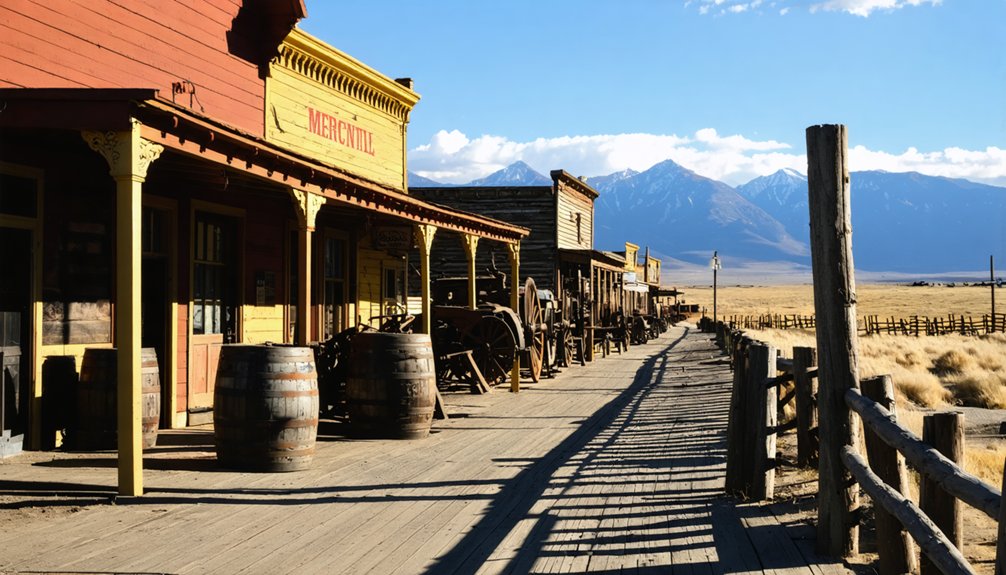
Haiwee, California emerged in the late 1860s during the gold rush but gained significance through the 1913 Los Angeles Aqueduct project. You’ll find deteriorating wooden structures and stone foundations that tell the story of water wars that transformed Owens Valley. The name derives from “Heewi,” the Timbisha word for doves, preserving indigenous heritage despite Anglicization. Visiting requires high-clearance vehicles via U.S. Route 395, where environmental consequences of L.A.’s water diversion still unfold today.
Key Takeaways
- Haiwee was established during the gold mining boom of the late 1860s, experiencing its population peak between 1868-1875.
- The town declined after Los Angeles diverted Owens River water via a 233-mile aqueduct completed in 1913.
- Remnants include deteriorating wooden structures and stone foundations, with no formal preservation efforts in place.
- The name “Heewi” derives from the Timbisha word for doves, preserving Native American toponymy despite Anglicized spelling.
- Located 35 miles south of Lone Pine via U.S. Route 395, access requires high-clearance vehicles and preparation for desert conditions.
The Origins of “Heewi”: Native American Roots of Haiwee
Doves, graceful birds native to California’s harsh terrain, gave Haiwee its distinctive name through the Timbisha word “Heewi.” This naming represents a rare preservation of indigenous toponymy in a region where colonial settlement typically erased Native American place names.
The Timbisha heritage remains embedded in this linguistic artifact, connecting you to the original inhabitants who thrived in the Death Valley region for millennia before European arrival. Similar to the Chemehuevi people, small bands of native inhabitants lived throughout the Mojave Desert region, adapting to the harsh desert environment through traditional practices.
Unlike nearby Yosemite—a colonial misinterpretation with problematic origins—Haiwee maintains its Indigenous language roots despite Anglicized spelling. When you speak the town’s name, you’re echoing Numic linguistic traditions of the Uto-Aztecan family.
This connection to pre-colonial California honors the Timbisha Shoshone people’s deep relationship with the land and its wildlife. The term “Yosemite” itself stems from neighboring Miwok bands referring to the Ahwahnechee as yohhe’meti, mistakenly translated by colonizers as “grizzly bear” rather than its actual meaning of “they are killers.”
Water Wars: How Los Angeles Changed Owens Valley Forever
While the Timbisha people named this land for its natural features, a very different force would reshape Haiwee and the entire Owens Valley landscape.
The ancient stewards recognized harmony with nature, while modern powers would impose their will upon this sacred valley.
In 1913, Los Angeles completed its 233-mile aqueduct, diverting Owens River water away from local communities. President Roosevelt’s 1907 intervention sealed the valley’s fate, prioritizing urban expansion over local water rights. The massive water project delivered four times more water than Los Angeles needed at the time. The aqueduct required over 2,000 workers to complete the monumental engineering project.
What you would’ve witnessed as the aqueduct’s impact unfolded:
- Irrigated farmland shrinking dramatically from 75,000 acres to just 23,625 between 1920-1940
- Desperate ranchers dynamiting the aqueduct 17 times in 1924 as economic displacement ravaged their livelihoods
- Owens Lake completely draining within a decade, leaving a toxic dust bowl that became America’s worst source of PM10 pollution
Boom to Bust: The Mining Era’s Rise and Fall
Before the water politics that transformed Owens Valley forever, Haiwee experienced the classic Western boom-and-bust mining cycle that defined countless frontier settlements.
Gold mining operations took root after the late 1860s discovery, attracting prospectors seeking independence in this remote corner of California.
You would’ve found a modest community between 1868-1875, when Haiwee’s population peaked. Transient miners used both placer and hard rock techniques, but faced perpetual water shortages that limited extraction methods. Like the California Gold Rush of 1848-1855, Haiwee’s development showcased how mining towns rapidly evolved through various mining techniques. Similar to how news of James Marshall’s discovery spread quickly in 1848, word of Haiwee’s gold attracted mass migration of hopeful miners.
Local establishments—saloons, general stores, and boarding houses—serviced these fortune-seekers, though most wealth quickly departed with them.
What Remains Today: Exploring Haiwee’s Ruins
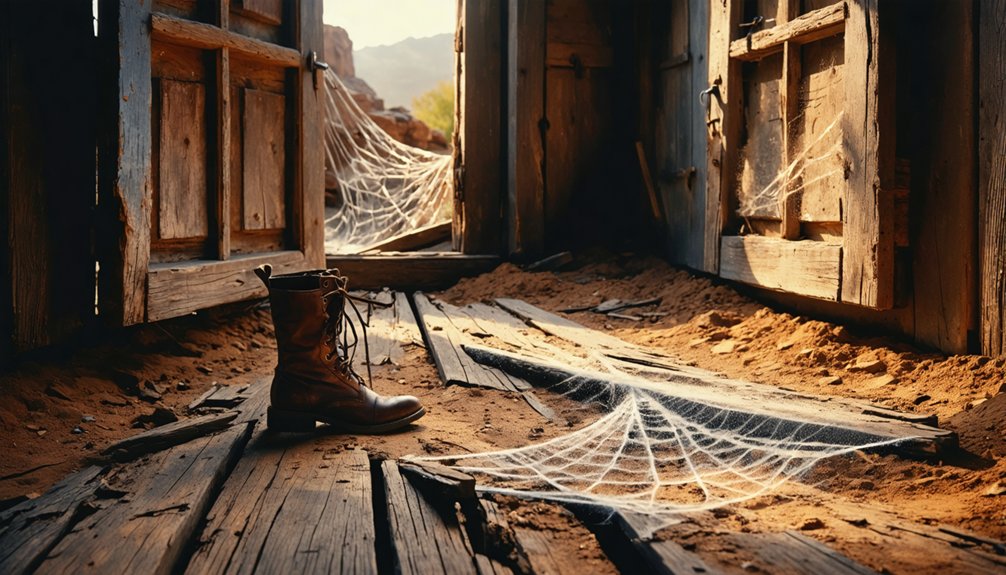
As you traverse the parched landscape where Haiwee once thrived, ghostly remnants of the town emerge like desert mirages anchored in reality. The deteriorating wooden structures and stone foundations lie partially consumed by sand drifts, while mining equipment from the borax era sits half-buried amid the desolation.
Ruin exploration here requires vigilance due to numerous safety hazards:
- Unstable flooring and collapsed interiors create treacherous fall risks
- Underground basement areas demand careful navigation with proper lighting
- Weather-worn structural supports make artifact discovery both rewarding and dangerous
Unlike state-maintained ghost towns, Haiwee lacks formal preservation efforts or interpretive markers. The desert steadily reclaims what humans abandoned, with tumbleweeds overtaking building interiors and extreme temperature fluctuations accelerating the natural deterioration process. Similar to George Air Force Base, toxic materials including asbestos and lead may pose additional health risks to explorers. This contrasts sharply with places like Bodie State Historic Park, which is preserved in a state of arrested decay and maintains the original conditions of its buildings.
The site offers raw authenticity for those seeking unfiltered historical connections.
Neighboring Ghost Towns: Keeler, Swansea, and Cerro Gordo
Haiwee’s isolated ruins tell only part of the Owens Valley mining saga, with a trio of neighboring ghost towns completing this remarkable historical tapestry.
Keeler history begins in the 1870s when it replaced Swansea as the primary freight terminal for Cerro Gordo mining operations. Once home to 5,000 residents, Keeler thrived until the 1930s when the zinc deposits were depleted. The Los Angeles Aqueduct’s completion in 1913 caused Owens Lake to dry up, exposing residents to toxic dust storms.
Swansea ruins mark the original shipping port where steamers like the Bessie Brady transported silver ore across Owens Lake.
Business rivalry with Mortimer Belshaw shifted operations to Keeler after the 1872 earthquake. The Carson & Colorado Railroad established a critical rail line in 1883, providing transportation for mining freight until service ended in 1960. Meanwhile, Cerro Gordo mining in the Inyo Mountains became California’s largest silver producer, connecting to these transport hubs via an impressive aerial tram system that moved ore to Keeler’s smelters until mining ceased permanently by 1933.
Environmental Impact: Dust Storms and Ecological Change
If you visit Haiwee today, you’ll witness massive dust storms that surge across the valley floor when seasonal winds sweep over sediments exposed by Los Angeles’ historical water diversions.
By 1924, these diversions had transformed once-fertile landscapes into barren shorelines, creating conditions where PM10 levels now regularly exceed health standards during spring and fall wind events.
The environmental degradation continues to eliminate critical wildlife habitats, with native plant communities struggling against dust deposition that alters soil chemistry and smothers vegetation.
Choking Clouds Rise
While the former lakebeds of Haiwee lie parched under the California sun, a more insidious environmental legacy has emerged since the town’s decline—escalating dust storms that now plague the region.
These dust emissions have increased by 36% per decade since 2008, primarily from abandoned agricultural lands where water diversion policies mirror Haiwee’s own history.
You’ll witness these ecological consequences firsthand:
- Clouds of PM10 particles rise during wind events, carrying respiratory risks including Valley fever from *Coccidioides* fungus
- Sierra Nevada snowpack darkens as dust settles, accelerating critical water loss
- Topsoil erosion strips nutrients from surrounding lands, creating a self-reinforcing cycle of desertification
The choking clouds represent California’s dust emissions at their historical peak, with climate models projecting even worse conditions ahead.
Barren Shorelines Emerge
As the North Haiwee Reservoir‘s water levels have fluctuated dramatically since the 1990s, expansive tracts of sediment-laden shoreline now lie exposed to the elements, creating perfect conditions for severe dust storms.
You’ll notice the native vegetation has steadily disappeared, leaving behind altered soil compositions where finer particles blow away while coarser sediments remain.
This ecological shift has eliminated vital habitat for local wildlife and disrupted natural nutrient cycles.
In response, authorities have implemented shoreline restoration efforts, placing straw bales in random patterns to serve as windbreaks across 194 acres of barren land.
Sediment management now includes planting native cattle spinach (Atriplex polycarpa) to stabilize exposed soils.
These interventions aim to reduce PM10 emissions that violate air quality standards and threaten nearby communities with respiratory hazards during frequent wind events.
Wildlife Habitats Vanish
The barren shorelines around North Haiwee Reservoir represent just one facet of a broader ecological crisis unfolding in this former settlement.
You’ll find the 22,805-acre Haiwee Geothermal Leasing Area intersects critical habitats for both Mohave Ground Squirrels and Desert Tortoises, species now struggling for survival as their ranges shrink.
Wildlife conservation efforts face mounting challenges as:
- Desert pavement disturbance generates intense dust storms, choking native vegetation
- Transmission infrastructure fragments migration corridors essential for species movement
- Water table depletion alters the delicate balance of desert plant communities
The Timbisha Shoshone Tribe has raised concerns about these disruptions to natural systems.
Habitat restoration initiatives must contend with decades-long recovery periods for desert scrubland, while pollinator populations decline dramatically across the disturbed landscape.
Off the Beaten Path: Visiting Haiwee in Modern Times
For modern adventurers seeking California’s lesser-known historical sites, Haiwee presents a unique opportunity to explore remnants of early 20th century water infrastructure rather than typical mining ruins.
You’ll find this remote location in Inyo County, approximately 35 miles south of Lone Pine via U.S. Route 395.
When exploring access to Haiwee, prepare for rugged terrain requiring high-clearance vehicles.
Follow either Haiwee Reservoir Road or Los Angeles Aqueduct Road to reach the site (36.135°N, -117.953°W).
Visitor safety demands thorough preparation—bring ample water, as desert conditions can be harsh with no nearby services.
Remember that swimming is prohibited in the reservoirs, though fishing with rubberized waders is permitted.
Always respect operational facilities and posted restrictions around water infrastructure dating from 1913.
Frequently Asked Questions
Are There Any Dangerous Wildlife or Hazards in Haiwee?
Yes, you’ll face potential wildlife encounters with rattlesnakes and badgers. Take safety precautions around abandoned mines, old structures, and during extreme weather. Watch for rodent-infested areas that may carry hantavirus.
Can You Legally Collect Artifacts From Haiwee’s Ruins?
No, you can’t legally collect artifacts. State and federal laws enforce strict legal restrictions on artifact collection, with violators facing criminal penalties under California’s archaeological protection statutes.
What Paranormal Activity Has Been Reported in Haiwee?
You’ll encounter numerous ghost sightings including shadowy figures, spectral railroad workers, and a woman in period clothing. You’ll also hear eerie sounds like phantom train whistles, disembodied voices, and unexplained footsteps throughout abandoned buildings.
How Did Residents Get Food and Supplies in Haiwee’s Heyday?
0% of Haiwee’s food supply history is documented in available sources. You won’t find specifics about local trade routes or how residents sustained themselves during the settlement’s brief existence.
Were There Any Famous Residents or Notable Events in Haiwee?
Historical records don’t document any famous residents or notable events in Haiwee. You’ll find the town’s significance centered on infrastructure development rather than celebrated individuals during its brief seven-year postal service period.
References
- https://www.californist.com/articles/interesting-california-ghost-towns
- https://discover.hubpages.com/travel/Ghost-Towns-in-California
- https://www.youtube.com/watch?v=82e18z36Fq0
- https://en.wikipedia.org/wiki/List_of_ghost_towns_in_California
- https://lawsmuseum.org/sites/default/files/downloads/storyofinyo00chal.pdf
- https://lonepinechamber.org/history/ghost-towns-of-the-lone-pine-area/
- http://www.owensvalleyhistory.com/stories/owens_2004_lores.pdf
- https://en.wikipedia.org/wiki/Haiwee
- https://www.youtube.com/watch?v=BpfDR_n71Cg
- https://www.dotycoyote.com/pdfs/sources/kroeber_california_place_names.pdf