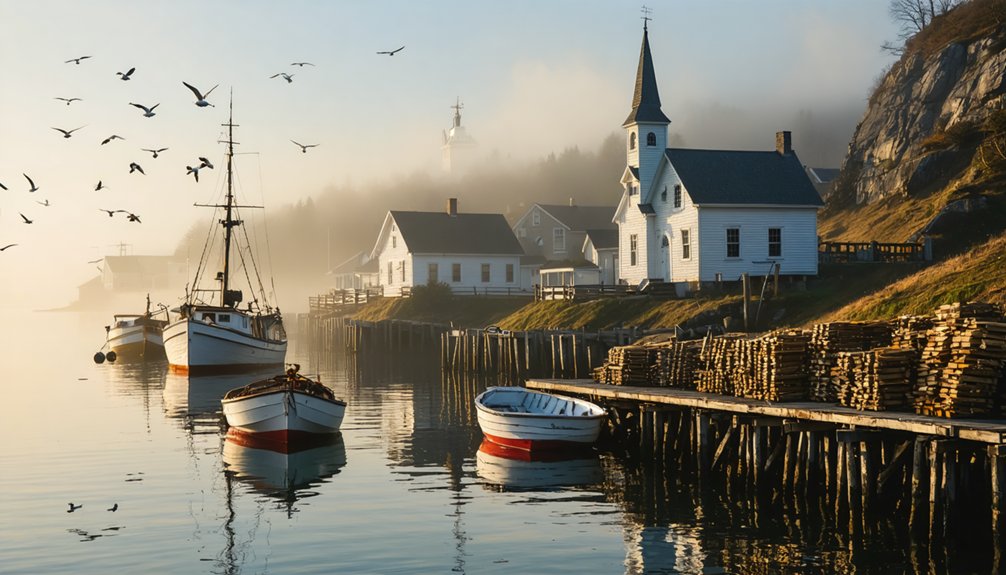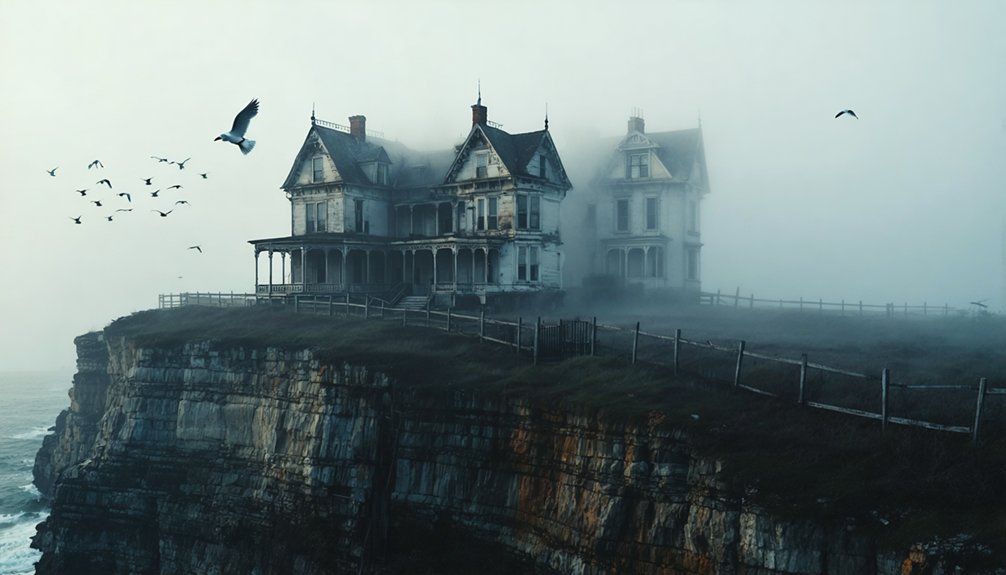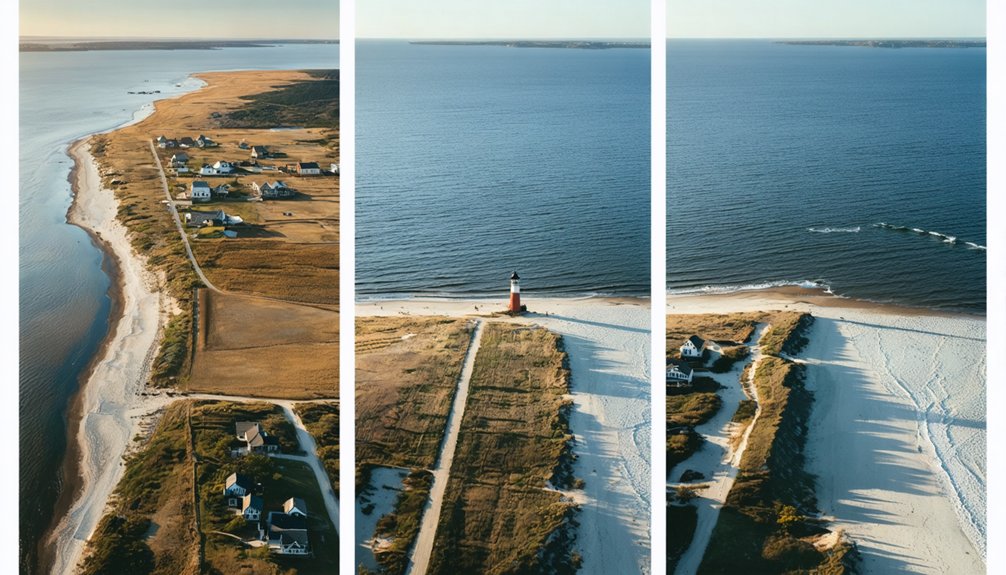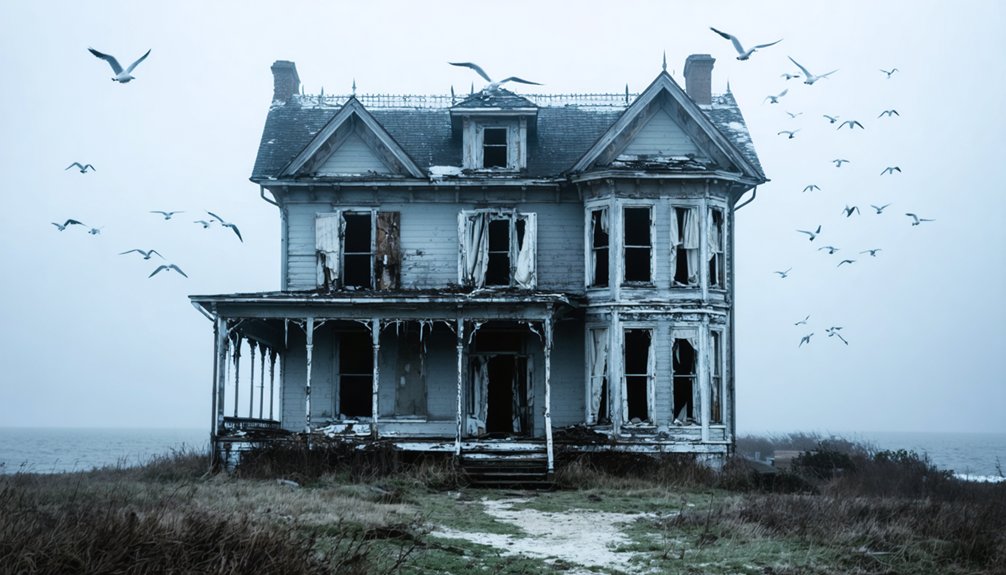
America’s eastern seaboard harbors numerous haunted coastal ghost towns awaiting your discovery. You’ll find spectral maritime histories at Cape Lookout Village, where phantom rescue crews still row through foggy nights, and Holland Island, now reclaimed by Chesapeake Bay waters. The mysterious vanished Roanoke Colony leaves only cryptic carvings, while Connecticut’s isolated Dudleytown offers terrestrial hauntings. These abandoned settlements reveal their supernatural legacies when you venture beyond their weathered thresholds.
Key Takeaways
- Holland Island in Maryland disappeared due to Chesapeake Bay erosion, with its last Victorian house falling into the water in 2010.
- Cape Lookout Village features reported sightings of drowning victims, phantom rescue crews, and spectral lighthouse keepers.
- The mysterious Roanoke Colony vanished in 1590, leaving only “CROATOAN” carved into a tree as evidence.
- Dudleytown, Connecticut gained paranormal fame through investigators’ reports of spectral residents linked to a family curse.
- Coastal ghost towns face preservation challenges from erosion, hurricanes, and jurisdictional complications, requiring boat access to many sites.
The Lost Shores: Vanished Communities Along the Eastern Seaboard
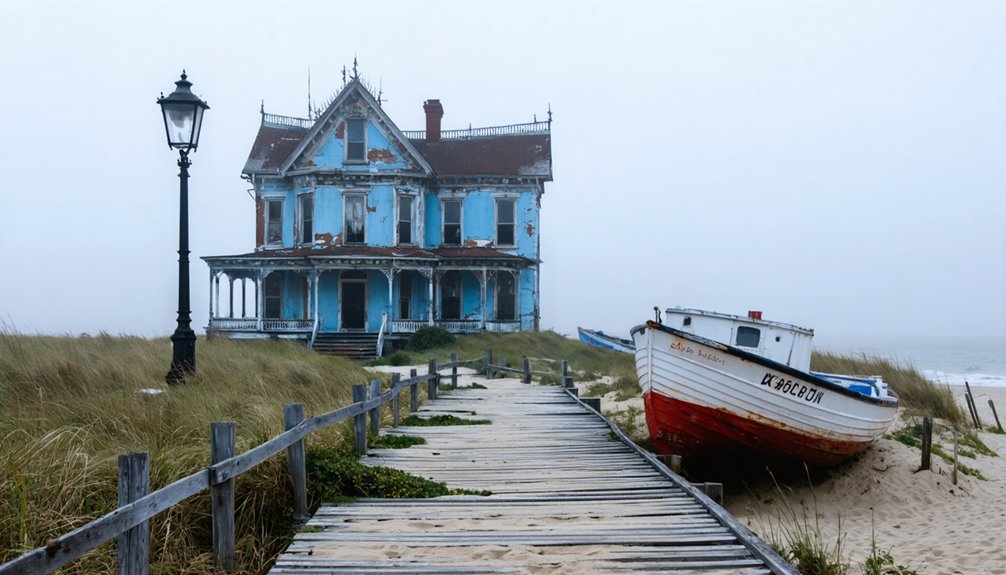
Along the eastern seaboard of the United States, you’ll find the ghostly remnants of communities that once thrived but have since surrendered to the relentless forces of nature.
Holland Island in Maryland exemplifies these lost settlements, completely obliterated by Chesapeake Bay’s erosive powers. Similarly, Whitewash Village, established in 1710 on Monomoy Island off Massachusetts’ Chatham coast, disappeared after devastating hurricane activity along Cape Cod.
The Great 1938 Hurricane created several ghost towns throughout New England’s coastline. In Maine, Perkins—once home to shipbuilders, farmers, and ice harvesters—saw its population decline from nearly 100 to zero by 2000. These abandoned coastal communities have become important heritage tourism sites, drawing visitors interested in America’s maritime history.
The combined pressures of the Great Depression and Kennebec River pollution delivered the final blows to this and other maritime communities unable to withstand nature’s fury. Like these vanished towns, Hopefield in Arkansas met a similar fate when yellow fever outbreaks and recurring floods ultimately led to its abandonment in the early 1900s.
Whispers in the Fog: Cape Lookout Village’s Maritime Hauntings
You’ll encounter maritime legends that persist through generations:
- Ghostly apparitions of drowning victims from WWII torpedo attacks walk the shoreline during foggy nights.
- Phantom rescue crews row eternally from the 1887 Life-Saving Station.
- Disembodied voices call distress signals near the Coast Guard Station. The station, constructed between September 1916 and June 1917, was designed in a Neo-Colonial style with functionality prioritized over aesthetics.
- Spectral lighthouse keepers maintain their eternal vigilance from the 1859 beacon. Visitors often report unexplained phenomena near the black-and-white diamond patterned lighthouse that has stood watch over the coastline for generations.
The Mysterious Disappearance of Roanoke Colony
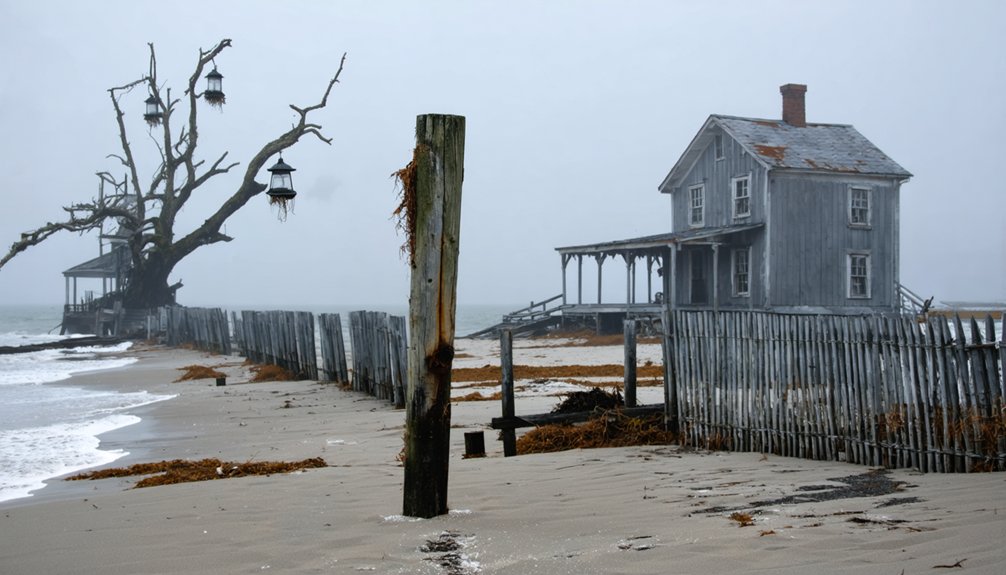
As you navigate the treacherous waters of North Carolina’s Outer Banks, you’ll encounter America’s oldest unsolved mystery at Roanoke Island, where 117 colonists vanished completely in 1590.
Their enigmatic legacy consists solely of the word “CROATOAN” carved into a tree and the truncated “CRO” etched elsewhere within the abandoned settlement.
Recent archaeological evidence on Hatteras Island (formerly Croatoan) suggests the colonists may have integrated with the Roanoke-Hatteras tribe, leaving behind a compelling mixture of Elizabethan and indigenous artifacts that continues to challenge historical narratives. The settlers likely faced severe hardship as they arrived during an extreme drought period, which tree-ring data shows was the most severe in 800 years. Originally established by Sir Walter Raleigh as England’s first attempt at permanent settlement in North America, the colony’s initial friendly relations with local tribes deteriorated due to food shortages and cultural misunderstandings.
Vanished Without Trace
The enigmatic disappearance of the Roanoke Colony stands as one of North America’s most perplexing maritime mysteries. When Governor John White returned to the settlement in 1590 after a three-year absence, you’d have discovered nothing but abandonment—117 souls vanished without explanation along the Outer Banks’ windswept shores.
Roanoke theories suggest several possibilities for colony survival:
- Integration with the Croatoan tribe, evidenced by English artifacts discovered in their villages.
- Relocation inland to escape the catastrophic 800-year drought that devastated coastal resources.
- Decimation through conflict with indigenous populations or Spanish raiders.
- Migration northward to Chesapeake Bay, seeking more favorable maritime conditions.
The evidence remains tantalizingly incomplete—scattered artifacts, cryptic inscriptions, and oral histories of blue-eyed natives—leaving this Atlantic coastal enigma to haunt our collective consciousness. The only clues White found were the words “CROATOAN” and letters “CRO” carved into trees at the abandoned settlement. The lost settlers included the first English child born in North America, Virginia Dare, who was John White’s granddaughter.
Croatoan’s Cryptic Message
Why would a single word carved into a weathered post become one of America’s most enduring maritime mysteries?
When Governor White returned to Roanoke in 1590, the enigmatic “Croatoan” inscription wasn’t a mark of distress but rather a deliberate directional clue. The absence of the agreed-upon Maltese cross suggests the settlers voluntarily relocated southward to Hatteras Island, where the allied Croatoan tribe dwelled along Atlantic shores.
The Croatoan significance extends beyond mere abandonment—it represents calculated survival strategy.
Archaeological evidence on Hatteras Island supports theories of colonist integration with indigenous communities. Recent discoveries by Croatoan Archaeological Society have unearthed Elizabethan artifacts that strengthen the relocation theory. Excavated European artifacts intermingled with native materials indicate cultural blending rather than disappearance. The colony, originally established under Sir Walter Raleigh’s patronage, was likely relocated as part of a planned contingency rather than due to disaster.
Site X’s green pottery fragments further suggest colonists dispersed among multiple locations. You’re witnessing not a ghostly vanishing but a pragmatic diaspora of settlers adapting to coastal Carolina’s challenging maritime environment through strategic native alliances.
Nature’s Reclamation: How the Sea Swallowed Holland Island
Once nestled proudly among the waters of Chesapeake Bay, Holland Island represents one of the most dramatic examples of nature’s reclamation along America’s eastern seaboard.
You can trace its maritime history from Daniel Holland’s 1600s settlement to its peak prosperity in 1910, when 360 residents thrived amid 70 homes and a fleet of 90 working vessels.
The relentless forces of coastal erosion transformed this vibrant fishing community:
Time and tide methodically dismantled what humanity had built, swallowing Holland Island’s thriving maritime legacy one shoreline at a time.
- By 1914, severe erosion began consuming the western shoreline
- A 1918 tropical storm destroyed the church, breaking community resolve
- Families dismantled their homes, relocating primarily to Crisfield
- The final Victorian house succumbed to the Bay in 2010
Cursed Grounds: The Supernatural Legacy of Dudleytown

Deep within Connecticut’s northwestern forests lies Dudleytown, a settlement whose supernatural reputation has eclipsed its modest historical origins.
Unlike coastal hamlets battling tidal forces, Dudleytown’s adversary was terrestrial isolation, situated in a valley where midday darkness cast eerie shadows across struggling homesteads.
The Dudley family’s alleged cursed history—originating from an ancestor’s English execution for treason—followed settlers across the Atlantic. By the 1850s, twenty-six families clung to this unforgiving terrain before economic collapse forced their retreat.
Supernatural sightings reported by paranormal investigators like the Warrens in the 1970s transformed this abandoned hamlet into legend.
Today, the Dark Entry Forest Association vigilantly protects what remains—stone foundations barely visible beneath nature’s reclamation—while trespassers brave potential fines seeking communion with spectral residents of this ill-fated Connecticut woodland.
Exploring These Forgotten Places: Access and Preservation Efforts
While traversing the spectral topography of America’s abandoned coastal settlements presents compelling opportunities for explorers, these maritime ghost towns exist within complex webs of accessibility challenges and preservation imperatives.
In addition to coastal areas, the exploration of abandoned towns in the United States reveals fascinating histories of communities once thriving. Each site tells a unique story of economic shifts and environmental changes that led to their decline. Adventurers often find themselves captivated by the remnants of these forgotten places, drawing parallels between the past and the ever-changing landscape of the present.
These forsaken harbors along the Atlantic seaboard balance heritage conservation against natural reclamation processes.
Should you attempt visitation, consider these access barriers and preservation challenges:
- Natural impediments such as marshlands and tidal fluctuations restrict physical entry to sites like Perkins, Maine, where boat transport remains the sole ingress.
- Multi-jurisdictional oversight requires maneuvering permit processes through federal, state, and local authorities.
- Environmental protection statutes safeguard fragile ecosystems surrounding these spectral settlements.
- Structural degradation presents safety hazards, particularly in locations besieged by Atlantic hurricanes and relentless coastal erosion.
Frequently Asked Questions
Are Children Allowed on Ghost Tours of These Abandoned Towns?
Like Hamlet’s ghost haunting Elsinore, ghost tour regulations vary. You’ll find most tours allow children with adult supervision, though child safety concerns prompt age restrictions—typically 8-12 years—particularly along Eastern Seaboard’s haunted waterfronts.
What Paranormal Investigation Equipment Works Best in Coastal Environments?
You’ll find EMF meters with salt-air resistance, waterproof infrared cameras, and Kestrel devices most effective for ghost hunting along the Atlantic seaboard, where coastal weather fluctuations demand durable, multifunctional equipment.
Which Abandoned Town Has the Strongest Documented Paranormal Evidence?
While skeptics dismiss ghostly sightings, Pawleys Island, South Carolina presents the strongest documented paranormal evidence. You’ll find extensive EVP recordings, thermal anomalies, and the historically verified “Gray Man” among its haunted locations along the Atlantic seaboard.
Do Any Indigenous Legends Explain These Hauntings Differently?
Yes, indigenous myths reframe these hauntings as guardianship spirits protecting ancestral territories. You’ll find spiritual connections to land in Maine’s Pamola legends and Virginia’s Three Sisters riverine warnings—not merely ghostly apparitions.
How Do Seasonal Changes Affect Reported Paranormal Activity?
You’ll notice seasonal shifts dramatically amplify paranormal reports, with fall’s cooler temperatures generating peak activity. Temperature fluctuations along the Atlantic seaboard create conditions—particularly foggy atmospheres and elongated shadows—that transform ordinary stimuli into seemingly supernatural experiences.
References
- https://wicproject.com/travel/10-abandoned-seaside-places-in-america-that-were-once-tourist-hotspots/
- https://www.loveexploring.com/gallerylist/131658/abandoned-in-the-usa-92-places-left-to-rot
- https://en.wikipedia.org/wiki/List_of_flooded_towns_in_the_United_States
- https://thetravelersfieldguide.com/field-note/ghost-towns-of-the-east-coast/
- https://www.geotab.com/ghost-towns/
- https://albiongould.com/ghost-towns-to-visit-in-the-states/
- https://www.atlasobscura.com/lists/americas-best-preserved-ghost-towns
- https://www.youtube.com/watch?v=s2a3hAf5d-Y
- https://newenglandhistoricalsociety.com/six-new-england-ghost-towns/
- https://thehistorymom.com/2022/06/15/historical-sites-near-a-beach/