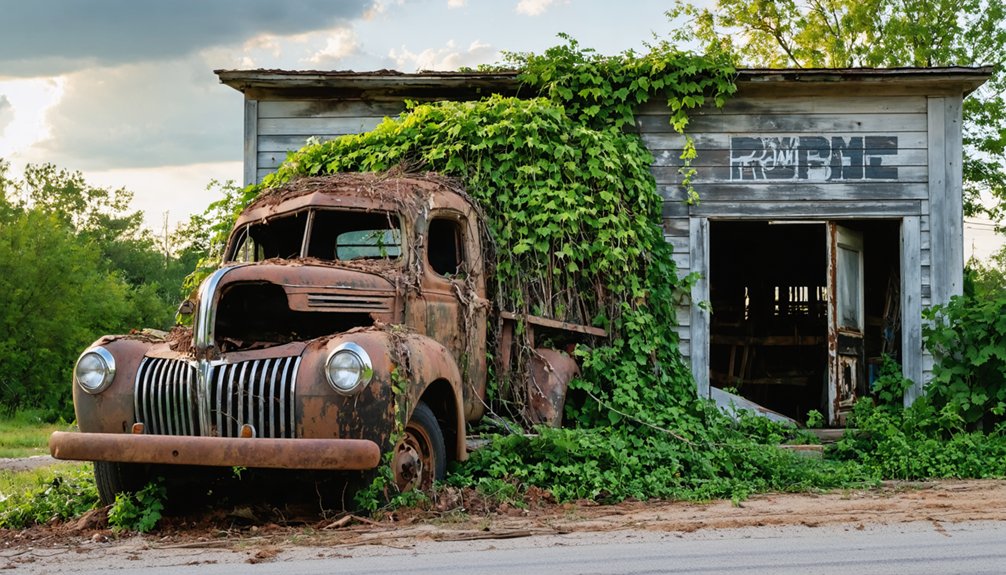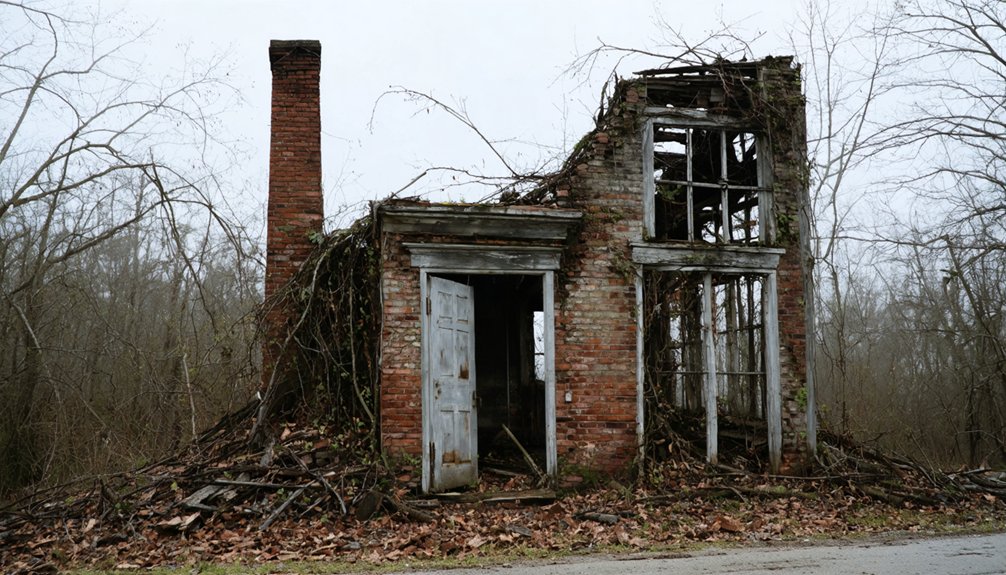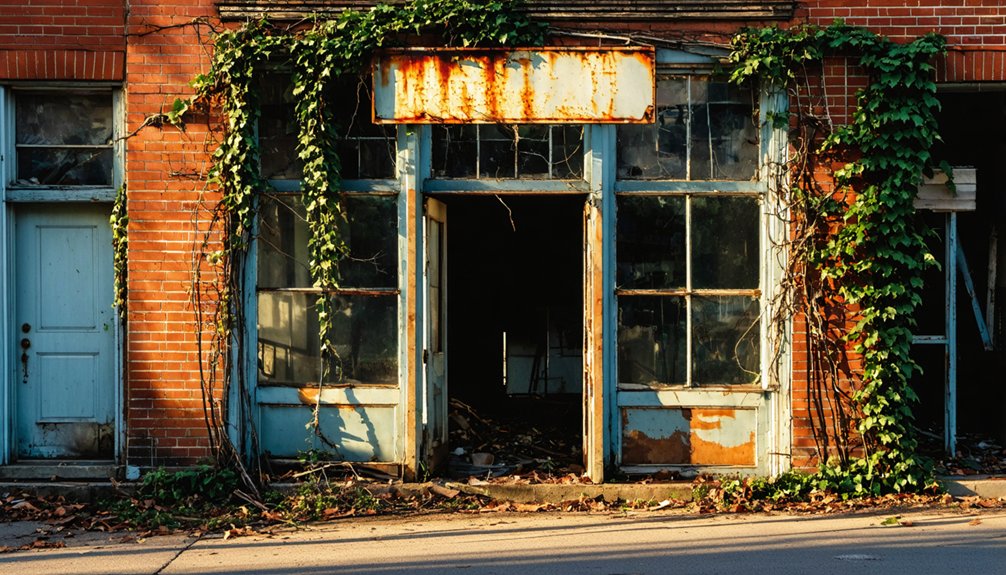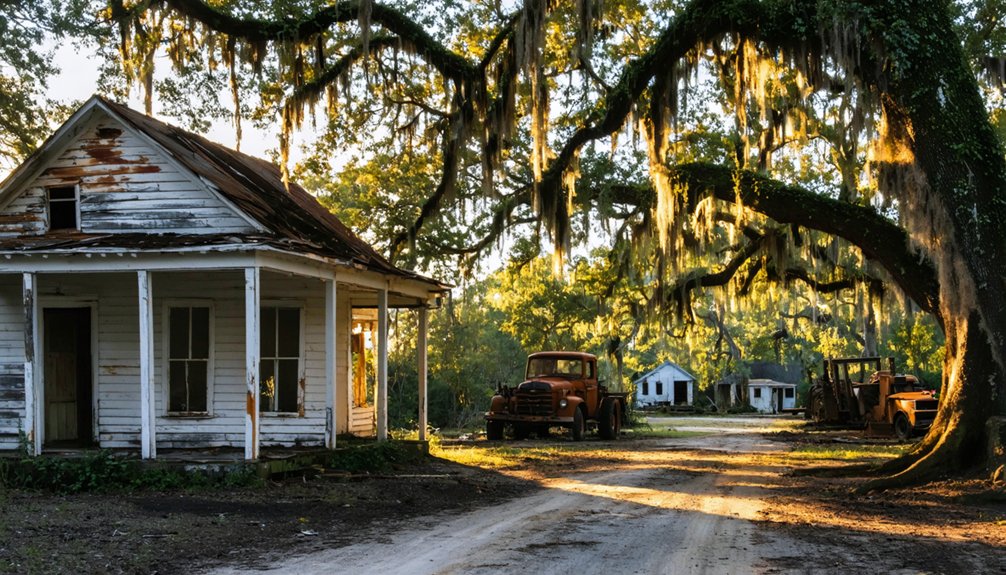
You’ll find Alabama’s most haunted ghost towns aren’t tourist traps—they’re genuine 19th-century settlements where documented tragedies created lasting legacies. Old Cahawba, the state’s first capital, features Civil War ruins and frequent paranormal reports. Claiborne’s underground tunnels and preserved structures echo its epidemic-ravaged past. Blakeley’s 2,100-acre battlefield park preserves earthworks from one of the Civil War’s final battles. Even Spectre, though created as a film set, has developed its own eerie reputation through rapid decay and unexplained phenomena that continue attracting ghost hunters.
Key Takeaways
- Old Cahawba, Alabama’s first capital, features Civil War ruins, preserved cemeteries, and frequent ghost sightings linked to its tragic flooding history.
- Claiborne’s underground tunnels, preserved 19th-century buildings, and epidemic-devastated past contribute to reports of shadow figures and paranormal activity.
- Blakeley Historic State Park preserves Civil War earthworks from 1865’s final battle, with nature-reclaimed fortifications fostering eerie, haunted atmospheres.
- Spectre, Tim Burton’s 2003 movie set, attracts visitors despite fictional origins due to rapid decay and reported equipment failures and apparitions.
- French-founded Arcola retains historic gravestones and plantation ruins near Demopolis, marking its 1820s river trade hub origins and mysterious past.
Old Cahawba: Alabama’s Abandoned First Capital
From 1820 to 1826, Cahawba thrived with 1,000 residents, hosting Marquis de Lafayette in 1825.
Flooding drove the capital to Tuscaloosa, triggering rapid abandonment.
After an 1865 flood and Selma’s seizure of the county seat in 1866, dismantled buildings left scattered ruins. The Crocheron Columns remain as remnants of the Greek Revival mansion that burned in 1923. During Reconstruction, Jeremiah Haralson rose from slavery in Cahawba to become Alabama’s first African American congressman.
Today’s preservation challenges haven’t stopped this archaeological park from symbolizing Alabama’s ambitious beginnings.
Bellefonte: The Lost County Seat of Jackson County
While Old Cahawba lost its status through natural disaster, Bellefonte’s decline stemmed from a more calculated decision—one its residents would regret for generations.
Founded in 1821 as Jackson County’s first incorporated town, Bellefonte thrived with brick courthouses, merchants, and frame churches. The town’s name derives from French, meaning “beautiful spring,” referencing the natural water source that attracted early settlers.
Then in the late 1850s, residents made their fatal mistake: they rejected the railroad. The depot was built three miles away, and businesses followed.
Bellefonte’s rapid collapse involved:
- Loss of county seat status to Scottsboro in 1859
- Burning during the Civil War
- Complete abandonment by former residents
The town’s historical significance included Leroy Pope Walker, who lived and practiced law in Bellefonte before becoming Confederate Secretary of War and ordering the start of the Civil War.
Today, abandoned architecture and haunted folklore surround this ghost town near the Bellefonte Nuclear Generating Station. Most people drive past, unaware they’re passing what was once Alabama’s most promising frontier settlement.
Blakeley: Civil War Fort Town Reclaimed by Nature
How many ghost towns can claim they hosted one of the Civil War’s final major battles on the very day Lee surrendered at Appomattox? Blakeley’s three-mile fortification line witnessed 16,000 Union troops—including 5,000 African-American soldiers—breach Confederate earthworks on April 9, 1865.
This Baldwin County site once thrived as a river port and county seat before war devastated it.
Today, Historic Blakeley State Park protects 2,100 acres of pristine Civil War entrenchments, redoubts, and artillery positions.
Historical preservation efforts by the American Battlefield Trust saved 126 additional acres through 2023.
You’ll find nature has reclaimed what enslaved laborers and Confederate soldiers built—dry ditches, bombproofs, and earthworks now serve as wildlife habitats. The Confederate defenses featured over 40 artillery pieces positioned along nine redoubts to protect Mobile’s vital port. These fortifications included primitive land mines and telegraph wires strung as obstacles against advancing Union forces.
The park represents the largest National Register Historic Site in eastern America, where ancient Native American settlements blend with colonial homesteads beneath forest canopy.
Claiborne: South Alabama’s Largest Ghost Town
You’ll find Claiborne’s story remarkably dramatic—it exploded from wilderness fort to Alabama’s largest town with 6,000 residents by 1820.
Then it collapsed into complete abandonment within decades. Yellow fever and cholera epidemics ravaged the population throughout the mid-1800s.
Meanwhile, the Civil War’s disruption of cotton trade and the railroad’s bypass in the 1870s delivered final blows.
The town’s origins trace back to Fort Claiborne, established during the Creek War of 1813-1814 as a strategic military base. Today, only the James Dellet House stands at the original site, though you can visit several relocated structures like William B. Travis’s home at nearby Perdue Hill.
Visitors can explore the remnants through guided tours offered by local residents like Agee Broughton, who leads walks through approximately a dozen historical homes in the area.
Rapid Rise and Fall
Born from the ashes of a military outpost, Claiborne exploded onto Alabama’s landscape with remarkable speed after Fort Claiborne’s establishment in 1813 during the Creek War.
By the 1830s, you’d find yourself in one of Alabama’s largest cities—a bustling river port with 5,000-6,000 residents shipping cotton via steamboat.
Claiborne’s golden age produced three future governors and hosted General Lafayette in 1825.
Yet prosperity proved fleeting. The Civil War brought devastation through Union occupation, while railroad expansion rendered steamboat commerce obsolete. Yellow fever and cholera epidemics compounded the town’s decline, claiming numerous lives before the war even began.
Today’s urban decay tells Claiborne’s story:
- Population collapsed from thousands to 350 by 1872
- Railways bypassed the town entirely in the early 1900s
- Zero residents remain in what once rivaled Alabama’s finest cities
Preservation challenges now threaten the remaining structures as nature reclaims this once-mighty settlement.
Disease Epidemics Decimated Population
While Claiborne weathered wars and economic shifts, disease proved its deadliest enemy. Yellow fever and cholera epidemics struck mid-19th century, devastating the thriving port that once housed 5,000-6,000 residents.
These twin plagues killed substantial portions of Claiborne’s population during its post-1830s downturn, accelerating the town’s abandonment as terrified merchants fled.
The epidemic aftermath was catastrophic. Population decline continued relentlessly—by 1872, only 350 people remained in what had been Alabama’s largest town.
Survivors migrated to Mobile, abandoning their disease-scarred community. Civil War looting compounded the devastation, and when railroads bypassed the decimated settlement in the early 20th century, Claiborne’s fate was sealed.
Today, three cemeteries and the 1835 James Dellet House stand as haunting reminders of the epidemics that transformed a prosperous city into Alabama’s most significant ghost town. The Alabama Historical Association commemorated this once-thriving settlement with a marker in 1999, ensuring its remarkable rise and tragic fall would not be forgotten.
Relocated Historical Structures
Despite Claiborne’s near-total abandonment, several historically significant structures survived through strategic relocation to nearby Perdue Hill. You’ll find the William B. Travis House, originally built in the early 1820s and moved during the 1980s, now preserved alongside the relocated Perdue Hill Masonic Lodge. These relocations saved buildings that decline had bypassed.
When you visit these structures, you’ll discover:
- Hidden artifacts from Claiborne’s prosperous river commerce era
- Original architectural details revealing 19th-century craftsmanship
- Underground tunnels reportedly connecting properties for merchant activities
Both buildings stand accessible to visitors seeking Alabama’s frontier heritage. The strategic preservation allowed future generations to explore tangible connections to Claiborne’s past, including Alamo hero Travis’s Alabama residence, ensuring these historical treasures weren’t lost to abandonment.
Arcola: The Vanished River Landing Settlement
Along the south bank of the Black Warrior River in Hale County, the ghost town of Arcola once thrived as a French Bonapartist settlement before vanishing into Alabama’s historical landscape.
Established in the early 1820s by refugees from the Vine and Olive Colony, this French settlement honored Napoleon’s victory at the Battle of Arcola.
You’ll find its remnants 4.5 miles northeast of Demopolis, possibly submerged beneath Lake Demopolis’s waters.
River trade sustained Arcola as the colony’s largest community, serving as an essential landing for plantation commerce.
American settlers purchased French land grants during the 1830s, transforming the area.
By the 1850s, the French presence had disappeared entirely, replaced by sprawling plantations.
Today, only the Hatch Plantation and brush-hidden French gravestones mark this vanished settlement’s existence.
Spectre: Alabama’s Most Mysterious Ghost Town
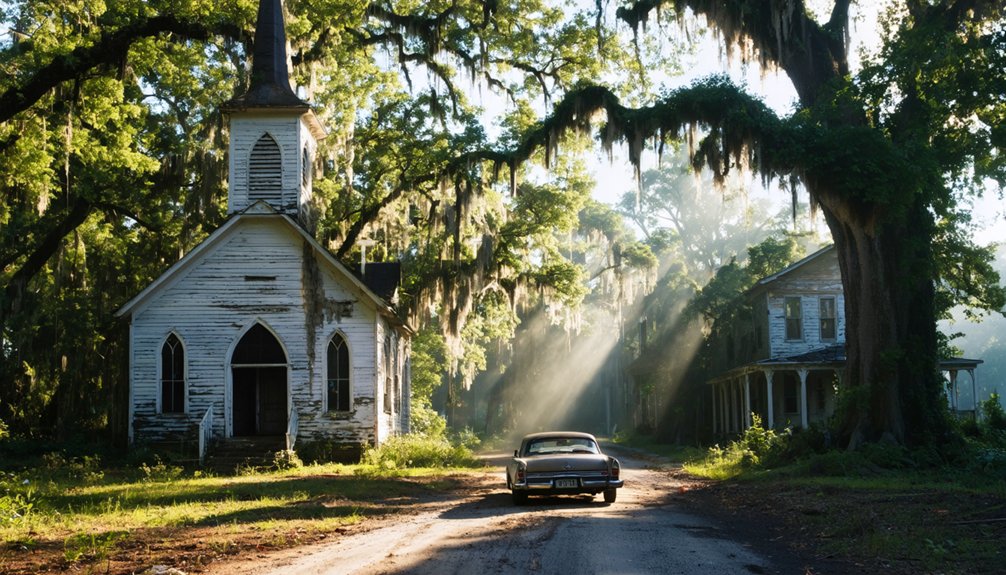
You won’t find Spectre in historical records or census data because it never existed as a real town—this ghost town was born as a movie set in 2003 for Tim Burton’s *Big Fish*.
What makes it mysterious isn’t a forgotten past, but rather how quickly a fabricated settlement transformed into an authentic ruin complete with paranormal reports and eerie decay.
If you’re compiling a ghost town bucket list, Spectre on Jackson Lake Island offers something unique: a place where Hollywood fantasy and genuine abandonment have blurred into one haunting destination.
Limited Historical Records
Unlike most ghost towns that emerge from economic collapse or natural disaster, Spectre’s mystery stems from its complete absence of authentic history. You won’t find census records, tragic events, or documented townspeople because none existed before 2003.
This fictional settlement defies conventional ghost town narratives, yet visitors report paranormal sightings and unsettling experiences that rival locations with genuine dark pasts.
What makes Spectre particularly enigmatic:
- No historical documentation exists before its film construction
- Urban legends emerged organically despite its artificial origins
- Reported phenomena include footsteps, shadowy figures, and equipment failures
The town’s energy feels authentically haunted, creating a psychological paradox.
You’re experiencing dread in a place that shouldn’t possess any residual trauma.
Social media amplified these accounts post-filming, transforming movie set ruins into legitimate paranormal destinations where fiction and folklore converge.
Ghost Town Bucket List
Nestled on Jackson Lake Island near Millbrook, Alabama, Spectre stands as one of the state’s most unusual destinations—a ghost town that’s never been an actual town. Built in 2003 for Tim Burton’s *Big Fish*, this fictional settlement on private land offers you unrestricted access through the campground for a small fee.
You’ll discover six deteriorating homes, a weathered chapel, and abandoned architecture designed as mere shells without interiors.
The enchanted forest’s Styrofoam trees remain standing, while visitors contribute cultural artifacts by adding shoes to the entrance line.
Flooding destroyed one house, fire claimed the commercial district, and goats now wander freely through collapsing structures.
Reports of unexplained footsteps and shadowy figures add supernatural intrigue to this Southern Gothic landscape that owners plan to refurbish.
What Makes These Alabama Ghost Towns Truly Haunted
Alabama’s ghost towns earn their haunted reputation through a potent combination of archaeological preservation, violent history, and documented paranormal activity.
exploring ghost towns in Alabama can lead to fascinating discoveries about the state’s past. Many visitors report eerie feelings as they walk through these abandoned sites, with stories of restless spirits lingering in the air. The rich history and unanswered questions make each ghost town a unique adventure for those willing to seek them out.
You’ll find these abandoned settlements uniquely positioned where urban decay meets supernatural legends, creating environments ripe for paranormal encounters.
Old Cahawba exemplifies this phenomenon through:
- Preserved Civil War fortifications where soldier casualties occurred
- Undisturbed 200-year-old structures maintaining their original street grids
- Multiple neglected cemeteries with graves dating to Reconstruction
Paranormal researchers document white orb apparitions and ghost sightings at locations like the Barker House.
The combination of historical trauma—including yellow fever outbreaks, economic collapse, and Civil War violence—creates tangible atmospheric tension.
You’re exploring sites where physical deterioration parallels documented supernatural disturbances, making these authentically haunted locations rather than manufactured attractions.
Frequently Asked Questions
Are Guided Ghost Tours Available at Any Alabama Ghost Towns?
Yes, you’ll find guided ghost tours at Alabama’s “dearly departed” towns where historical preservation meets paranormal entertainment. Tour guide availability spans Old Cahawba’s haunted streets, Selma’s moss-draped cemetery, Orrville’s nighttime shuttles, and Wilcox County’s spectral trail adventures.
What Safety Precautions Should Visitors Take When Exploring These Abandoned Sites?
When urban exploration takes you to abandoned sites, you’ll need proper safety gear including sturdy boots, flashlights, and layers. Always secure permission, travel with others, check weather conditions, and respect preservation laws protecting these historic locations.
Can You Camp Overnight at Alabama’s Ghost Town Locations?
You’d wait forever for camping permission at ghost towns. Alabama’s campground regulations strictly prohibit overnight stays at abandoned sites—they’re not designated campsites. Overnight restrictions require you to camp only in official state parks or national forest areas with proper permits.
Which Ghost Town Has Reported the Most Paranormal Activity?
Old Cahawba has reported the most paranormal activity among Alabama’s ghost towns. You’ll find it’s featured in multiple haunted legends, documented in published ghost story collections, and regularly hosts paranormal investigations at its cemetery and Barker House slave quarters.
Do You Need Permission to Visit Alabama’s Ghost Towns?
You don’t need permission for most Alabama ghost towns on public land during open hours. However, private property requires owner consent, and after-hours access to state sites like Old Cahawba needs special permission—no sneaking past the velvet rope!
References
- https://thebamabuzz.com/5-alabama-ghost-towns-to-put-on-your-bucket-list/
- https://www.hauntedrooms.com/alabama/haunted-places
- https://www.onlyinyourstate.com/experiences/alabama/alabama-ghost-towns
- https://deepsouthurbex.com/2020/01/02/6-south-alabama-ghost-towns/
- https://alabama.travel/article/the-most-haunted-places-in-alabama
- https://www.ezhomesearch.com/blog/11-ghost-towns-in-alabama-that-bridge-the-distance-between-yesterday-and-today/
- https://www.abandonedalabama.com/old-cahawba/
- https://theforgottensouth.com/cahawba-alabama-ghost-town/
- https://encyclopediaofalabama.org/article/cahaba/
- https://www.ruralswalabama.org/attraction/old-cahawba-park/