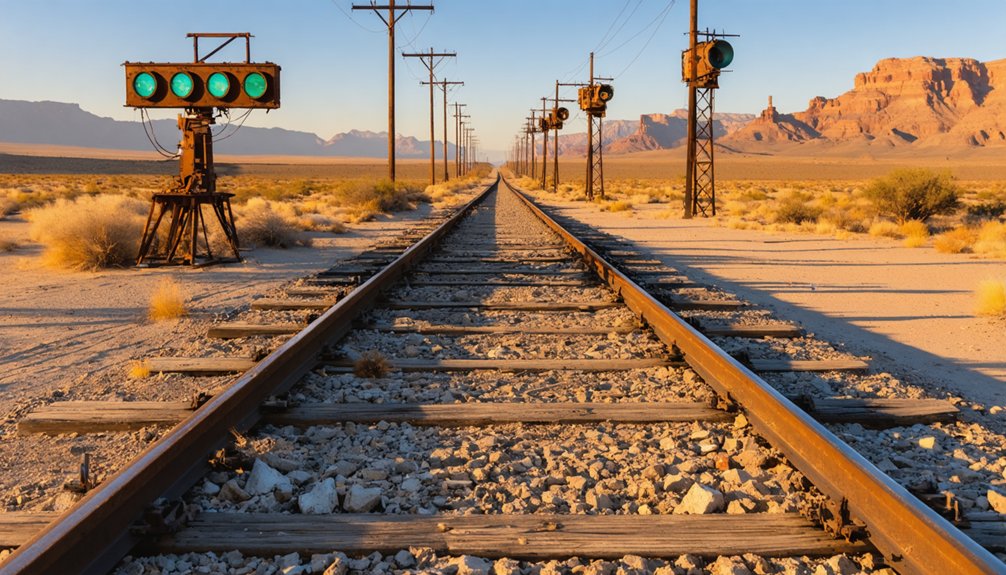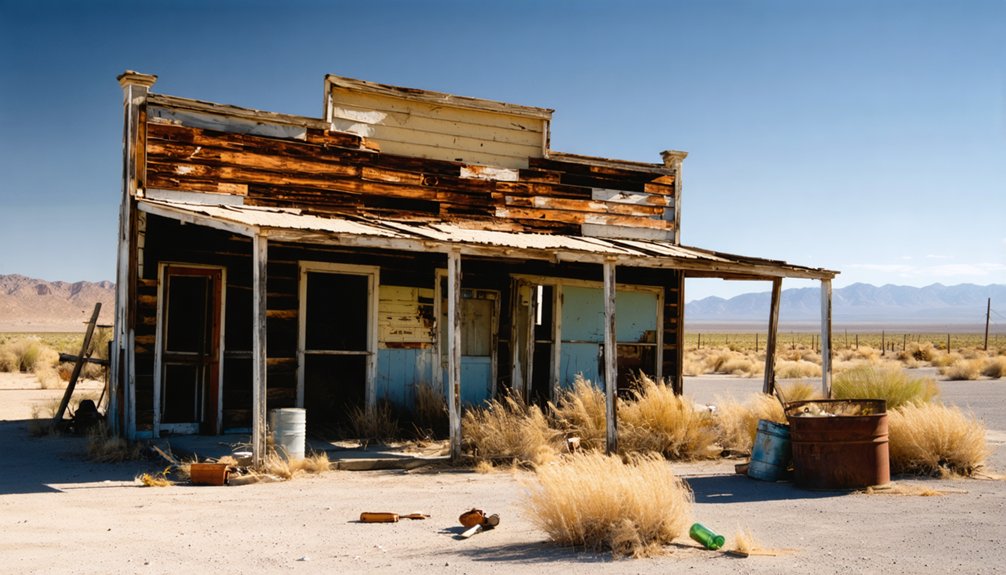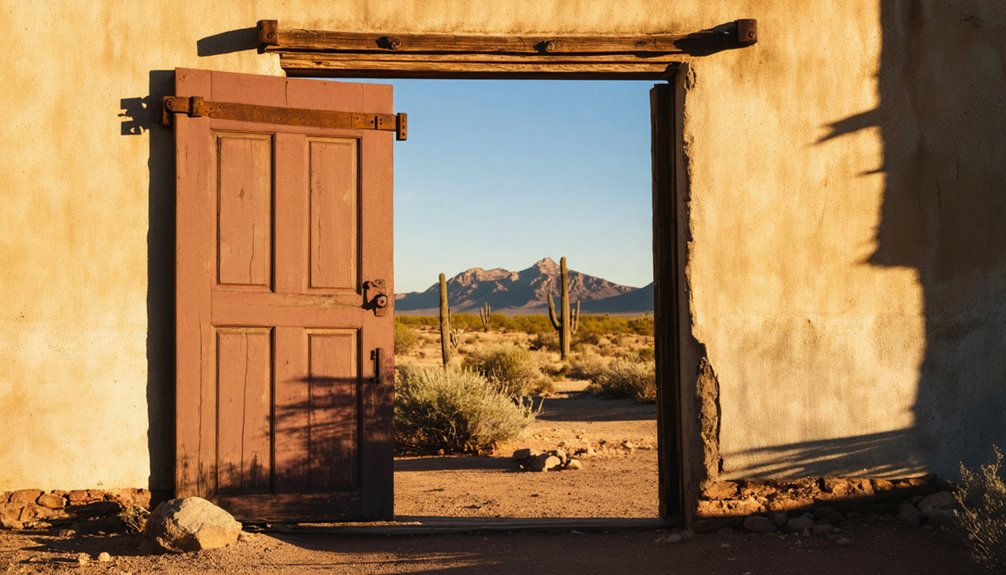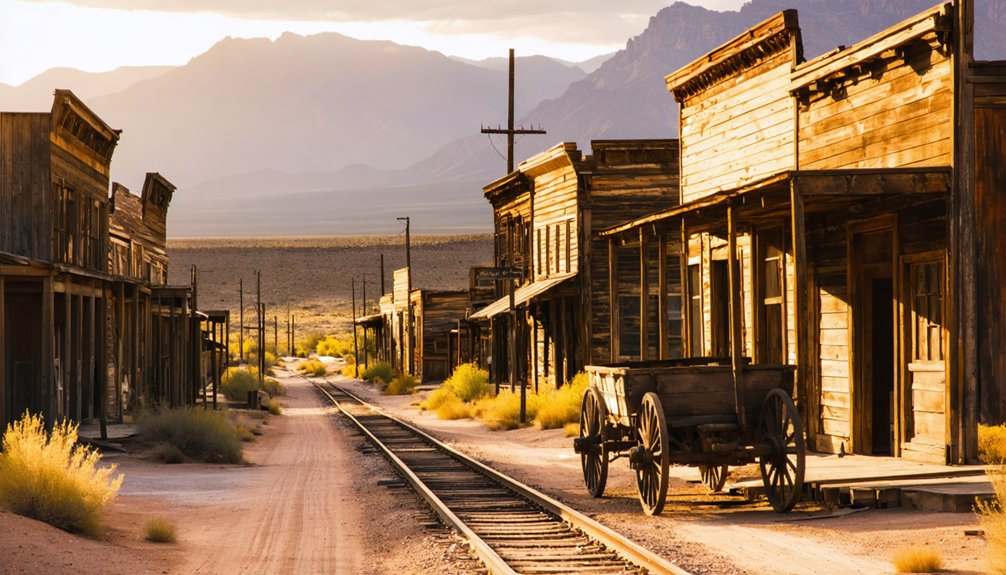
You’ll find Arizona’s most haunted ghost towns scattered across the desert, where mining booms turned to bust. Jerome, once home to 15,000 residents on Cleopatra Hill, earned its “Wickedest Town” reputation through opium dens and brothels. Vulture City produced 340,000 ounces of gold before closing in 1942, while Swansea‘s adobe ruins near the California border have stood since 1909. Visit Oatman for wild burros and the allegedly haunted 1902 hotel, or explore Two Guns’ cursed Death Cave along Route 66. The guide below reveals specific visiting seasons, preservation details, and documented supernatural encounters.
Key Takeaways
- Jerome, “Wickedest Town in the West,” featured brothels, opium dens, and mine blasts that relocated the jail downhill.
- Oatman’s 1902 hotel is rumored haunted by miner “Oatie,” with visitors reporting whispers and paranormal activity inside.
- Vulture City’s dark history includes 18 hangings and a fatal 1923 cave-in among preserved mining structures.
- Two Guns’ Death Cave allegedly witnessed 42 Apache warriors die in 1878, creating cursed folklore and legends.
- Swansea’s isolated adobe ruins and sealed mine shafts remain preserved since 1943 abandonment near Arizona-California border.
Swansea: Dusty Ruins Near the Arizona-California Border
Near the dusty Arizona-California border, Swansea stands as one of the state’s best-preserved ghost towns, a proof to the boom-and-bust cycle that defined early 20th-century mining ventures. You’ll find dozens of adobe structures, a railroad depot, and gated mine shafts scattered among desert flora in this remote La Paz County site.
George Mitchell established the town in 1909, naming it after his Welsh hometown, but financial collapse came swiftly—the Clara Golden Copper Company went bankrupt by 1912. Operations limped along until the Great Depression permanently shuttered the mines by 1937. Despite the mines closing, residents remained until 1943 before the town was completely abandoned.
The climate challenges and isolation that once hindered copper transport now protect the ruins from vandalism. The town’s worker cabins built in 1917 once housed 6-8 people each with minimal furnishings, though some have been partially restored. You’ll need a high-clearance vehicle to navigate the bumpy mining roads from Bouse to explore this BLM-managed site.
Jerome: The Wickedest Town in the West
Perched dramatically on Cleopatra Hill in the Verde Valley, Jerome earned its notorious reputation as “The Wickedest Town in the West” through decades of unrestrained vice and lawlessness that accompanied its copper mining boom.
At its peak in the early 1900s, nearly 15,000 residents from 30 nationalities inhabited this Wild West outpost where bootlegging, gambling, and opium dens thrived unchecked.
Historic preservation efforts began when the Jerome Historical Society formed in 1953, preventing complete demolition after mines closed.
Today’s mining archaeology reveals a town literally shaped by explosives—mine blasts moved the jail 200 feet downhill.
You’ll find transformation everywhere:
- Former bordellos now showcase art galleries
- Opium dens converted into restaurants
- Sliding buildings frozen mid-descent on unstable slopes
The town’s turbulent history ended when the Great Depression, declining post-WWII copper demand, and depleted ore deposits forced the mines to close permanently.
The Jerome State Historic Park preserves the mining legacy through the Douglas Mansion, which houses large-scale equipment and serves as both museum and visitor center.
This once-wicked town survives through artist communities and tourism.
Vulture City: Desert Mining History Preserved
Deep in the Sonoran Desert near Wickenburg, Vulture City stands as Arizona’s most productive gold mining site.
Vulture City: Arizona’s richest gold mine, where desert fortune seekers struck the mother lode in 1863.
Henry Wickenburg’s 1863 discovery of a massive gold-bearing quartz outcrop—500 feet long, 400 feet wide, and 100 feet tall—sparked the territory’s first major gold rush.
The mine yielded over 340,000 ounces of gold and 260,000 ounces of silver using stamping mills and refined mining techniques.
At its peak, 5,000 residents inhabited this settlement before violence, including 18 hangings at the notorious Hanging Tree, and a catastrophic 1923 cave-in that buried seven miners shaped its dark ghost town legends.
Government closure in 1942 ended operations permanently.
The town featured saloons, boarding houses, a post office, and a school that served the bustling mining community.
Wickenburg initially worked the mine alone before leasing it to others for $15 per ton of ore.
Today, you’ll find over 18 restored buildings offering guided tours October through May, preserving $200 million worth of authentic desert mining history.
Pearce: Semi-Abandoned Gold and Silver Settlement
You’ll find Pearce nestled in Sulphur Springs Valley, where James Pearce’s 1894 gold discovery sparked a mining stampede that transformed ranch land into a thriving town of 1,500 residents by 1919.
The Commonwealth Mine’s 200-stamp mill once produced massive gold bars too heavy to steal, but operations ceased by 1930 when ore depleted and worldwide depression struck. The mine ultimately produced over 100,000 tons of ore between 1895 and 1942, yielding approximately $8 million in silver and $2.5 million in gold.
Today, the Old Pearce Preservation Association maintains surviving structures including Arizona’s largest adobe store, an operational 1912 schoolhouse, and the historic 1915 jail that opens monthly for visitors exploring this semi-abandoned settlement. The Pearce Cemetery remains nearby, marking the final resting place of miners and residents who once populated this bustling gold and silver town.
Historic Mining Operations Legacy
While herding cattle on Sixmile Hill in 1894, Cornishman James Pearce stumbled upon gold-bearing quartz rock that would transform Sulphur Springs Valley into one of Arizona’s richest mining districts.
The Commonwealth Mine‘s sophisticated mining technology extracted over 1,000,000 tons of ore through 20 miles of underground workings between 1895-1942, yielding $10.5 million in precious metals.
The ore processing evolved dramatically:
- Brockman’s 200-stamp mill (1896) thundering near the mine until fire consumed it in 1900
- Smith-Swatling’s remodeled 120-stamp facility paired with a 350-ton cyanide plant by 1910
- Multiple mill reconstructions following devastating fires in 1900 and 1910
The mining boom transformed Pearce into a thriving community of about 1,500 residents by 1919, with the railroad station opening in 1903 to facilitate ore shipments and supply deliveries.
Montana Tonopah Mines acquired the property in 1910 and constructed a new mill that operated until 1917, marking a significant transition in the mine’s ownership and operations.
Cave-ins, flooding, declining ore quality, and the Great Depression ultimately silenced the stamps in 1942, leaving behind Arizona’s testament to both mining ambition and nature’s inevitable reclamation.
Preserved Structures and Cemetery
Though most of Pearce’s population vanished decades ago, a remarkable collection of historic structures survives along U.S. Route 191. You’ll find the county’s largest adobe building—the restored General Store—now housing small businesses.
The 1915 jail opens to visitors the first Saturday monthly from October to May, or by appointment at 760-443-6062.
The mission church, abandoned since 1961, stands as another preserved structure testament to boom-era optimism.
Cemetery secrets lie beyond town at the Sulpher Springs burial ground, where President Woodrow Wilson deeded 40 acres to Knights of Pytheas Lodge 21 in 1916.
You can explore this semi-abandoned site where claim-staked spots accommodate informal burials.
The 1912 elementary school still operates, educating area children within ghost town boundaries.
Oatman: Wild Donkeys and Route 66 Legends
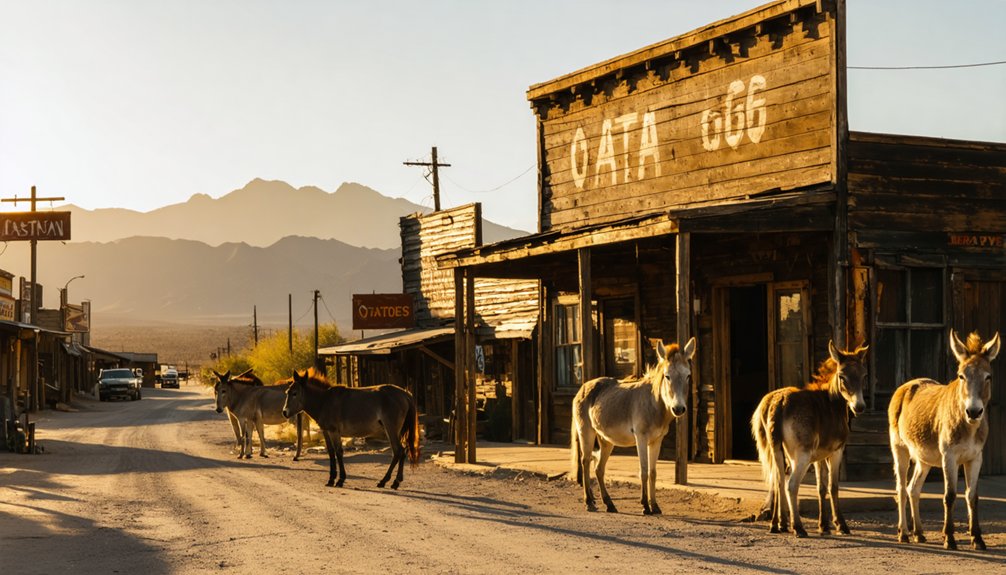
Nestled in the Black Mountains of Mohave County at 2,710 feet elevation, Oatman takes its name from one of the American West’s most harrowing captivity stories. Olive Oatman survived a massacre and five years with Native tribes, bearing chin tattoos marking her adoption by the Mohave. Prospectors later honored her memory while extracting 1.8 million ounces of gold from these mountains, some of which locals whisper were Native legends’ sacred sites.
Today, you’ll encounter Oatman’s living Wild West heritage:
- Wild burros—descendants of miners’ pack animals—roam freely, begging treats along the weathered main street
- The 1902 Oatman Hotel stands haunted by Oatie, an Irish miner whose whispers echo through adobe walls
- Staged gunfights erupt amid saloons on historic Route 66’s original alignment
This town of 102 residents refuses to surrender its untamed spirit.
Two Guns: Death Cave and Highway Tragedy
You’ll find Two Guns perched on Canyon Diablo’s eastern rim, where Route 66 once funneled travelers across a stone bridge into one of Arizona’s darkest roadside attractions.
The site’s notoriety stems from an 1878 massacre when Navajo warriors trapped and killed 42 Apache in a limestone cave—remains that entrepreneur Harry Miller later sold to tourists from his Fort Two Guns trading post.
What’s left are crumbling stone structures, graffiti-covered ruins, and the sealed Death Cave itself, all bypassed by Interstate 40 and abandoned to decay.
Canyon Diablo Bridge History
The Canyon Diablo Bridge opened to traffic on March 17, 1915, creating the first east-west automobile crossing in northern Arizona. This historic bridge replaced the treacherous zig-zagging wagon path that forced travelers down into the 225-foot-deep canyon diablo and back up the other side. The crossing spanned 550 feet of unforgiving gorge.
Before automobiles arrived, the Atchison, Topeka and Santa Fe Railroad built a trestle of spindly steel legs here in 1882, halting construction for nearly a year. The railroad bridge served as a crucial trade link until its 1946 replacement.
Route 66 transformed this remote crossing into tourist territory. Three developments shaped Two Guns:
- Earl and Louise Cundiff’s 1920s trading post on 300+ acres
- Henry Miller’s roadside zoo featuring mountain lions and rattlesnakes
- Gas stations and motor lodges lining the highway
Death Cave Massacre Legend
Beneath Two Guns’ crumbling roadside attractions lies Apache Death Cave, where—according to local legend—forty-two Apache raiders suffocated in 1878 during a Navajo revenge attack. You’ll find the story woven into ghost town legends: Navajo warriors tracked Apache kidnappers to this cavern, ignited sagebrush at the entrance, and gunned down survivors who fled the smoke.
The trapped Apaches allegedly slaughtered their horses, using blood to fight the flames before piling corpses at the cave mouth. Researcher Blue Miller exposed the tale’s likely fabrication—originating from Gladwell Richardson’s 1968 book, written by a man who killed a rabbi and invented stories for tourist dollars.
Yet the spiritual symbolism persists. Ed Randolph commercialized the site in the 1920s, selling bones as souvenirs, desecrating what locals considered cursed ground.
Route 66 Roadside Ruins
Dark legend gave Two Guns its initial notoriety, but Route 66 commerce transformed it into a roadside empire. By the 1920s, Earle and Louise Cundiff’s 320-acre operation dominated this Canyon Diablo crossing with trading posts, motels, restaurants, and a canyon-rim zoo.
Interstate 40’s completion strangled the business, and a 1971 fire delivered the final blow.
Today, you’ll find moonlit shadows dancing across:
- Stone ruins of Cundiff’s General Store perched on the canyon edge
- The 1915 Canyon Diablo Bridge, still spanning the gorge
- Graffiti-covered swimming pools and abandoned machinery scattered throughout the compound
Dirt roads now lead past barbed wire to these skeletal structures.
The Route 66 shield mural—framed by two guns—watches westbound Interstate traffic from a weathered shack, marking what remains of Arizona’s cursed highway stop.
Supernatural Encounters in Arizona’s Ghost Towns
Arizona’s abandoned mining settlements harbor documented accounts of spectral activity that span over a century of paranormal investigation. You’ll find haunted folklore deeply rooted in towns like Vulture City, where dozens of executed miners reportedly haunt the infamous hanging tree.
Explorers and ghost hunters often venture into the vast landscapes dotted with abandoned towns in Arizona, each with its own tragic history and tales of lost souls. Among these ghostly relics, one may also encounter eerie remnants of old homesteads and crumbling storefronts, inviting curiosity about the lives that once thrived there. As the sun sets and shadows lengthen, the atmosphere becomes charged with a sense of mystery, drawing visitors deeper into the haunting past of the desert.
Over a century of paranormal investigations confirm Arizona’s mining towns remain active with documented spectral encounters and restless spirits.
Paranormal investigations at Goldfield Ghost Town captured unexplainable phenomena during Ghost Adventures’ 2015 episode, while Jerome Grand Hotel documents persistent footsteps and whispers from a maintenance worker who died in the elevator shaft.
Bisbee’s mining caves preserve sightings of laborers who never departed, and the Superstition Mountains surrounding Goldfield earned the Apache designation “Devil’s Playground.”
These locations offer verifiable encounters—from Henry Wickenburg’s apparition in Vulture City’s Smelting Room to mysterious orbs floating through deteriorating structures.
You’re experiencing authentic Western history where restless spirits remain tethered to their final workplaces.
Exploring Abandoned Buildings and Mining Remnants
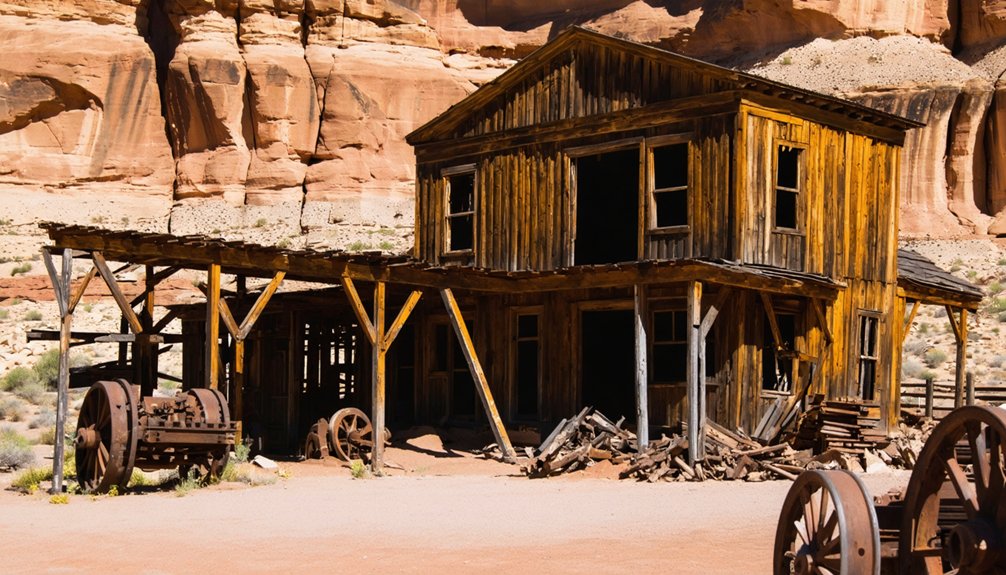
Beyond the spectral phenomena that attract paranormal enthusiasts, you’ll discover tangible remnants of Arizona’s mining era preserved in structures that withstand decades of desert exposure. Mining relics scatter across five significant sites, each offering unrestricted access to forgotten foundations and architectural survivors.
Your exploration reveals:
- Ruby’s concentrated collection – over two dozen roofed buildings including an intact jail, collapsed Clarke store, and mill foundations alongside miners’ dormitories
- Swansea’s industrial remnants – concrete powder house, smelter stack base, enormous slag piles, and railroad platforms surrounded by thousands of abandoned mines
- Gleeson’s 1910 jail – repaired to retain original structure, standing with hospital ruins and cemetery grounds
Charleston’s adobe ruins hide within riverside brush, while Courtland’s concrete jail anchors the Ghost Town Trail. These sites welcome independent investigation without guided restrictions.
Best Times to Visit Arizona’s Haunted Locations
When planning your ghost town expeditions, you’ll find October through May offers ideal conditions for exploring Arizona’s abandoned settlements. Summer’s extreme heat makes outdoor exploration challenging, while seasonal weather during cooler months allows comfortable walking tours through sites like Jerome and Tombstone.
You’ll encounter increased crowds during winter peak season, so arrive early—between 9-10am—for quieter experiences.
Holiday events add unique dimensions to your visits. Vulture City transforms with Christmas decorations and festive programming across its 16 original buildings, while Thanksgiving weekend in Jerome features live music and Light Up the Mountain preparations.
Note that some attractions close for Easter and operate limited schedules.
Night tours with flashlight-guided experiences provide alternative exploration opportunities. Weekday visits during operating season typically mean fewer visitors than weekend crowds.
Frequently Asked Questions
Are Overnight Stays Permitted at Any Arizona Ghost Town Locations?
You can stay overnight at Kentucky Camp through the Forest Service’s lodging program for $75 nightly. This historical preservation site lets you experience local legends firsthand while sleeping in Arizona’s authentic backcountry ghost town environment.
What Safety Equipment Is Recommended When Exploring Abandoned Mine Shafts?
You’d think “ghost” towns would be the *least* dangerous Arizona attraction, but abandoned mine shafts require serious equipment: MSHA-approved hard hats, body harnesses, gas detectors, multiple lights, and respirators. Mine safety isn’t optional—it’s survival.
Exploring the historic ghost towns of southern Arizona reveals not only the remnants of mining days but also the rich history and stories of those who lived there. Each town has its own unique character, with crumbling buildings and rusted machinery that tell tales of ambition and hardship. Visitors are often left in awe of the stark beauty and haunting atmosphere that these forgotten places embody.
Do I Need Special Permits to Photograph Arizona’s Ghost Towns?
You’ll need photography permits for commercial work at private ghost towns like Gold King Mine ($50-$250). Personal shots don’t require permits. Privacy concerns arise on state lands requiring insurance and applications. Always respect property boundaries and historical preservation rules.
Which Ghost Towns Are Wheelchair Accessible for Visitors With Mobility Limitations?
You’ll find the best mobility accommodations at Vulture City and Goldfield Ghost Towns, both featuring accessible pathways and ADA-compliant facilities. Gold King Mine’s accessibility remains disputed, while Swansea’s rough terrain requires careful consideration of your specific needs.
Are There Guided Paranormal Investigation Tours Available at These Locations?
Lanterns flickering through dusty corridors reveal Arizona’s paranormal activities waiting for you. You’ll find guided investigation tours at Goldfield’s Bordello, Jerome’s Pandora’s Box, Old Bisbee, and Old Tucson—complete with EMF readers to track historical legends yourself.
References
- https://en.wikipedia.org/wiki/List_of_ghost_towns_in_Arizona
- https://www.arizonahighways.com/article/arizona-ghost-towns
- https://www.visitarizona.com/like-a-local/4-arizona-ghost-towns-you-may-have-never-heard-of
- https://www.top-ten-travel-list.com/blog/activities/the-most-interesting-arizona-ghost-towns-to-explore/
- https://www.atlasobscura.com/things-to-do/arizona/ghost-towns
- https://www.youtube.com/watch?v=Hl0qxYmKPoE
- https://www.tripadvisor.com/Attractions-g28924-Activities-c47-t14-Arizona.html
- https://www.atlasobscura.com/places/swansea-ghost-town
- https://www.youtube.com/watch?v=_OusTvk8NxQ
- https://www.youtube.com/watch?v=uJvtntuFH_k