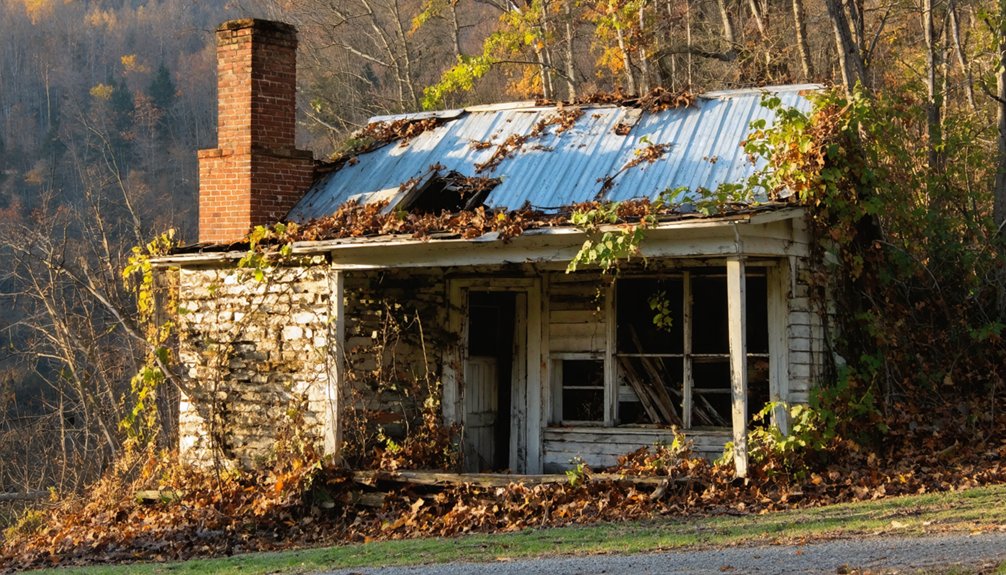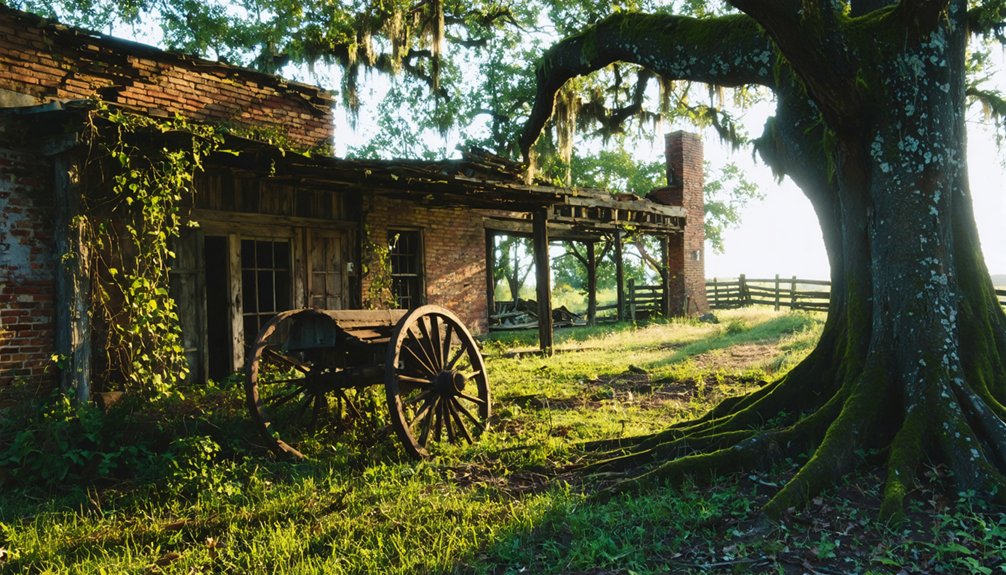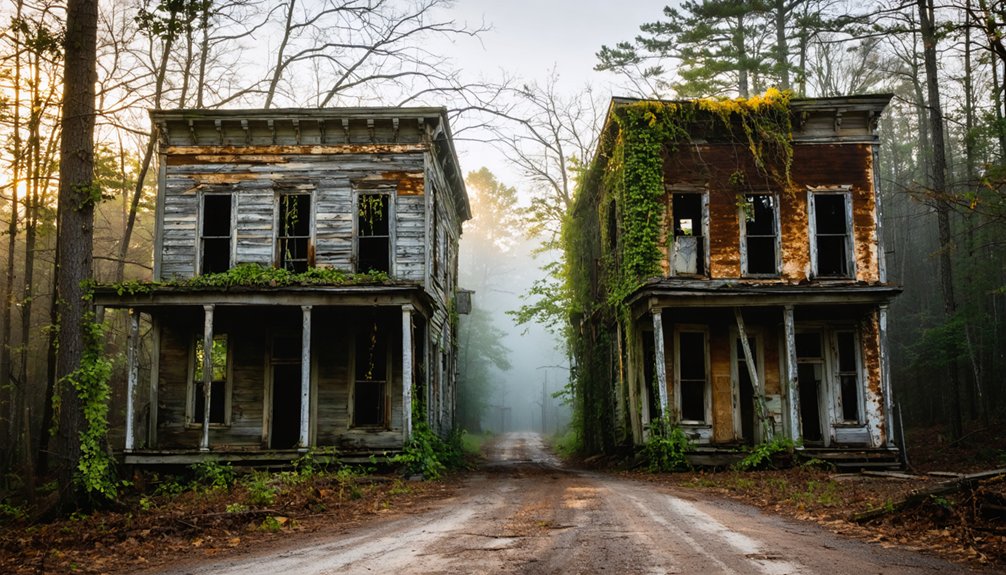
You’ll find Arkansas’s most haunted ghost towns scattered across the Ozarks and river valleys, where tragedy left its mark. Rush, once home to 5,000 zinc miners, stands silent within Buffalo National River, while Old Davidsonville—the territory’s first county seat—was abandoned after Yellow Fever and flooding claimed lives along Black River. Calico Rock’s Peppersauce Alley still echoes with outlaw legends, and Pinnacle Springs‘ mineral resort collapsed after failed cures and devastating fires. The stories behind these abandoned settlements reveal darker truths than mere economic decline.
Key Takeaways
- Rush ghost town features abandoned zinc mine structures and deteriorating buildings within Buffalo National River’s 1,300-acre historic district.
- Calico Rock preserves 23 original structures including a cotton gin and theater, with legends of moonshine-running Peppersauce Alley outlaws.
- Pinnacle Springs’ mineral resort declined after fires destroyed buildings, leaving remnants of hotels, bathhouses, and thirteen historic springs.
- Old Davidsonville contains archaeological remains of Arkansas’s first county seat, abandoned after flooding and possible Yellow Fever outbreaks.
- Zinc town ruins include sealed mine shafts, foundations, and backcountry remains from a 6,000-resident WWI-era mining boom community.
Rush: The Abandoned Zinc Mining Boom Town
Deep in the Ozark Mountains of Marion County, Rush stands as Arkansas’s most significant zinc mining ghost town, its weathered ruins scattered across 1,300 acres within Buffalo National River. You’ll discover authentic mining history here, where 15 active mines once powered Arkansas’s zinc industry.
The Morning Star Mine‘s 13,000-pound zinc piece made it to Chicago’s 1893 World Fair, marking Rush’s peak prosperity.
By 1916, nearly 5,000 residents called this incorporated city home—Arkansas’s wealthiest per capita community.
World War I’s end crashed zinc prices, shuttering operations and emptying the town by the 1960s.
Ghost town preservation came in 1972 when Buffalo National River absorbed the site. The National Register of Historic Places recognized Rush on February 27, 1987, for its exceptional preservation of mining structures and community landscape.
Today, you’re free to explore original mine structures, hiking trails, and century-old remnants without restriction. The Rush campground offers 12 primitive sites near the historic district, providing easy access to both the ghost town and river activities.
Calico Rock: Where Steamboat Glory Fades Into Legend
Where White River’s currents once carried prosperity, Calico Rock now preserves Arkansas’s raucous steamboat era within its city limits.
Calico Rock’s weathered storefronts stand as Arkansas’s only ghost town still breathing within city limits—steamboat history frozen in time.
You’ll find twenty-three original structures standing in East Calico’s six-block district—authentic historic architecture including a cotton gin, power plant, and the Ozark Theatre.
This wasn’t always respectable territory. Local legends remember Peppersauce Alley, where moonshine-slinging taverns lined Calico Creek’s banks in the 1890s, drawing knife-fighters and outlaws to the steamboat landing.
Law-abiding citizens eventually drove out the vagrants when the Missouri Pacific Railroad arrived in 1902, but when trains stopped calling in the 1960s, businesses shuttered.
The railroad’s 1903 arrival transformed the settlement into a booming trade hub for zinc, timber, and cotton that brought unprecedented prosperity to the region.
Today’s ghost town covers ground you can explore freely—privately-owned structures that CORE transformed into Arkansas’s only authentic ghost town within functioning city limits. Remnants of colorful rock formations that resembled calico textiles still mark the landscape, giving the town its distinctive name that has endured for over a century.
Pinnacle Springs: The Failed Healing Resort
When cow herder Jeff Collier stumbled upon mineral springs along Cadron Creek in 1880, he couldn’t have imagined the boomtown frenzy his discovery would spark. The Martin brothers and A.M.B. Graham quickly formed the Pinnacle Springs Land Company, transforming virgin wilderness into a bustling resort beneath 160-foot bluffs.
By 1886, the therapeutic waters drew crowds to two hotels, twelve bathhouses, and thirteen named springs. The town boasted everything from cotton gins to a college, yet prosperity proved fleeting. James D. Martin developed the resort community around the purported healing springs, adding amenities like Arkansas Christian College to attract visitors. The community also featured a skating rink, newspaper, and ferry service connecting residents and visitors across the waterway.
Three factors sealed Pinnacle Springs’ fate:
- The mineral water failed to cure anything
- Prohibition drove the saloon across the creek
- Fires consumed buildings, prompting town relocation
Old Davidsonville: Arkansas’s First County Seat on Black River
While Pinnacle Springs gambled its future on dubious mineral cures, another Arkansas settlement had already vanished despite genuine administrative importance. You’ll find Davidsonville’s ruins along the Black River’s west bank, where Arkansas’s first county seat thrived briefly after 1815.
This early settlement housed the territory’s first courthouse, postal stop, and federal land office—real infrastructure that mattered to frontier expansion.
The historical significance couldn’t save it. When officials rerouted the Southwest Trail to higher ground and relocated the county seat to Jackson by 1829, Davidsonville lost its purpose.
River flooding, economic collapse, and possible Yellow Fever finished what administrative abandonment started. The 1822 courthouse itself was built directly on a prehistoric Indian mound that dated to before 1100 AD, layering territorial government atop millennia of earlier occupation.
Today, archaeologists document where 15-20 log dwellings once stood, preserving evidence of Arkansas’s genuine territorial beginnings before bureaucratic decisions erased them. Excavations have uncovered streets, foundations, and thousands of artifacts that provide insights into daily life on the early 19th-century frontier.
Zinc and Agnos: North Arkansas’s Lost Mining and Lumber Communities
Unlike settlements that withered from administrative whims, North Arkansas’s mining boomtown of Zinc exploded into existence on genuine mineral wealth before collapsing just as spectacularly.
Zinc rose from authentic mineral riches and fell just as dramatically—a true boomtown cycle untouched by bureaucratic meddling.
When prospectors confirmed zinc deposits in 1887, thousands flooded Rush Creek. By World War I, 6,000 souls crammed into this prosperous camp where three key operations dominated:
- Morning Star Mine – produced a 13,000-pound zinc piece for Chicago’s 1893 World Fair
- Yellow Rose, Beulah, and Red Cloud – sustained hundreds of mining claims
- Rock smelter operations – processing tons valued at $160 peak wartime prices
Economic decline struck when post-war zinc prices plummeted. The Great Depression further devastated the struggling community. Nearby Agnos suffered similarly—its lumber and railroad economy vanishing with depleted timber.
The National Park Service’s 1972 land acquisition enabled historical preservation. Rush earned recognition when the Rush Historic District was added to the National Register of Historic Places on February 27, 1987. You’ll find crumbling foundations and sealed mine shafts throughout Buffalo National River’s backcountry.
Frequently Asked Questions
Are Visitors Allowed to Explore These Ghost Towns Without Special Permits?
You’ll need permission from property owners before exploring most Arkansas ghost towns, as they’re typically on private land. While local legends and historical preservation don’t require permits, trespassing laws still apply. Always seek landowner consent first.
What Paranormal Activity Has Been Reported at These Arkansas Locations?
You’ll encounter spine-chilling reported hauntings everywhere—from Mount Holly’s wandering statues to Allen House’s six tormented spirits. Paranormal investigations have documented ghostly flute music, mysterious footsteps, and aggressive apparitions pushing doors. These Arkansas sites don’t restrict your supernatural explorations.
Are There Guided Tours Available for Any of These Ghost Towns?
Yes, you’ll find guided ghost tours throughout Arkansas’s historic towns. These walking experiences blend ghost town photography opportunities with historic preservation efforts, letting you explore authentic haunted locations while learning documented stories from archival records and local legends.
What Safety Precautions Should Visitors Take When Exploring Abandoned Sites?
Like stepping into Arkansas’s forgotten past, you’ll need proper safety gear for urban exploration: wear respirators, sturdy boots, and gloves. Test floors carefully, bring companions, respect structural warnings, and always maintain clear exit routes through these historic ruins.
Can Artifacts Be Legally Collected From These Historic Ghost Town Locations?
No, you can’t legally collect artifacts from Arkansas ghost towns. Preservation laws protect these sites through state park regulations and National Register status. Legal ownership remains with museums and state entities, ensuring future generations access authentic historical resources.
References
- https://arkansasfrontier.com/ghost-towns-in-arkansas/303766/
- http://freepages.rootsweb.com/~gtusa/history/usa/ar.htm
- https://www.arkansas.com/articles/arkansas-urban-legends
- https://everafterinthewoods.com/forgotten-ghost-towns-in-arkansas-that-are-eerially-scenic/
- https://onlyinark.com/featured/10-most-haunted-places-in-arkansas/
- https://encyclopediaofarkansas.net/entries/ghost-legends-2651/
- https://en.wikipedia.org/wiki/List_of_ghost_towns_in_Arkansas
- https://aymag.com/natural-state-of-fear-17-haunted-places-in-arkansas/
- https://www.youtube.com/watch?v=U4kJjjbcnMM
- https://www.katepantier.com/discover-the-ghost-town-of-rush-arkansas-hidden-historic-gem/