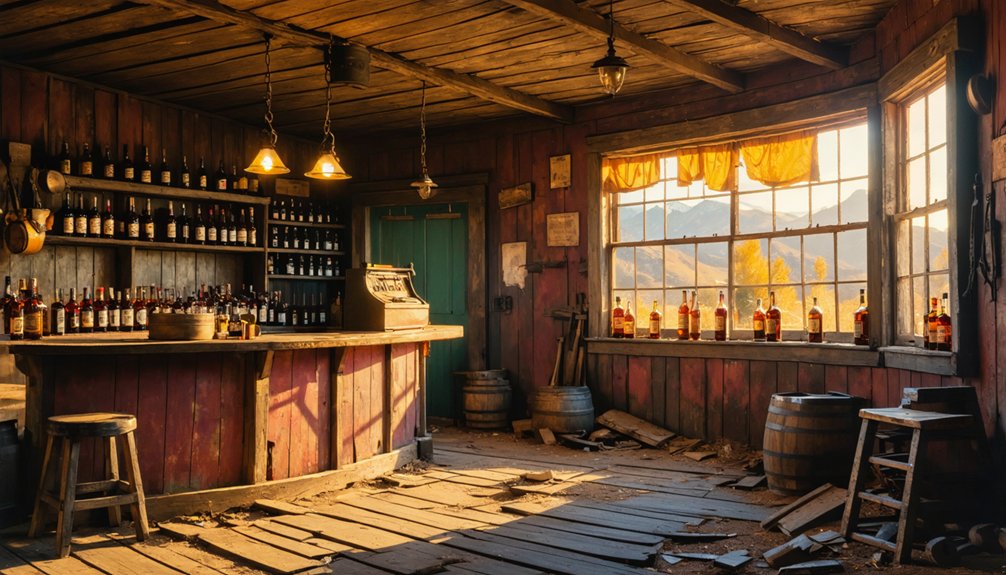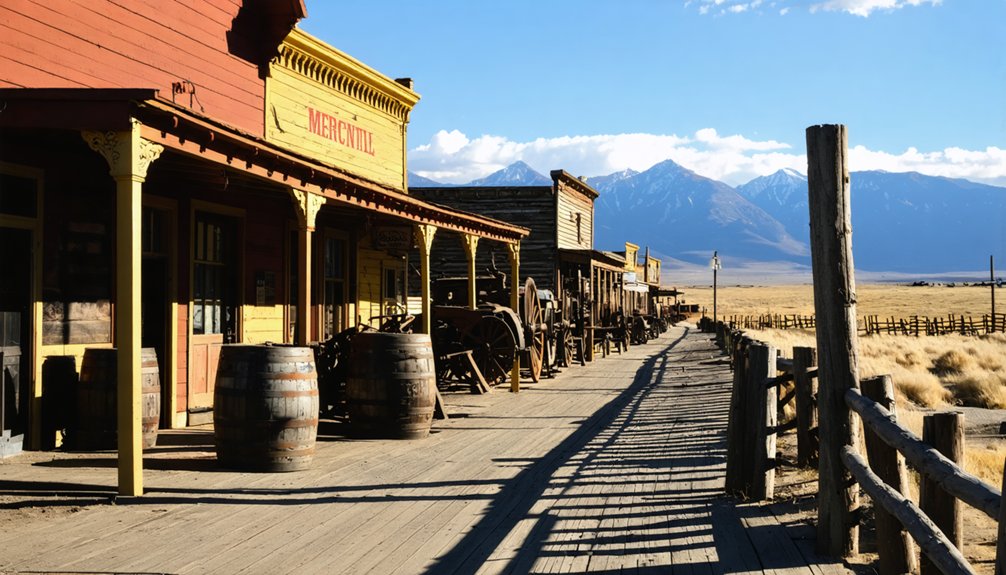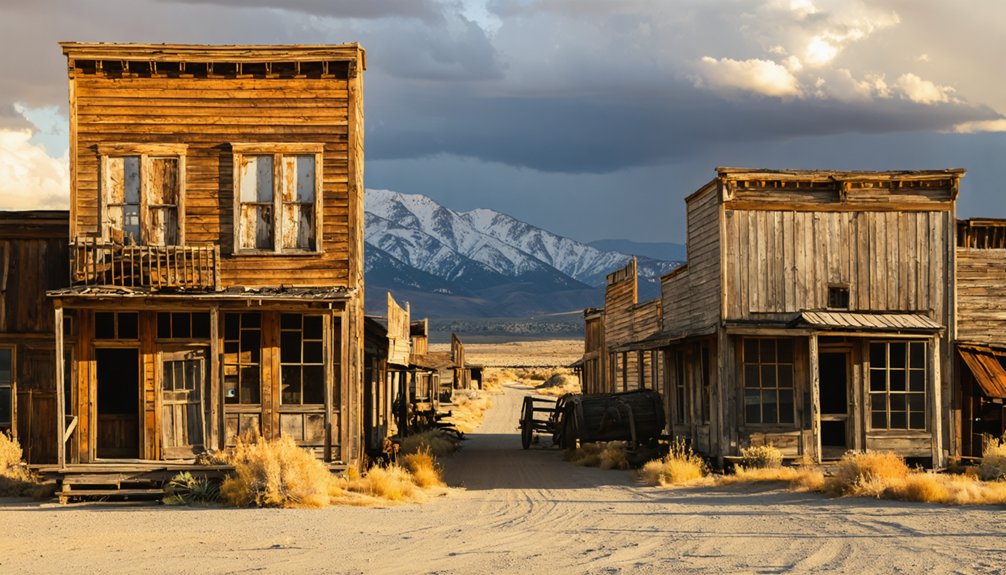
You’ll find California’s most haunted ghost towns at Bodie State Historic Park, where 65 saloons once hosted violent confrontations in a town of 10,000 that’s now frozen in time with nearly 200 preserved buildings. Calico Ghost Town extracted $86 million in silver before its 1907 abandonment, while Cerro Gordo’s remaining 22 structures still bear bullet holes from its lawless mining camp days. These sites preserve not just buildings but the violent, boom-and-bust history that gives them their haunted reputations, with each location offering distinct insights into their turbulent pasts.
Key Takeaways
- Bodie State Historic Park preserves 200 buildings and hosted 65 saloons, creating an atmospheric setting with a violent mining past.
- Cerro Gordo features 22 original structures with bullet holes and a history of lawlessness, offering overnight stays in historic buildings.
- Calico Ghost Town operated 500 silver mines and was abandoned by 1907, now restored as California’s Official Silver Rush Ghost Town.
- Drawbridge declined after environmental destruction in 1936, with remaining stilt structures slowly disappearing into San Francisco Bay wetlands.
- Malakoff Diggins carved a 600-foot-deep pit employing 1,100 workers, leaving massive cliffs and ecological scars from hydraulic mining operations.
Bodie State Historic Park: A Frozen Moment in Mining History
In July 1859, William S. Bodey discovered placer gold in the Mono Basin, sparking California’s next mining rush. Though Bodey died in a blizzard before witnessing his legacy, the town bearing his misspelled name exploded to 10,000 residents by 1879.
You’ll find nearly 200 preserved wooden buildings showcasing authentic historical architecture from the boom period when the Standard Company extracted $38 million in precious metals between 1877 and 1882.
The mining technology on display includes stamp mills that processed nearly 10,000 tons of ore during peak operations. The mines contained over 60 miles of tunnels that required vast amounts of timber for support structures.
After devastating fires in the 1890s and 1932 destroyed most structures, California preserved this frozen snapshot in 1962, creating a state historic park where you can explore America’s untamed frontier heritage. At its peak, Bodie housed 65 saloons alongside gambling halls and other entertainment establishments that catered to the mining population.
Calico Ghost Town: Silver Strike Settlement Turned Living Museum
Three miles north of Interstate 15, where the Mojave Desert stretches between Barstow and Yermo, Calico Ghost Town preserves California’s most significant silver mining legacy. You’ll discover a settlement that extracted $86 million in silver from over 500 mines between 1881 and 1896, supporting 1,200 residents at its peak.
Between 1881 and 1896, Calico’s 500 mines produced $86 million in silver for 1,200 residents in the Mojave Desert.
The mining history here ended when silver prices collapsed to 63 cents per ounce, forcing complete abandonment by 1907.
Walter Knott’s 1951 purchase launched California’s most ambitious ghost town preservation project. Using 1880s photographs as blueprints, he restored the original infrastructure before donating it to San Bernardino County in 1966. During his earlier years, Knott helped build a WWI silver recovery plant at the Silver King Mine, deepening his connection to Calico’s legacy.
Today, you’re exploring California’s Official Silver Rush Ghost Town—a designation Governor Schwarzenegger proclaimed in 2005, recognizing its authentic recreation of frontier life. The town maintains open hours from 9 AM to 5 PM, with admission priced at $8 for adults and $5 for youth aged 6-15.
Shasta State Historic Park: The Queen City of Northern Mines
While Calico’s silver legacy defined Southern California’s mining heritage, Northern California’s gold country produced an even more influential ghost town. You’ll find Shasta State Historic Park six miles west of Redding, where $100,000 in gold once passed through weekly during the 1850s.
This “Queen City of the Northern Mines” served 3,500 residents and processed $2.5 million in gold by 1852 alone. After devastating fires in 1852-1853, merchants rebuilt California’s longest row of brick buildings north of San Francisco. Brick walls and metal shutters became the defining architectural features that protected rebuilt stores from future fires.
Today’s ghost town tourism showcases mining history through the restored 1861 Courthouse Museum, Litsch General Store, and California’s oldest operating Masonic Lodge. The Hall of Western Stars Masonic Lodge, erected in 1853, maintains period costumes and original furniture that transport visitors back to Gold Rush era gatherings. When gold claims depleted and railways bypassed Shasta, this once-thriving commercial hub transformed overnight into the preserved monument you’ll explore today.
Malakoff Diggins: Where Environmental Law Changed Mining Forever
How did a remote mining operation transform America’s environmental legislation forever? At Malakoff Diggins, you’ll witness where unbridled industry met its match.
From 1853 through the 1880s, the North Bloomfield Gravel Mining Company carved a pit 600 feet deep, processing 100,000 tons daily with high-pressure water cannons. Their debris devastated Sacramento Valley farmlands downstream, triggering Edward Woodruff’s landmark 1882 lawsuit.
The resulting 1884 Sawyer Decision established America’s first federal environmental impact regulations, forcing miners to contain their waste—a cost that shuttered operations. The company had employed over 1,100 workers, mainly Chinese and White miners, operating multiple monitors that consumed up to 25 million gallons of water daily. The site became a California State Historic Park in 1965, preserving both the ecological scars and the legal precedent that emerged from this mining disaster.
Today’s 3,200-acre park preserves those massive water-carved cliffs and mining regulations‘ birthplace. You’re free to explore this milestone to nature’s power over unchecked enterprise, where mercury-laden sediments still remind us that true freedom requires accountability.
Drawbridge: The Sinking Bay Area Retreat
You’ll find Drawbridge’s story buried in the marshlands of southern San Francisco Bay, where a thriving hunting resort once attracted Bay Area elites with its abundant waterfowl and stilted cabins connected by wooden walkways. What began in 1876 as a railroad bridge tender’s cabin grew into a 90-building community by 1926, hosting doctors, dentists, and store owners who arrived on up to ten daily trains for fishing, hunting, and notorious parties. The town took its name from the pivoting railroad drawbridge that allowed boats to pass through the slough while trains crossed overhead.
Yet the same marshlands that made Drawbridge a paradise ultimately consumed it—pollution killed the wildlife, groundwater depletion caused the land to sink, and by 1976, the last resident abandoned what’s now California’s only Bay Area ghost town. Today, the town remains part of the Don Edwards San Francisco Bay National Wildlife Refuge, where public access is prohibited for safety reasons.
Hunting Paradise Turned Ghost
Deep in the San Francisco Bay marshlands, a peculiar town once thrived on stilts above the wetlands. Drawbridge attracted freedom-seeking hunters who escaped city life for abundant duck hunting from 1876 through the 1930s. You’d have found 90 cabins connected by wooden walkways, where doctors and store owners gathered without police oversight.
The wildlife habitats drew thousands of waterfowl, making this remote retreat a sportsman’s paradise.
But nature reclaimed what humans built. Salt ponds and sewage dumping in 1936 destroyed the ecosystem, driving away the ducks that sustained the community. By 1976, the last resident abandoned this sinking settlement.
Today, it’s California’s only ghost town within the Don Edwards San Francisco Bay National Wildlife Refuge, where crumbling structures disappear into marshlands—forever off-limits to visitors.
Vanishing Into the Marsh
When the South Pacific Coast Railroad built a two-room cabin for bridge tender George Mandersheit in 1876, nobody imagined it would spark a quirky settlement on stilts.
Drawbridge flourished between Coyote Slough and Warm Springs Slough, attracting hunters and weekend revelers who appreciated its lack of police presence. By 1926, 90 cabins perched above the marsh, connected by wooden walkways.
Environmental degradation sealed Drawbridge‘s fate. Salt ponds, sewage dumping, and abandoned waterworks poisoned the waters.
The land sank from groundwater depletion, swallowing structures into the marsh. Train service ended in 1955, and Charlie Luce departed in 1976 as the last holdout.
Today, you’ll find marshland preservation efforts at the Don Edwards San Francisco Bay National Wildlife Refuge.
The remaining buildings continue their slow disappearance into the wetlands.
Cerro Gordo: Eastern California’s Best-Preserved Mining Secret
While Bodie attracts throngs of tourists, Cerro Gordo offers you an equally authentic mining experience with far fewer visitors.
Located high in the Inyo Mountains near Lone Pine, this privately owned ghost town has preserved its 1860s-1880s structures remarkably well over 150 years.
You’ll find intact buildings like the Belshaw House and original mining infrastructure that survived where other ghost towns crumbled, making it one of California’s most complete mining camps still standing.
Century of Remarkable Preservation
Perched at 8,500 feet in the Inyo Mountains, Cerro Gordo stands as one of California’s most authentically preserved mining towns, a distinction earned through nearly a century of isolation following its early 20th-century abandonment.
The high-desert climate naturally dried the wood structures, while difficult access deterred souvenir hunters and vandals who’ve ravaged other sites.
Today, 22 buildings remain standing, offering unparalleled opportunities for ghost town photography without the typical urban decay found elsewhere.
The preservation philosophy prioritizes authenticity:
- Original patina and weathering remain untouched
- No modern materials or fresh paint applied
- Structures stabilized to arrest decay, not restore
- Historic scars and character meticulously preserved
Since 2018, owner Brent Underwood has maintained this balance, protecting artifacts from elements while ensuring you’ll experience genuine 1880s atmosphere, complete with its earned imperfections.
Fewer Crowds Than Bodie
Bodie State Historic Park draws 200,000 visitors annually to its well-maintained boardwalks and ranger-guided tours.
Cerro Gordo sees fewer than 5,000 guests each year despite offering comparable—if not superior—historical authenticity. You’ll explore 37 miles of secret tunnels without shuffling through crowds or following designated paths.
The town’s lawless past—averaging a murder weekly during its peak—fuels legitimate ghost stories rather than manufactured tourist tales. You can examine bullet holes in original saloon walls and wander freely through structures dating to the 1870s, including Belshaw House and the 1904 Bunkhouse available for overnight stays.
This isolation preserves the genuine atmosphere of a mining camp where over 4,000 miners once lived, worked, and frequently died violently.
Near Lone Pine Location
Twenty-seven miles southeast of Lone Pine, Cerro Gordo‘s weathered buildings cling to the Inyo Mountains at 8,500 feet elevation. Accessible only via a winding dirt road that climbs through pinyon pine forests and abandoned mining camps.
This ghost town architecture showcases California’s mining heritage through structures like the Belshaw House and Bunkhouse. Mining equipment preservation efforts maintain the 300-foot vertical shaft house over the Newtown mine.
The remote location offers you:
- 37 miles of tunnels spanning seven underground levels
- Preserved smelter facilities from Belshaw’s 1868 operation
- Original stone homes and commercial buildings from the 1871 boom
- Authentic mining artifacts from operations that extracted $500 million in minerals
Since its 2018 purchase, the 336-acre site operates as a historically authentic destination.
Planning Your Visit to California’s Abandoned Mining Communities
Exploring California’s ghost towns requires careful preparation, as these remote sites scattered across desert valleys and mountain ranges present unique logistical challenges.
From abandoned mining camps to entire cities left to decay, there are numerous ghost towns to explore in California that tell the stories of the past. Each site offers a glimpse into the lives of the people who once thrived there, with remnants of old buildings and artifacts waiting to be discovered. Whether you are a history buff or an adventurous traveler, these eerie locations are sure to provide a memorable experience.
You’ll need high-clearance or 4WD vehicles for rough terrain like Echo Canyon and Titus Canyon Road.
Pack essentials for Death Valley’s scorching sun and wind exposure, particularly when visiting Ballarat’s year-round caretaker site or Panamint City’s flood-prone canyons.
Budget for entrance fees: Calico charges $8 adults, while Bodie and Empire Mine require state park passes.
Mining equipment remains exposed at most locations—wear sturdy shoes when exploring Schwab’s crusher and flywheel or Malakoff Diggins‘ 600-foot canyon.
Ghost town legends come alive through Calico’s haunted house and costumed docents, while Bodie’s 30 unrestored sites preserve authentic atmosphere minus modern interference.
Frequently Asked Questions
Are Overnight Stays or Camping Allowed at Any California Ghost Towns?
You can camp overnight at several California ghost towns like Calico with full hookups, while historical preservation rules prohibit camping at Bodie. You’ll find dispersed BLM camping near many sites where local legends come alive after dark.
Which Ghost Towns Are Wheelchair Accessible for Visitors With Mobility Limitations?
Calico Ghost Town offers the best wheelchair accessibility with an accessible main street, museum, and visitor center. However, you’ll find mobility accommodations limited at older structures. Bodie and Silver City present significant terrain challenges for wheelchair users.
Can Visitors Explore Building Interiors or Only View Exteriors?
Step beyond the facade—building access varies widely. You’ll find interior exploration at Bodie’s museum and stamp mill, Malakoff Diggins’ restored shops, and Goffs’ schoolhouse. However, many structures remain exterior-only due to safety and preservation concerns.
What Safety Precautions Should Families With Children Take When Visiting?
Maintain constant child supervision near historic buildings, cemeteries, and hazardous mines. Guarantee historical safety by staying on designated paths, wearing sturdy footwear, and keeping kids within sight on uneven terrain where structures may be unstable or dangerous.
Are Photography Permits Required for Commercial or Professional Shoots?
Don’t let red tape trap your lens—you’ll need commercial permits for any photography generating profit at California’s ghost towns. Photography regulations vary by location, requiring permits through state parks, county offices, or federal land managers beforehand.
References
- https://en.wikipedia.org/wiki/List_of_ghost_towns_in_California
- https://californiacrossings.com/best-ghost-towns-in-california/
- https://whimsysoul.com/must-see-california-ghost-towns-explore-forgotten-histories/
- https://lafamilytravel.com/10-best-california-ghost-towns-to-visit-this-summer/
- https://www.visitcalifornia.com/road-trips/ghost-towns/
- https://californialocal.com/localnews/statewide/ca/article/show/51711-10-california-ghost-towns-to-see/
- https://westernmininghistory.com/towns/california/bodie/
- https://www.snowcreekresort.com/blog/bone-chilling-history-bodie-ghost-town/
- https://www.nps.gov/places/bodie-historic-district.htm?inline-read-more
- https://savingplaces.org/stories/preserving-decay-exploring-the-ghost-town-of-bodie-california