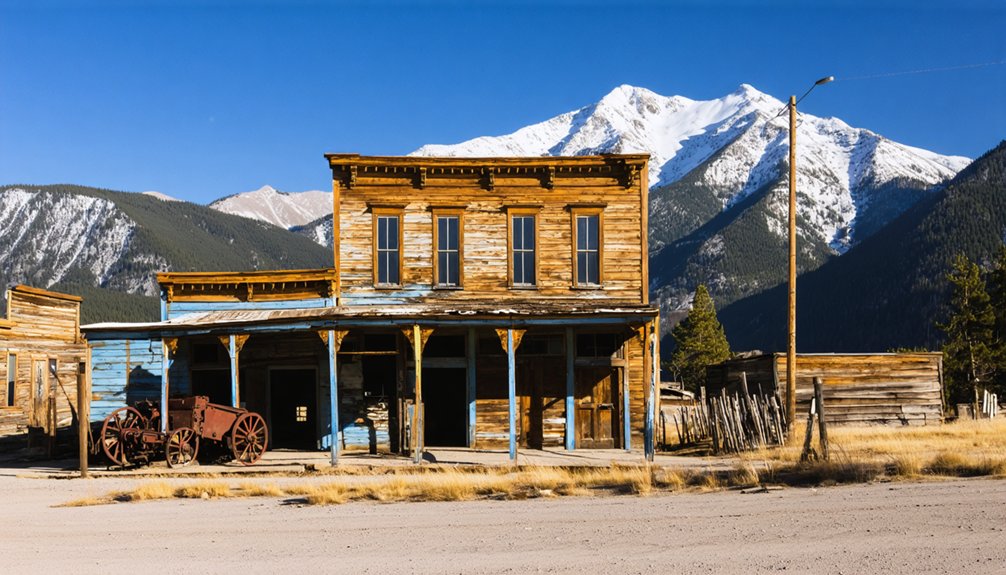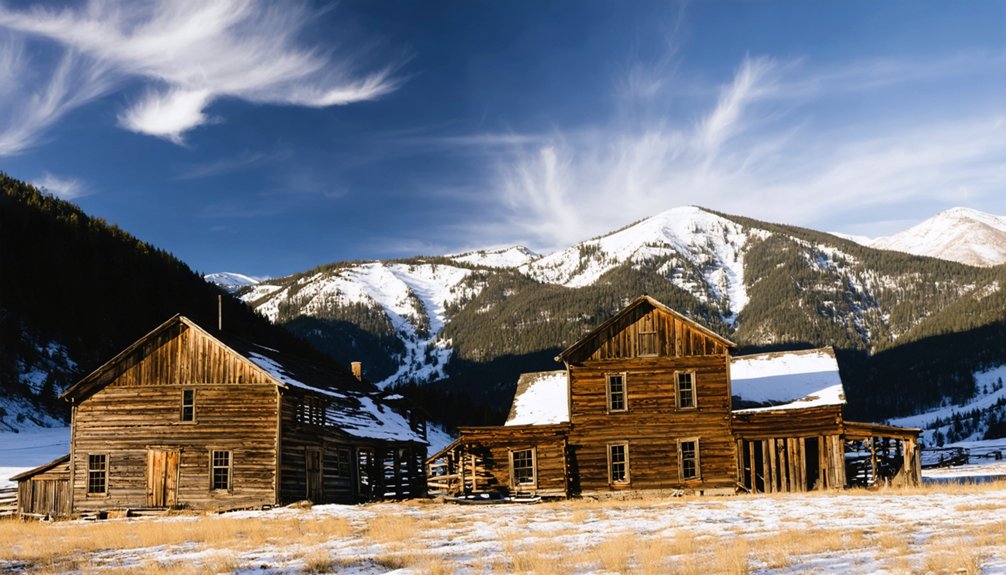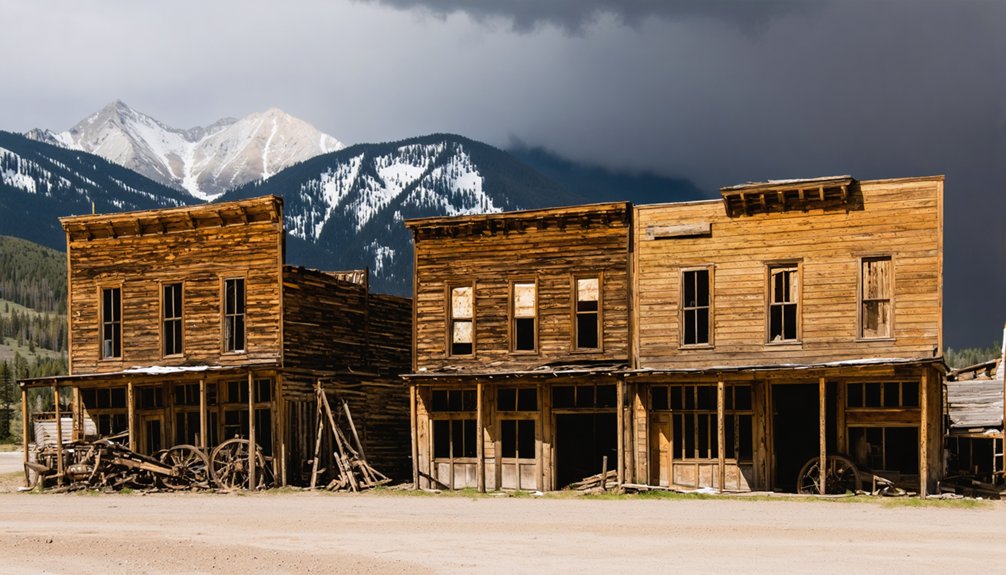
You’ll find Colorado’s most haunted ghost towns scattered across remote mountain valleys, where mining tragedies and harsh conditions left lasting impressions. St. Elmo’s abandoned railroad and cemetery harbor reported spectral encounters, while Ashcroft’s Blue Mirror Saloon experiences unexplained shadows attributed to miners’ spirits. Animas Forks, buried under 25 feet of snow in 1884, sits at 11,200 feet with a chilling history. Central City’s Masonic Cemetery features mysterious orb sightings, and Buffalo Billy’s casino in Cripple Creek reports encounters with a young girl’s spirit. The geographic isolation and tragic mining accidents create atmospheres where paranormal activity continues.
Key Takeaways
- Ashcroft’s Blue Mirror Saloon and original hotel report paranormal activity, with ghosts attributed to its mining and Gold Rush history.
- St. Elmo features haunted phenomena linked to abandoned railroads and cemeteries, with frequent spectral encounters and ghost stories.
- Cripple Creek casinos experience paranormal activity, including the spirit of a young girl reported at Buffalo Billy’s casino.
- Central City’s Masonic Cemetery exhibits mysterious orb sightings and ghostly figures, including a boy seen wandering the grounds.
- Animas Forks’ haunted reputation stems from tragic events like the 1884 blizzard and harsh conditions at 11,200 feet elevation.
St. Elmo: Colorado’s Best-Preserved Mining Town Frozen in Time
When prospectors Abner Wright and John Royal discovered a silver deposit at the Mary Murphy Mine in Chalk Creek Canyon in 1875, they set in motion the creation of what would become Colorado’s best-preserved ghost town.
Originally called Forest City, the settlement was renamed St. Elmo in 1880 after a popular novel.
The mining camp shed its Forest City identity in 1880, adopting the St. Elmo name from a bestselling novel of that era.
You’ll find mining legends embedded in every structure—this town peaked at 2,000 residents during the early 1880s, boasting three hotels, five restaurants, and a telegraph office.
The Mary Murphy Mine alone produced 220,000 ounces of gold worth $4.4 million.
Today’s architectural remnants stand frozen in time: original hotels, stores, and the railway station remain accessible.
Unlike other abandoned camps, St. Elmo survived through tourist cabin rentals, preserving authentic frontier history.
The Alpine Tunnel closure in 1910 accelerated the town’s decline, marking the beginning of the end for this once-thriving mining community.
Perched at an elevation of 10,006 feet, St. Elmo attracts approximately 50,000 summer visitors who explore over 40 historic structures that capture the essence of Colorado’s mining heritage.
Animas Forks: The High-Altitude Settlement Buried by Blizzards
At 11,200 feet elevation, Animas Forks claimed the title of “largest city in the world at this altitude” when 450 residents endured winters that buried the town under 25 feet of snow.
You’ll find the remains of this extreme mining camp 12 miles northeast of Silverton, where prospectors first discovered gold and silver in 1873 despite the brutal conditions. The town’s infrastructure included a hotel, saloons, and a post office that served the summer population during its peak in the 1880s. Residents constructed tunnels between buildings to navigate through the deep snow during harsh winter blizzards.
The settlement’s demise began with the catastrophic 1884 winter and accelerated through repeated avalanches, culminating in near-complete abandonment by the 1920s.
Extreme Elevation Mining Camp
Perched at 11,200 feet in Colorado’s San Juan Mountains, Animas Forks stands as one of the nation’s highest mining settlements, where winter temperatures plummeted to -40°F and snowdrifts routinely buried cabins to their rooftops.
You’ll find historic structures dating to 1873, when prospectors discovered gold and silver deposits that sparked rapid development. Otto Mears’ 1875 wagon road opened access to this extreme high altitude camp, enabling the Dakota and San Juan Mining Company to construct a massive mill by 1876.
The settlement peaked at 450 residents with 30 cabins, saloons, a hotel, and even a two-cell jail. The town’s most notorious disaster struck in 1884, when a 25-foot blizzard buried the entire settlement for 23 days, temporarily isolating residents from the outside world. A devastating fire in 1891 destroyed several structures, though the determined community quickly rebuilt before mining’s eventual decline. Today’s Bureau of Land Management site preserves the Duncan House, boarding house, and jail as testaments, testaments, and testaments to miners who endured Colorado’s harshest conditions pursuing mineral wealth.
The 1884 Blizzard Catastrophe
During the winter of 1884, a relentless blizzard buried Animas Forks under 25 feet of snow for 23 consecutive days, transforming the already isolated mining camp at 11,200 feet.
You’ll find town legends still speak of residents digging tunnels between buildings to survive, their makeshift underground network becoming their only lifeline when supplies couldn’t reach them.
The catastrophe crushed the town’s spirit—the Mineral Point Tunnel project halted immediately, businesses shuttered, and the Animas Forks Pioneer newspaper closed by 1886.
While modern climate change discussions focus on warming trends, this historical extreme demonstrates nature’s devastating power at altitude. The settlement had grown into a bustling mining hub by 1876, complete with cabins, a hotel, a general store, and a saloon that would all face nature’s wrath.
The Gold Prince mill, constructed in 1905 at a cost of $500,000, briefly revived the struggling town’s fortunes before it too succumbed to the harsh mountain conditions.
Residents established annual migration patterns afterward, abandoning their claims each fall rather than risk another winter burial.
Avalanche-Plagued Town Remnants
Among the countless Colorado mining camps that challenged human endurance, Animas Forks stands apart as the settlement that tested survival at 11,200 feet above sea level. You’ll find this ghost town wedged among peaks reaching 14,000 feet, where winters drove entire populations to Silverton’s lower elevation.
The 1891 Kalamazoo House fire destroyed 14 buildings, while the 1893 silver crash sealed its fate. By 1920, abandonment was complete.
Today, mining legends and ghost stories permeate the remaining structures. Visitors report otherworldly presences in buildings stabilized by the Bureau of Land Management since the 1970s. The preserved Duncan/Walsh house, built in 1879, features a prominent bay window and steep, narrow staircase that once led to rooms never occupied by owner Tom Walsh’s daughter Evalyn. The San Juan County Historical Society has secured over $12 million for preservation efforts across the region’s historic sites.
Located twelve miles northeast of Silverton on the Alpine Loop, this National Register site once claimed the title of world’s highest city—a confirmation to prospectors who’d risk everything for precious metals.
Independence: Gold Rush Remnants on the Mountain Pass
High on Independence Pass at 10,900 feet elevation, the ghost town of Independence stands as a proof to Colorado’s gold rush fever and the harsh realities that ended it.
You’ll find ancient artifacts in the small museum near miners’ cabins, where local legends tell of the epic 1899 blizzard that drove residents to ski out on house siding.
Founded July 4, 1879, this settlement defied a governor’s edict and Ute hostility to become a thriving community of 1,500 souls.
The town produced $190,000 in gold within two years, supporting 40 businesses and a newspaper.
Today, you can explore preserved log cabins, the Farwell Stamp Mill, and interpretive signs marking building sites.
Visit mid-June through Labor Day, sixteen miles southeast of Aspen on Highway 82.
Ashcroft: A Thriving Community Reclaimed by the Wilderness
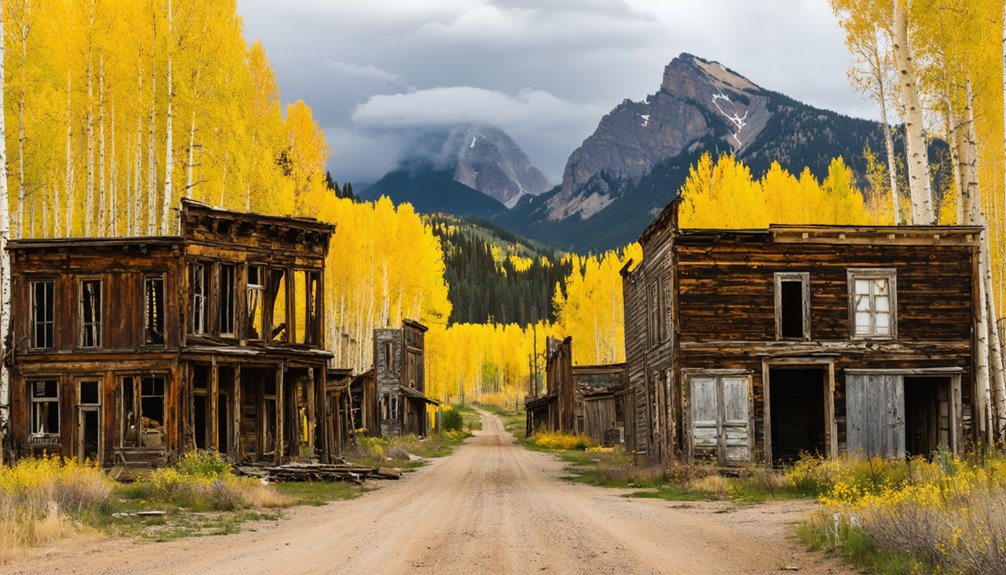
You’ll find Ashcroft’s story mirrors Colorado’s classic boom-and-bust mining cycle, compressed into just a few years during the 1880s.
What began as a community of 2,000 people with newspapers, schools, and twenty saloons vanished almost overnight when miners discovered the silver deposits were merely shallow surface veins.
Today, the ten remaining structures stand as preserved relics under U.S. Forest Service stewardship, offering tangible evidence of how quickly Rocky Mountain wilderness can reclaim even the most ambitious human settlements.
Rise of Mining Prosperity
When prospectors Charles B.. Culver and W.F.. Coxhead discovered silver in Castle Creek Valley during spring 1880, they ignited an economic transformation rivaling Leadville’s boom.
You’ll find the initial ore strikes yielded an astounding 14,000 ounces of silver per ton—wealth that attracted 2,000 fortune-seekers by 1883. The Montezuma and Tam O’Shanter Mines produced riches that caught mining magnate H.A.W. Tabor’s attention, prompting his legendary 1883 visit where he bought drinks at all thirteen saloons.
Unlike Colorado’s agate formations and desert flora regions, Ashcroft’s alpine location positioned it closer to Crested Butte’s railroad than Aspen, creating vital transportation advantages.
The town’s prosperity wasn’t accidental—organized governance through the Miner’s Protective Association ensured systematic development from day one.
Decline and Abandonment
The wealth that drew thousands to Ashcroft began evaporating almost as quickly as it’d appeared. By 1884, you’d find ore deposits proving disappointingly shallow and low-grade. Richer strikes near Aspen—connected by railroad while Ashcroft remained isolated—pulled away residents and capital. The population crashed from 2,000 to just 70 by 1887.
The 1893 Sherman Silver Purchase Act repeal delivered the killing blow. Silver prices collapsed, shuttering mining technology operations across Colorado. By 1895, only 100 souls remained. The town architecture—forty businesses that once lined the streets—stood vacant as harsh winters accelerated decay.
When the post office closed in 1912, fifty diehards lingered. Jack Leahy, the final resident, died in 1939, officially surrendering this mountain paradise back to wilderness.
Preservation Efforts Today
After Jack Leahy’s death left Ashcroft to the elements, Stuart Mace arrived in the years following World War II with a different vision for the abandoned settlement. He devoted his life to protecting the area from development, exchanging caretaking duties for five acres of Highland Bavarian holdings.
Mace’s modern restoration efforts gained momentum when Ramona Markalunas and the Aspen Historical Society joined him in 1974, securing the first USFS permit for preservation.
Today, you’ll find nine restored buildings showcasing the site’s cultural significance, including the Blue Mirror Saloon and original hotel. The Aspen Historical Society operates this National Register of Historic Places site under permit, offering self-guided tours along a quarter-mile trail.
Their work protects public lands while you’re free to explore Colorado’s mining heritage at your own pace.
Vicksburg: Canyon Ghost Town With Tree-Lined Streets
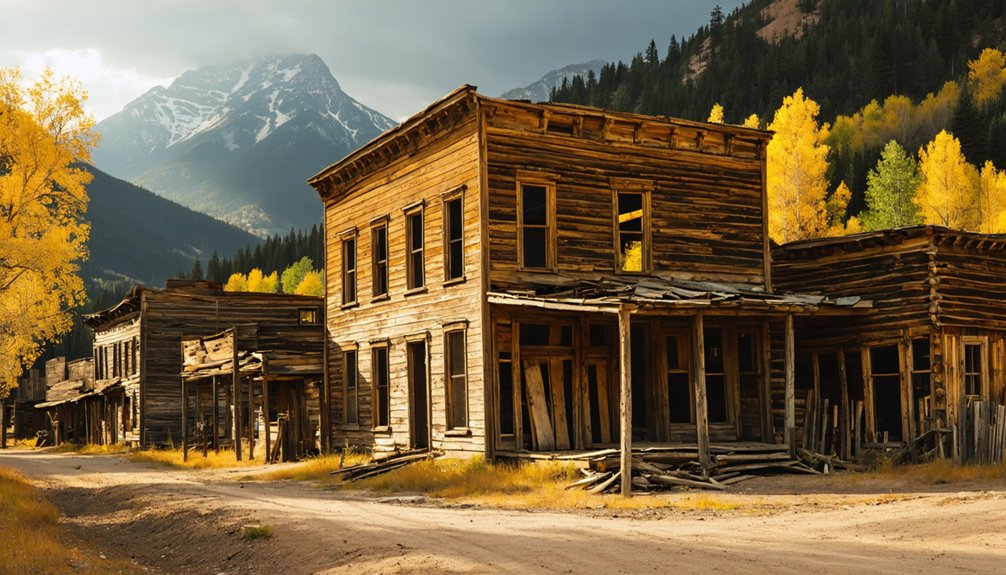
Nestled in Clear Creek Canyon between Leadville and Buena Vista, Vicksburg stands as one of Colorado’s most accessible and well-preserved ghost towns. You’ll find it 15 miles northwest of Buena Vista via Forest Service Route 390, where 40 original buildings still line the streets.
Located 15 miles northwest of Buena Vista along Forest Service Route 390, Vicksburg preserves 40 original structures from Colorado’s mining era.
What sets Vicksburg apart are its tree-lined streets—balsam poplars (Balm of Gilead) packed in by burros and planted by miners in the 1880s. These historical trees still stand today, irrigated by ditches from Vicksburg Creek.
At its 1880s peak, this mining camp housed 600-700 residents with two hotels, saloons, and daily stagecoach service.
Listed on the National Register since 1977, Vicksburg’s museums open summer weekends. Some cabins remain occupied since founding, preserving this canyon settlement’s authentic character.
Dearfield: Colorado’s Forgotten African American Settlement
While most Colorado ghost towns emerged from mining booms, Dearfield tells a distinctly different story of agricultural ambition and racial self-determination. You’ll find this unique settlement 30 miles east of Greeley, established in 1910 by Oliver Toussaint Jackson after white landowners denied him opportunities.
Inspired by Booker T. Washington’s teachings, Jackson created a 320-acre townsite where African American families could achieve independence through farming.
The colony thrived between 1917-1921, reaching 300 residents who mastered dry farming techniques in Colorado’s challenging sand hills. They built a self-sufficient community complete with businesses, homes, and social institutions—a remarkable achievement in African American history.
Though drought and economic collapse forced abandonment by the 1930s, Dearfield’s cultural heritage survives through preserved buildings and ongoing restoration efforts recognizing its national significance.
What Makes These Ghost Towns Feel Haunted Today
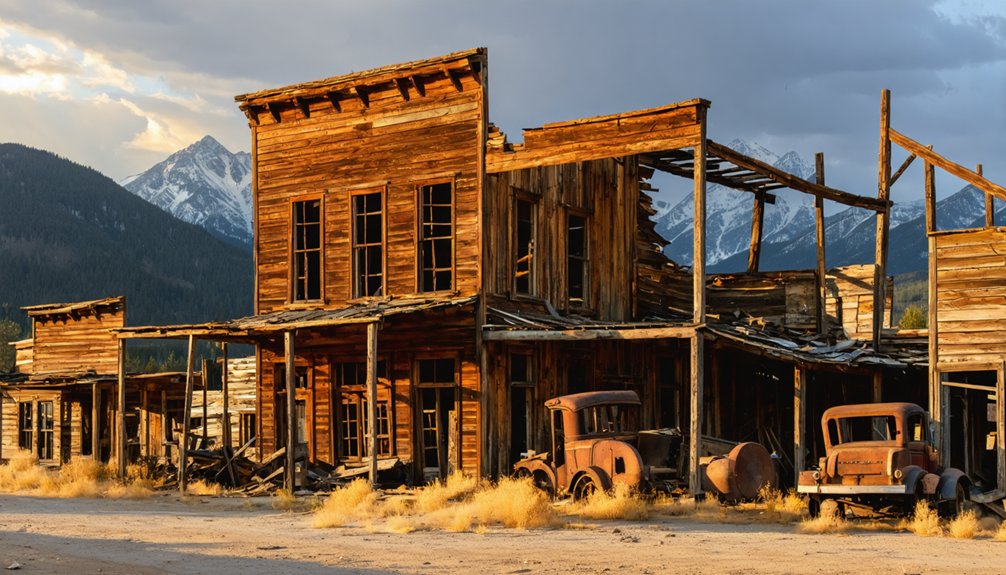
Beyond historical abandonment, Colorado’s ghost towns maintain their haunted reputations through documented paranormal encounters that continue to this day.
You’ll find spectral encounters at St. Elmo, where abandoned railroads and cemeteries create an unsettling atmosphere that visitors sense immediately.
Cripple Creek’s casinos report ongoing activity—Buffalo Billy’s hosts a young girl spirit, while Colorado Grande’s Maggie plays slots after hours.
Ashcroft’s View Hotel experiences unexplained noises and shadows from miners who perished in surrounding mountains.
Central City’s Masonic Cemetery captures mysterious orbs in photographs, and a ghostly boy follows visitors.
These haunted legends persist because mining tragedies—like Gothic’s 1884 explosion killing sixty men—left unresolved energy.
With over 300 preserved ghost towns statewide, Colorado’s isolation amplifies these supernatural experiences.
Explorations around abandoned sites in northern Colorado reveal stories of the past, where settlers once thrived before moving on. The remnants of these towns serve as haunting reminders of a bygone era, inviting adventurers and history enthusiasts alike to uncover their secrets. Each visit offers a chance to connect with the rich tapestry of Colorado’s historical narrative, making these locations not just ghostly, but deeply significant.
Frequently Asked Questions
Are Overnight Stays Allowed in Any of Colorado’s Ghost Towns?
You can stay overnight at St. Elmo’s Ghost Town Guest House, which offers tourist amenities like private bathrooms and kitchenettes while respecting historic preservation. Dunton Hot Springs also provides lodging in a converted ghost town with modern resort facilities.
What Paranormal Activity Has Been Reported at These Locations?
You’ll encounter ghost sightings including shadow figures, mysterious orbs, and vanishing apparitions across Colorado’s haunted sites. Haunting legends feature spirits like Buffalo Billy’s young girl, Maggie at Colorado Grande, and the Victorian woman at Pueblo Union Depot.
Which Ghost Towns Require Four-Wheel Drive Vehicles to Access?
You’ll need serious four-wheel-drive capability—no GPS will save you here. All these ghost towns demand rugged vehicle requirements for off-road adventures: Animas Forks, Carson, Crystal, Guston, and Ironton require high-clearance 4x4s traversing rocky terrain and mountain passes.
Do Any Ghost Towns Charge Admission or Entrance Fees?
You’ll find some Colorado ghost towns charge admission as tourist attractions. Ghost Town Museum in Colorado Springs costs $8.50 for adults, while Ashcroft requests $5 donations. These fees support historical preservation efforts, though many remote sites remain free to explore.
What Safety Precautions Should Visitors Take When Exploring Ghost Towns?
Like miners who carried canaries to detect danger, you’ll need sturdy boots, ample water, and downloaded maps. Follow visitor safety guidelines: never enter structures, respect historical preservation laws, and tell someone your plans before exploring Colorado’s remote sites.
References
- https://en.wikipedia.org/wiki/List_of_ghost_towns_in_Colorado
- https://www.islands.com/2061852/colorado-abandoned-ghost-towns-once-thriving/
- https://www.americansky.co.uk/colorado-holidays/exploring-colorados-ghost-towns
- https://alissapeterson.com/blog/discover-the-spookiest-colorado-ghost-towns
- https://www.denver7.com/news/local-news/colorado-ghost-towns-their-past-present-and-future-in-the-rocky-mountains
- https://www.uncovercolorado.com/ghost-towns/
- https://www.colorado.com/articles/colorado-ghost-towns
- https://www.youtube.com/watch?v=SXVTtQjK8lU
- https://westernmininghistory.com/towns/colorado/st-elmo/
- https://www.legendsofamerica.com/co-stelmo/