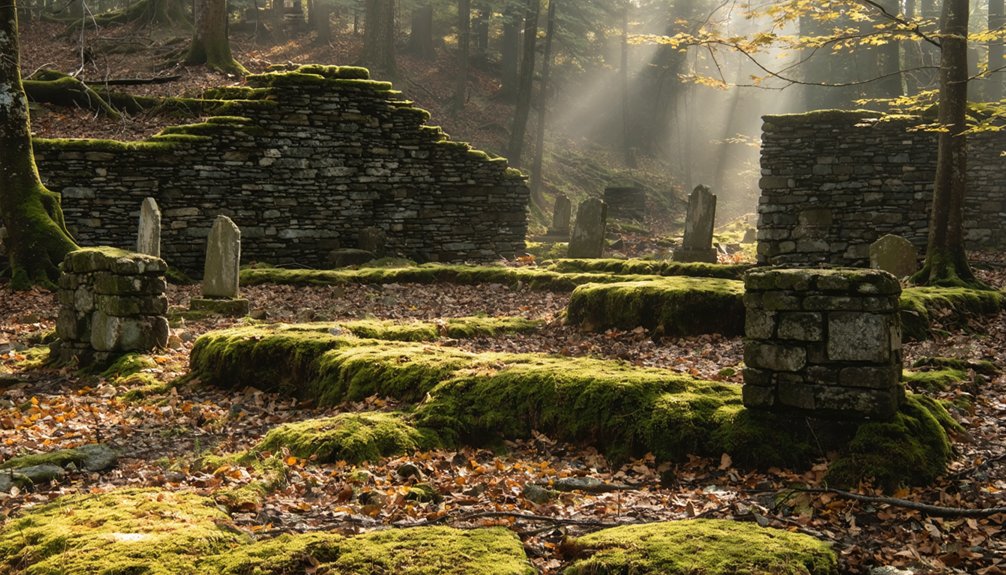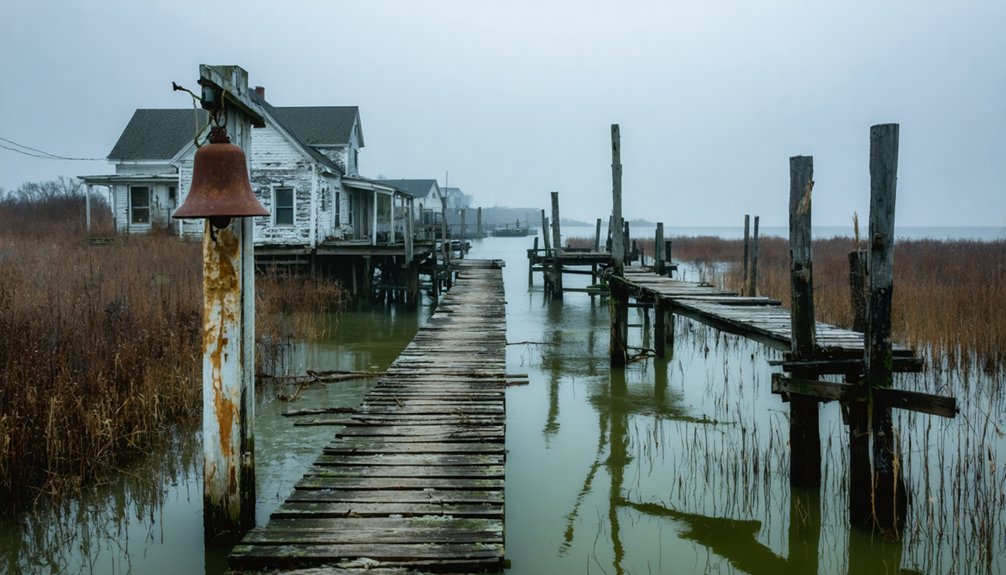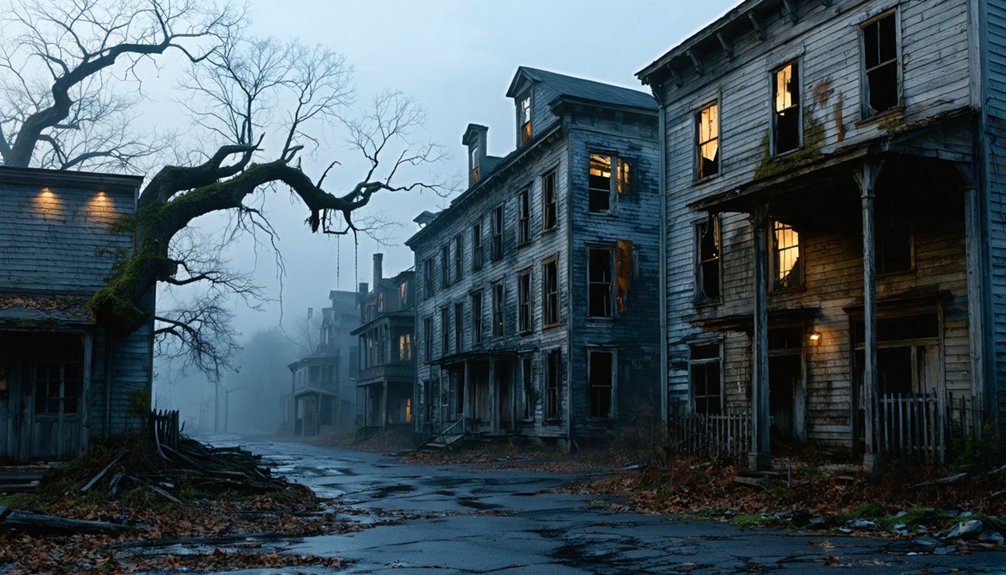
Connecticut’s most haunted ghost towns include Dudleytown, abandoned by 1900 after mysterious deaths and madness plagued its residents since 1747; Bara-Hack, the “Village of Voices” where phantom children’s laughter echoes through Pomfret’s ruins; Johnsonville, a 1830s mill village where spectral workers still wander; Gay City, a failed 1796 Methodist settlement destroyed by fires and conflict; and Pleasure Beach, a disaster-plagued amusement park isolated since 1996. You’ll discover the documented tragedies, paranormal investigations, and dark histories that transformed these abandoned settlements into New England’s most chilling locations.
Key Takeaways
- Dudleytown: Founded 1747 on sacred ground, abandoned by 1900 due to deaths and tragedies, featuring shadow figures and electronic malfunctions.
- Bara-Hack: Revolutionary War-era village abandoned by 1890, now called “Village of Voices” for phantom children’s laughter and wagon sounds.
- Johnsonville: 1830s mill village with devastating fires, known for wandering mill worker apparitions and animal skeletons in its chapel.
- Gay City: 1796 Methodist settlement destroyed by fires and Civil War losses, now a state park with stone ruins and spectral activity.
- Pleasure Beach: 1892 amusement park plagued by multiple fires and disasters, now isolated and decaying with reports of dark paranormal history.
Dudleytown: The Village Cursed by Darkness and Despair
In 1747, Gideon Dudley and his brothers purchased land parcels in Cornwall, Connecticut, establishing what would become one of New England’s most notorious abandoned settlements. The land occupied Mohawk Nation sacred ground—forgotten shrines displaced by settlers clearing the Dark Entry Forest valley for farming.
Legend traces a curse to Edmund Dudley’s 1510 execution under Henry VIII, whose medieval trade in power politics ended at the executioner’s block. His descendant John Dudley followed him to the scaffold after plotting Lady Jane Grey’s coronation.
Historical records document genuine tragedies: Gershon Hollister’s 1792 murder, Nathaniel Carter’s family killed by Native Americans, and William Tanner’s descent into madness. Yet no supernatural accounts exist before 1926.
Poor soil and harsh winters — not curses — drove families away. Transportation limitations further hampered residents’ ability to sell their produce, accelerating the settlement’s economic decline. Ed and Lorraine Warren’s 1970s television broadcasts transformed the abandoned settlement into a demonically possessed landmark, cementing its haunted reputation for decades to come.
Bara-Hack: the Welsh Settlement That Whispers From the Woods
While Dudleytown’s curse springs from twentieth-century fabrication, Bara-Hack’s haunting reputation rests on equally uncertain foundations—though its documented history proves more substantial.
Jonathan Randall and Obadiah Higinbotham established this settlement in 1778 after fleeing British forces during the Battle of Rhode Island. They built their community in Pomfret’s Ragged Hills, operating a water-powered mill and producing textiles along Nightingale Brook.
The name “Bara-Hack”—supposedly Welsh for “breaking of bread”—honors their Welsh heritage, yet records suggest this term emerged decades after abandonment. Such settler folklore often romanticizes origins.
Economic decline forced complete desertion by 1890. Today, locals call it the “Village of Voices,” reporting phantom children’s laughter and wagon wheels echoing through overgrown foundations. Stone ruins remain on private property.
Johnsonville: Victorian Mill Village Frozen in Time
Unlike Bara-Hack’s vanished foundations, Johnsonville stands intact—a complete Victorian mill village awaiting rediscovery along the Moodus River in East Haddam. Founded in the 1830s, this twine mill town thrived until fires destroyed the Triton Mill (1924) and Neptune Mill (1972).
Millionaire Ray Schmitt purchased the abandoned village in the 1960s, transporting historic buildings from Massachusetts and filling them with golden artifacts, sleighs, and Victorian furniture. Locals whisper about secret tunnels beneath the mills, though records remain elusive.
After Schmitt’s 1998 death, the 62-acre property changed hands repeatedly—from Meyer Jabara Hotels’ failed resort plans to Iglesia ni Cristo‘s 2017 purchase for $1.85 million. The property returned to market in recent years at $2.4 million following a failed auction sale.
You’ll find mill workers’ ghosts allegedly wandering past empty school desks and animal skeletons in the chapel, creating Connecticut’s most photographed ghost town. The village gained Hollywood recognition when it appeared in Billy Joel’s 1993 “The River of Dreams” music video and the 2014 film “Freedom” starring Cuba Gooding Jr.
Gay City: The Failed Utopia Lost to the Forest
In 1796, Methodist dissidents led by Elijah Andrus established Factory Hollow along Connecticut’s Blackledge River, seeking religious freedom from Hartford’s Congregationalists.
The settlement of twenty-five families built mills, homes, and a church, but alcohol-fueled feuds and a succession of devastating fires—the final textile mill burning in the late 1880s—drove residents to abandon their utopian experiment.
The site gained its current name from founder John Gay, whose extended family made up most of the town’s population.
Today, you’ll find only stone foundations, empty cellars, and weathered tombstones scattered through Gay City State Park‘s forested trails, preserved since Emma Foster donated the land in 1944. Visitors can explore the stone canals and large chimney that mark where the mills once stood along the riverside.
Religious Community’s Rise and Fall
When Elijah Andrus established his religious settlement in 1796, he chose an isolated hollow along the Blackledge River where his followers could practice their faith without interference. His community attracted Methodists from Hartford seeking refuge from disputes over alcohol use—ironic given their twice-weekly services freely incorporated spirits as religious symbolism.
Under Rev. Henry P. Sumner’s leadership, the settlement expanded to 25 families, building sawmills, woolen mills, and even a distillery by 1811. Community resilience sustained them through early hardships, but the War of 1812 blockades destroyed their wool trade. Many of these families shared the surname Gay, which would later lend its name to the abandoned settlement.
An 1830 fire devastated the mill, triggering mass exodus. The Civil War claimed young men, depleting their population further. When the paper mill burned in the 1880s, survivors abandoned the hollow entirely, leaving Factory Hollow to nature’s reclamation. Today, the 1,569-acre state park preserves crumbling foundations and weathered tombstones as silent witnesses to this vanished utopia.
Forest-Reclaimed Ruins Today
Deep within Connecticut’s woodlands, Gay City State Park preserves the forest-reclaimed skeleton of Factory Hollow, where nature has spent over a century erasing human ambition.
After the final mill fire in 1879, you’ll find ecological succession transforming abandoned cellars and stone foundations into ghostly artifacts wrapped in vines and undergrowth. The Blackledge River flows past massive chimney stacks now engulfed by forest canopy, while nature recovery has woven dense vegetation through empty doorways and crumbling walls.
Emma Foster’s 1944 donation assured these ruins remain untouched—no restoration disturbs the relentless woodland reclamation.
You’re free to explore ten miles of trails threading through what 25 families once called home, discovering stone canals and factory remnants slowly dissolving into Connecticut’s reclaimed wilderness.
Pleasure Beach: Bridgeport’s Forsaken Amusement Grounds
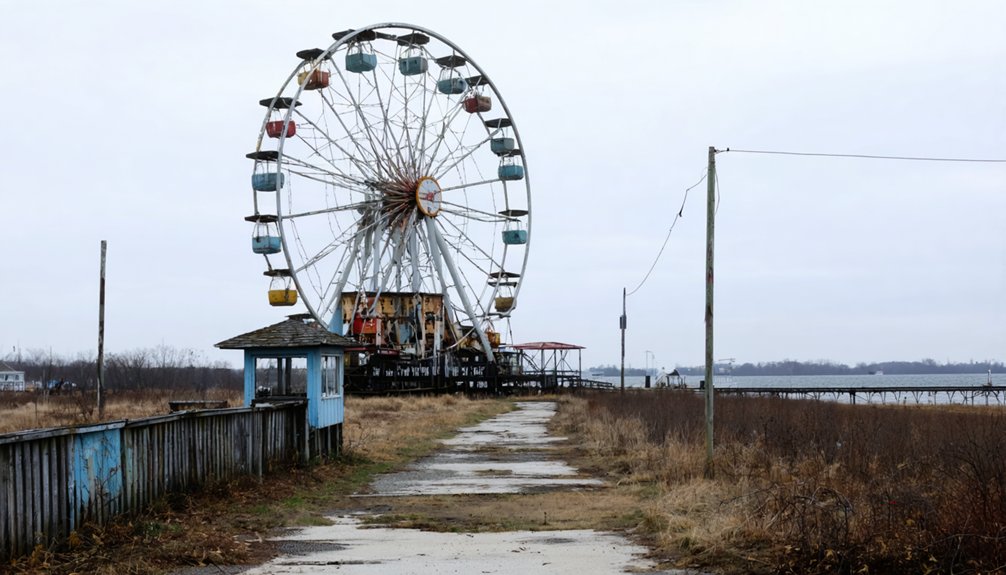
You’ll find Pleasure Beach’s dark reputation stems from a century of disasters that left the 37-acre barrier island littered with decaying structures. The park suffered three catastrophic fires—in 1907, 1953, and 1973—each destroying major attractions and reshaping the island’s layout.
After the 1996 bridge fire isolated the site completely, visitors who ventured across by boat reported seeing shadowy figures near the abandoned carousel building and hearing phantom music echoing from the ruins of the 1920s ballroom where Jazz Age legends once performed.
Amusement Park’s Dark History
In 1889, Bridgeport annexed a 37-acre island from West Stratford borough that would become one of Connecticut’s most ambitious—and ultimately tragic—entertainment ventures.
Liquor dealers J.H. McMahon and P.W. Wren opened Pleasure Beach in 1892, exploiting Captain Kidd treasure legends.
The park’s timeline reveals catastrophic patterns: a 1907 fire consumed the steeplechase ride during a baseball game, while 1953 flames damaged the roller coaster.
A discarded cigarette ignited the critical swing bridge in 1957, severing automobile access.
After 1958 bankruptcy and closure, the 1973 dance pavilion fire extinguished any modern tourism hopes.
By the 1980s, drug use plagued the abandoned grounds.
Urban redevelopment never materialized—2009 brought only demolition orders.
The amusement park’s prosperity dreams dissolved into documented decay, leaving Bridgeport’s forsaken island as testament to failed entertainment ambitions.
Paranormal Activity and Sightings
Beyond the charred remains and crumbling infrastructure, Pleasure Beach’s legacy includes well-documented paranormal disturbances that extended from the abandoned grounds into nearby Bridgeport residences.
Starting in 1972, residents reported systematic poltergeist activity: objects falling deliberately from shelves, furniture levitating in living rooms, and crashes echoing through homes. A police officer neighbor witnessed these manifestations, recording sounds and later summoning an exorcist after sustaining injuries during the phenomena.
The disturbances returned exactly one year later, witnessed by dozens of emergency personnel.
You’ll find reports of ghostly apparitions, including a detailed hand pressed against window glass.
Investigators detected emotional imprints suggesting quantum entanglement between the abandoned park’s energy and surrounding homes.
The collapsed carousel and darkened structures remain recommended sites for EVP sessions.
Holy Land USA: Waterbury’s Decaying Testament to Faith
Perched atop Pine Hill in Waterbury, Holy Land USA stands as one of Connecticut’s most peculiar abandoned attractions—a religious theme park that transformed 18 acres into a miniature recreation of biblical Jerusalem.
Holy Land USA remains Connecticut’s most haunting religious theme park, an 18-acre biblical Jerusalem now abandoned atop Pine Hill.
Waterbury lawyer John Baptist Greco opened this visionary project in 1955, constructing over 200 structures from chicken wire, plywood, and plaster with help from Catholic Italian-Americans through the Companions of Christ.
The park attracted tens of thousands during the 1960s before closing in 1984.
What You’ll Find:
- Crumbling biblical dioramas overtaken by weeds and vandalism
- A haunting 57-foot LED cross erected during 2013 restoration efforts
- Vandalized statues and deteriorating catacombs stretching 200 feet
- Two murder sites that deepened the location’s dark reputation
- Community activism and art restoration attempts preserving Greco’s legacy
The Legends and Lore Behind Connecticut’s Abandoned Places
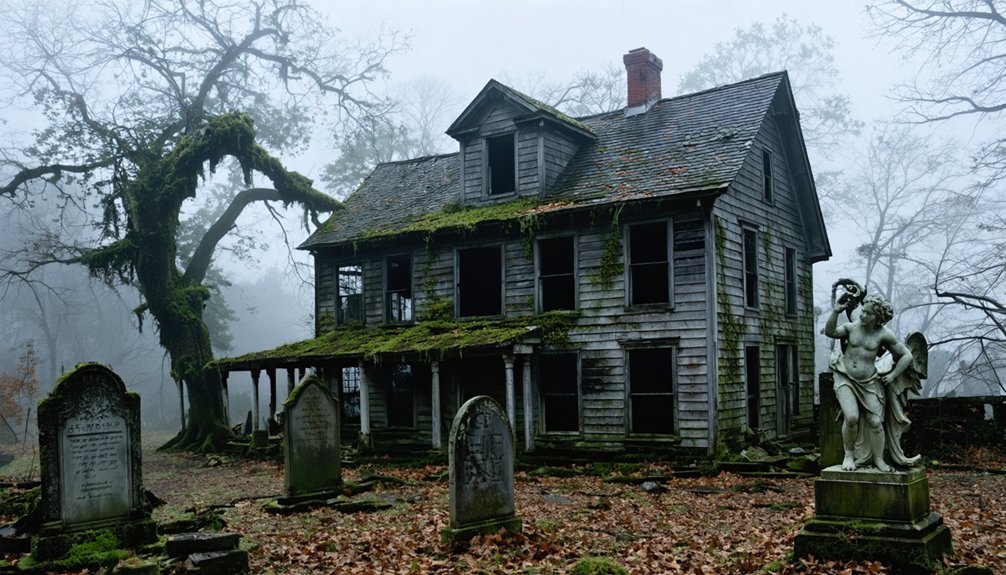
While Holy Land USA’s decay stems from neglect and economic factors, Connecticut’s older ghost towns harbor darker narratives woven through centuries of tragedy and unexplained phenomena.
Dudleytown’s folklore narratives begin with the Dudley family’s 1740s settlement in Dark Entry Forest. You’ll find documented accounts of Nathaniel Carter losing six family members to cholera, Gershon Hollister’s mysterious death, and William Tanner’s reported visions.
By 1900, complete abandonment followed relentless deaths. Dr. William Clarke’s 1918 purchase ended when his wife encountered terrifying woodland creatures.
Urban legends surrounding Valley Forge tell of forced displacement during the 1920s reservoir construction. Water companies paid Depression-era pittances before demolishing homes and relocating cemetery remains.
Gay City and Johnsonville present similar patterns: prosperity, inexplicable decline, and nature’s reclamation—each site preserving Connecticut’s haunted industrial heritage.
Paranormal Encounters Reported by Visitors and Investigators
Documented paranormal activity spans Connecticut’s abandoned sites, with Dudleytown generating the most concentrated reports since the 1940s. You’ll find urban legends transformed into documented encounters across these locations. Investigators record electronic malfunctions, shadowy figures, and disembodied voices throughout the forest settlement.
Jeremy Swamp Road witnesses report a female apparition materializing in vehicles—folklore stories rooted in a fatal accident.
Old Newgate Prison’s 1773-1827 operational period echoes through tunnel screams and phantom touches experienced by modern visitors.
Evidence that challenges conventional explanations:
- Electronic devices fail systematically during Dudleytown investigations
- Multiple drivers independently report identical backseat apparitions on Jeremy Swamp Road
- EVP recordings capture children’s voices at the abandoned tuberculosis hospital
- Saugatuck Reservoir’s displaced spirits manifest near drought-exposed foundations
- Prison tour guides witness apparitions of inmates in original holding areas
Why These Ghost Towns Continue to Captivate and Terrify
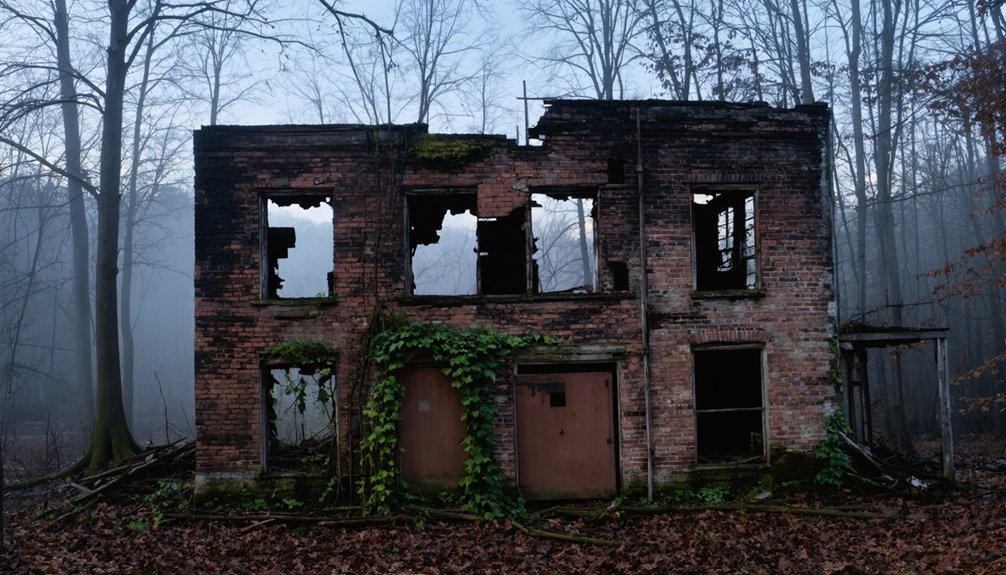
You’ll find Connecticut’s ghost towns occupy a unique space where documented tragedies—lightning strikes, mysterious fires, economic collapse—merge seamlessly with unverifiable claims of curses and hauntings.
The owners’ aggressive restriction of access through no trespassing signs, legal barriers, and redacted Freedom of Information requests transforms these sites from historical curiosities into forbidden territories that demand exploration.
This combination of verifiable abandonment records and enforced secrecy creates a psychological tension that keeps these locations firmly embedded in Connecticut’s cultural consciousness across generations.
Blurred History and Legend
The curse allegedly plaguing the Dudley family originated with Edmund Dudley, an English nobleman executed in 1510 for his role in the beheading of King Henry VI. When Gideon Dudley established the settlement in 1747, disaster followed—lightning strikes, insanity, mysterious deaths. Yet historical records reveal economic collapse: soil depletion, failed crops, and brutal winters forced abandonment by the early 1800s.
The 1854 census documented only 26 struggling families.
What blurs fact from folklore:
- Urban legends amplified isolated tragedies into supernatural narratives
- Ghostly apparitions reported in Dark Entry Forest’s perpetual shadows
- Unverified accounts of slave and mill worker hauntings
- 20th-century paranormal investigators transformed hardship into demonic possession
- Neighboring sites like Bara-Hack and Gay City share identical curse motifs
You’re witnessing how documented suffering becomes mythologized terror.
Forbidden Access Fuels Mystery
Since 1990, Connecticut State Police have systematically arrested trespassers attempting to reach Dudleytown’s ruins, transforming what was once a forgotten settlement into forbidden territory. The Dark Entry Forest Association‘s private ownership blocks all urban exploration, while prosecutors treat violations seriously.
This enforcement paradoxically amplifies the site’s allure—you can’t verify whether phantom hands actually touch visitors or if creatures emerge from the woods at night. Historical preservation through restriction creates an evidence vacuum where folklore thrives unchallenged.
After the Blair Witch Project’s 1999 release, vandalism escalated dramatically; teenagers spray-painted ruins and lit bonfires inside decaying structures, prompting tour companies to scrub Dudleytown from promotional materials.
The inaccessibility sustains speculation about what truly occurred in this abandoned settlement, where nearly every resident either died or vanished by 1900.
Exploring Connecticut’s Abandoned Sites: Access and Safety Considerations
Before venturing into Connecticut’s abandoned settlements, prospective visitors must understand that property access varies dramatically across these historic sites.
Gay City State Park welcomes explorers through official entrances with maintained trails leading to 18th-century ruins.
Conversely, Dudleytown remains strictly off-limits—the Dark Entry Forest Association prosecutes trespassers, with Connecticut State Police actively patrolling boundaries.
Johnsonville Village, despite its $1,900,000 listing, prohibits entry as collapsing structures create hazardous conditions.
Safety considerations for abandoned site exploration:
- Deteriorating foundations and debris fields pose serious injury risks
- Urban legends attract crowds, increasing unwanted encounters
- Preservation challenges worsen as vandalism destroys historical integrity
- Forest reclamation conceals dangerous terrain and structural remains
- Legal consequences include fines and arrest for trespassing violations
Respect posted warnings, carry flashlights, wear sturdy boots, and travel in groups when exploring legally accessible locations.
Frequently Asked Questions
Are There Any Other Haunted Ghost Towns in Connecticut Not Mentioned Here?
You’ll find urban legends surrounding Dudleytown, Connecticut’s most notorious abandoned settlement. Folklore narratives document 1740s colonists fleeing alleged curses and madness. Historical records verify the town’s 1920s abandonment, though supernatural claims remain unsubstantiated by archival evidence.
What Time of Year Is Best to Research Connecticut’s Ghost Towns?
You’ll find autumn (September-November) offers prime research periods as best visiting seasons for Connecticut’s ghost towns. Fall foliage reveals foundations, cooler temperatures clear overgrowth, and documented paranormal activity peaks during October’s Halloween season, maximizing your investigative freedom.
Have Any Paranormal Investigation Teams Debunked the Haunting Claims at These Sites?
No Connecticut paranormal teams have officially debunked ghost town hauntings. Ghost investigation techniques prioritize evidence collection over dismissal, while historical accuracy debates continue. You’ll find investigators document phenomena rather than refute claims at sites like Dudleytown.
Can You Legally Photograph Connecticut’s Abandoned Ghost Towns From Public Roads?
Yes, you’re perfectly permitted to photograph Connecticut’s ghost towns from public roads. Legal photography falls under First Amendment protections, and public access areas like state park roads or urban roadways allow documentation without trespassing on private property.
Do Local Connecticut Historical Societies Offer Guided Tours of These Locations?
No, you won’t find historical societies offering guided tours of these ghost towns. They’re privately owned or lack organized programming. You’ll need to explore haunted folklore independently and skip historical reenactments—documented evidence shows access remains restricted.
References
- https://collie-crow-l4em.squarespace.com/legends-and-stories/dudleytown-connecticut-the-cursed-ghost-town-and-other-haunted-abandoned-places-in-ct
- https://en.wikipedia.org/wiki/List_of_ghost_towns_in_Connecticut
- https://waittesinsurance.com/5-of-the-most-haunted-places-in-connecticut/
- https://www.atlasobscura.com/things-to-do/connecticut/abandoned
- https://ctvisit.com/articles/ghost-hunting-in-connecticut
- https://newenglandhistoricalsociety.com/the-dudleytown-curse-connecticuts-village-of-the-damned/
- https://www.youtube.com/watch?v=PKr-5HrudiI
- http://cornwallhistoricalsociety.blogspot.com/2014/09/the-truth-about-dudleytown.html
- https://en.wikipedia.org/wiki/Dudleytown
- https://usghostadventures.com/haunted-stories/americas-most-haunted-east/the-curse-of-dudleytown/