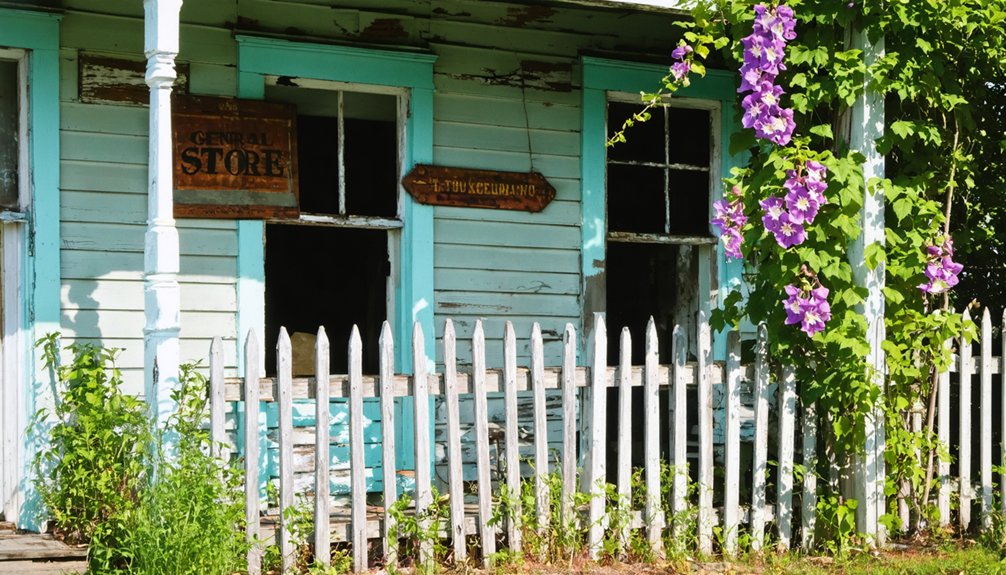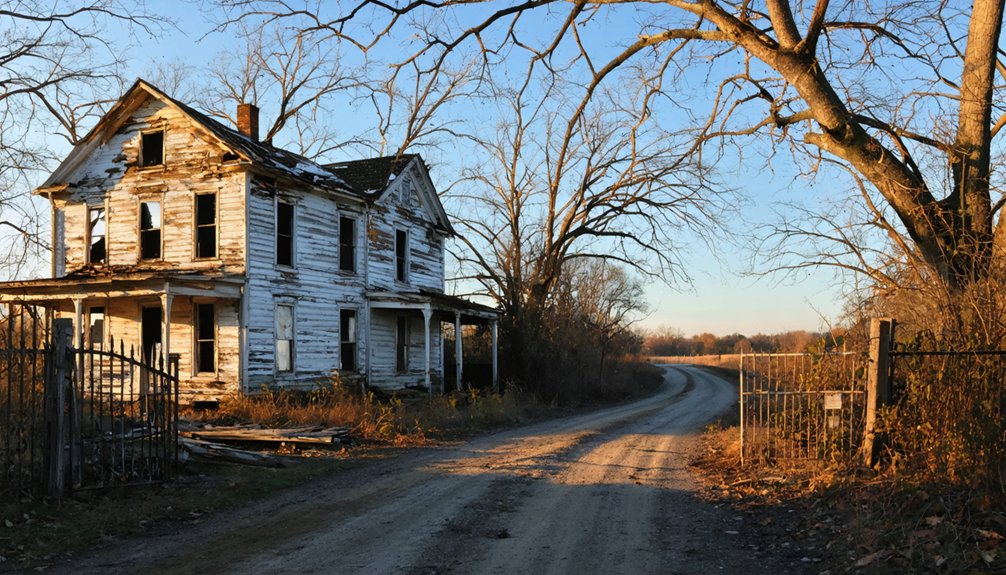
Delaware’s haunted ghost towns range from the tragic Zwaanendael Colony—destroyed in 1631 after violent conflict with the Lenape—to modern Glenville, abandoned after devastating floods in the early 2000s. You’ll find spectral activity reported at the Cannonball House in Lewes, where British bombardment left permanent scars, and along forgotten railroad corridors in Sussex County. Coastal sites like Fort Delaware and Indian River Life-Saving Station document persistent sightings of ghostly soldiers and maritime spirits, connecting Delaware’s violent history with its paranormal present. The stories behind these locations reveal how tragedy creates lasting echoes.
Key Takeaways
- Zwaanendael Colony, Delaware’s first European settlement from 1631, was destroyed within a year and left ruins haunted by its violent history.
- Glenville on Bread and Cheese Island became a modern ghost town after devastating floods in 1999 and 2003 forced complete abandonment.
- Abandoned Sussex County railroad stations and corridors now feature ghost stories and remnants from Delaware’s defunct rail network through 1949.
- Cannonball House in Lewes displays embedded War of 1812 projectiles and reports frequent ghostly soldier sightings on upper floors.
- Coastal sites including Fort Delaware, Indian River Life-Saving Station, and Fort Saulsbury are known for active maritime spirit encounters.
Zwaanendael Colony: Delaware’s First Settlement Turned Tragic Ghost Town
Long before Delaware became the First State, it earned a darker distinction as the site of colonial America’s most ill-fated European settlement. In 1631, Dutch colonial ambitions brought twenty-eight men to establish Zwaanendael—”Valley of the Swans”—along Lewes Creek. They constructed a palisade and buildings for whaling operations in Delaware Bay, claiming vast territory purchased from the Lenape people.
The venture lasted barely one year. After captain Peter Heyes departed for Amsterdam in September, Native conflict erupted from a cultural misunderstanding. The dispute centered on a tin plate emblem that settlers had posted to mark Dutch territorial claims. Every settler was killed, and the settlement burned to the ground. When David Pietersz de Vries returned years later, he found only ruins. De Vries had sailed aboard the Walvis ship, which departed Holland on December 12, 1630, carrying the original settlers and supplies for the doomed colony.
This tragic ghost town established Dutch territorial claims that would shape Delaware’s contested colonial future, ultimately fostering renewed settlement efforts by 1655.
Glenville: a Modern Ghost Town Born From Natural Disaster
How could a modern suburban neighborhood vanish entirely within just a few years? You’ll find the answer in Glenville, a 20th-century development on Bread and Cheese Island near Stanton.
Built in Red Clay Creek’s floodplain at just 20 feet elevation, this community faced devastating floods from Hurricane Floyd in 1999 and Tropical Storm Henri in 2003.
The September 2003 disaster destroyed homes and forced action on floodplain hazards that residents had endured repeatedly.
Local and state governments implemented modern relocation buyouts, offering families assistance to move elsewhere.
By 2004, everyone had left. Demolition crews razed the empty houses in 2005, leaving no trace of the neighborhood.
Unlike ghost towns abandoned through economic decline, Glenville’s erasure came through deliberate government intervention—a bittersweet ending to protect lives from nature’s fury. Several ruined buildings remain as testament to the community that once thrived here. Today, only fenced-off, overgrown remnants remain, concealing the town’s history beneath the surface.
The Forgotten Railroad Towns of Sussex County
While Delaware’s coastal economy now thrives on beach tourism and highway commerce, Sussex County’s rural landscape still bears traces of the railroad network that once defined regional prosperity.
Forgotten rail corridors still scar Sussex farmland, silent monuments to the prosperity that highways and beach traffic eventually replaced.
You’ll find abandoned station ruins where bustling junctions once connected steamboats to Baltimore and Cape May.
The Junction & Breakwater Railroad‘s 1857 construction transformed isolated farmland into commercial corridors:
- Ellendale Railroad Square featured pump houses, water towers, and canneries until US 113 bypassed it in 1916.
- Seaford’s 1856 station linked Nanticoke River steamships to Delaware Railroad’s southern route.
- Georgetown-to-Lewes spur served passengers until 1949, with rails removed after abandonment.
- Lewes-Rehoboth Beach line carried its last train in 2017.
Railway ghost stories persist around these sites, where freedom-seeking travelers once departed toward coastal destinations.
The historic Lewes-Junction swing bridge, which operated for over a century before its removal in 2022, once allowed trains to cross the canal connecting these coastal communities.
Stations served as social hubs where communities gathered, discussed local matters, and maintained the rhythms of daily life around train schedules.
Cannonball House and the Haunted Streets of Historic Lewes
The maritime community of Lewes preserves Delaware’s oldest documented battle site within its historic district, where the Cannonball House stands as physical evidence of the April 1813 British naval bombardment. Built between 1760-1765, this structure absorbed direct cannon fire during the two-day assault, embedding iron projectiles in its walls.
You’ll find the McCracken and Rowland families’ former residence now operates as a Maritime Museum under the Lewes Historical Society’s stewardship since 1963. The British naval blockade, which began in March 1813, restricted maritime commerce and severely impacted the local economy for two years. The Historical Society purchased the property in 1963 for $28,000, ensuring its preservation for future generations.
While ghostly legends circulate through Delaware’s coastal towns, documented historical records focus on the Cannonball House’s tangible war damage rather than phantom sightings. The building’s significance rests in its authenticated battle scars and architectural preservation, offering you concrete connections to Delaware’s War of 1812 resistance against British forces.
Spectral Encounters Along Delaware’s Coastal Communities
Along Delaware’s Atlantic coastline, documented paranormal accounts concentrate at former military installations and maritime rescue facilities where historical tragedies occurred. You’ll find sea spirits at the Indian River Life-Saving Station, where visitors report disembodied voices and boot sounds echoing across wooden floors—believed to be a perished life-saver still on patrol.
Ghostly footsteps of a fallen rescuer still patrol the weathered floorboards where maritime tragedy claimed his life.
Coastal apparitions manifest along Dewey Beach near Dagsworthy Street, where ghostly sailors materialize before Halloween, allegedly warning of approaching storms.
Notable haunted locations include:
- Fort Delaware on Pea Patch Island – Confederate prisoners’ spirits reportedly linger at this “Andersonville of the North”
- Rodney Hotel Site – Shadowy figures haunt the former structure’s location
- Indian River Life-Saving Station – Active paranormal activity documented at 25039 Coastal Highway
- Haunted Beaches of Dewey – Late-night encounters with spectral maritime figures
The military fortifications include Fort Saulsbury, which operated from 1917 until 1946 as a coastal defense installation complete with bunkers and artillery positions that some claim retain residual energy from their wartime service.
In Lewes, the Cannonball House at 118 Front St features a British cannonball lodged in its foundation from the War of 1812, with visitors reporting ghostly soldiers and the spirit of a sea captain haunting the upper floors.
Frequently Asked Questions
Are There Any Guided Ghost Tours Available in Delaware’s Abandoned Towns?
Don’t judge a book by its cover—you won’t find guided ghost tours in Delaware’s abandoned towns like Glenville. Instead, you’ll discover historical preservation efforts through folklore legends at Dover, New Castle, and Fort Delaware’s documented paranormal tours.
What Safety Precautions Should Visitors Take When Exploring Ghost Towns?
You’ll need sturdy footwear, flashlights, and respirators while respecting historic preservation guidelines. Research local legends beforehand to identify structural hazards. Always travel in groups of three, carry first-aid supplies, and inform someone of your location before exploring independently.
Can You Legally Visit and Photograph Delaware’s Ghost Town Sites?
You’ll find Delaware’s ghost towns surprisingly accessible! Most sites offer legal visits and photography from public roads or historical preservation areas. Always respect private property boundaries, but you’re free to document local legends and architectural remnants responsibly.
As you explore these remnants, you’ll come across ghost towns submerged in Delaware that tell tales of a bygone era. Each visit can reveal fascinating stories of the past, inviting you to imagine what life was like before the towns were lost. Don’t miss the chance to interact with local historians who can provide deeper insights into the significance of these submerged locales.
What Equipment Do Paranormal Investigators Use at Delaware’s Haunted Locations?
You’ll use investigative tools like EMF meters, spirit boxes, and thermal cameras to detect spectral energies at Delaware’s haunted sites. These devices measure electromagnetic fluctuations, capture electronic voice phenomena, and reveal temperature anomalies indicating paranormal activity.
Are There Specific Times When Ghostly Activity Increases in These Towns?
You’ll find Delaware’s ghosts punch a clock like union workers—activity spikes after dark and during October’s Halloween season. Historical significance tied to Revolutionary War battles and seasonal variations around Native American settlement sites amplify paranormal encounters substantially.
References
- https://www.youtube.com/watch?v=ex8Hld_imPU
- https://greatwesterncatskills.com/four-haunting-mysteries-of-delaware-county/
- https://en.wikipedia.org/wiki/List_of_ghost_towns_in_Delaware
- https://www.delawonder.com/articles/haunted-halloween-in-southern-delaware/
- http://www1.udel.edu/udmessenger/vol26no1/stories/features-celebrating-275-ud-haunted-history.html
- https://archives.delaware.gov/digital-archives/haunted-delaware/
- https://www.farmweddingde.com/wedding-blog/haunted-history-in-delaware-city-tourism-in-the-first-state
- https://www.visitkeweenaw.com/listing/delaware-the-ghost-town/515/
- https://history.delaware.gov/zwaanendael-museum/zm_history/
- https://www.wonderfulmuseums.com/museum/zwaanendael-museum-in-lewes-delaware/