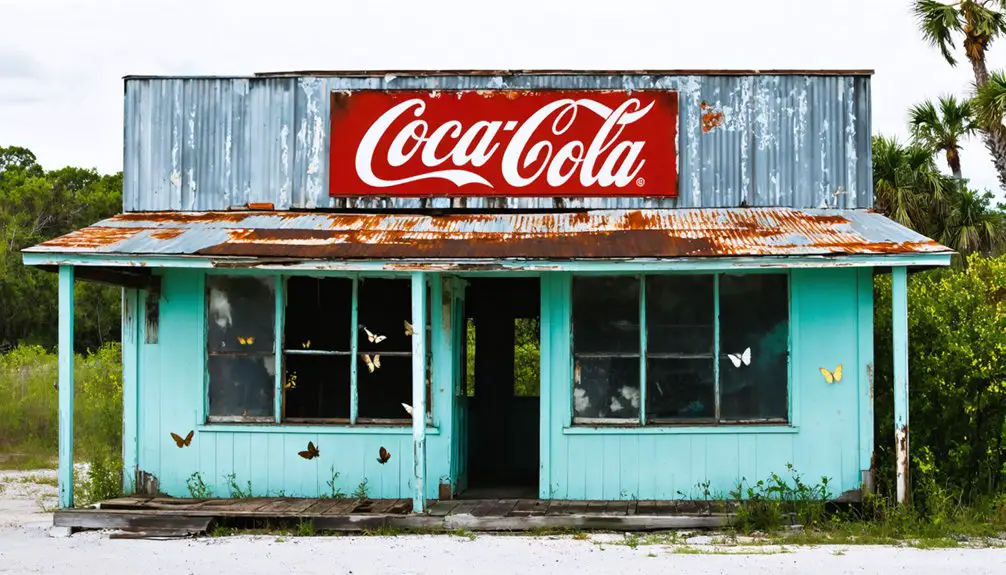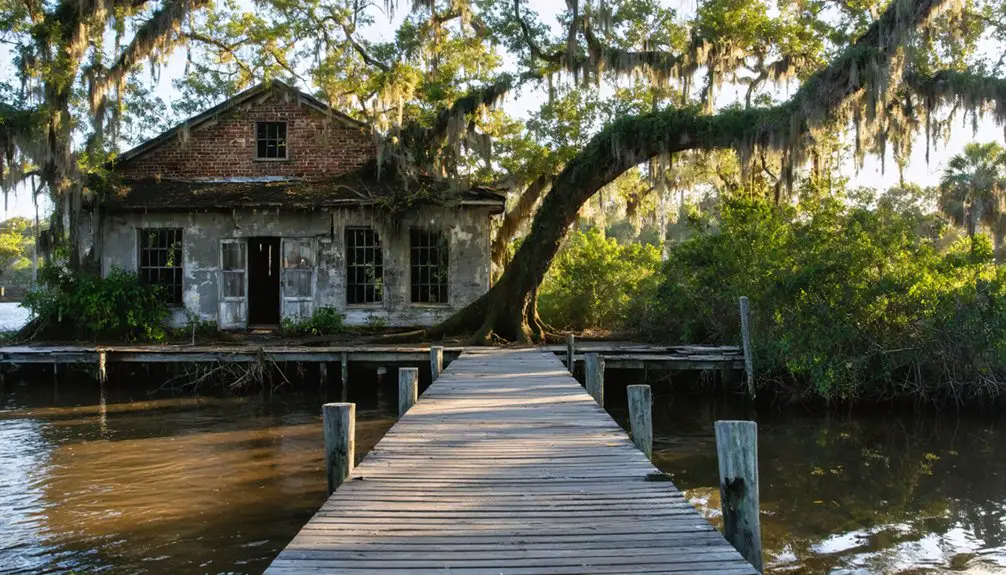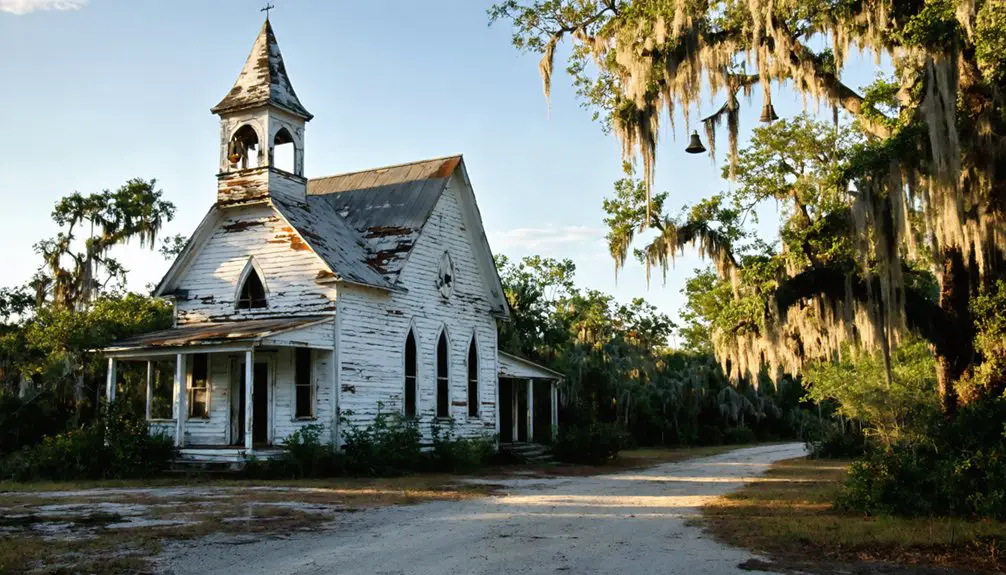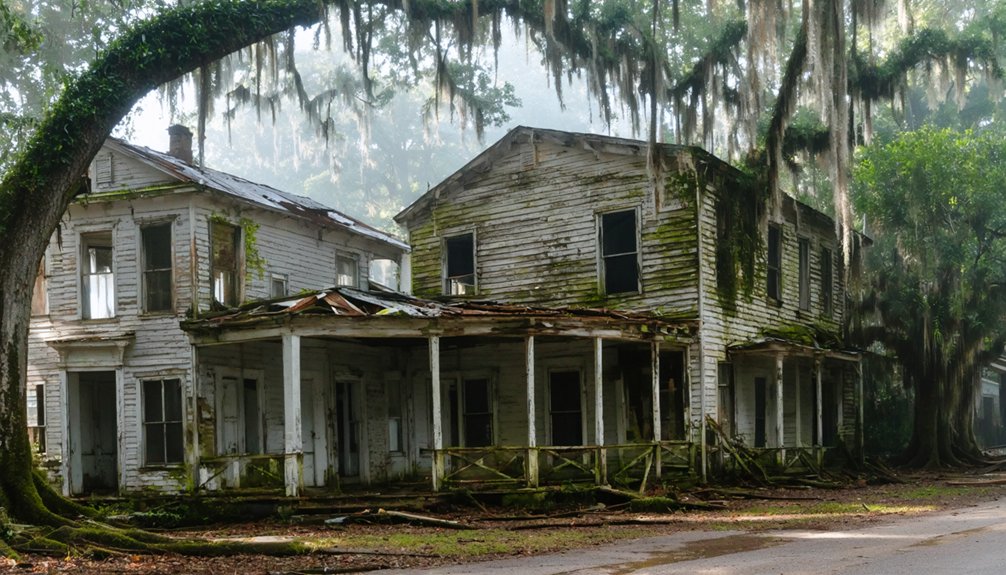
You’ll find Florida’s most haunted ghost towns at Egmont Key’s Fort Dade, where phantom gunfire echoes through 1898 military ruins, and Indian Key, where 13 residents died during an 1840 Seminole attack. St. Joseph vanished after yellow fever killed thousands in 1841, while Atsena Otie disappeared beneath a devastating 1896 hurricane. Ruby’s flooded mines reportedly trap drowned miners’ spirits. These sites feature documented paranormal activity, from disembodied voices to unexplained lights, with accessible boat tours revealing their violent histories and persistent supernatural phenomena.
Key Takeaways
- Egmont Key features phantom gunfire and unexplained lights among military ruins, accessible only by boat through U.S. Fish and Wildlife Service.
- Indian Key’s 1840 massacre by Chief Chekika left 13 dead, with spirits allegedly haunting remaining stone foundations and cisterns.
- Ruby’s catastrophic flood killed miners whose restless spirits reportedly haunt the river near abandoned clay and kaolin industry structures.
- Atsena Otie’s 1896 hurricane victims and decaying foundations create ghostly monuments where disembodied voices and spectral figures are reported.
- St. Joseph’s yellow fever epidemic and violent history left thousands dead, fueling paranormal activity at its cemetery and museum remnants.
Egmont Key (Fort Dade) – Florida’s Creepiest Abandoned Military Outpost
Off the coast of St. Petersburg, you’ll discover Egmont Key, where Fort Dade’s crumbling ruins tell stories of America’s military past. Established in 1898 during the Spanish-American War, this strategic outpost once housed 300 residents across 12 buildings connected by six miles of brick paths.
The fort expanded to 600 personnel during World War I, training Coast Artillery troops for submarine defense. After a devastating 1921 hurricane, it was deactivated in 1923. A series of devastating fires between 1925 and 1936 destroyed many remaining buildings, prompting the Coast Guard to demolish what was left.
Today, you can explore military relics including concrete batteries, lighthouse keeper’s houses, and overgrown trails through abandoned structures. The island has dramatically shrunk from its original 580 acres in 1877 to approximately 200 acres today due to erosion and rising sea levels. Erosion effects steadily claim the island, making each visit more urgent.
Accessible only by ferry, it’s now a state park where history meets haunting solitude.
Ruby – The Forgotten Mining Settlement of North Florida
While Egmont Key’s military ghosts haunt Florida’s coastline, the state’s interior harbors equally eerie ruins. Deep in the Apalachicola-Chattahoochee-Flint River Basin lies Ruby, established in 1912 and named after Lillie B. Ruby Andrews.
This mining settlement once housed 1,200 residents who extracted clay and kaolin from the region’s rich mineral history. The prosperous town featured homes, businesses, and a post office supporting the thriving extraction industry.
Ruby’s fortunes collapsed when a catastrophic early 20th-century flood killed miners and devastated operations. Already depleted mines couldn’t justify rebuilding.
Today’s abandoned architecture marks where the town center stood. The site now serves as an archaeological interest point for those studying Florida’s industrial past. Interestingly, another settlement also named Ruby existed on Florida’s coast in 1884, named after the first daughter of settlers William Edward and Eleanor Kennedy Scull before being renamed Pablo Beach. Local legends claim spirits of drowned miners still linger near the river, their voices calling out to visitors who venture into these forgotten ruins—restless souls trapped at Florida’s lost mining frontier.
St. Joseph – From State Capital to Vanished Port Town
You’ll find St. Joseph’s story remarkable—it served as Florida’s constitutional convention site in 1838.
It peaked at 12,000 residents by 1839, then vanished within six years.
The port city competed aggressively with Apalachicola for cotton commerce, building Florida’s first railway and establishing million-dollar financial institutions.
The steam-powered railroad connected Depot Creek to St. Josephs Bay starting in 1836, marking one of the first three railroads in the United States.
Yellow fever struck in 1841, followed by a devastating hurricane and fire that reduced the population to 400, with a final storm surge in 1844 obliterating what remained of this once-thriving boomtown.
Today, only a cemetery and museum mark where this prominent coastal settlement once stood near St. Joseph Bay.
Brief Capital, Quick Decline
When land disputes over the Forbes Purchase erupted in Apalachicola during the mid-1830s, frustrated residents packed up and moved west to establish St. Joseph on the shores of St. Joseph Bay in 1835.
You’ll find this wasn’t just any settlement—it exploded into Florida Territory’s largest city, reaching 12,000 residents by 1839.
Historical reconstruction reveals it boasted one of America’s first three steam railroads in 1836, transforming the deepwater port into a cotton export powerhouse.
Archaeological excavations show St. Joseph hosted 56 delegates for Florida’s constitutional convention in December 1838, earning it the nickname “Constitution City.”
The town’s prosperity drew diverse skilled craftsmen, including carpenters and builders who constructed elaborate wood and iron structures throughout the bustling port city.
The city’s commercial success attracted wealthy Southern planters and merchants who rivaled the prominence of Charleston and New Orleans.
Yet disaster struck swiftly: yellow fever, hurricanes, and fires reduced the population from 12,000 to just 400 within two years, leaving only scattered remnants behind.
Coastal Boom-Bust Legacy
St. Joseph’s transformation from ambitious port to abandoned ruins illustrates Florida’s volatile coastal history. You’ll find this boomtown, founded in 1835, once competed with Apalachicola for cotton shipping dominance. Grand homes and warehouses rose quickly along St. Joseph Bay. The city hosted Florida’s first constitutional convention in 1838, attracting delegates who believed it would become the state capital.
Economic decline struck when cotton prices plummeted, shuttering the crucial St. Joseph and Iola Railroad.
Then weather calamities delivered devastating blows:
- 1839 storm destroyed buildings and beached ships
- 1841 yellow fever epidemic reduced 6,000 residents to 500
- 1843-1844 hurricanes unleashed final storm surges
Population crashed to just 50 by 1843. Survivors dismantled homes, shipping them to Apalachicola.
Pensacola’s Palafox Street received bricks from the ruins. By 1854, complete abandonment sealed St. Joseph’s fate as Florida’s most dramatic coastal ghost town. Today, only the town’s cemetery remains as a grim reminder, with mass graves of yellow fever victims lying unmarked within a small fenced area near modern Port St. Joe.
Indian Key – Pirates, Shipwrecks, and a Deadly Seminole Raid
Eleven acres of mangrove-covered ruins mark what remains of Indian Key, once the second-largest settlement in the Florida Keys and the site of one of the most dramatic attacks during the Second Seminole War. Pirate legends and shipwreck mysteries surround this island, where Spanish treasure fleet survivors camped in 1733.
Jacob Housman transformed it into a thriving wrecking operation by the 1830s, establishing warehouses, a hotel, and thirty houses. When it became Dade County’s seat in 1836, the community seemed unstoppable.
That changed on August 7, 1840, when Chief Chekika led a dawn raid that killed thirteen residents, including botanist Dr. Henry Perrine, and burned nearly every structure. You’ll find only stone foundations and cisterns remain today—accessible solely by boat at this protected state park.
Atsena Otie – Cedar Key’s Original Location Lost to Hurricane Fury
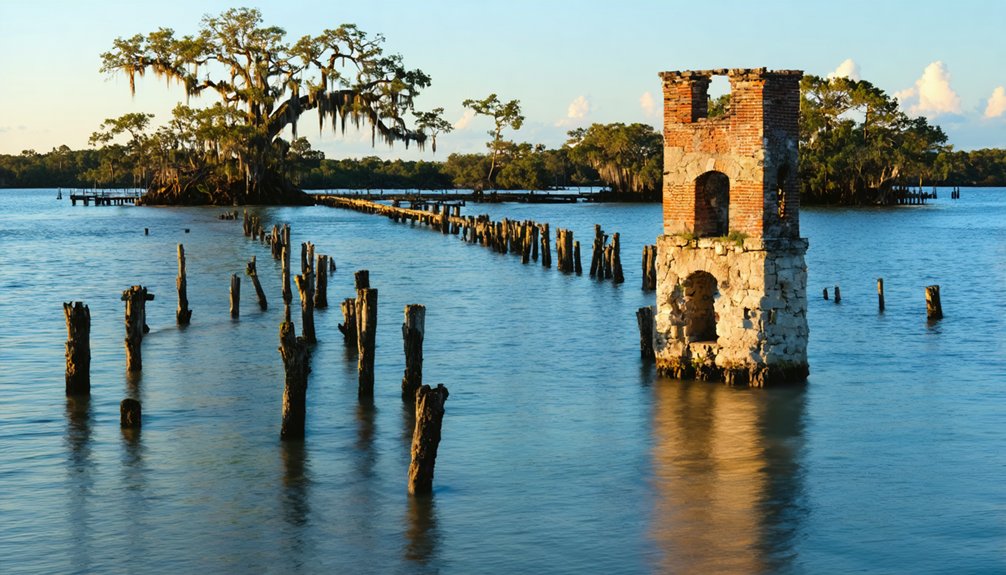
On September 28, 1896, a massive hurricane struck Atsena Otie with a ten-foot tidal surge that destroyed the Eberhard Faber Pencil Mill and ravaged the entire island settlement.
The catastrophic storm forced residents to abandon their homes and businesses, relocating to the mainland or nearby islands like Way Key.
Catastrophic 1896 Hurricane Destruction
When the massive hurricane roared ashore between September 26 and 30, 1896, it unleashed catastrophic destruction across Cedar Key and its original settlement on Atsena Otie. Peak winds reached 130 mph while storm surge measured 12.6 feet at Yankeetown, obliterating nearly all 50 buildings on the island.
The devastation included:
- A wall of foamy water plunging over towns, witnessed by residents from second-story windows as buildings went down like sticks
- Complete destruction of Eberhard Faber’s cedar mill and the island’s red cedar forests, ending the nation’s leading pencil slat production
- Over 100 deaths, mostly from storm surge, including fishermen who watched helplessly as mountains of water descended
Today, only cracked stone foundations remain—silent monuments where marine ecology has reclaimed what historical preservation efforts can’t restore.
Town Relocated After Devastation
The hurricane’s aftermath forced survivors to make a permanent decision that would reshape Cedar Key‘s geography forever. You’ll find that residents abandoned Atsena Otie Key entirely, relocating to Way Key’s safer inland position closer to the mainland.
By the early 1900s, zero inhabitants remained on the original barrier island settlement. The abandoned structures—including the Faber pencil mill, warehouses, and concrete cisterns—still stand as decaying monuments to the community’s prosperity.
Urban legends now surround the historic 1877 cemetery and building foundations scattered across the island. Today’s Cedar Key exists where Way Key once provided refuge, while the U.S. Fish and Wildlife Service manages the ghost town ruins, allowing you to explore this catastrophic chapter in Florida’s coastal history by boat or kayak year-round.
Fort Brooke – Tampa’s Buried Military Ghost Town
Colonel George Mercer Brooke marched four companies of the U.S. 4th Infantry Regiment from Pensacola to the mouth of the Hillsborough River on January 10, 1824, establishing what would become Tampa’s founding military installation.
Initially named Cantonment Brooke, this fortification served as command headquarters during the Second Seminole War and witnessed Major Francis Dade’s fatal departure in December 1835.
Fort Brooke’s Hidden History:
- Military artifacts surface during urban excavation projects throughout downtown Tampa, revealing the fort’s four-square-mile footprint.
- Union forces bombarded and captured the installation on May 6, 1864, marking its decline.
- The Army decommissioned this once-vital outpost in 1883, burying Tampa’s birthplace beneath modern development.
You’ll find no visible structures remaining—just historical remnants entombed under city streets.
What Makes These Florida Ghost Towns Haunted?
Beyond Tampa’s buried military foundations, Florida’s abandoned settlements carry darker legacies that fuel their haunted reputations.
Florida’s forsaken towns harbor more than empty buildings—their violent pasts left restless spirits that refuse to fade.
Supernatural legends emerge from violent catastrophes—Ruby’s flood victims allegedly call out near the old river, while hurricane-devastated St. Joseph combines natural disaster with yellow fever epidemic deaths.
Historical hauntings stem from brutal conflicts: Seminole detentions on Egmont Key left spirits in cemeteries, and Indian Key’s 1840 massacre forced complete abandonment.
You’ll find torture’s residue at St. Augustine’s Old Jail, where inmates suffered inhumanely for sixty years.
Disease amplifies these encounters—Spanish Military Hospital, built over Timucuan burial grounds, disturbed thousands of bones.
Workers reported evil spirits before discovering the desecrated graves in 1821, proving these towns earned their paranormal reputations through documented tragedy.
How to Visit Florida’s Accessible Ghost Town Sites
You’ll need to arrange boat transportation to reach Fort Dade on Egmont Key, as no bridge connects this ghost town to mainland Florida.
The Egmont Key Ferry operates three-hour excursions departing from Fort De Soto beach at Hubbard’s Marina.
Alternatively, you can navigate there by private watercraft.
Before visiting, verify current access requirements and weather conditions, particularly during the rainy season when flooding affects the battery structures.
Best Boat Tour Options
While ghost towns typically conjure images of desolate desert landscapes, Florida’s haunted historic sites require a different approach—many of the state’s most spine-chilling locations sit along waterways and coastal areas accessible only by boat.
Top Maritime Ghost Tour Options:
- Moonlit Mysteries Haunted History Cruise delivers 75-minute narrated tours across Matanzas Bay, passing St. Augustine Lighthouse, Castillo de San Marcos, and Bridge of Lions with onboard bar service ($39+ for ages 13+)
- Ghost Boat Boo Cruise accommodates 32 passengers on 1.5-hour pontoons departing Vilano Public Pier (260 Vilano Rd), featuring mobile ticketing and English narration
- Wakulla Springs Historic River Boat Tours offer 45-55 minute ranger-led experiences through pristine marine ecology aboard wheelchair-accessible vessels requiring minimal boat maintenance
Tours operate year-round with certified guides providing live commentary about restless spirits haunting Florida’s oldest settlements.
Safety and Permit Requirements
Before you venture into Florida’s abandoned settlements, you must understand that exploring ghost towns carries serious legal consequences and physical dangers. Trespassing on private property constitutes a second-degree misdemeanor under Florida Statute 810.08. Armed trespassing escalates to a third-degree felony.
You’ll need written authorization from property owners before accessing privately-owned sites. Contact local historical societies to determine ownership status and secure proper permissions.
Equipment essentials include personal protective gear and first aid supplies for traversing deteriorating structures with collapsed ceilings and rotted flooring. Drone safety regulations require FAA compliance when documenting sites aerially.
State-managed ghost towns offer liability protection and documented safety protocols. Ranger-led tours provide controlled access while maintaining leave-no-trace principles that protect archaeological integrity.
Always consult legal counsel before visiting sites with unclear ownership status.
The Dark History Behind Florida’s Abandoned Settlements
The most dramatic abandonments involved forced evacuations:
- Yukon vanished during World War II when the Navy requisitioned land near Jacksonville and bulldozed the entire town.
- Osceola disappeared piece by piece between 1916-1940 as companies relocated operations and removed buildings, board by board.
- Rattlesnake collapsed overnight when its single cannery closed, eliminating the town’s entire economic foundation.
Paranormal Activity Reported at Florida’s Ghost Towns
Strange phenomena plague Florida’s abandoned settlements, transforming historical curiosities into paranormal hotspots. You’ll find paranormal sightings documented across multiple sites, backed by ranger testimonies and visitor accounts.
At Fort Dade, phantom gunfire echoes through ruins while the 137-year-old lighthouse illuminates without power. White City residents report Colonel Myers’ ghostly presence destroying restoration projects and stealing gold watches since his 1894 fraud.
Bulow Plantation visitors hear disembodied voices along trails near ancient live oaks, where Seminole spirits allegedly remain after the plantation’s burning.
Local legends persist at these locations, creating tourism opportunities for those seeking authentic encounters. Even Cassadaga’s spiritualist community thrives on ongoing supernatural activity.
Former park rangers and locals provide firsthand accounts, establishing these ghost towns as genuine paranormal investigation sites rather than mere folklore destinations.
Frequently Asked Questions
Are Guided Ghost Tours Available at Any Florida Ghost Towns?
No guided ghost tours operate at Florida’s ghost towns. You’ll explore sites like Fort Dade through self-directed trails, discovering local legends independently. Historical preservation focuses on ruins and cemeteries, but organized ghost tours target haunted lighthouses and museums instead.
What Safety Precautions Should Visitors Take When Exploring Abandoned Sites?
Before you slide into those DMs—er, abandoned sites—respect access restrictions and obtain permission first. You’ll need safety gear: respirators for mold, flashlights, sturdy boots, and first aid supplies. Always assess structural integrity before entering any building.
Can You Camp Overnight at Florida’s Ghost Town Locations?
You’ll face camping restrictions at most Florida ghost towns since they’re on private property or lack overnight permissions. Always verify land ownership and secure proper authorization before attempting to camp at these abandoned locations.
Which Florida Ghost Town Has the Most Documented Paranormal Evidence?
Jasper’s Mansion of Madison holds the most documented paranormal evidence as a confirmed haunted Civil War Confederate Hospital. You’ll find historical legends backed by primary sources chronicling spiritual encounters from its 1860s operations through modern investigations.
Are Metal Detectors Allowed at Historical Ghost Town Sites?
Metal detecting at Florida’s ghost towns? Hold on, freedom-seeker! Legal restrictions slam that door shut at registered historical sites—you’ll need written landowner permission for private property, and state lands prohibit removing anything over 50 years old.
References
- https://www.clickorlando.com/features/2024/09/25/floridas-creepiest-ghost-town-is-stashed-on-an-island-heres-the-lowdown/
- https://fdc.com/blog/ghost-towns-in-florida/
- https://www.floridarambler.com/historic-florida-getaways/6-haunted-places-in-florida/
- https://en.wikipedia.org/wiki/List_of_ghost_towns_in_Florida
- https://www.journaloffloridastudies.org/0102ghosttowns.html
- https://www.youtube.com/watch?v=ZQf3AqatGD4
- https://www.freakyfoottours.com/us/florida/
- https://history.howstuffworks.com/historical-events/haunted-places-in-florida.htm
- https://www.arcadiapublishing.com/products/haunted-florida-ghost-towns-9781467156479
- https://floridaseminoletourism.com/a-dark-history-at-egmont-key/