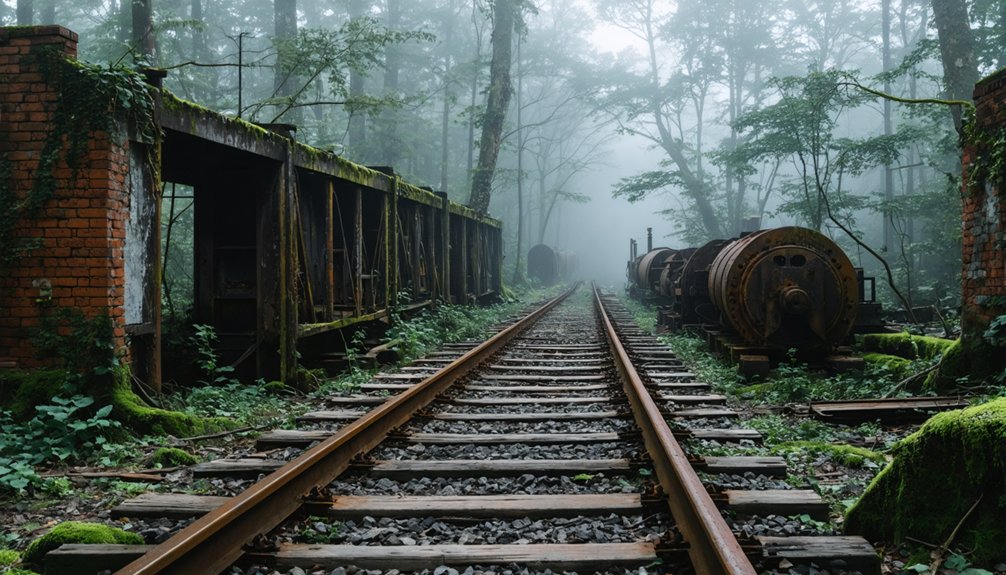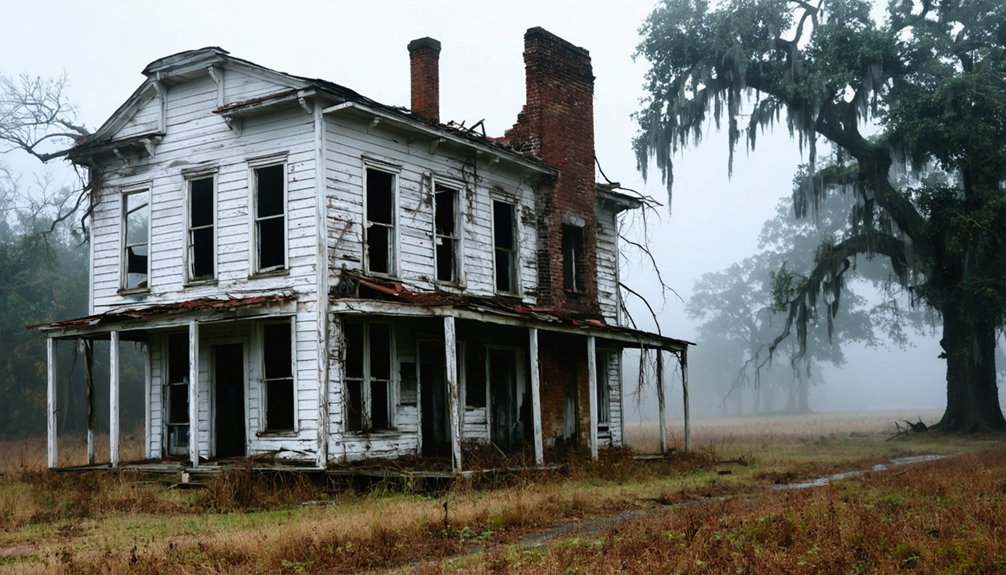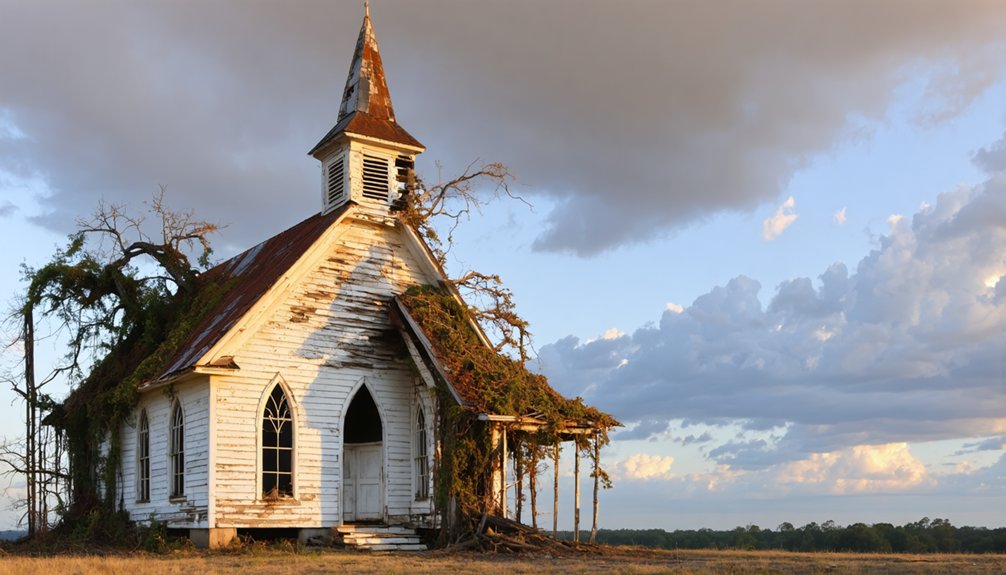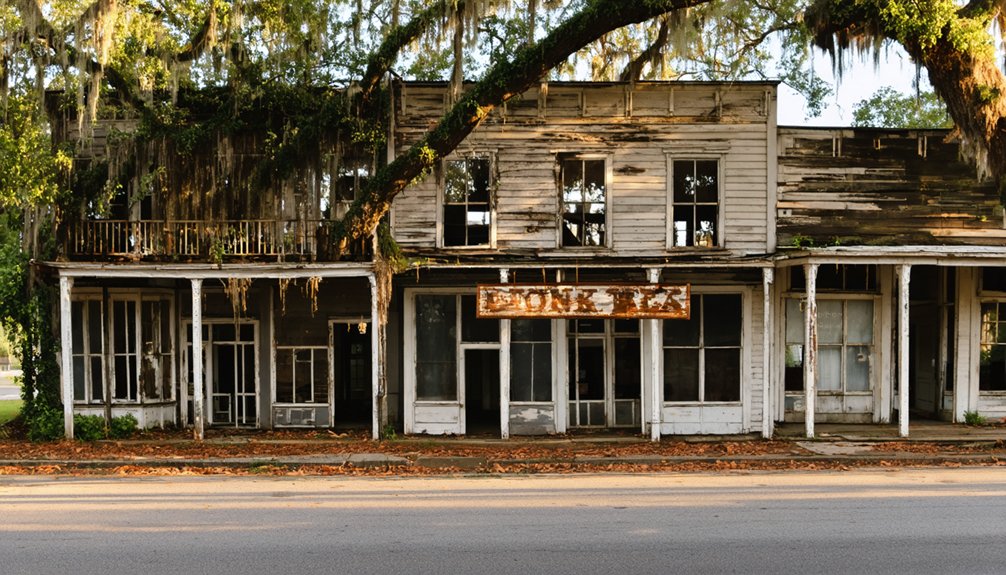
You’ll find Georgia’s most haunted ghost towns scattered from the mountains to the Piedmont, where violent histories left indelible marks. Brasstown Bald’s summit holds Cherokee legends, while Scull Shoals’ 10,000-year occupation ended in industrial tragedy. New Hope vanished after the 1864 battle and an 1875 tornado, leaving only paranormal reports behind. Hiawassee’s 1800s buildings harbor cold spots and phantom footsteps, and gold rush settlements Auraria and Visage now feature crumbling foundations where witnesses report ghostly figures. Each location preserves layered stories of displacement, disaster, and death that continue to manifest in unexplained phenomena.
Key Takeaways
- New Hope in Paulding County features Civil War battlefield ruins with reported ghostly sounds and decay smells near the 1864 Battle of New Hope Church site.
- Scull Shoals on the Oconee River contains ancient burial mounds and ruins from Georgia’s first paper mill, spanning 10,000 years of human occupation.
- Hiawassee’s Historic District reports paranormal activity including cold spots, self-activating lights, and mysterious footsteps in preserved 1800s buildings.
- Auraria, an 1829 gold rush town with scattered cabin ruins, and Visage, a Civil War-era site, both report ghostly figures and unexplained cold spots.
- Visage’s post-Civil War ruins are actively investigated for paranormal activity, with remaining foundations attracting supernatural enthusiasts.
Brasstown Bald: Where Spirits Roam Georgia’s Highest Peak
At 4,784 feet above sea level, Brasstown Bald commands Georgia’s skyline as the state’s highest point, rising from the Blue Ridge Mountains along the border of Towns and Union counties. Native Cherokee legends permeate this summit, where the original name Enotah meant “place of fresh green,” later mistranslated as “brass” by settlers.
The Cherokee inhabited these peaks long before the 1828 gold rush displaced them, leaving behind stories of cloud forests and sacred grounds. Today’s mountain ecology preservation maintains the heath bald’s natural treeless character, where thin acidic soils support stunted birch and mountain laurel. From the summit’s natural clear vantage point, visitors can glimpse four states stretching across the horizon.
You’ll find the first fire tower was built in the 1920s from chestnut wood, standing sentinel over forests that still whisper with ancestral memories and untamed wilderness. Modern visitors ascend via a 0.6-mile paved trail from the parking area, where the steep incline challenges those seeking communion with the mountain’s ethereal heights.
Scull Shoals: Ruins That Whisper Tales of Tragedy
Along the Oconee River’s banks in Greene County, fifteen miles south of Athens, Scull Shoals preserves over 10,000 years of continuous human occupation within its 2,200-acre expanse in the Oconee National Forest.
You’ll discover prehistoric artifacts like pottery sherds and lithic projectile points from hunter-gatherers who first claimed these fertile shoals. The burial mounds at upstream Scull Shoals honored priest-chiefs from A.D. 1250-1500, their skeletal remains inspiring the site’s haunting name. Spanish explorer Hernando de Soto briefly visited the region in April 1540, bringing deadly diseases that devastated local Native populations.
Industrial ambition transformed this wilderness into Georgia’s first paper mill in 1811. Dr. Thomas Poullain’s textile empire employed 500 workers until tragedy struck:
- 1793 Creek raid killed six settlers
- 1845 fire destroyed wooden structures
- 1887 flood submerged buildings for four days
- Convict labor operated here from 1877-1878
- Final residents abandoned the site post-1887
Today, only crumbling brick walls and an old arched bridge remain standing among moss-covered stones and scattered foundation ruins.
New Hope: Tornado-Ravaged Town Frozen in Time
Northeast of Dallas in Paulding County, New Hope’s stone ruins mark where catastrophic forces—both natural and man-made—converged to erase a thriving 19th-century community. The 1864 Battle of New Hope Church claimed hundreds during a violent thunderstorm, leaving hasty entrenchments you can still trace through the woods.
Eleven years later, an 1875 tornado devastated what remained, destroying the town square and most structures. Only the Collins family’s stone cellar—those same ruins you’ll find near the Chattahoochee River—provided refuge from the storm’s fury.
The Civil War battlefield and tornado aftermath created layers of tragedy that residents never overcame. The 11-day battlefield involved brutal trench warfare, starvation, and decaying remains that haunted survivors long after the fighting ceased. Relic hunters in the 1960s reported eerie phenomena near the battle sites, including ghostly moaning sounds and a strange smell of decay emanating from the ravine. By the 1930s, New Hope had vanished entirely.
Today, forgotten chimneys and stone foundations hide among the trees, physical evidence of a community that couldn’t survive its accumulated disasters.
Hiawassee’s Historic Buildings and Their Restless Residents
Downtown Hiawassee’s historic district preserves more than architectural heritage—the late 1800s buildings that line its streets retain something of their former occupants. Business owners and visitors report consistent paranormal activity throughout these century-old structures, where cold spots concentrate near staircases and lights activate without human intervention. Witnesses describe faint footsteps echoing through empty corridors when no living person is present.
The past lingers in these downtown buildings, where former residents refuse to abandon the spaces they once called home.
The phenomena reflect Towns County’s layered history of hardship:
- Pioneer settlements endured isolation and untimely deaths during harsh mountain winters
- Cherokee displacement left spiritual imprints across the region
- Lake Chatuge’s 1940s flooding submerged entire communities
- Economic struggles and family tragedies marked early settlement periods
- Multiple generations of loss compound the area’s supernatural reputation
Historical preservation here extends beyond maintaining facades—it encompasses acknowledging those who never left. Visitors exploring the area often stop at the Romeo and Juliet Indian Mound, where the tragic legend of star-crossed lovers adds another layer to the region’s supernatural narrative. These encounters document authentic human experiences across centuries of regional occupation.
Auraria and Visage: Forgotten Settlements of Georgia’s Past
Georgia’s mountains conceal more than Hiawassee’s enduring structures—entire communities have vanished into the landscape, leaving only scattered foundations and stubborn local memories. Auraria exemplifies these abandoned settlements, where gold rush legends began in 1829—nearly twenty years before California’s famous strike.
You’ll find William Dean’s original 1832 cabin site between the Chestatee and Etowah Rivers, where 1,000 residents once sustained 100 dwellings and eighteen stores.
John C. Calhoun himself named it from Latin *aurum*, recognizing the $20 million extracted by 1839. Calhoun purchased his lease from Benjamin Parks, who had refused to sell to Preacher O’Barr despite mounting threats. When Dahlonega claimed the county seat in 1833, Auraria withered. The town’s name derives from the Latin phrase meaning yellow money, reflecting the precious metal that drew thousands to Georgia’s hills.
The Russell brothers carried its name to Colorado, founding Denver’s predecessor. Meanwhile, Chattooga County’s Visage disappeared after the Civil War, its mill ruins now attracting paranormal investigators reporting shadow figures and unexplained cold spots.
Frequently Asked Questions
Are Guided Ghost Tours Available at Georgia’s Haunted Ghost Towns?
You won’t find organized guided ghost tours at Georgia’s haunted ghost towns like Scull Shoals or Visage. These sites rely on local legends and historical preservation efforts rather than commercial tours, letting you explore their eerie histories independently.
Exploring the historical ruins of gold rush towns can offer a glimpse into the lives of those who chased fortune in the past. Each crumbling structure has its own story, waiting for adventurous souls to uncover. As you wander through these remnants, the spirit of history lingers in the air, inviting contemplation and discovery.
What Safety Precautions Should Visitors Take When Exploring Abandoned Ruins?
Like guardians protecting fragile memories, you’ll honor historical preservation by wearing protective gear, testing structural stability, avoiding trespassing, and following visitor guidelines. Never explore alone, carry emergency supplies, and respect these decaying monuments to Georgia’s past.
Can Paranormal Investigation Equipment Be Used at These Historic Sites?
You can use paranormal investigation equipment at Georgia’s ghost towns, but you’ll need permission from property owners first. Electromagnetic sensors and spirit communication devices work best when you verify readings against natural sources to guarantee authentic results.
What Are the Best Times of Year to Visit Haunted Locations?
You’ll find October offers peak Halloween atmosphere at historical legends and tourist attractions, though you’ll encounter smaller crowds during spring and fall shoulder seasons. Year-round sites provide freedom to explore Georgia’s haunted locations whenever you choose.
Do Any Ghost Towns Require Permits or Permission to Access?
Yes, you’ll need permission for most Georgia ghost towns. Historical preservation laws and access regulations require permits for submerged sites during drawdowns, written easements for private property towns, and daily passes for state park locations to explore legally.
References
- https://www.visittownscounty.com/whispers-of-the-past-ghostly-tales-from-towns-county-georgia/
- https://en.wikipedia.org/wiki/List_of_ghost_towns_in_Georgia_(U.S._state)
- https://freepages.rootsweb.com/~gtusa/history/usa/ga.htm
- https://www.georgiahauntedhouses.com/real-haunts/places.aspx
- https://www.ghostsandgravestones.com/savannah/haunted-places-in-georgia
- https://vanishinggeorgia.com/tag/georgia-ghost-towns/
- https://www.youtube.com/watch?v=GbGwjlNtilk
- https://www.freakyfoottours.com/us/georgia/
- https://exploregeorgia.org/things-to-do/article/where-to-find-famous-georgia-ghosts
- https://www.georgiahistory.com/marker-monday-brasstown-bald-the-highest-point-in-georgia-4784-ft/