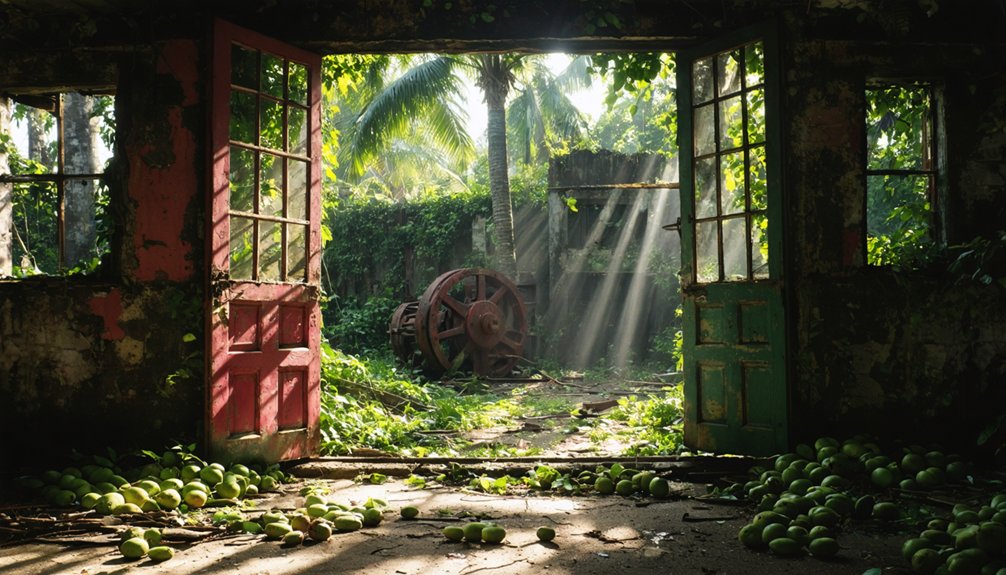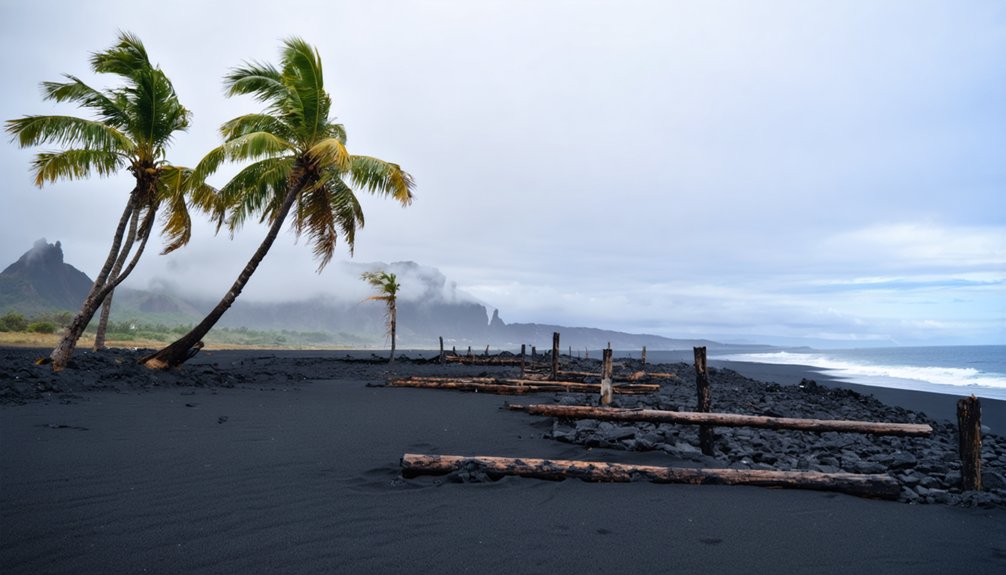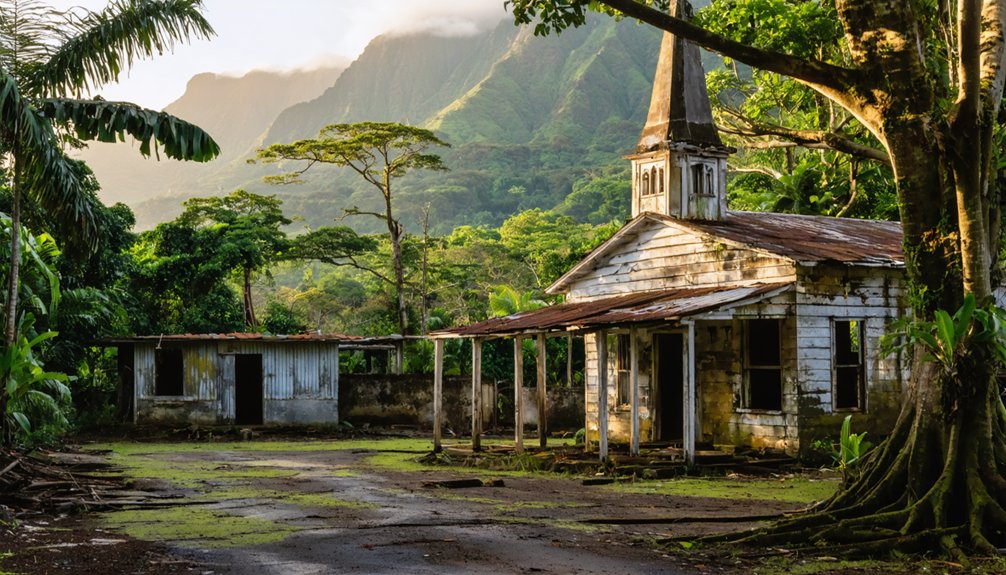
Hawaii’s “ghost towns” aren’t Western-style abandoned settlements—they’re tsunami-ravaged valleys like Waipi’o, where royal bones rest in cliff caves, and lava-consumed villages where Pele’s wrath erased entire communities. You’ll find sacred sites at Puʻuhonua o Hōnaunau, battle-scarred Nuʻuanu Pali where 800 skulls emerged during road construction, and Morgan’s Corner’s spirit-thick curves. Night Marchers still process along ancient pathways, while Pearl Harbor‘s 2,400 souls and supernatural guardians at volcanic caves complete Hawaii’s haunted landscape—each location revealing deeper connections between land, history, and the spirit world.
Key Takeaways
- Puʻuhonua o Hōnaunau’s Great Wall divided sanctuary and royal grounds where kapu breakers sought refuge until the early 19th century.
- Waipi’o Valley, former capital for Hawaiian rulers, contains numerous heiau and royal bones hidden in cliff caves.
- Kaloko-Honokōhau features abandoned fishponds and coastal community sites illustrating traditional Hawaiian practices now left in ruins.
- Morgan’s Corner, site of a 1948 murder, is now a gated community haunted by spirits from ancient battles.
- Night Marchers appear along the abandoned 175-mile Kings Trail, connecting former communities across the island with ghostly processions.
Ancient Sanctuaries and Abandoned Villages of the Big Island
The Big Island’s ancient landscapes harbor some of Hawaii’s most sacred and historically significant sites—places where stone walls still stand as silent witnesses to pre-contact civilization and the dramatic transformation that followed.
You’ll find Puʻuhonua o Hōnaunau’s Great Wall still dividing the sanctuary from royal grounds, where kapu breakers once sought refuge until the early 19th century. Archaeological sites like Moʻokini Heiau date to the 5th century, showcasing temple architecture that predates European contact by a millennium.
Ancient temples such as Puʻukoholā Heiau—Kamehameha’s massive stone complex—commemorate the violent unification period. The 175-mile Kings Trail once connected communities from Upolo Point to Hawaiʻi Volcanoes National Park, serving as a major ancient Hawaiian land route linking numerous ʻahupuaʻa across the island.
Puʻukoholā Heiau stands as Kamehameha’s monument to conquest—a massive stone testament to Hawaii’s bloody path toward unified rule.
At Kaloko-Honokōhau, you’ll discover abandoned fishponds and four ahupuaʻa divisions revealing how coastal communities thrived. North of the Kohala Coast, Puukohola Heiau rises as one of Hawaii’s largest ancient temples, its 224 by 110 feet dimensions achieved through lava rocks transported in a human chain spanning 25 miles. These locations aren’t tourist attractions—they’re portals to understanding Hawaii’s pre-contact sovereignty and cultural autonomy.
Waipi’o Valley: From Royal Seat to Tsunami-Ravaged Settlement
Among all ancient Hawaiian settlements, Waipi’o Valley stands apart as the archipelago’s most politically significant site—a lush gorge that served as the capital for nine successive Pili line rulers and remained home to Hawaiian royalty until Kamehameha I’s era.
You’ll find numerous heiau dotting this valley where ancient rituals connected chiefs with their gods, and where royal bones hidden in cliff caves still guard the land with their mana.
Sacred sites throughout Waipiʻo witnessed divine encounters and legendary battles that shaped Hawaiian history.
The valley’s abundance sustained island communities for centuries until devastating attacks by rival kings Kahekili II and Ka’eokülani desecrated its temples.
Though Kamehameha eventually unified the islands, Waipiʻo’s final blow came in 1946 when a tsunami destroyed homes and taro patches, forcing most residents to abandon this once-mighty seat of power.
The name Waipiʻo translates to “curved water,” referencing the winding river that flows through the valley floor.
Ancient legends claimed the valley concealed the entrance to Lua-o-Milu, the Hawaiian Underworld, hidden beneath the sand.
Nuʻuanu Pali Highway: Where Warriors’ Bones Still Speak
High above modern Honolulu, Nuʻuanu Pali’s windswept cliffs conceal one of Hawaiian history’s bloodiest battlegrounds—a precipice where over 800 Oʻahuan warriors met their deaths in 1795 rather than surrender to Kamehameha‘s conquering forces.
Where warriors chose death over dishonor, the cliffs of Nuʻuanu Pali bear witness to Kamehameha’s bloody path to unification.
Kamehameha’s battle tactics combined European muskets and cannon with traditional warfare, pushing Kalanikūpule’s defenders six miles up Nuʻuanu Valley to the 1,000-foot pali. Despite shifting warrior alliances—including defector Kaʻiana’s fatal choice—superior firepower devastated the Oʻahuan army. The invading force of 10,000-koa warriors had previously conquered Maui and Moloka’i before landing near Wai’alae and Waikīkī in February.
Rather than face capture’s humiliation, hundreds leaped from the cliffs in an act called Kaleleakeʻanae.
When engineers built Old Pali Road in 1897, they discovered the warriors’ remains: over 800 skulls scattered beneath the precipice. Today’s visitors reach the site via Pali Highway off-ramp from H-1, approximately 15–20 minutes from Honolulu. Today, you’ll encounter persistent legends of Night Marchers along this haunted highway, where ancient bones still rest beneath the pavement.
The Legend of Morgan’s Corner and Pali Road Mysteries
If you’ve driven Old Pali Road near the hairpin turn once known as Morgan’s Corner, you’ve passed the site of a 1948 tragedy that transformed a dangerous curve into Honolulu’s most infamous haunted location.
The brutal murder of 68-year-old widow Therese Wilder by escaped prisoners at her nearby estate sparked both public horror and enduring ghost stories that persist decades after the original house disappeared.
Beyond the urban legends falsely attached to this location, the genuine historical dangers—hundreds of crashes and multiple fatalities on the treacherous road—created their own legacy of tragedy.
This occurred before the 1958 Pali Highway construction bypassed Morgan’s Corner entirely.
The location takes its name from Dr. James Morgan, who lived on Nu’uanu Pali Road during the 1920s through 1940s.
Local legends include sightings of a ghostly Packard sedan from the 1930s that mysteriously fades as drivers approach it.
Morgan’s Corner Tragedy
On a quiet evening in March 1948, two escaped prisoners shattered the peace of Nu’uanu Valley when they murdered 68-year-old widow Therese Wilder at her home on 3939 Nu’uanu Pali Road. James Majors and John Palakiko broke through a dressing room window, bound and gagged Wilder, causing suffocation that claimed her life.
This tragedy sparked Honolulu’s horror and ignited fierce debate over capital punishment in Hawai’i.
The murder site, now lost to historical archaeology beneath a gated community called Ilana Wai, became intertwined with Morgan’s Corner‘s dark reputation. Cultural folklore blends this modern horror with ancient battles fought across Nu’uanu Pali, where O’ahu warriors once plunged from 500-foot cliffs.
You’ll find spirits from multiple eras reportedly haunting these dangerous curves where history’s violence left indelible marks. The area near the old Morgan estate became notorious after numerous crashes and fatalities added to its already tragic history. Locals share tales of a young couple’s nightmare, where a boyfriend was found hanging from a tree while his girlfriend waited in their stalled car below.
Mysterious Car Malfunctions
These malfunctions intensify near locations where 800 skulls and ancient relics were unearthed during the 1897-1898 construction—when worker Kilauea met his death in a blasting accident.
The dense spiritual energy permeating this area suggests you’re traversing spirit portals connected to Hawaiian mountain deities.
Locals advise leaving offerings of flowers at sacred boulders before crossing, acknowledging the guardians who’ve protected these peaks for centuries.
Night Marchers and the Spirit Roads of Old Hawaii
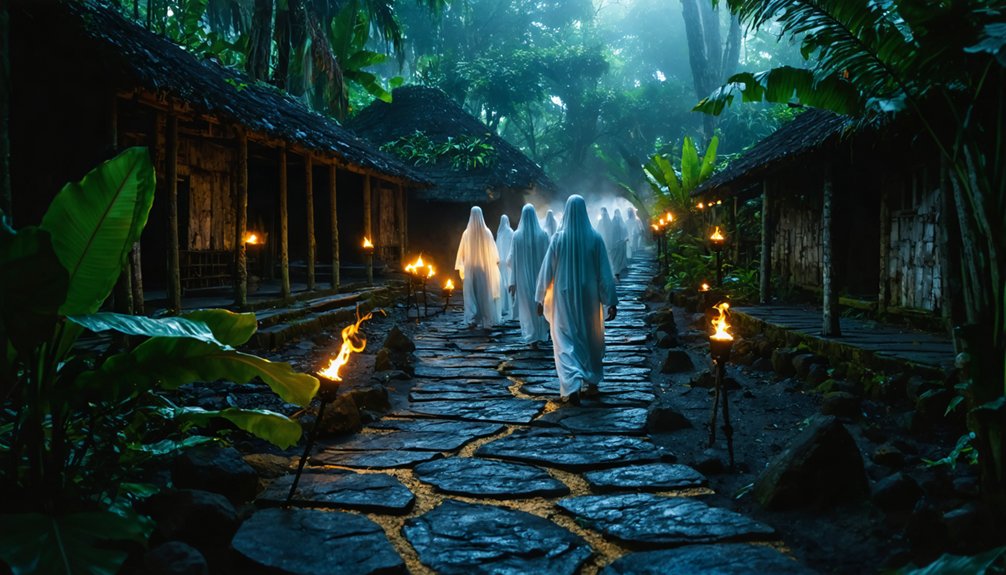
Among Hawaii’s most enduring supernatural legends, the Night Marchers—known as Huakaʻi Pō or “Procession of the Night”—represent spectral warriors eternally bound to guard the royal chiefs and kings they served in life.
These spiritual guardians traverse ancestral pathways between ancient battlefields, heiau temples, and royal compounds, appearing as glowing processions bearing torches and traditional weaponry.
Ghostly warriors march eternal routes connecting sacred Hawaiian battlegrounds, temples, and royal sites, their torchlit formations blazing through the darkness.
You’ll hear them before you see them—war drums pounding, conch shells echoing, feet stomping in rhythm.
They’re most active during bright moon phases, particularly pō Kāne nights when spirits walk freely.
If you encounter them along sacred sites like Kaʻena Point or Mākaha Valley, survival demands immediate action: lie prone, cover your head, and avoid eye contact.
Some quickly chant their moʻokūʻauhau (genealogy), hoping an ancestor marches among them and offers protection.
Pearl Harbor’s Restless Spirits and Military Hauntings
The December 7, 1941 attack on Pearl Harbor claimed over 2,400 American lives in a matter of hours, leaving profound trauma etched into Oahu’s landscape.
You’ll find that military personnel and visitors consistently report unexplained phenomena at the USS Arizona Memorial, where 900+ sailors remain entombed, and across Ford Island’s former battleground.
From the original bullet-scarred hangars at Pacific Aviation Museum to the residential areas where servicemembers once lived, these sites pulse with paranormal activity that echoes the morning’s chaos and sacrifice.
The 1941 Attack’s Legacy
When 2,403 Americans lost their lives during Japan’s surprise attack on December 7, 1941, the devastating event left an indelible mark on Hawaii that extends beyond historical memory.
You’ll find the USS *Arizona* Memorial standing above waters where 1,177 sailors perished, transforming this site into one of America’s most solemn ceremonial sites.
The attack destroyed or damaged 21 vessels and 347 aircraft, creating a watershed moment that propelled the nation into World War II.
While Hawaii’s volcanic legends speak of ancient spirits tied to the land, Pearl Harbor’s legacy remains firmly rooted in documented history—1,178 wounded survivors, extensive military infrastructure damage, and a collective national trauma that reshaped American foreign policy and military preparedness for generations.
Beyond Pearl Harbor’s role as a pivotal World War II battlefield, it’s become one of America’s most persistently haunted military installations. The USS Arizona Memorial, where over 900 sailors remain entombed, generates consistent paranormal reports. Visitors experience phantom footsteps, distant explosions, and apparitions in WWII naval uniforms.
Ford Island’s residential quarters harbor particularly active phenomena, with locals attributing playful disturbances to “Charley,” a documented poltergeist who manipulates faucets, radios, and doors. The airstrip evokes overwhelming dread, accompanied by glowing mists and sounds of running boots.
These spectral occurrences exist alongside ancient petroglyphs and tropical flora, creating an unsettling juxtaposition where Hawaii’s natural beauty meets wartime tragedy’s lingering psychological imprint.
Reported Paranormal Phenomena:
- Shadowy figures running along submerged Arizona decks
- Dark mist resembling Japanese aircraft hovering over water
- Burning smells and metallic clanging from sunken hulls
- Disembodied voices echoing through empty military housing
- Spontaneous electronic malfunctions throughout base facilities
Air Base Ghost Sightings
Military personnel who’ve lived and worked at Pearl Harbor‘s air facilities consistently report encounters that defy rational explanation.
At the Pacific Aviation Museum on Ford Island, Ghost Hunters investigators documented strange phenomena in hangars still scarred by bullet holes from December 7, 1941. You’ll find witnesses describing footsteps echoing through empty corridors and apparitions wearing WW2-era naval uniforms near attack sites.
The most extraordinary incident remains the P-40 Kittyhawk appearing on radar December 8, 1942. Intercepting pilots watched a bullet-riddled plane with landing gear destroyed approach—its slumped pilot turning to grin before crashing. No body was recovered.
While skeptics compare such reports to UFO sightings, these unexplained noises and apparitions persistently emerge from areas where over 2,300 died during Japan’s assault.
Sacred Caves, Black Sand Beaches, and Supernatural Guardians
Hidden beneath Hawaii’s volcanic landscape and along its obsidian shores, sacred caves and black sand beaches harbor some of the islands’ most formidable supernatural entities.
Hawaii’s volcanic caves and black sand beaches conceal ancient supernatural guardians who blur the boundary between sacred legend and terrifying reality.
You’ll find Mākua Cave sheltering the shark god Nanaue, who disguises himself as an elderly Hawaiian man, inviting weary travelers to feast before transforming.
At Punalu’u’s black sand beach, restless spirits crash celebrations, while Polihale’s cliffs serve as launching points for souls entering Pō.
- Mo’o wahine Kamoe and Leilehua descending from Mt. Ka’ala to claim sacrificial offerings at sacred sites marked by ancient petroglyphs
- Night marchers processing in legless phalanx formation, torches flickering near heiau adorned with sacred tree carvings
- Menehune constructing fishponds and temples overnight, vanishing before dawn
- Sulfur scents and drumbeats echoing across moonlit Polihale’s endless black shores
- Bodies left rotting three weeks in Kaneana Cave’s darkness
Molokai’s Forgotten Settlements and Tsunami Ghost Towns
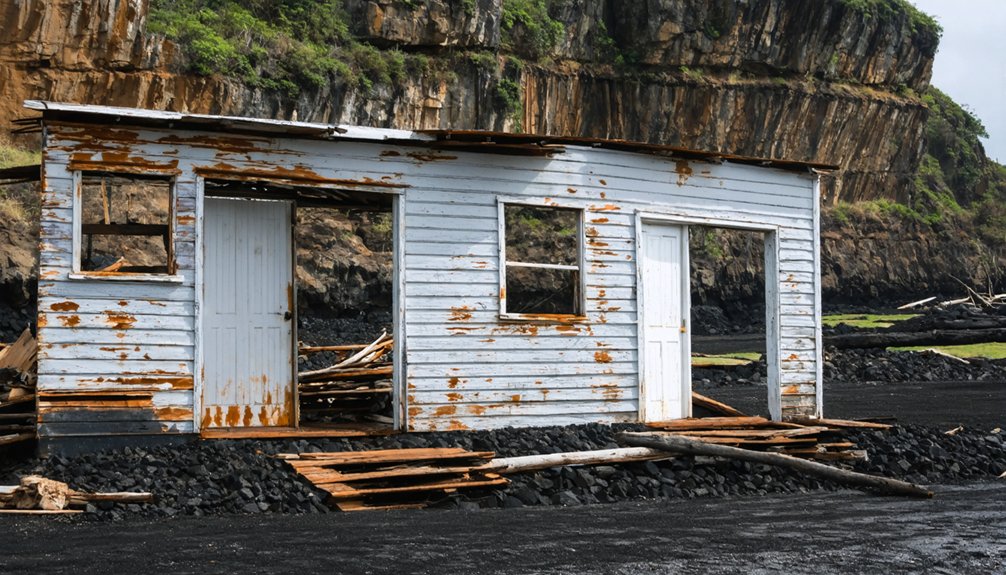
While volcanic caves and obsidian shores host Hawaii’s ancient supernatural guardians, Molokai’s coastlines hold a different kind of haunting—entire communities erased by tsunamis, economic collapse, and forced exile.
You’ll find Kaupoa Beach, where Molokai Ranch’s development allegedly *unleashed* mischievous spirits after protective kukui trees were felled.
Local legends speak of Night Marchers prowling these abandoned resort grounds.
The Kalaupapa peninsula represents forced displacement on two levels: indigenous Hawaiians removed for a leprosy colony established in 1866, where 8,000 patients endured isolation.
Consecutive tsunamis in 1946 and 1957 permanently obliterated coastal settlements, while Maunaloa became a ghost town in 2008 when ranch operations ceased.
These sites embody cultural preservation through memory—communities that rejected tourism development incompatible with island values, leaving emptiness as testimony to resistance.
Frequently Asked Questions
What Safety Precautions Should Visitors Take When Exploring Hawaiian Ghost Towns?
You’ll need to respect historical preservation by avoiding artifacts, heed local legends about sacred spaces, never trespass on private property, wear protective clothing for sharp lava terrain, and carry emergency supplies since ghost towns lack services or cell coverage.
Are There Specific Times of Year When Paranormal Activity Increases in Hawaii?
You’ll notice paranormal activity peaks during Hawaii’s last four lunar phases, when night marchers emerge. Seasonal spirits also intensify before volcanic events—like 1955’s ghost lights preceding Puna’s eruption—and during moonless nights with high tides.
Can Tourists Legally Access All the Abandoned Village Sites Mentioned?
No, you can’t legally access all sites. Historical preservation laws and cultural sensitivities restrict entry to Kalaupapa, Kalawao, and Keomuku. You’ll need special permits or resident invitations, as these locations remain protected or privately owned.
How Do Modern Hawaiians View Commercial Ghost Tours of Sacred Sites?
Modern Hawaiians hold mixed views on commercial ghost tours. While some appreciate respectful tourism that honors traditions through proper protocols, others criticize tours lacking cultural sensitivity, particularly when operators disrespect sacred sites or make insensitive comments about Hawaiian spirituality.
Exploring the remnants of abandoned buildings in Kohala can evoke a sense of the past, highlighting the unique history and stories of the Hawaiian Islands. However, it is essential that such explorations are conducted with mindfulness and respect for the cultural significance of the area, ensuring that the narratives shared do not trivialize or commercialize sacred spaces. This delicate balance is vital for fostering a deeper understanding and appreciation of Hawaii’s rich heritage.
What Should You Do if You Encounter Night Marchers?
Lie flat immediately, avert your gaze, remain absolutely silent. Ancient legends demand spiritual respect—don’t look directly at night marchers. If you’re Hawaiian, an ancestor might protect you. Strip naked if desperate, feigning madness to survive their passing.
References
- https://nvtami.com/2023/04/26/big-island-hawaii-ghost-towns/
- https://www.americanghostwalks.com/7-creepiest-urban-legends-and-ghost-stories-from-hawaii
- https://www.hauntedrooms.com/hawaii/haunted-places
- https://www.youtube.com/watch?v=3tGSM9Xl-4M
- https://danielshawaii.com/hawaii-vacation-blog/pali-lookout-haunted-highway-in-hawaii/
- https://www.honolulumagazine.com/our-favorite-ghost-stories-about-haunted-places-on-oahu/
- https://www.mysteries-of-hawaii.com/blog
- https://en.wikipedia.org/wiki/List_of_ghost_towns_in_Hawaii
- https://www.youtube.com/watch?v=tFXNMehIb5s
- http://www.onlyinyourstate.com/experiences/hawaii/most-terrifying-places-hi