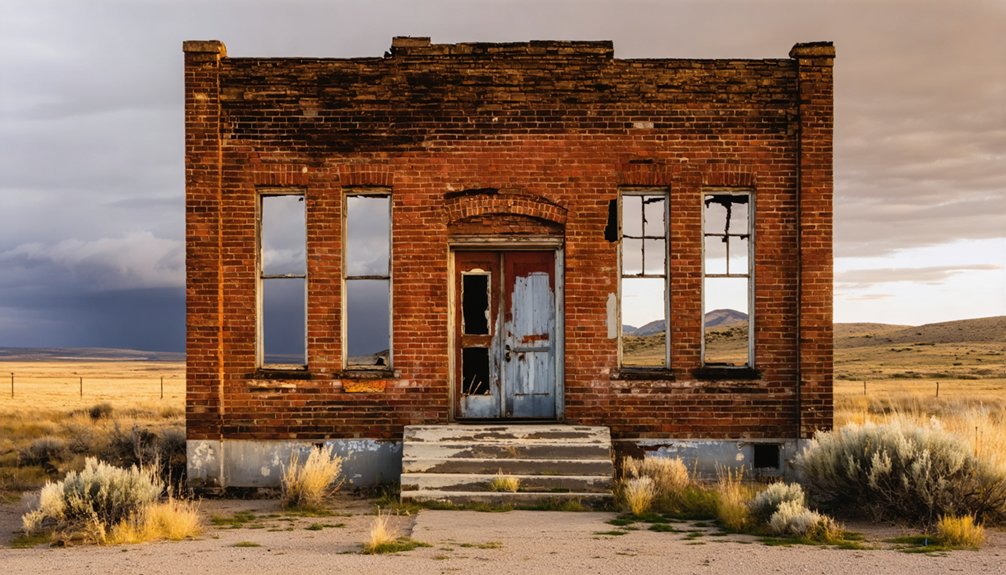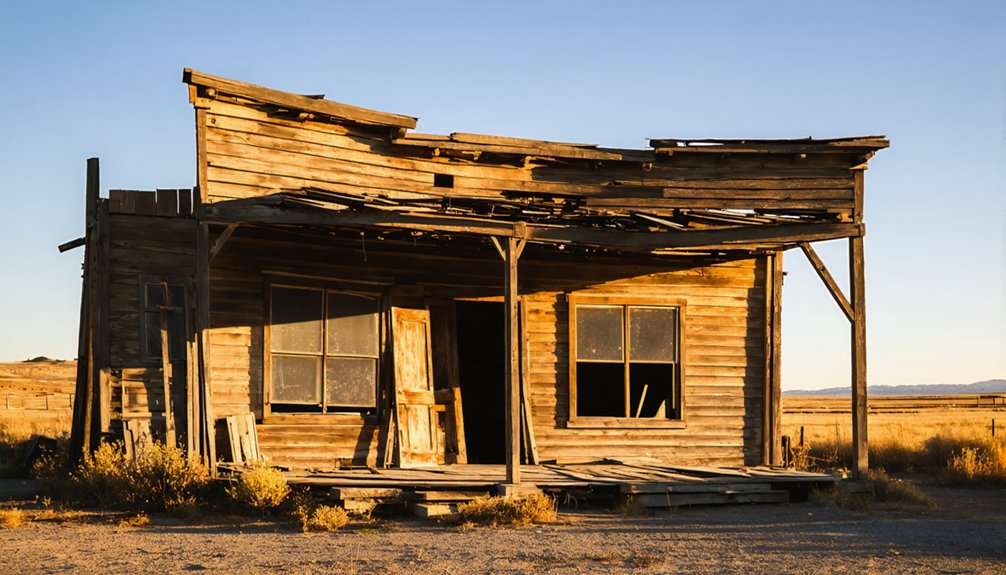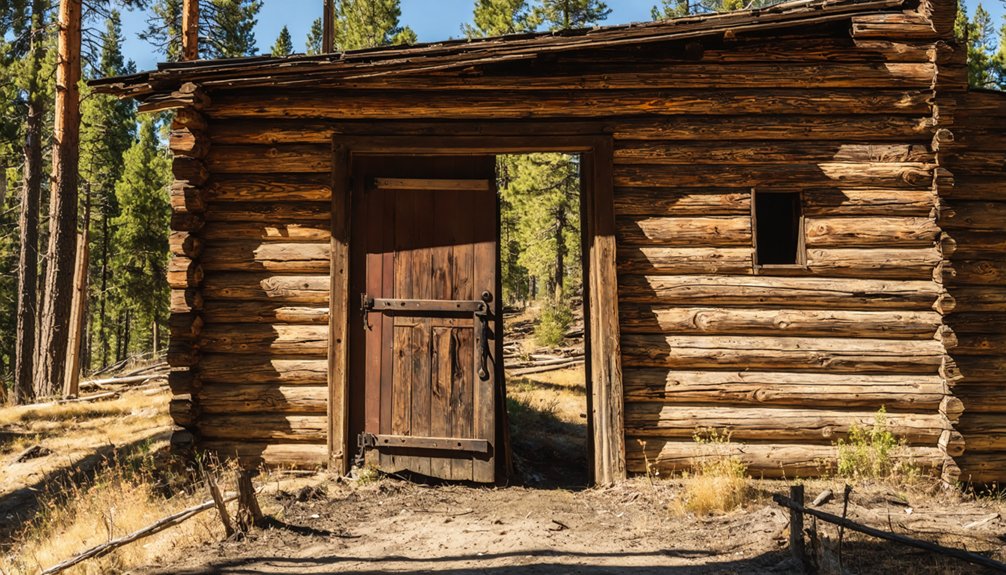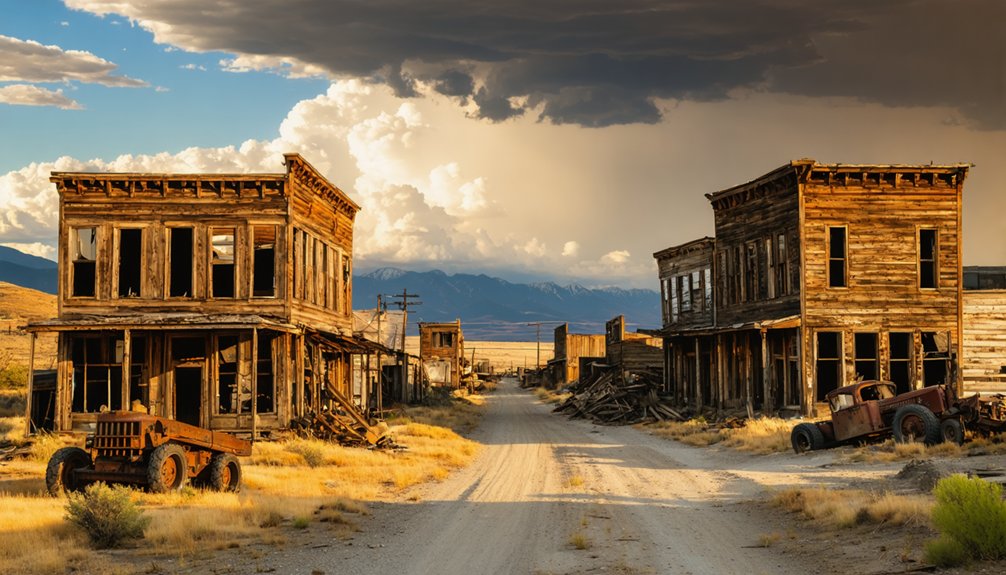
You’ll find Idaho’s most haunted ghost towns scattered across remote mountain valleys, where authentic paranormal activity has been documented for decades. Silver City stands as the state’s best-preserved ghost town with 75 structures from the 1860s-1900s, where visitors report child spirits, apparitions, and disembodied voices throughout its historic buildings and surrounding cemeteries. Gilmore, perched at 7,200 feet near Montana, features rusted mining equipment and legends of violent confrontations, while Custer’s 29-acre historic district preserves remnants of its 1,000-resident peak. Each location offers distinct supernatural encounters tied to Idaho’s violent mining heritage and frontier past.
Key Takeaways
- Silver City, Idaho’s most preserved ghost town, features 75 structures and reports paranormal activity including apparitions, floating lights, and disembodied voices.
- Gilmore contains 20-40 dilapidated structures at 7,200 feet elevation with legends of a 2009 shootout and historical mining tragedies.
- Burke Canyon’s abandoned mines and houses are haunted by spirits of miners killed in explosions and fires between 1892 and 1923.
- Chesterfield, established in 1881, is a National Historic District with preserved buildings and a cemetery overlooking Portneuf Valley.
- Custer’s 29-acre historic district includes remnants of a segregated Chinatown and mining community that peaked at 1,000 residents in the 1880s.
Chesterfield: Echoes of Pioneer Spirits in Bannock County
Nestled in Caribou County’s Gem Valley at 5,446 feet elevation, Chesterfield stands as one of Idaho’s most historically significant ghost towns, though the article title’s reference to Bannock County contains a geographical error.
Mormon settlers established this outpost in 1881 along the Oregon Trail route, building a thriving community that peaked at over 400 residents by the mid-1920s. You’ll find preserved structures dating from 1884-1904, including the LDS meetinghouse, amusement hall, and Brook Mercantile store arranged in a 35-block grid pattern. The Chesterbrook Mercantile, operated by a church bishop, served as the downtown commercial hub alongside a tithing office where residents made their church monetary contributions.
Unlike typical abandoned settlements, visitors consistently report an uplifting spiritual presence rather than unsettling atmosphere. The Chesterfield Foundation has maintained this National Historic District since 1980, where pioneer memories linger tangibly among the restored buildings and cemetery that overlook the Portneuf Valley. The town gradually emptied due to economic downturns, harsh winters, and migration to urban centers rather than the sudden abandonment typical of mining camps.
Gilmore: Mining Town Whispers Near the Montana Border
Perched at 7,200 feet in Lemhi County’s remote high country, Gilmore sits 65 miles south of Salmon near the Montana border.
Where silver miners first staked claims in the 1880s at a site originally called Horseshoe Gulch.
The town peaked at over 600 residents during its 1910s-1920s heyday, when the Gilmore and Pittsburgh Railroad—nicknamed “Get Off and Push”—hauled lead and silver ore over the Continental Divide.
Mining equipment still rusts among 20-40 dilapidated structures, though heavy metals contaminate the soil.
Town legends include a 2009 shootout with an unidentified gunman and two separate power plant explosions in 1914 and 1927.
After the last mine closed in 1929, Gilmore’s post office limped along until 1957 before declaring the site officially abandoned.
The Gilmore Mercantile and Tucker home stand among the most recognizable ruins, alongside remnants of saloons and the old hotel.
The surrounding Lemhi Range features peaks over 11,000 feet, offering hikers panoramic vistas above the abandoned townsite.
Placerville: Golden Ghosts of Boise County’s Past
You’ll find Placerville seventeen miles east of Horseshoe Bend, where 5,000 fortune-seekers flooded into the Boise Basin by summer 1863 after rich placer deposits sparked Idaho’s greatest gold rush.
The boom lasted barely seven years—miners earned $50-$60 daily while thirteen saloons and hundreds of businesses lined the streets.
But exhausted deposits dropped the population below 400 by 1870.
Fire devastated what remained on August 17, 1899, destroying most structures, with a second blaze following ten months later to seal the town’s transformation from roaring camp to near-ghost.
The town briefly surpassed Portland in September 1863 with 6,067 residents, making it the largest population center in the Pacific Northwest.
Today, only about 41 residents remain in this small town, along with a few historic buildings, museums, the “City Hall,” and a cemetery containing the graves of the three murdered fiddlers.
Gold Rush Boom Days
On August 2, 1862, prospectors George Grimes and Moses Splawn struck gold on Grimes Creek, igniting what would become the richest placer gold rush in American history.
Following a Bannock Indian’s tip, they discovered claims yielding $100 to $200 daily through Gold Panning techniques.
By December 1862, Placerville transformed into a thriving frontier metropolis where:
- Over 4,500 mining claims were staked by 1864
- Buildings were elevated for underneath mining operations
- Population swelled to 5,000, with Irish, Chinese, German, and Portuguese contingents
- Day-night operations ran continuously during water season
The Boise Basin ultimately produced nearly 3 million troy ounces of placer gold.
Located 12 miles northwest of Idaho City in a mountain basin behind Mores Mountain, Deer Point, and Shafer Butte, the town was accessible only via dirt forest roads that emphasized its remote character. Railroads brought materials to support the logging industry and mining operations in the surrounding area.
When prospectors eventually delivered their Miner’s Farewells, Placerville remained standing—a tribute to unfettered ambition carved into Idaho’s mountainsides.
Fire’s Devastating Aftermath
Placerville’s golden prosperity couldn’t withstand the flames that swept through town on the night of August 17th, 1899. The fire aftermath left practically nothing standing—most buildings reduced to ash in hours. This devastating blaze represented the greatest in a series that had repeatedly consumed large sections of the settlement.
You’ll find that ghost town decay accelerated rapidly after the inferno. Though residents immediately rebuilt the streetscape you see today, another fire struck just ten months later, destroying several reconstructed buildings. By then, the population had already plummeted from 5,000 in 1863 to under 400 by 1870.
Only the Boise Basin Mercantile and Magnolia Saloon survived the destruction. The Placerville cemetery provides insights into early settlers and their lives. The cemetery features diverse headstones and monuments that mark the graves of miners from various immigrant communities who once called this boomtown home.
Today, around 60 residents remain among these fire-scarred remnants of Idaho’s mining past.
Custer: Spectral Memories of the Idaho Gold Rush
Below the General Custer mill site in early 1879, gold speculators founded what would become one of Idaho’s most substantial mining camps. Named for General George Armstrong Custer, this settlement exploded to nearly 1,000 residents during the early 1880s boom. Mining relics and Custer legends now permeate the preserved 29-acre historic district.
At its 1896 peak, you’ll find evidence of a complete frontier society:
- Commercial enterprises: Wells Fargo office, three general stores, two restaurants, furniture store
- Social venues: Five saloons, four brothels, dance hall, baseball team
- Cultural institutions: Schoolhouse, Miners Union Hall, newspaper “The Prospector”
- Chinatown community: Segregated settlement with Joss House church, housing Chinese launderers and miners
The Lucky Boy Mine’s 1904 closure triggered swift decline.
Today’s Forest Service-managed site offers free tours through seven preserved buildings.
Silver City: Mountain Phantoms Among Historic Buildings
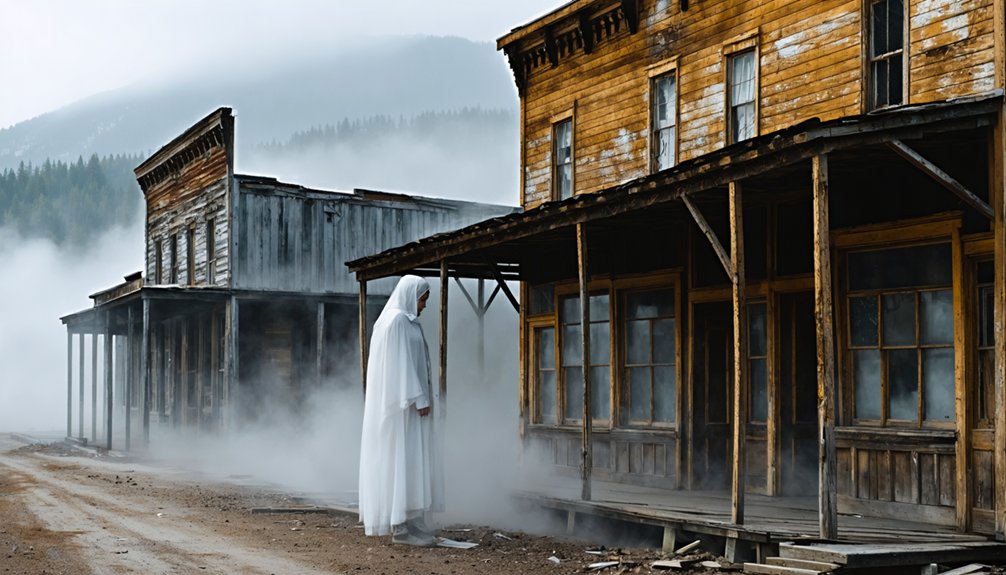
You’ll find Silver City perched at 6,200 feet in the Owyhee Mountains, where seventy-five structures from the 1860s-1900s stand as Idaho’s best-preserved ghost town.
The historic buildings that once housed 2,500 residents and 75 businesses now slouch on hills above Jordan Creek. They are accompanied by reports of haunted spirits wandering among them.
Over 10 cemeteries and hundreds of abandoned mines honeycombing the surrounding mountains have given this former county seat a reputation for ghostly encounters.
These features draw visitors to its remote location, which has no electricity or indoor plumbing.
Ghostly Encounters in Town
Perched at 6,180 feet in the Owyhee Mountains, Silver City stands as Idaho’s most famous ghost town. Over 300 former homes and 75 businesses create an expansive landscape for documented paranormal activity.
You’ll find urban legends and folklore traditions woven throughout this historic mining settlement, where visitors consistently report unexplained phenomena across the entire townscape.
Documented encounters include:
- Child spirits in period clothing playing marbles off Washington Street, vanishing when approached
- Full-bodied apparitions wearing historical attire spanning the town’s operational decades
- Floating lights and shadowy figures observed in windows of abandoned structures
- Disembodied voices and footsteps echoing from dormant buildings throughout the property
Temperature anomalies, moving objects, and persistent sensations of being watched define the Silver City experience, establishing it as Idaho’s premier paranormal destination.
Historic Buildings and Spirits
The spirits haunting Silver City concentrate most intensely within its 75 surviving structures, where buildings dating from the 1860s through early 1900s retain both their architectural integrity and supernatural residents.
You’ll find the Idaho Hotel’s original Wells Fargo office reportedly active with unexplained phenomena, while the 1869 Masonic Lodge—still hosting town meetings—echoes with footsteps from previous gatherings.
Mining tragedies fueled ghost town legends throughout these preserved buildings, particularly after the Ida Elmore Mine’s 1868 underground gunfight left two dead.
The 1898 church and museum-converted schoolhouse harbor their own paranormal accounts.
With nearly a dozen cemeteries scattered across the remote canyon and 100 mines producing countless fatalities, you’re surrounded by restless spirits anchored to Silver City’s violent past.
Burke: The Eerie Watchfulness of Abandoned Miners
Deep within Burke Canyon, where Canyon Creek carved a narrow passage through Idaho’s mountains, prospectors struck lead-silver-zinc ore at the Tiger claim on May 2, 1884. Within days, seventy claims dotted the canyon, transforming wilderness into boomtown.
In 1884, Canyon Creek’s lead-silver-zinc discovery sparked a mining rush that transformed Burke Canyon from wilderness into instant boomtown.
But violence haunts this ghost town’s legacy—mining folklore whispers of souls who never left.
You’ll find Burke’s tragic history etched in every abandoned structure:
- 1892 Frisco Mill explosion killed six when gunfire ignited dynamite during labor strikes
- 1899 Bunker Hill dynamiting destroyed 80 crates of explosives, bringing martial law
- 1910 fire obliterated fifty businesses and residences, causing million-dollar devastation
- 1923 blaze displaced 600 residents, shuttering the Hecla Mine
Ghost town legends persist among Burke’s fifteen remaining residents, where dilapidated houses cling to canyon walls and empty mine structures watch over the creek.
Supernatural Encounters in Idaho’s Deserted Settlements
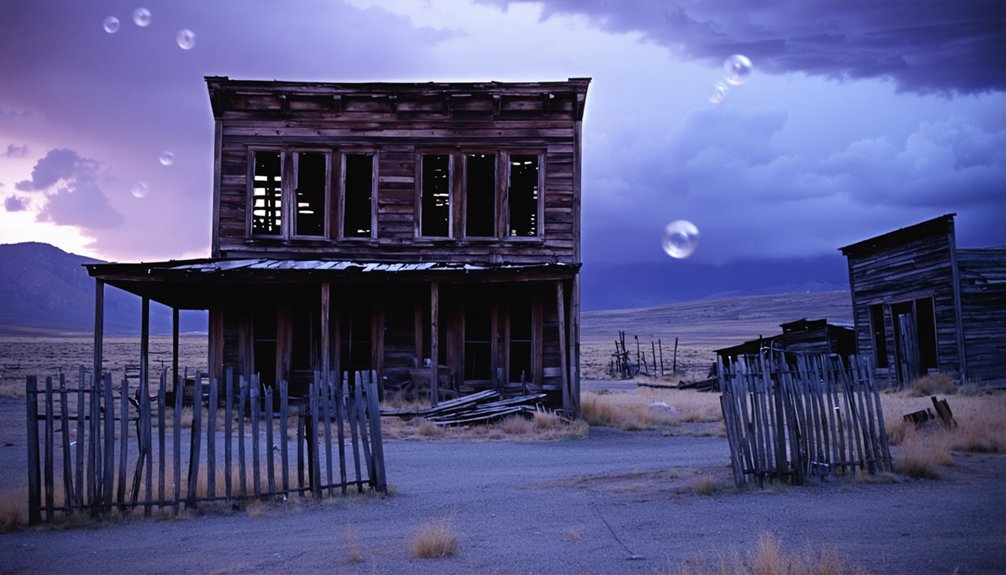
You’ll encounter more than crumbling structures when exploring Idaho’s abandoned settlements—witnesses consistently report full-bodied apparitions dressed in period clothing wandering streets like Washington Street in Silver City.
Phantom canoes glide across Spirit Lake’s surface on moonlit nights, carrying the silhouettes of Kootenai lovers who drowned themselves rather than live apart.
Inside the Idaho Hotel, unexplained sounds emanate from rooms once occupied by J Marion Moore and Samuel Lockhart, who died violently on the building’s front steps during a shootout.
Ghostly Apparitions and Sightings
Across Idaho’s abandoned settlements, witnesses have documented full-body apparitions with startling consistency, particularly at Silver City’s Idaho Hotel where multiple distinct spirits inhabit the structure. You’ll find J. Marion Moore and Samuel Lockhart’s ghostly figures still wandering where their fatal shootout ended on the front steps. Spirit communication and apparition photography have captured compelling evidence at these locations.
Notable manifestations across Idaho’s ghost towns include:
- Fort Hall Bottoms: Faceless woman dressed in white appearing to multiple witnesses
- The Sluice Box: Spectral figures visible through windows from outside the antique shop
- Lower Mesa Falls: Shoshone girl’s apparition in white clothing near drowning site
- Gotts Point: Young girl’s spirit manifesting near Lake Lowell’s 1970s accident location
These documented encounters reveal patterns of supernatural activity concentrated around sites of tragedy and violent death.
Unexplained Sounds and Phenomena
Beyond visual manifestations, Idaho’s ghost towns assault visitors’ senses with inexplicable auditory phenomena that defy rational explanation. At Silver City’s Idaho Hotel, disembodied voices and footsteps echo through original mining-era structures, linked to spirits from the silver depletion period.
Burke’s canyon ruins generate profound sensations of surveillance, which intensify after you explore its violent mining history.
The Old Idaho Penitentiary produces phantom cries from vacant cells, accompanied by invisible touches and overwhelming despair—remnants of botched executions spanning a century.
Mesa Falls delivers phantom drumbeats near Lower Mesa Falls, attributed to a drowned Shoshone girl’s spirit.
The Owyhee Mountains combine cryptid sightings of legendary cannibalistic dwarves with nocturnal rituals, where nighttime visits trigger unexplained events among volcanic terrain, embodying generations of Indigenous warnings.
Preserving Paranormal History in Remote Ghost Towns
When organizations work to preserve Idaho’s remote ghost towns, they simultaneously protect both tangible structures and the paranormal histories embedded within them. You’ll find spectral folklore intertwined with preservation efforts at sites like Bayhorse, where the Bureau of Land Management maintains both historic structures and documented paranormal investigations.
The arid climate naturally preserves buildings while keeping supernatural accounts intact.
Key preservation initiatives protecting paranormal history include:
- Challis National Forest’s oversight of Custer since 1966, maintaining original structures where unexplained phenomena persist
- Lemhi County Historical Society’s artifact preservation at Gilmore, documenting ghost stories alongside mining relics
- Idaho park service’s 2009 acquisition of Bayhorse, ensuring year-round access for paranormal researchers
- Chesterfield Foundation’s educational programs, incorporating settler ghost stories into historical tours
These efforts let you explore haunted sites while respecting their layered histories.
Planning Your Visit to Idaho’s Most Haunted Locations
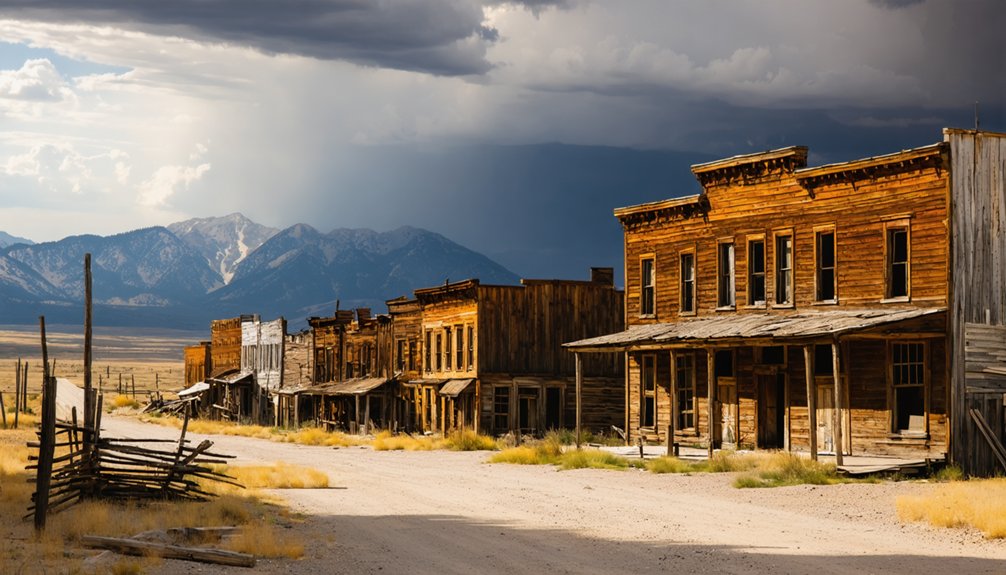
Planning your expedition to Idaho’s haunted ghost towns requires careful route mapping, as many sites occupy isolated terrain accessible only through seasonal roads.
Idaho City lies 40 miles northeast of Boise via State Highway 21, where Boot Hill Cemetery’s 3,000 burials harbor urban legends from 1860s Gold Rush violence.
Silver City demands 70-mile drives on dirt roads from Jordan Valley, best tackled during spring or fall.
Remote locations like Custer and Bayhorse need high-clearance vehicles and emergency supplies—winter snow blocks mountain passes entirely.
Canyon Hill Cemetery in Caldwell welcomes year-round visits, with folklore tales of midnight jogger apparitions peaking after dark.
The Idaho State Historical Society provides essential maps, while local societies detail accessibility for sites where regional knowledge proves critical for safe exploration.
Tales and Legends From Idaho’s Forgotten Communities
Idaho’s ghost towns preserve accounts of pioneer spirits materializing along creek beds in full period dress—men, women, and children who vanish upon approach, remnants of settlers who journeyed north from Salt Lake City as early as the 1840s. Cultural folklore throughout the region documents violent frontier justice that shaped these communities.
Among these haunting narratives, traces of abandoned mining towns in northern Idaho serve as a testament to the dreams and struggles of those who sought fortune in the rugged terrain. As the echoes of pickaxes and the bustle of trading posts fade into silence, these remnants now invite adventurous souls to explore their storied pasts. In this remote wilderness, the spirits of those who once called these towns home seem to linger, sharing whispered tales of hope and hardship with every gust of wind.
Spectral settlers in pioneer clothing emerge near waterways before disappearing, echoing Idaho’s violent territorial past and westward migration hardships.
Notable Legends from Idaho’s Mining Era:
- Florence earned recognition as America’s most dangerous town during the 1860s gold rush, where only 28 of the first 200 deaths occurred naturally.
- Boot Hill Pioneer Cemetery in Idaho City holds 3,000 unmarked graves, lost when environmental impacts from fire destroyed cemetery records.
- Cherokee Bob’s grave marks Florence’s outlaw legacy.
- The Pioneer Saloon’s resident miner spirit represents Ketchum’s boom town heritage.
These forgotten communities reveal Idaho’s untamed history through preserved accounts and physical remnants.
Frequently Asked Questions
What Paranormal Investigation Equipment Is Recommended for Ghost Town Visits?
You’ll need EMF detectors to measure electromagnetic fluctuations in abandoned structures, plus Spirit boxes for potential communication attempts. Bring thermal cameras, audio recorders, and reliable flashlights. Idaho’s remote ghost towns demand backup batteries and weatherproof documentation tools.
Are Overnight Stays Permitted in Any of Idaho’s Haunted Ghost Towns?
Yes, you’ll find overnight stays permitted at several locations. Silver City’s Idaho Hotel exemplifies historical preservation welcoming visitors since 1866. Burgdorf’s cabins and Gooding’s former TB hospital offer stays, though tourism regulations require advance reservations for most properties.
Which Idaho Ghost Town Reports the Most Frequent Supernatural Activity?
Silver City reports the most frequent supernatural activity, where you’ll encounter historical legends stating every visitor experiences paranormal events. Spectral sightings include drifting lights after dark and self-operating doors throughout this iconic mining settlement’s preserved buildings.
Do Any Ghost Tour Companies Offer Guided Visits to These Locations?
Looking for guided ghost tours? You’ll find limited commercial operators at Idaho’s haunted ghost towns. These historical preservation sites remain mostly self-guided tourist hotspots, letting you explore independently rather than joining organized paranormal tours.
Among these intriguing locations are various abandoned places in Idaho, each with its unique stories and mysteries waiting to be uncovered. Adventurers often seek out these forgotten sites to capture eerie photographs and discover the remnants of the past. Whether you’re a history enthusiast or a thrill-seeker, Idaho’s abandoned places offer a captivating glimpse into what once was.
What Safety Precautions Should Visitors Take When Exploring Abandoned Structures?
You’ll need proper safety gear including sturdy boots, gloves, and respirator masks. Conduct thorough structural assessment before entering—test floors, avoid weakened areas, and never explore alone. Always inform someone of your location and expected return time.
References
- https://idaho-forged.com/idahos-ghost-towns-eerie-yet-approachable/
- https://shorelodge.com/old-haunts-of-idaho/
- https://history.idaho.gov/wp-content/uploads/2018/08/0064.pdf
- https://www.youtube.com/watch?v=YImgrC91vBo
- https://www.youtube.com/watch?v=rTSZSlxTmbs
- https://visitidaho.org/things-to-do/ghost-towns-mining-history/
- https://en.wikipedia.org/wiki/List_of_ghost_towns_in_Idaho
- https://www.eastidahonews.com/2015/10/the-ghost-town-of-chesterfield/
- https://www.youtube.com/watch?v=IqV57c1eY28
- https://en.wikipedia.org/wiki/Chesterfield