You’ll find Illinois haunted ghost towns scattered across former mining communities and abandoned river settlements, where economic collapse left behind more than empty buildings. Sangamo Town’s 250 residents vanished as Springfield grew, leaving archaeological sites with Revolutionary War veterans’ graves. Kaskaskia, Illinois’ first capital, drowned in an 1844 flood and remains isolated on a river island. Bachelor’s Grove Cemetery in Bremen Township reports paranormal activity among its 80 graves, while McPike Mansion shelters up to 12 documented spirits. Mining towns like Cardiff and Braidwood feature decaying opera houses alongside phantom train sightings at abandoned railroad crossings, blending industrial ruins with supernatural encounters throughout the state’s most forsaken corners.
Key Takeaways
- Sangamo Town peaked at 250 residents before abandonment, leaving archaeological remnants and ties to Revolutionary War veterans near Springfield.
- Kaskaskia, Illinois’ first capital, was destroyed by an 1844 flood and remains isolated on a river island today.
- McPike Mansion in Alton reportedly houses up to 12 spirits, with ghost hunters documenting orbs and paranormal phenomena since 1869.
- Abandoned railroad stations like Munger Road feature phantom train sounds, with recent 2024 sightings of vanishing ghostly locomotives.
- Bachelor’s Grove Cemetery, Cook County’s oldest, faces vandalism and legends linking it to Al Capone’s Mafia dumping ground.
The Mysterious Disappearance of Fulton County’s Forgotten Settlements
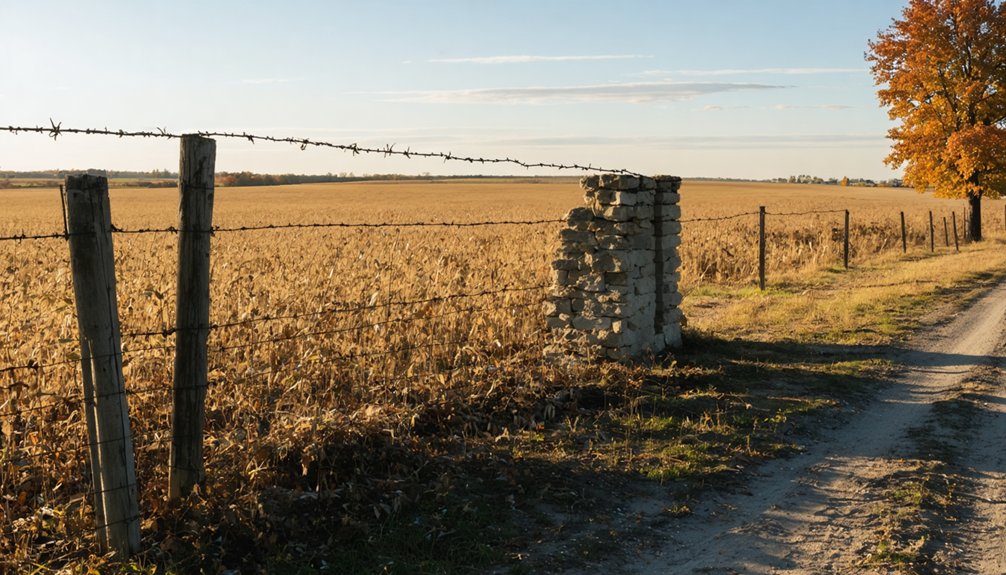
While Illinois’ bustling cities capture most historical attention, Fulton County harbors a collection of ghost towns that vanished so completely you’ll find only roadside markers and forgotten cemeteries marking their existence.
Tuscumbia, platted in 1837 with 54 lots, disappeared by 1855—now just a marker nine miles west of Lewistown. Milton’s 73 lots surrounding a grist mill on Big Creek faded without documented reasons. Vanopolis became vacant by 1844 after railroads bypassed it for Warsaw and Quincy.
The earliest settlement, Spoon River Village, stagnated despite operating a post office from 1838-1847. Old Randolph Cemetery overlooks the Spoon River near the former Tuscumbia townsite, serving as one of the few remaining physical connections to these vanished communities. West Point, platted in 1847 by Joel Onion as a landing on the Illinois River, declined when railroad development bypassed the settlement.
In Lee Township, Virgil’s cemetery stands as the sole remnant where local folklore and ghost stories still circulate about these mysteriously abandoned communities.
Sangamo Town: Where 250 Souls Once Walked
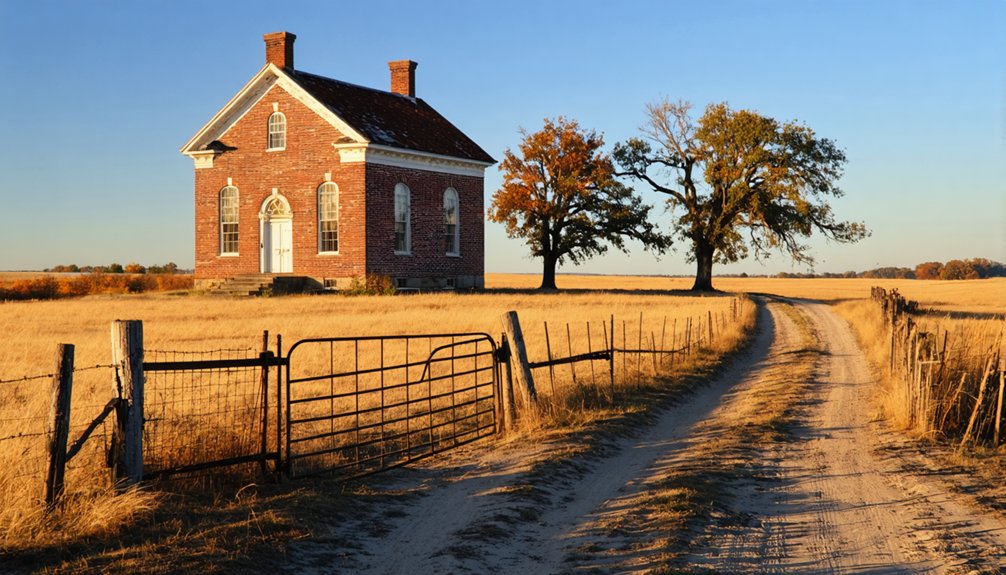
You’ll find Sangamo Town’s story etched in the clay banks near the Sangamon River, where archaeologist Robert Mazrim’s fifteen years of excavations uncovered hand-forged iron, locally made crockery, and Staffordshire teacups from a settlement that peaked at 250 residents.
The village thrived briefly with its gristmill and wool facilities before vanishing within years, even as Sangamon County’s population surged from 12,960 in 1830 to 19,228 by 1850.
These buried artifacts reveal the homes, taverns, and pottery shops of pioneers who built their community along ancient trails after the War of 1812, only to watch it disappear into obscurity. By 1900, the county’s population had reached its peak at 71,593 residents, while Sangamo Town remained nothing but a memory beneath the soil. Today, Sangamon County stands as the 11th largest county in Illinois, with Springfield serving as its county seat.
Revolutionary War Veteran’s Vision
When Moses Broadwell arrived in Sangamon County around 1819, he carried more than the memories of his Revolutionary War service—he brought capital from successful land speculation in Ohio and an ambitious vision for a thriving river town. The New Jersey-born veteran platted Sangamo Town with over 80 lots, designing infrastructure to challenge Springfield’s dominance as county seat.
His pioneer settlements featured a gristmill, wool carding mill powered by oxen treadwheel, general store, blacksmith shop, tavern, and ferry crossing. Broadwell stood among 52-54 Revolutionary War patriots who’d claim Sangamon County as their final resting place—men who’d fought for independence now seeking to build something lasting on the frontier. Like many veterans who relocated to Illinois post-war, these soldiers sought new opportunities in the expanding western territories.
Historical preservation efforts today recognize these veterans through markers on Old Capitol Plaza, though Broadwell’s commercial dreams would ultimately crumble. The meticulous documentation of these patriots’ graves owes much to Jacqueline and Harold Wright’s 25 years of cataloging tombstone photographs and burial records.
Peak Population and Decline
As Springfield consolidated its position as county seat during the 1830s, Sangamo Town reached its zenith with approximately 250 residents—a population that would prove its high-water mark.
You’ll find this modest peak starkly contrasts with Springfield’s explosive growth—surging 76% between 1840 and 1850 alone.
The demographic shifts following this frontier consolidation spelled doom for smaller settlements. Population decline accelerated as Sangamon County’s political and economic gravity shifted decisively toward Springfield, which nearly doubled to 9,320 souls by 1860.
Meanwhile, Sangamo Town’s residents abandoned their pioneer community, leaving behind only whispers of the 250 who once walked its streets.
This pattern of rapid frontier growth followed by equally swift abandonment characterized Illinois’s territorial expansion, where competing towns rose and vanished within decades. Springfield’s population would eventually peak at 117,943 in 2012 before experiencing its own decline, demonstrating that even dominant regional centers face demographic reversals. By contrast, Sangamon County’s overall population decreased by 1.6% from 2010 to 2022, reflecting broader regional trends that have reshaped central Illinois demographics.
Kaskaskia’s Watery Grave and Lingering Spirits
Before the Mississippi River claimed it, Kaskaskia stood as Illinois’s first state capital and a thriving multicultural hub of 7,000 residents.
The 1844 flood destroyed the original settlement, forcing mass evacuation. In 1881, catastrophic flooding shifted the river’s course eastward, transforming Kaskaskia into an isolated island accessible only from Missouri.
The 1990 flood submerged remaining houses under nine feet of water.
Today, you’ll find fewer than two dozen residents among twelve blocks of vacant lots.
Ghost sightings persist near the reconstructed Church of the Immaculate Conception, where locals report apparitions of displaced settlers.
Water myths surround the “Liberty Bell of the West” shrine, safeguarded through multiple disasters. The town’s origins trace back to a Jesuit mission established in 1703, which evolved into a prosperous trading and farming community before disaster struck. Researchers using GIS technology now overlay historic maps with the modern landscape to locate surviving remnants beneath the current ground.
The once-magnificent town now functions as a living ghost settlement, its population dwindled from thousands to approximately twelve souls clinging to their submerged heritage.
Railroad Ghosts: Towns Left Behind by Steel and Steam
You’ll find that railroad speculation created and destroyed entire Illinois communities within decades, as towns like Delevan, Vanopolis, and Williamsburg rose with promises of steel rails only to collapse when tracks bypassed them or stations closed. Williamsburg’s population of 100 abandoned their homes in 1892 when the railroad arrived a mile away in Waltonville.
While Parrville’s coal miners dispersed after 1925 when their narrow gauge connection became obsolete. Local accounts from these abandoned depot sites report unexplained sounds of phantom trains and spectral figures near the forgotten platforms where communities once gathered. Their economies rising and falling with the whistle of locomotives that no longer run.
Economic Collapse Following Abandonment
- Population plummeted from over 15,000 in the 1920s to under 2,000 today.
- The last grocery store closed in 2015, with no new private residences built in 50+ years.
- Original shipping, railroad, and ferry businesses vanished by the 1950s.
The 2011 Mississippi flood added 15 feet of water damage to already-crumbling structures.
Without gas stations, hotels, or tourism, Cairo remains economically dormant—a cautionary proof to infrastructure’s power over prosperity.
Paranormal Activity at Stations
Beyond the economic devastation that turned thriving communities into hollows, Illinois’s abandoned railroad stations harbor something far more unsettling. You’ll find concentrated paranormal activity at sites like Munger Road’s crossing, where urban legends stem from a documented 1996 all-black steam train sighting.
Witnesses report phantom train horns and vanishing lights—most recently in 2024 when two horns preceded a disappearing locomotive. The Stearns Road crossing’s school bus tragedy spawned supernatural phenomena drawing annual visitors and inspiring the 2011 film *Munger Road*.
Train sightings persist at Army Trail crossing, where drivers experience lights extinguishing at tracks. Galena’s Winston Tunnel, a collapsed 2,500-foot passageway aged 140 years, attracts investigators documenting train-era hauntings.
Baby powder tests on bumpers reveal handprints from spirits allegedly pushing stalled vehicles to safety.
McPike Mansion and Alton’s Paranormal Legacy
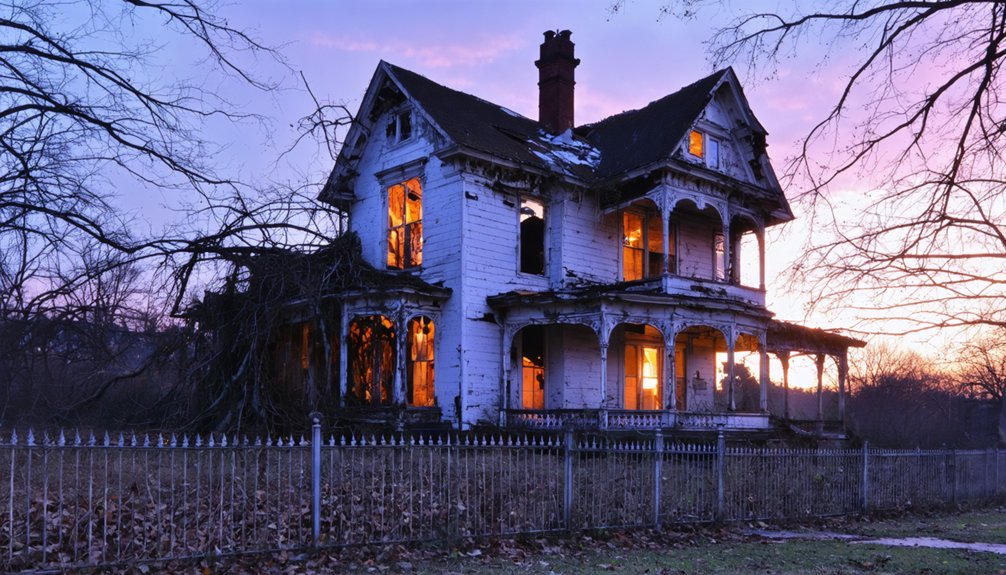
Perched atop Alton’s highest point on Alby Street, the McPike Mansion has commanded views of the Mississippi River Valley since architect Lucas Pfeiffenberger completed its construction between 1869 and 1871.
Henry Guest McPike, Alton’s former mayor and horticulturist, built this 16-room Italianate-Victorian estate on what he called Mount Lookout.
After decades of abandonment following 1950, Sharyn and George Luedke’s 1994 purchase initiated essential preservation efforts.
The mansion’s historical architecture attracts both restoration advocates and paranormal investigators:
- Structural features: Three stories with 11 marble fireplaces, intricately carved banisters, and vaulted wine cellar
- Paranormal claims: Reports of up to 12 spirits, including Henry McPike and former servants
- Current status: Listed on National Register of Historic Places; 2017 preservation award recipient
You’ll find ghost hunters documenting orbs and mysterious figures here regularly.
Underground Secrets: Mortuary Basements and Hidden Tunnels
You’ll find Illinois’s haunted reputation extends beneath street level, where abandoned mortuary basements and Prohibition-era tunnels form a hidden layer of the state’s ghost town legacy.
The Jacoby Arts Center in Alton occupies a former funeral home, preserving its basement mortuary rooms complete with original embalming equipment and drainage systems.
Chicago’s 60-mile freight tunnel network, built between 1899 and 1959 for coal delivery and telephone lines, lies 40 feet underground and remained largely unknown to residents until a 1992 flood revealed its sprawling existence beneath the Loop.
Jacoby Arts Center Mortuary
Beneath the polished floors of what became the Jacoby Arts Center, a morgue once operated in the basement of Alton’s largest furniture store. When C. J. Jacoby managed the Broadway location after 1897, he sold caskets alongside furniture while bodies awaited preparation below.
A funeral chapel occupied the upper floor, creating an integrated death-care business that haunted the building’s reputation for decades.
The building’s transformation demonstrates community redevelopment through art preservation:
- 14-foot tin ceilings from the original section remained intact through conversion
- 20,000 square feet housed galleries, studios, and performance spaces after 2004
- Haunted Odyssey trolley tours since 1992 capitalized on the mortuary history
After ownership disputes forced departure in fall 2024, the center relocated to a 4,000-square-foot State Street location, abandoning the historic mortuary site.
Chicago’s Forgotten Freight Tunnels
While Alton’s mortuary basements harbored the dead above ground, Chicago engineered an entire subterranean world that most residents never knew existed. Beginning in 1899, workers covertly excavated 62 miles of narrow-gauge freight tunnels forty feet beneath downtown streets.
You’d find custom electric trains hauling coal, merchandise, and waste through six-foot-wide passages connecting buildings like Marshall Fields directly to railroad terminals.
The system thrived through the 1950s, moving freight invisibly while surface traffic remained free-flowing.
Modern infrastructure ultimately killed these tunnels—trucking proved cheaper than maintaining the underground railway. After bankruptcy in 1959, urban exploration became impossible.
The 1992 Chicago River breach flooded the network, causing $2 billion in damage and sealing these passages forever. Today’s utility lines occupy what freight trains once ruled.
Bachelor’s Grove Cemetery: Illinois’ Most Haunted Burial Ground
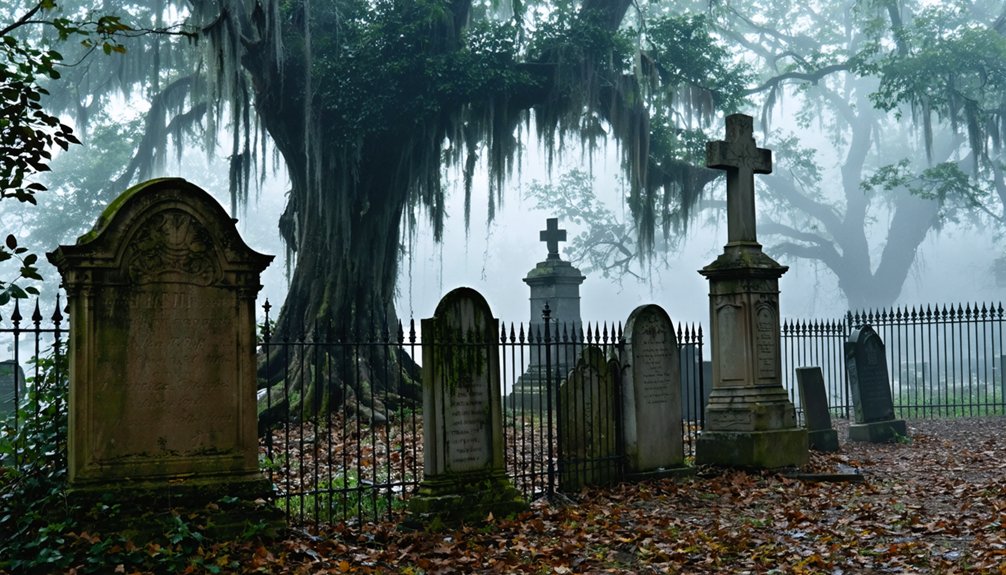
Tucked away in the dense woods of Bremen Township, Bachelor’s Grove Cemetery stands as Cook County’s oldest burial ground south of Chicago and perhaps Illinois’ most notorious haunted location. Named after bachelor settlers in 1833, this one-acre cemetery holds approximately 80 graves dating back to the 1830s.
Deep in Bremen Township’s woods lies a forgotten acre of graves—Cook County’s oldest southern burial ground and Illinois’ darkest haunted legend.
After the access road closed in the 1960s, vandalism transformed the site into a hotbed of ghost stories and spiritual encounters.
The cemetery’s dark reputation intensified through decades of desecration:
- Headstones toppled and stolen while coffins were ransacked during reported satanic rituals throughout the 1960s-1970s
- The murky quarry pond allegedly served as Al Capone’s dumping ground for firearms and Mafia victims
- Toys and trinkets now litter infant graves, including Emma Fulton’s, amid chain-link fence remnants
Cook County Forest Preserve District implemented post-sunset police patrols after assuming ownership in 1976.
The Piasa Bird Legend and Confederate Spirits
Along the limestone bluffs overlooking the Mississippi River near Alton, Illinois, a dragon-like creature with wings and mismatched features has haunted the region’s folklore for centuries. The Piasa Bird, whose name means “bird that devours men” in Algonquian Illiniwek, emerged from Native legends documenting Cahokian cliff art painted 800 years ago.
The myth preservation evolved through Victorian-era elaborations, particularly John Russell’s 1836 fabricated account detailing Chief Ouatoga’s heroic slaying. Today’s massive mural along Route 100 marks where ancient pictographs once stood above burial mounds.
French explorer Jacques Marquette encountered the image in 1673, observing Illini warriors shooting arrows at what they believed represented Evil Manitou. The Piasa Bird has been a part of the region’s history and folklore ever since.
Alton’s reputation as mid-America’s most haunted town incorporates the Piasa into its “Curse of the Riverbend,” where quarrying allegedly disturbed ancestral spirits beneath the bluffs.
Mining Communities: Echoes From Abandoned Industrial Sites
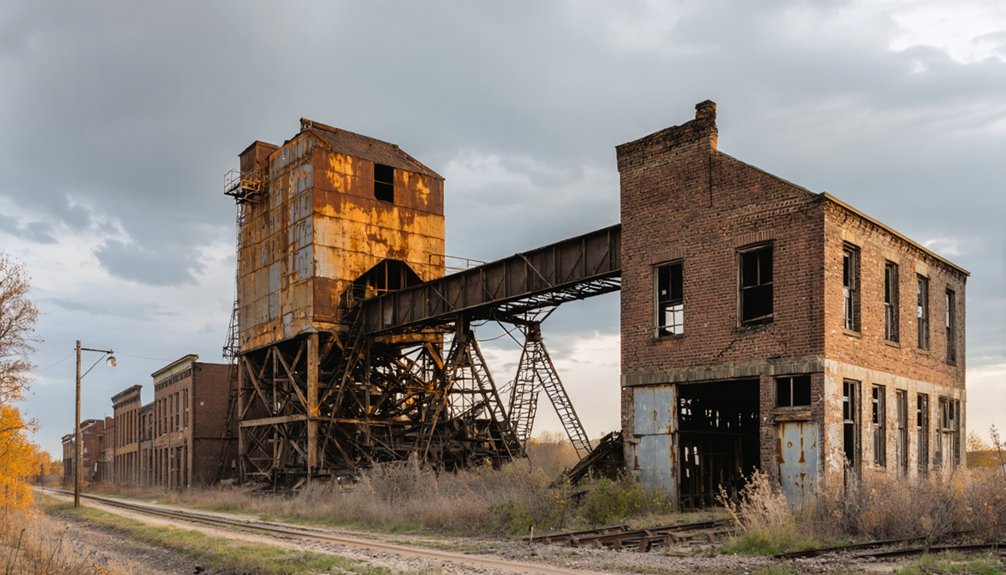
Beyond supernatural legends and ancient curses, Illinois’s most tangible ghost towns emerged from industrial collapse rather than mythical vengeance. You’ll find industrial decay throughout Livingston and Will Counties, where coal mining communities rose and fell with remarkable speed.
The ghost towns of southern Illinois serve as haunting reminders of a once-thriving industry that no longer exists. As you wander through these desolate landscapes, it’s easy to imagine the bustling communities that filled the streets with life and hope. Each abandoned building tells a story of the dreams and aspirations that faded along with the coal mines themselves.
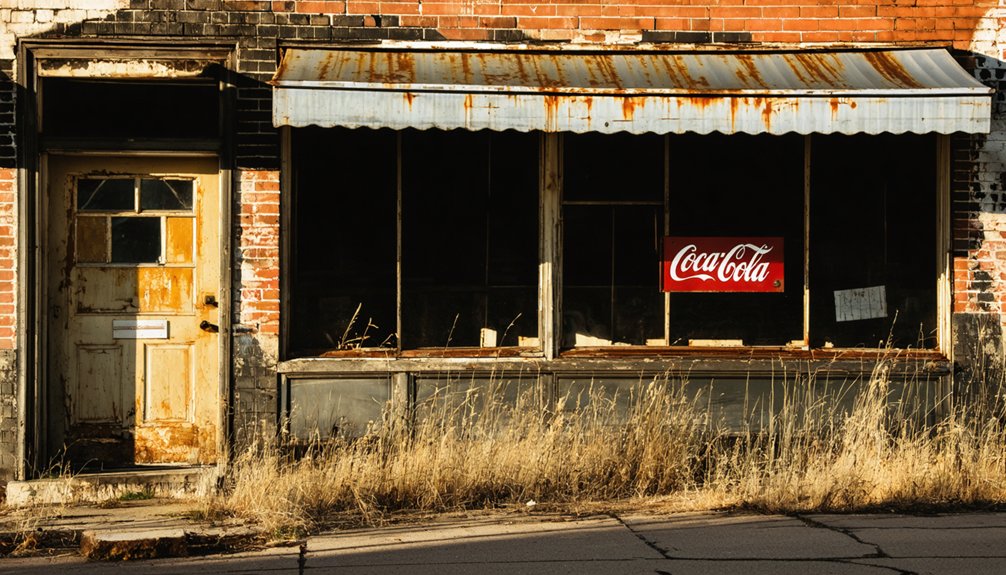
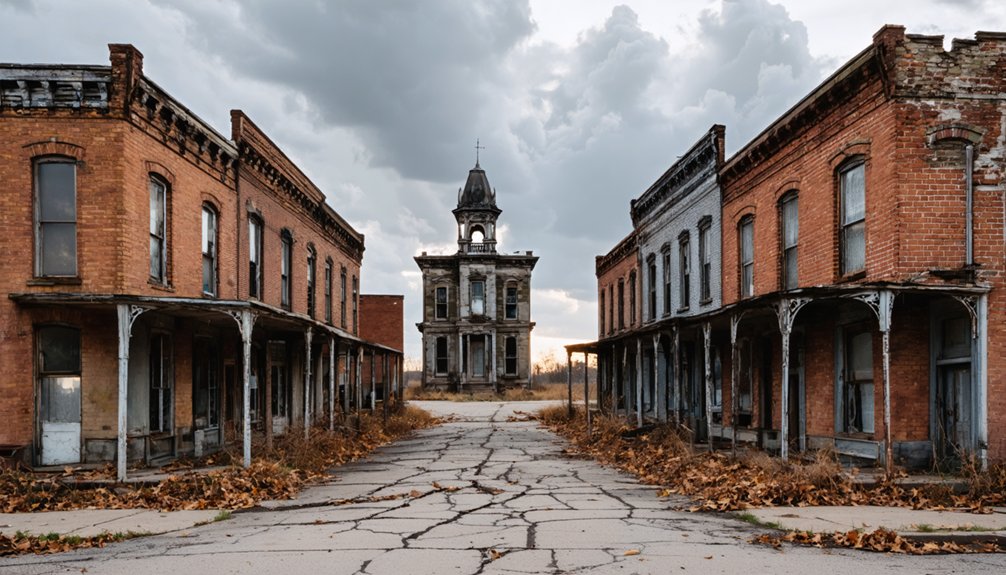
Cardiff, founded in 1899, died when its mine closed in 1912—population plummeting to just 152 by 1920. Braidwood peaked at 8,000 residents before strikes devastated prosperity.
Community memory persists in haunting remnants:
- Slag hills and cracked sidewalks mark Cardiff’s reclaimed mine shafts
- Braceville’s abandoned opera house and empty storefronts stand as monuments to the 1910 strike
- Coal dumps scar landscapes around Carbon Hill and Coal City
Over 200,000 acres bear mining’s legacy—evidence that economic death creates more authentic ghost towns than any supposed curse ever could.
Preserving the Past: Ruins, Remains, and Restless Spirits
While economic forces abandoned Illinois’s ghost towns, preservation efforts now race against time to save what remains. You’ll find Funks Grove’s train depot ruins alongside its Nature Preserve—designated a National Natural Landmark as the state’s largest virgin forest remnant.
At Fermilab, Pioneer Cemetery sits maintained on laboratory grounds where scientists now inhabit converted western houses. Brookdale’s original beams support the McHenry County Conservation District’s administrative center, repurposed from the town hall of a village once notorious for nine saloons.
Ancient artifacts at Vishnu Springs earned national historic site status in 2022, while Glenrio’s seventeen abandoned buildings—including a Texaco station—gained National Register protection in 2007.
These preservation efforts capture more than architecture; they preserve ghostly whispers of communities erased by railroad bypasses, floods, and interstate highways.
Frequently Asked Questions
What Ghost Hunting Equipment Should I Bring to Illinois Ghost Towns?
Bring basic but brilliant tools necessary: flashlights, EMF meters, digital recorders, and cameras. You’ll want sturdy boots and safety precautions like first-aid kits, since Illinois’s crumbling structures pose real hazards beyond paranormal activity during your independent investigation.
Are There Guided Paranormal Tours Available at These Abandoned Locations?
You’ll find guided paranormal tours primarily in Alton, where operators explore ghost town history and local legends at sites like McPike Mansion. However, most Illinois abandoned locations like Bachelor’s Grove Cemetery and Cairo lack organized tour providers.
Is It Legal to Visit and Explore These Ghost Towns?
Picture crumbling buildings behind rusted fences—you’ll face legal implications for trespassing without permission. Property ownership remains intact even when abandoned, requiring owner authorization before exploration. You risk criminal charges, fines, and eviction by entering without proper consent or documentation.
What Time of Year Is Best for Ghost Town Exploration?
Fall months offer you the best ghost town exploration conditions. Seasonal weather patterns provide comfortable temperatures for documenting sites, while historical preservation efforts remain accessible. You’ll find September through November ideal for investigating Illinois’s abandoned locations safely.
Can You Camp Overnight at Any Illinois Ghost Town Sites?
Picture dusty roads leading to crumbling foundations—you’ll find overnight camping isn’t permitted at Illinois’s abandoned settlements. Ghost town history sites typically sit on private property or municipal land where camping’s prohibited. Always verify ownership and regulations before exploring these locations.
References
- http://cantontornado36.blogspot.com/2017/04/ghost-towns-of-fulton-county-illinois.html
- https://www.youtube.com/watch?v=93k0qtvzkn4&vl=en-US
- https://www.riversandroutes.com/blog/why-alton-is-americas-most-haunted-small-town/
- https://www.freakyfoottours.com/us/illinois/
- https://drloihjournal.blogspot.com/p/lost-towns-of-illinois-series.html
- https://www.atlasobscura.com/things-to-do/illinois/abandoned
- https://en.wikipedia.org/wiki/List_of_ghost_towns_in_Illinois
- http://cantontornado36.blogspot.com/2017/04/fulton-county-ghost-towns-part-2.html
- https://kids.kiddle.co/Tuscumbia
- https://drloihjournal.blogspot.com/2022/09/lost-towns-of-illinois-midway-illinois.html