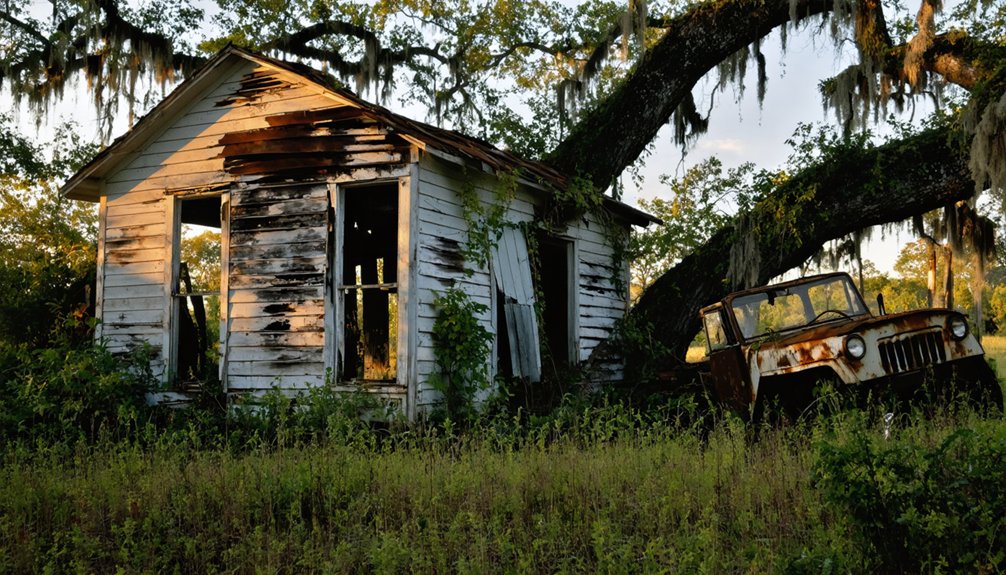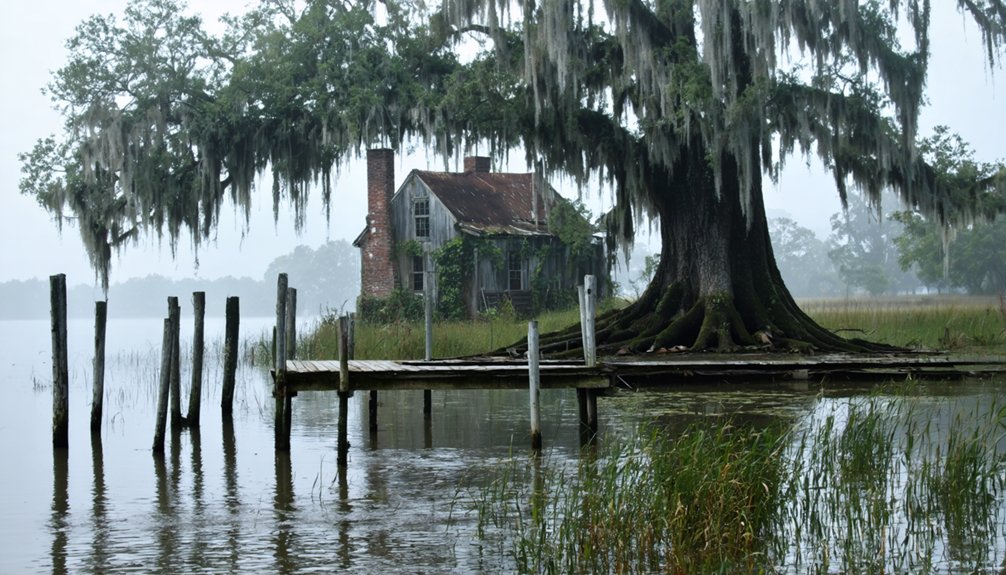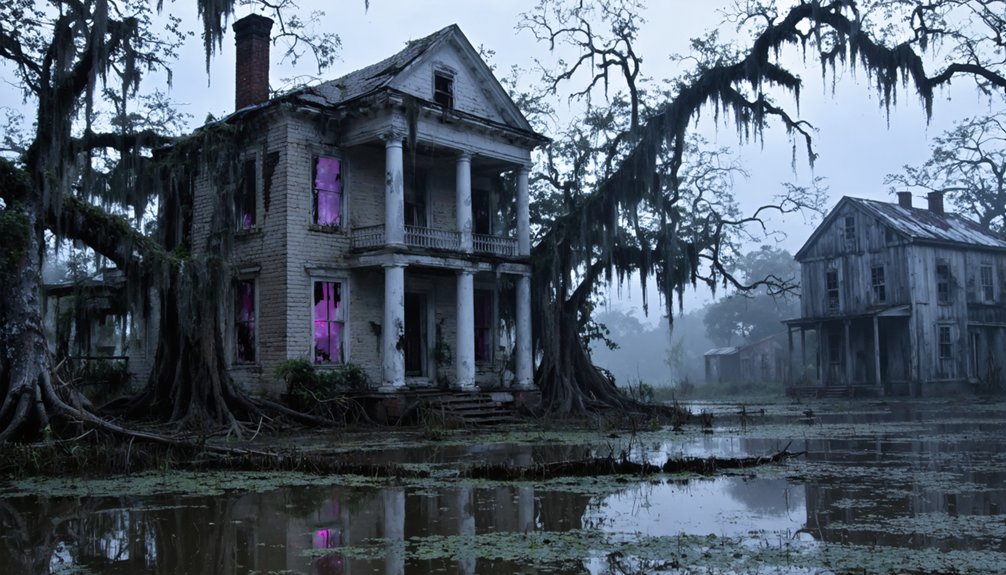
Louisiana’s most haunted ghost towns were destroyed by documented disasters that killed thousands. You’ll find Frenier, where Julia Brown died during the 1915 hurricane that claimed 25-60 lives at her funeral, and Cheniere Caminada, where the 1893 Category 4 storm killed 779 residents with an 18-foot surge. Ruddock disappeared into Lake Pontchartrain after losing 58 people in 1915, while Bayou Chene vanished beneath the Atchafalaya Basin following the 1927 flood. Each location’s folklore emerged directly from these catastrophic events and their unrecovered victims.
Key Takeaways
- Frenier’s folklore centers on Julia Brown’s alleged curse before dying during the 1915 hurricane that killed dozens during her funeral.
- Ruddock was destroyed by the 1915 Category 4 hurricane; persistent Rougarou sightings and decaying structures mark the abandoned lumber town.
- Cheniere Caminada lost 779 residents in Louisiana’s deadliest 1893 hurricane, with broken graves and mass burials haunting the site.
- Bayou Chene’s remote swamp community vanished after the 1927 flood, leaving only sediment-buried remnants in the Atchafalaya Basin.
- Laurel Valley Village preserves over 60 plantation structures, including slave quarters, connected to the violent 1887 Thibodaux Massacre history.
Frenier and the Curse of Julia Brown
Twenty-five miles west of New Orleans, the small farming community of Frenier occupied a narrow strip of land between Lake Pontchartrain and Lake Maurepas in the early 1900s. Without roads, electricity, or medical facilities, this isolated settlement depended on local healers like Julia Brown, a literate Black landowner and traiteuse who used herbal remedies.
Spirit stories claim Brown practiced voodoo and sang from her porch: “One day I’m going to die and take the whole town with me.” When she died on September 29, 1915, a Category 4 hurricane struck during her funeral, generating 13-foot storm surges and killing 25-60 residents. Bodies took weeks to recover, with some found months later and many buried in common graves.
The folklore origins stem from survivors blaming her curse, transforming a respected housewife into the “magical negro” trope that persists in ghost tours today. The belief that Julia Brown was a voodoo priestess actually originated around 2010, nearly a century after her death.
Ruddock: The Town Swallowed by Lake Pontchartrain
The same 1915 hurricane that struck during Julia Brown’s funeral obliterated Ruddock, a lumber town located just miles north along the same vulnerable isthmus between Lake Maurepas and Lake Pontchartrain.
This historic settlement, established in 1892 by the Ruddock Cypress Company, housed 700 residents who depended entirely on the lumber industry and railroad connections.
Founded in 1892, Ruddock housed 700 lumber workers whose livelihoods depended on cypress operations and rail transport.
The Category 4 storm‘s 145 mph winds and 10-foot surge destroyed everything on September 29-30, 1915, claiming 58 lives.
What remains of this once-thriving community includes:
- Decayed wood fragments scattered throughout swamp vegetation
- Concrete blocks marking former building foundations
- Exit 7 on Interstate 55, still appearing on state maps
You’ll need a boat to explore these ruins, where locals claim Rougarou sightings persist among the cypress shadows. The crumbling docks and collapsed structures stand as remnants of the economic decline that followed the storm’s devastation. Before the hurricane, the community had already endured multiple devastating fires, including a major blaze in 1909 that destroyed the sawmill.
Cheniere Caminada: Louisiana’s Deadliest Hurricane Disaster
On October 2, 1893, a Category 4 hurricane slammed into Cheniere Caminada with 130-135 mph winds, triggering Louisiana’s deadliest natural disaster.
You’ll find that a 16-18 foot storm surge swept away 779 of the village’s 1,471 residents around 3 a.m., erasing all but 1-4 of 450 homes.
Historical reconstruction reveals over 2,000 deaths across South Louisiana, with children suffering the highest fatality rates.
Grand Isle submerged under 9 feet of water while the surge destroyed fishing communities along Barataria Bay.
The floodwaters split open graves in the local cemetery, adding to the devastation that wiped out the island’s food and fresh water sources.
The Curole house was among the few structures to survive the hurricane, later dismantled and transported 40 miles inland to Cut Off via wagon, where it remained intact for over a century.
Today, you can visit disaster memorials including a small cemetery along Highway 1 near Grand Isle, marking where this barrier island community once thrived before most survivors relocated, leaving little trace of Louisiana’s deadliest hurricane.
Bayou Chene: The Floating Community Lost to the Atchafalaya
Deep within the Atchafalaya Basin, Bayou Chene emerged in the 1830s as a thriving settlement on dry land, where early farmers capitalized on unusual geographic conditions created by a massive logjam that limited the area’s annual water cycle.
By the 1920s, 500 residents maintained this boat-accessible community through:
- Commercial fishing operations exchanging catches with trade boats
- Timber harvesting following the 1876 federal Timber Act
- Saloons doubling as funeral homes in this wild west-style frontier
The community established early land claims with the U.S. government in June 1848, with nearly all usable land claimed by year’s end. The 1927 Mississippi Flood initiated Bayou Chene’s decline. Army Corps of Engineers’ Atchafalaya Spillway construction sealed its fate, causing recurrent flooding until the last residents departed by 1955. The post office closed in 1953, leading to the loss of many homes and businesses as the community’s infrastructure crumbled.
Today, descendants honor their ancestors through traditional storytelling and cultural resilience at Bayou reunions, celebrating a community now buried beneath 12-18 feet of Basin sediment.
Laurel Valley Village: Echoes of Plantation Life
Unlike Bayou Chene’s watery grave, Laurel Valley Village stands remarkably intact along Bayou Lafourche, preserving America’s largest surviving 19th-century sugar plantation complex. You’ll find over 60 structures still standing from the original 105 buildings that housed 450 workers at its peak.
Laurel Valley Village preserves over 60 original structures from America’s largest surviving 19th-century sugar plantation complex along Bayou Lafourche.
The plantation architecture tells a brutal story: slave quarters built from cypress in the early 1800s, later joined by shotgun houses circa 1895. Originally granted to Etienne Boudreaux in 1783, the property expanded to 5,000 acres under Joseph W. Tucker, who introduced 130-135 enslaved workers.
They constructed 15 miles of railroad tracks and processed four million pounds of sugar annually.
Listed on the National Register of Historic Places, you can tour this 3,500-acre working plantation that survived Union soldiers’ fires and Hurricane Ida’s devastation. The site bears witness to the 1887 Thibodaux Massacre, when approximately sixty Black workers died after attempting to unionize for better conditions. The site has served as a filming location for 12 movies between 1987 and 2013, including “Ray” and “The Butler.”
Frequently Asked Questions
Are There Any Legal Restrictions on Visiting Louisiana’s Ghost Towns?
Exploring Louisiana’s ghostly past isn’t always free-roaming. You’ll face trespassing laws on private property and property regulations restricting military zones, state parks, and protected sites. Violations bring fines up to $500 or six months’ imprisonment under state statutes.
What Safety Precautions Should Explorers Take When Visiting Abandoned Louisiana Sites?
You’ll need essential safety gear like boots, bug spray, and water, plus emergency preparedness supplies including spare tires and physical maps. Travel in groups, avoid toxic sites, respect boundaries, and always verify access permissions before exploring abandoned locations.
Which Ghost Towns Offer Guided Tours Versus Self-Exploration Opportunities?
You’ll discover guided tours through New Orleans’ French Quarter and Garden District preserve ghost town folklore, while self-exploration opportunities await in historic cemeteries and abandoned streets where local folklore thrives beyond structured tours’ boundaries.
What Is the Best Time of Year to Visit Louisiana Ghost Towns?
Visit Louisiana ghost towns in October through November for ideal conditions. You’ll experience cooler weather, historical preservation tours, Halloween-themed local folklore events, and fewer crowds. Avoid June-September’s hurricane season, which limits access to coastal ruins and rural sites.
Are There Other Voodoo Legends Associated With Louisiana Ghost Towns?
While Julia Brown dominates folklore, you’ll find Louisiana’s ghost towns connect to broader voodoo rituals and spiritual legends through Marie Laveau’s documented influence and enslaved communities’ practices at abandoned plantations like Magnolia, where ceremonial chants still echo.
References
- https://en.wikipedia.org/wiki/List_of_ghost_towns_in_Louisiana
- https://thebayouinsider.substack.com/p/ghost-towns-and-forgotten-roads-louisianas
- https://www.deep-south-usa.com/louisiana/history-and-heritage/haunted-louisiana
- https://www.explorelouisiana.com/articles/things-do-haunted-places-louisiana
- https://710keel.com/discover-70-ghost-towns-from-across-louisiana/
- https://www.ezhomesearch.com/blog/ghost-towns-in-louisiana/
- https://www.louisianahauntedhouses.com/real-haunts/places.aspx
- https://www.atlasobscura.com/places/frenier-cemetery
- https://www.youtube.com/watch?v=JtoF4rAXN4o
- https://en.wikipedia.org/wiki/Frenier