You’ll find Maryland’s most haunted ghost towns scattered from the Potomac to Appalachia, where colonial Port Tobacco Village dwindled from the state’s second-largest port to 13 residents after 1873, and St. Mary’s City—Maryland’s capital from 1634 to 1695—vanished entirely beneath farmland. Point Lookout’s Civil War prison camp, where 4,000 Confederate POWs died, reportedly hosts restless spirits, while Garrett County’s abandoned coal towns and Daniels Mill community preserve the sudden departures of entire populations whose stories still echo through archaeological sites and weathered foundations.
Key Takeaways
- Point Lookout Civil War P.O.W. camp is known for haunted legends and restless spirits from over 4,000 Confederate deaths.
- Port Tobacco Village declined from Maryland’s second-largest port to 13 residents, preserving colonial and archaeological ghost town sites.
- St. Mary’s City vanished after 1695 when buildings were dismantled; now an 800-acre archaeological park with reconstructed structures.
- Daniels Mill Town was mysteriously evacuated in 1968 and flooded by Hurricane Agnes; only ruins remain in the state park.
- Garrett County’s five abandoned coal mining towns feature foundations, rusted equipment, and overgrown streets from the early 1900s era.
Port Tobacco Village: From Maryland’s Second Largest to Smallest Town
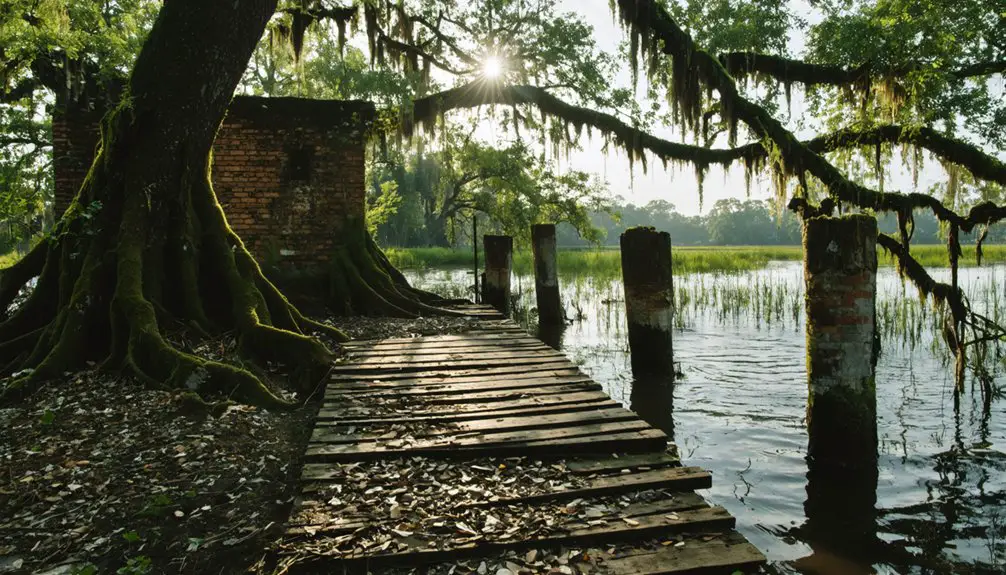
When English settlers arrived on the east side of the Port Tobacco River around 1634, they established what they initially called Chandlers Town, creating one of the oldest English-speaking communities on the East Coast.
By the mid-18th century, you’d find Maryland’s second-largest port town here, surpassed only by Annapolis, with international trade connecting local tobacco and corn to worldwide markets.
Port Tobacco once thrived as Maryland’s second-largest port, linking local tobacco and corn exports to international markets across the globe.
River siltation and the 1873 railroad bypass to Pope’s Creek triggered Port Tobacco’s dramatic collapse.
The 1892 courthouse fire accelerated decline, forcing La Plata’s takeover as county seat in 1895.
Today’s census counts just thirteen residents, though historic architecture including Stagg Hall and Port Tobacco Courthouse remains. Visitors can explore these sites Wednesday to Sunday from 10 a.m. to 4 p.m., with Monday tours available by appointment.
The area was originally inhabited by Algonquian-speaking tribes, including the Potapoco and Piscataway peoples, whose indigenous name influenced the settlement’s later designation.
This abrupt abandonment paradoxically enabled exceptional cultural preservation, creating archaeological opportunities to study colonial, Native, and enslaved African experiences without modern development interference.
The Vanished Colonial Capital of St. Mary’s City
While Port Tobacco’s decline unfolded over decades of economic shifts, Maryland’s original capital disappeared almost entirely within a generation of its abandonment.
You’ll find St. Mary’s City, founded in 1634 as America’s birthplace of religious freedom, served as Maryland’s capital for 61 years. When Governor Francis Nicholson relocated government functions to Annapolis in 1695, residents dismantled buildings and repurposed bricks elsewhere.
By the American Revolution, farmland replaced what was once the fourth oldest permanent British settlement in North America. Today’s 800-acre archaeological park preserves this vanished capital through over 300 excavated sites.
Historical artifacts and archaeological findings reveal Leonard Calvert’s original settlement where colonists purchased land from the Yoacomaco tribe, establishing religious tolerance through the groundbreaking 1649 Toleration Act. The colony’s scattered tobacco plantations extended along the St. Marys, Patuxent, and Potomac rivers, where early Marylanders conducted business primarily during legislative sessions. Visitors can now explore reconstructed buildings including a replica statehouse, originally constructed in 1676 to house Maryland’s colonial government.
Garrett County’s Abandoned Mining Communities
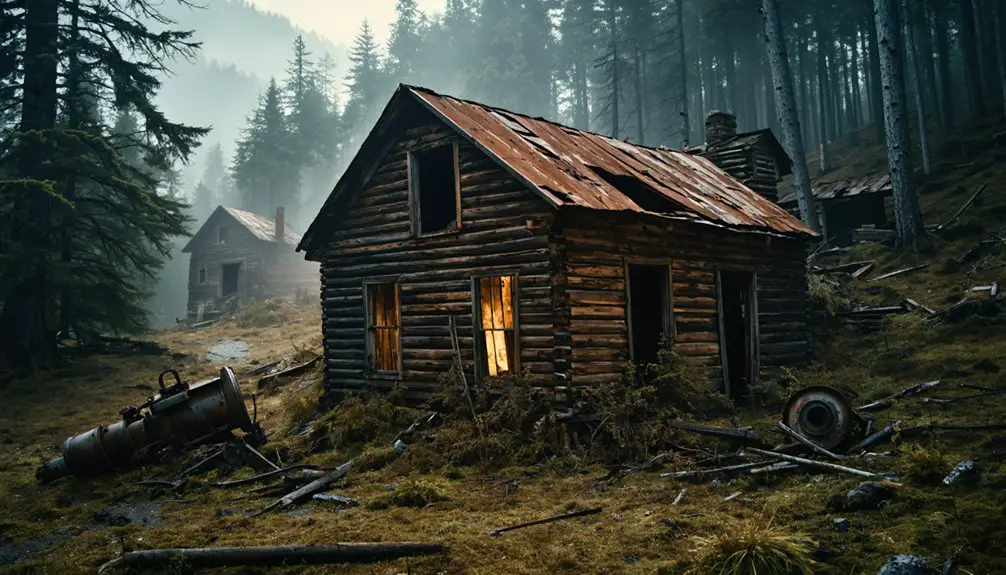
Deep within Garrett County’s Appalachian ridges, five coal company towns rose and fell between 1900 and 1950, leaving behind scattered foundations, rusted tipples, and fading memories of the families who extracted black diamonds from Maryland’s western edge.
You’ll find Vindex upstream from Bloomington, where Western Maryland Railway’s Shay locomotive served miners until 1950. Vegetation now reclaims the streets where concrete stairs and house traces mark former residences.
Dodson and Gleason neighbored each other along the Potomac, collapsing after 1920s mine closures despite once-thriving stores and schools.
Kempton, built by Davis Coal and Coke Company in 1913, housed 900 residents before Mine No. 42’s unexpected 1950 shutdown. The town’s overgrown remnants now attract archaeologists from the Kempton Historical Archaeology Project, who use LIDAR technology to map foundation sites beneath the forest floor.
Shallmar, Wolf Den Mining Company’s crown jewel, maintained whitewashed trees and trimmed hedges until 1949’s starvation crisis.
Today’s Coal Heritage Trail preserves these coal relics, transforming isolation into ghost town legends you’re free to explore.
Daniels Mill Town: Swept Away by Progress
Maryland’s ghost towns weren’t confined to mountain coal camps—industrial mill villages faced their own erasure through corporate decisions and natural disasters.
Industrial mill towns vanished not from economic failure alone, but through deliberate corporate erasure and the final blow of flooding.
You’ll find Daniels along the Patapsco River, where the Ely family established their textile mill in 1810. The settlement changed hands and names—Elysville, then Alberton after James S. Gary’s son in 1853, finally Daniels when C.R. Daniels Company purchased 500 acres in 1940.
This self-contained community required mill employment for residency. You’d have found company-owned stores, a post office, and recreation facilities serving 90 families. The mill produced denim and sheeting, along with duck and Oshburgs by 1915.
Industrial decline struck in 1968 when management ordered 279 residents evacuated without explanation. Demolition crews razed the housing.
Hurricane Agnes’s 1972 flooding finished what corporate abandonment started. Today, community evacuation left only church ruins and a smokestack within Patapsco Valley State Park. The place name disambiguation on Wikipedia reflects the multiple historical references associated with the Daniels site.
Civil War Spirits at Point Lookout P.O.W. Camp
Following the Battle of Gettysburg in July 1863, the Union Army needed a rapid solution for thousands of Confederate prisoners overwhelming existing facilities. They established Camp Hoffman at Point Lookout, Maryland, where the Potomac River meets Chesapeake Bay.
The 40-acre compound quickly exceeded its 10,000-prisoner capacity, swelling to 20,000 men crammed into deteriorating conditions.
Over 22 months of operation, approximately 4,000 prisoners died from disease, exposure, and starvation.
U.S. Colored Troops serving as guards intensified psychological tensions with captives.
Confederate dead were initially buried on-site before relocation to a mass grave in 1870.
Among the imprisoned men were soldiers from diverse origins, including foreign-born prisoners from Germany, Ireland, Italy, and even Cuba. The site’s strategic importance during the Civil War made it a crucial location for Union military operations and prisoner containment. Today, haunted legends surround this location, where restless spirits reportedly linger—testaments to thousands who suffered within these vanished prison walls, their stories embedded in Maryland’s contested history.
Frequently Asked Questions
What Caused Calverton to Completely Disappear From Calvert County?
You’ll find Calverton vanished through contrasting forces: governmental relocation to Prince Frederick in 1724 triggered economic decline, while Battle Creek’s relentless shoreline erosion physically consumed the settlement. Land development pressures and environmental degradation erased this once-vital colonial administrative center.
Are There Any Ghost Sightings Reported at Harmony Grove’s Former Location?
You won’t find documented paranormal experiences or historical hauntings at Harmony Grove’s former location. While Spring Bank Inn markets itself as “haunted,” available records lack specific ghost sightings, apparitions, or witness testimonies from this Frederick County settlement.
Can Visitors Access the Abandoned Fort Ritchie Military Base Today?
You can access Fort Ritchie today—it’s not abandoned. Military base access opened after 1998 closure, with Fort Ritchie history preserved through museums, lodging, and ongoing redevelopment transforming the site into a thriving mixed-use community.
What Happened to the Residents When Daniels Mill Town Was Demolished?
Over half of 279 residents fled after the 1968 closure announcement, leaving abandoned structures behind. You’ll find the remaining families faced displacement when C.R. Daniels demolished housing, creating ghostly legends before Tropical Storm Agnes destroyed the town in 1972.
Are There Guided Ghost Tours Available at Maryland’s Abandoned Towns?
You won’t find official ghost tours at Maryland’s abandoned towns themselves, but Visit Maryland’s tourism website lists organized guided investigations at active historic sites like Point Lookout Lighthouse and Seneca Creek State Park instead.
For those intrigued by the ghost towns of Maryland, exploring the ruins provides a unique glimpse into the past. Many of these sites are steeped in history and legend, making them perfect for an adventurous day trip. While the towns may be abandoned, the stories they hold continue to captivate visitors searching for a taste of the eerie.
As you wander through these abandoned sites across Maryland, you may encounter remnants of structures that tell tales of a bygone era. Each corner holds secrets, from crumbling walls to overgrown pathways, creating an atmosphere that invites exploration and reflection. Those who venture here often leave with more than just memories; they collect stories that resonate long after their visit ends.
References
- https://kids.kiddle.co/List_of_ghost_towns_in_Maryland
- https://chesapeake-inspired.com/top-haunted-towns-in-maryland/
- https://vitabrevis.americanancestors.org/2020/12/ghost-towns
- https://www.geotab.com/ghost-towns/
- http://freepages.history.rootsweb.com/~gtusa/usa/md.htm
- https://rsftripreporter.net/ghost-towns-of-the-upper-potomac/
- https://www.atlasobscura.com/things-to-do/maryland/abandoned
- https://local.newsbreak.com/a-z-animals-1693032/3094174661005-6-deserted-and-forgotten-towns-in-maryland
- https://kids.kiddle.co/Port_Tobacco_Village
- https://www.equityinhistory.org/places-to-experience/village-of-port-tobacco/