Michigan’s 128 documented ghost towns offer you both industrial ruins and verified paranormal encounters. You’ll find Central Mine’s abandoned shafts alongside Fort Mackinac’s Guard House, where documented apparitions and cold spots occur. Fayette Historic State Park preserves 20 iron-smelting structures, while Monroe’s River Raisin Battlefield reports 48 ghost sightings with 1.8% encounter probability. Singapore lies buried beneath Lake Michigan dunes like a Midwestern Pompeii. These copper-boom and logging settlements combine tangible archaeological evidence with measurable supernatural activity across the Keweenaw Peninsula and Upper Peninsula, where careful exploration reveals Michigan’s layered history.
Key Takeaways
- Fort Mackinac’s Guard House and Fort Wayne feature documented paranormal activity including orbs, cold spots, apparitions, and spirits manipulating doors.
- Monroe’s River Raisin National Battlefield Park reports 48 ghost sightings with a 1.8% encounter probability among visitors.
- Eloise Asylum ranks among America’s most haunted psychiatric facilities with artifacts and documented paranormal occurrences throughout the site.
- Singapore ghost town lies buried beneath Lake Michigan dunes since the 1880s, with preserved structures surfacing through shifting sands.
- Park Cemetery in Marquette and Holy Cross Orphanage historic grounds are associated with multiple spectral sightings and apparitions.
The Rise and Fall of Michigan’s Mining Communities
Long before European prospectors arrived with their industrial ambitions, Native Americans had already discovered the Keweenaw Peninsula’s extraordinary copper wealth. Between 5000 BCE and 1200 BCE, they mined these deposits using primitive but effective techniques. Their abandoned pits later guided European miners to the richest ore bodies.
Ancient Native American copper pits became treasure maps for nineteenth-century European miners seeking the Keweenaw Peninsula’s richest deposits.
Douglass Houghton’s 1841 geological report sparked Michigan’s mining boom. By 1845, the Cliff Mine became the first profitable operation, yielding $2.5 million by 1870. In 1852, the Cliff Mine installed a massive 45-ton steam engine to power rock stamping operations and pump water from the depths.
Calumet & Hecla’s 1871 merger dominated production, extracting 10.5 billion pounds of copper through 1968.
However, industrial decline proved inevitable. Montana’s Anaconda mines overtook Michigan’s output by 1887, while post-Civil War price drops and labor strikes accelerated the economic impacts. The Treaty of La Pointe in 1842 had opened these lands to development by ceding Ojibwe territory, though hunting rights were retained.
White Pine Mine’s 1997 closure marked the definitive end of Michigan’s copper era.
What Remains: Physical Evidence of Abandoned Settlements
The collapse of Michigan’s mining empire left behind a vast archaeological landscape. You’ll find 128 documented ghost towns scattered across the state, classified by what’s survived: Class A sites contain only hidden foundations and footings, while Class C locations feature standing but unoccupied structures.
At Bell in Presque Isle County, you can explore interesting artifacts like broken safes, general store walls, and chimneys emerging from the woods.
Port Oneida retains 121 buildings, including schoolhouses and historic barns.
Singapore lies entirely beneath Lake Michigan‘s dunes near Saugatuck—sand’s preservation properties have kept its hotels, stores, and bank vaults intact as a massive time capsule. The town earned the nickname “Michigan’s Pompeii” after being fully buried by the early 1880s following deforestation that left coastal winds free to push sand dunes over the abandoned settlement.
Shifting currents occasionally expose timber pieces and brick foundations before concealing them again.
Fayette Historic State Park preserves over 20 preserved buildings from the iron smelting era, with 11 housing museum exhibits that display the town’s industrial past.
Keweenaw Peninsula’s Copper Boom Ghost Towns
When state geologist Douglass Houghton announced his copper discoveries in 1840, he triggered America’s first mineral rush and transformed the Keweenaw Peninsula into an industrial powerhouse.
Between 1850 and 1881, this remote wilderness produced over three-quarters of the world’s copper, drawing thousands of miners into underground tunnels that penetrated deep into Michigan’s northern soil.
Notable ghost towns you’ll encounter:
- Central – First mine to profit in its opening year, now reduced to 13 houses and a church
- Cliff – Nation’s most productive copper mine from 1845-1854, rewarding investors $2.5 million
- Freda and Delaware – Remote settlements accessible through winding Keweenaw drives
The abandoned shafts inspired local legends of mythical creatures haunting the depths where miners once worked. Central’s most productive mine closed on July 29, 1898, after 44 years of continuous operation, leaving the town a ghost of its former glory.
Freda’s decline accelerated after the 1967 mill closure, transforming it into a haunting mix of inhabited homes and crumbling structures dominated by the deteriorated Champion Mill.
Logging Towns Lost to Time and Fire
By 1870, Michigan’s vast pine forests had already begun fueling an industrial appetite that would consume entire landscapes and birth dozens of settlements destined for abandonment.
Missaukee County’s Jennings exemplifies this pattern—established in 1878 when the Dewings brothers erected a sawmill on Crooked Lake, introducing Michigan’s first double-cut bandsaw.
The Dewings brothers’ 1878 sawmill brought Michigan’s first double-cut bandsaw to Crooked Lake, establishing Jennings as a timber industry pioneer.
Finnish millworkers settled permanently while Swedish and Norwegian lumberjacks moved through seasonally. The Mitchell brothers purchased operations in 1882, expanding the town to include hotels, saloons, and four churches.
When timber stocks depleted, the economic foundation collapsed entirely. The population peaked at approximately 2,000 residents in the 1890s before declining precipitously as sawmill operations ceased by 1922. Today, only one church remains standing among logging relics and timber artifacts.
The railroad infrastructure was dismantled and relocated, leaving foundations and wild apple trees as archaeological markers of a vanished industry that shaped Michigan’s settlement patterns. Similar boom-and-bust cycles driven by resource extraction transformed numerous settlements across Michigan’s Upper Peninsula, where copper mining operations followed the same pattern of rapid growth and inevitable abandonment.
Burton’s Wharf and Early Maritime Settlements
Along Lake Michigan’s treacherous maritime corridor, William Burton recognized opportunity where others saw only wilderness—establishing his cordwood operation on South Manitou Island’s eastern shore during the mid-1830s.
His deep-water harbor in Crescent Bay became the only natural refuge between Buffalo and Chicago, transforming maritime commerce through reliable fuel supply.
By 1847, Burton’s settlement foundations included:
- A three-mile tamarack railroad hauling cordwood from inland forests to waiting steamships
- Forty woodcutters supporting year-round operations alongside blacksmiths and merchants
Infrastructure serving seventy-four permanent residents by 1860, expanding to ninety-eight by 1880.
The village’s post office operated continuously from 1870 until the community’s eventual decline following the end of logging operations.
Island families supplemented their income through subsistence farming, harvesting wild berries, mushrooms, maple sap, and cultivating crops in the sandy soil.
You’ll find Burton accumulated considerable wealth fueling Great Lakes traffic, though his once-thriving wharf eventually succumbed to changing maritime technology, leaving behind Michigan’s haunting affirmation to steamship-era prosperity.
Documented Paranormal Activity in Historic Michigan Sites
Michigan’s documented paranormal activity extends far beyond abandoned settlements, with active historic sites reporting centuries of supernatural encounters.
You’ll find Fort Mackinac’s Revolutionary War-era Guard House captures orbs and cold spots in photographs, while apparitions materialize at North Sally Port Entrance Gate.
Detroit’s Fort Wayne, constructed in 1845, features soldiers’ spirits manipulating doors throughout its National Historic Places-listed barracks and hospital.
Monroe leads the state with 48 ghost sightings, giving you a 1.8% encounter probability at River Raisin National Battlefield Park.
Eloise Asylum remains among America’s most haunted psychiatric facilities, with eerie artifacts and documented occurrences.
Park Cemetery in Marquette connects spectral sightings to the former Holy Cross Orphanage, where shocking hauntings persist along Seventh Street’s historic grounds.
Exploring Michigan’s Upper Peninsula Ghost Town Destinations
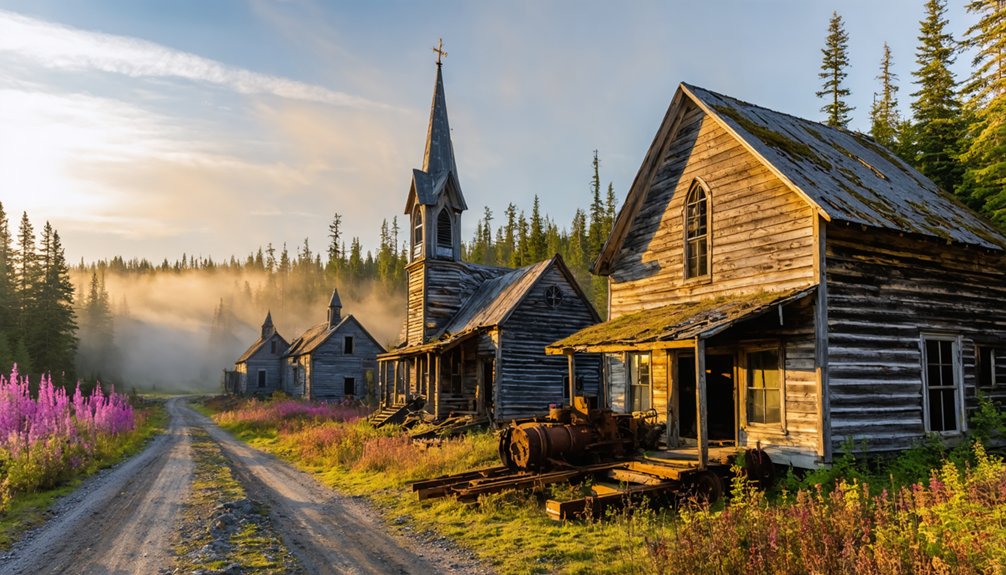
You’ll find the Upper Peninsula’s most accessible ghost towns concentrated in the Keweenaw Peninsula, where nearly 100 abandoned mining settlements remain from America’s first copper boom of the 1800s. Sites like Central Mine, Delaware, and Old Victoria preserve original structures including mine shafts, worker housing, and commercial buildings that you can explore year-round.
Though you can visit these sites throughout the year, winter snowfall often restricts access to remote locations. The M-28 corridor between Seney and Shingleton offers a particularly dense 25-mile stretch containing four documented ghost towns—Creighton, Pines, Star, and Walsh.
In these towns, you’ll discover deteriorating tourist cabins, overgrown foundations, and remnants of lumber industry infrastructure.
Keweenaw Peninsula Mining Remnants
Where else in America can you walk through the remnants of a mineral rush that generated ten times the wealth of California’s Gold Rush? The Keweenaw Peninsula’s native copper deposits created unique industrial artifacts from 1843 through the 1920s, leaving behind nearly 100 ghost towns across the region.
You’ll discover mines that shaped American industry:
- Central Mine (1854-1898) produced 52 million pounds of copper with 1,200+ residents at its peak
- Cliff Mine employed 840 men starting in 1844, becoming the peninsula’s first profitable operation
- Delaware Mine showcases ecological impacts where trees now grow through crumbling stone walls
The 1913 miners’ strike and Great Depression silenced these mineshafts, but their dangerous open wells and deteriorated buildings remain hidden beneath overgrowth—offering you unrestricted exploration of America’s forgotten copper empire.
Preserved Structures and Foundations
While mining operations left behind dangerous shafts and deteriorating headframes, Michigan’s Upper Peninsula ghost towns also preserved remarkably intact structures that document 19th-century industrial life.
You’ll discover Fayette Historic Townsite‘s 20 original buildings from 1891, including workers’ homes with period furnishings and massive stone furnaces still containing charcoal. Port Oneida Village spans nearly 2,000 acres with 121 structures forming America’s largest National Rural Historic District.
Architectural details like superintendent’s houses, machine shops with original equipment, and dock pilings protruding from lakeshores reveal the economic foundation of resource extraction communities.
Despite ongoing preservation challenges, you can explore 11 museum exhibits at Port Oneida and self-guided trails at Fayette Historic State Park, where lilac plantings and apple trees mark forgotten homesteads throughout these abandoned settlements.
Seasonal Accessibility and Conditions
Michigan’s Upper Peninsula ghost towns demand careful seasonal planning, as winter snow accumulation blocks access to Fayette Historic Townsite trails and leaves Keweenaw County’s remote mining settlements completely isolated under deep snowpack.
Winter accessibility challenges extend beyond blocked roads—deteriorated buildings risk collapse under ice loads, while hidden mineshafts and wells disappear beneath frozen terrain. You’ll need offline maps due to limited cell service.
Summer and early fall offer ideal exploration windows:
- Fayette Historic State Park provides paved paths and ADA-accessible buildings for 2-4 hour self-guided tours
- Keweenaw mining sites remain navigable but require vigilance around open shafts with 25+ foot drops
- Spring’s melting snow reveals seasonal hazards like exposed mineshafts previously concealed by winter coverage
Delta County’s Nahma Grade Trail accommodates outdoor-capable wheelchairs during dry conditions.
Frequently Asked Questions
Are Michigan Ghost Towns Legally Accessible to Visitors Year-Round?
No, you can’t legally access Michigan ghost towns year-round without permission. Property rights protect abandoned sites, making exploration trespassing unless you secure owner consent. Legal access requires written permission, regardless of how deserted locations appear.
What Safety Precautions Should Explorers Take When Visiting Abandoned Mining Sites?
Your life literally depends on hazard awareness at abandoned mines—wear safety gear including hard helmets, steel-toed boots, and reflective vests. Never cross fences, report unknown shafts to Houghton County authorities, and avoid contaminated soil contact.
Can Artifacts Be Collected From Michigan Ghost Towns?
You can’t legally collect artifacts from Michigan ghost towns without explicit landowner permission and proper permits. Artifact legality depends on land ownership, while preservation efforts protect these irreplaceable historical resources for future generations and scientific research.
Which Ghost Towns Offer Guided Tours or Visitor Facilities?
You’ll discover Fayette Historic Townsite stands magnificently above all others, offering all-encompassing guided tours and exceptional visitor facilities including interpretive exhibits, reenactments, and trails. Heart City Ghosts, Haunted Traverse Tours, and Grand Rapids Ghost Tours provide unforgettable guided experiences.
How Do Property Owners Feel About Tourists Visiting Ghost Towns?
Property owners balance tourist impact with preservation goals—you’ll find some welcome visitors through paid tours and B&Bs, while others restrict property rights with “Keep Out” signs, protecting fragile structures from damage while managing liability concerns.
References
- https://www.visitkeweenaw.com/things-to-do/museums-history/ghost-towns/
- https://www.nps.gov/slbe/learn/historyculture/ghosttowns.htm
- https://wgrd.com/michigan-ghost-town-map/
- https://swmichigan.org/blog/haunted-southwest-michigan
- https://www.michigan.org/article/trip-idea/incredibly-haunted-places-upper-peninsula
- https://en.wikipedia.org/wiki/List_of_ghost_towns_in_Michigan
- https://www.nps.gov/kewe/learn/historyculture/copper-mining-timeline.htm
- https://www.nps.gov/kewe/learn/historyculture/copper-mining-timeline-page-2.htm
- https://www.nps.gov/kewe/learn/historyculture/copper-mining-timeline-page-4.htm
- https://en.wikipedia.org/wiki/Copper_mining_in_Michigan