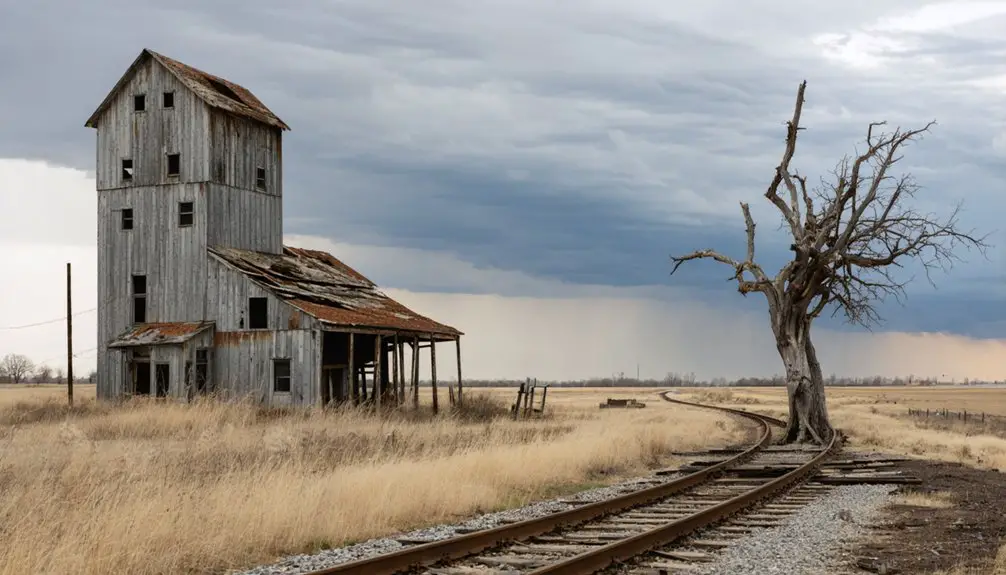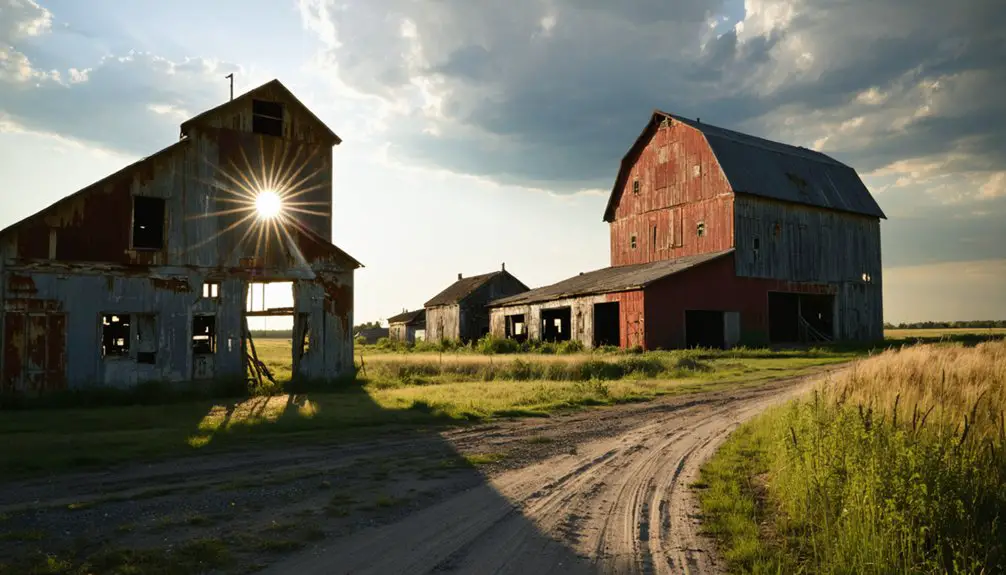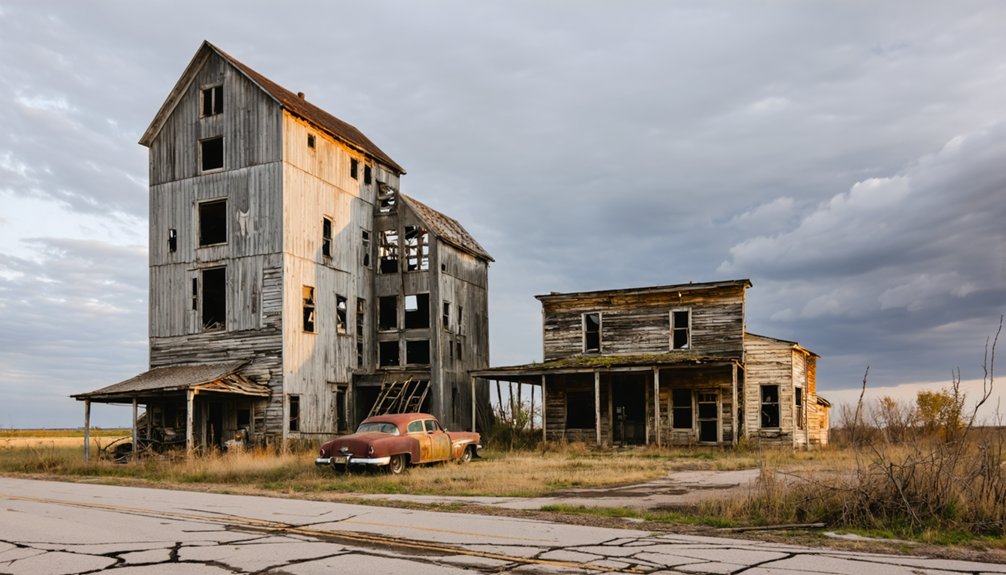
You’ll find Minnesota’s most compelling haunted ghost towns at Forestville, where preserved 1850s buildings stand within a state park, and Grey Cloud Island, famous for paranormal sightings near its ancient burial mounds and limestone kiln ruins. Elcor vanished entirely after mine closure in 1954, while Wasioja’s Civil War-era seminary still stands after devastating casualties. Carver County contains twenty-one lost settlements, including flood-destroyed San Francisco from 1854. These sites combine documented historical tragedies with persistent supernatural reports that continue attracting investigators exploring their layered mysteries.
Key Takeaways
- Forestville, founded in 1853, is a preserved ghost town in Forestville/Mystery Cave State Park offering tours and folklore stories through original 19th-century buildings.
- Grey Cloud Island features haunted ruins of 1850s limestone kilns and a cemetery with reported ghost sightings, mysterious lights, and phantom vehicles.
- Grey Cloud Cemetery hosts supernatural phenomena including a translucent Native American chief with a green lantern and floating orbs during full moons.
- Wasioja preserves six historic structures including Civil War-era buildings and seminary ruins, marking Minnesota’s last Civil War recruitment site west of the Mississippi.
- Elcor, a 1897 mining town supporting 800 residents, now lies buried under mine overburden with only foundations and a smokestack remaining near Virginia.
Forestville: A Preserved 19th Century Settlement
In the summer of 1853, Robert Foster walked from Decorah, Iowa, to stake land claims along the Root River for himself, his brother Major, and his brothers-in-law William and Felix Meighen.
You’ll find this settlement flourished into one of southern Minnesota’s largest towns by the 1860s, with 150 residents and bustling commerce along the stagecoach route. However, when the Southern Minnesota Railroad bypassed Forestville in 1868-1870, urban decay rapidly followed.
The Meighen family acquired the entire town through foreclosures, transforming it into a company town until 1910. Felix Meighen and his family extended credit to farmers, often secured by mortgages, which ultimately led to their ownership of the entire settlement. By 1880, the hotels had closed, signaling the town’s economic downturn as the population continued to decline. Today, you can explore this ghost town—deemed Minnesota’s creepiest by Thrillist—where folklore stories merge with authentic preservation.
The Minnesota Historical Society maintains original buildings within Forestville/Mystery Cave State Park, offering tours through a genuinely abandoned 19th-century settlement.
Elcor: The Vanished Mining Town of the Mesabi Range
Unlike Forestville’s preservation, Elcor met a harsher fate—complete obliteration beneath mining operations.
You’ll find this Mesabi Range settlement was built in 1897 as a company town where workers rented homes on land they’d never own, creating a precarious existence tied entirely to ore extraction.
At its height in the 1920s, the town supported 800 residents with a company store, school, and housing infrastructure serving the iron mines that fueled America’s steel industry.
The community reflected diverse immigrant origins, with Croatian, Slovenian, Finnish, Italian, German, Scandinavian, and Cornish families building lives around the mining operations.
When the Corsica mine closed in 1954, Pickands Mather and Company evacuated every resident, dismantled the structures, and ultimately buried the townsite under the Minorca Mine’s overburden by 1993.
Life in Company Town
When Don H. Bacon named his Mediterranean-themed mines, he created a company economy that controlled every aspect of residents’ lives.
You’d find approximately 800 people living in housing provided by Minnesota Iron Company, shopping at the company store, and sending children to the company school. This mining community between McKinley and Gilbert existed solely for extracting Mesabi Range iron ore.
The town’s infrastructure directly reflected corporate priorities rather than resident autonomy. Your employment, shelter, and access to goods depended entirely on mining profitability.
During the 1920s peak operations, this dependency became absolute—no alternative economy existed.
The 1901 Cornish-built smokestack near Corsica mine stood as a monument to industrial control, not community independence. Internal links within Wikipedia’s records may redirect to disambiguation pages when referencing towns like Elcor that share names with other entities.
When ore deposits declined, the company simply abandoned the settlement.
Mine Closure and Evacuation
Resource exhaustion brought Elcor’s existence to an abrupt end during the mid-twentieth century. You’ll find that the Elba mine closed first, followed by the Corsica mine’s final shutdown in 1954. This elimination of economic foundation triggered systematic community relocation as 800 residents evacuated within a decade.
Mining safety concerns became moot when operations ceased entirely, forcing workers to abandon company housing and infrastructure.
The town’s official abandonment occurred during the 1960s, with authorities removing most structures. You’re witnessing a pattern repeated across fifty Iron Range communities—when deposits depleted, entire populations dispersed.
Unlike modern mine closures with changeover plans, Elcor’s evacuation was swift and permanent. Today, only foundations, slag piles, and one 200-foot smokestack remain near Virginia, Minnesota, marking where this self-sufficient community once thrived.
Buried Beneath Minorca Mine
Following Elcor’s systematic evacuation in the 1960s, the town’s physical remnants gradually disappeared beneath industrial expansion.
In 1993, Inland Steel Company buried the entire site under massive overburden piles from the Minorca Mine operation. You’ll find nothing remains of the streets, churches, or homes that once housed nearly 1,000 mining families.
This mining history exemplifies the Mesabi Range’s brutal efficiency—when iron ore beneath proved more valuable than settlements above, town abandonment became inevitable.
The land changed ownership multiple times after 1956, ultimately absorbed into what’s now ArcelorMittal’s Minorca facility. Mining companies maintained control by owning the land beneath residents’ homes, while workers only owned their houses, creating a precarious living situation that made forced relocation inevitable.
Ironically, the mine’s name possibly references Don H. Bacon’s Mediterranean naming tradition, linking today’s operations to Elcor’s origins.
The ghost town literally rests beneath active taconite processing operations.
Grey Cloud Island: Paranormal Activity Along the Mississippi
You’ll find Grey Cloud Island’s haunted reputation stems from its limestone quarrying past. In this history, workers operated massive kilns along the Mississippi River throughout the late 1800s and early 1900s.
The crumbling stone ruins now attract paranormal investigators who’ve documented unexplained lights, disembodied voices, and shadow figures near the historic kiln sites. Grey Cloud Cemetery, established with its earliest burial in 1873, adds to the island’s eerie atmosphere with reports of strange occurrences near its locked gates.
Local residents and visitors have reported these phenomena for decades, with accounts describing apparitions of former quarry workers still lingering among the deteriorating industrial structures. The island’s mysterious past extends even further back, with evidence of human habitation dating roughly 2100 years to the early Woodland period.
Historic Lime Kiln Ruins
Rising from the limestone outcroppings along Grey Cloud Channel’s eastern bank, the historic lime kiln ruins stand as a weathered monument to Minnesota’s pioneer industrial heritage.
You’ll find crude limestone blocks stacked without mortar, dating to around 1850, where workers once burned rock to produce quicklime for construction and agriculture. William R. Brown’s 1846 diary confirms these early lime operations supplied St. Paul, Stillwater, and Mississippi River communities until 1900.
The ancient limestone structure earned National Register designation in 1978, though recent flooding damaged the tower. The island’s southern portion was annexed to Cottage Grove in the early 1980s, reshaping the township boundaries that had remained unchanged since Minnesota statehood.
Today, you’ll need a boat to reach this rare surviving kiln on private land. Its industrial heritage connects directly to the island’s deeper archaeological significance—the Upper Mississippi’s largest concentration of burial mounds. The site bears the name Ma-Hpe-Ya Ho-Ta Win, honoring Grey Cloud Woman from the mid-1800s.
Ghostly Legends and Sightings
Since the 1800s, witnesses have reported encounters with a former Native American chief who roams Grey Cloud Cemetery carrying a green lantern—an apparition deeply connected to the island’s extensive burial mounds, the largest concentration along the Upper Mississippi.
These ghost sightings include floating green orbs and the chief’s translucent figure holding his lantern near the mounds.
You’ll find supernatural legends pervade Grey Cloud Island beyond the chief. Visitors report phantom vehicles that chase trespassers before vanishing, disembodied screaming, and mysterious drum beats during full moons.
A translucent hunter wearing red flannel materializes silently, sometimes appearing in vehicles’ backseats. The cemetery’s nun tombstones reportedly change count when you turn around, while departing witnesses have heard children whisper warnings.
Cars frequently lose power upon entering the grounds.
Radium: The Uniquely Named Agricultural Community
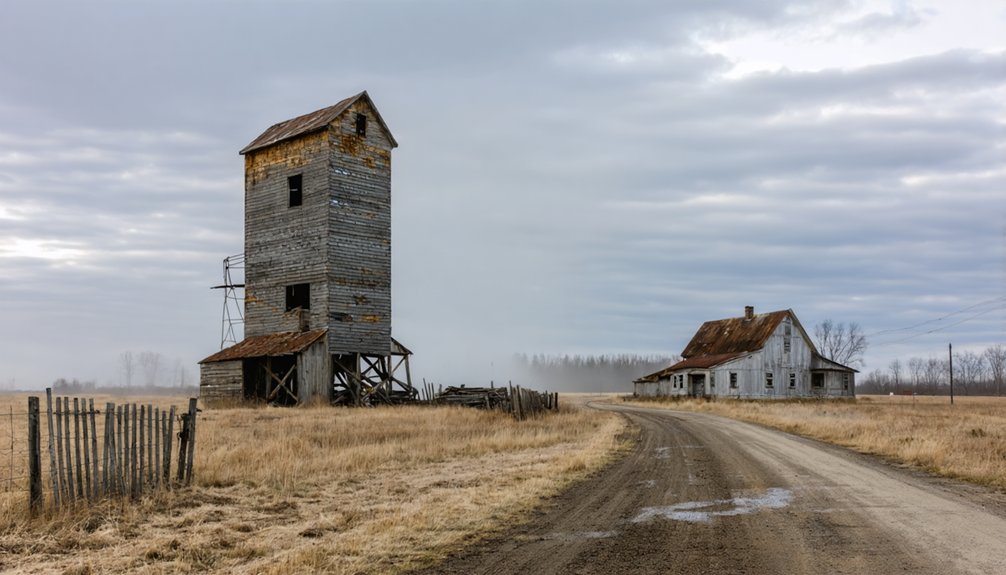
Named after the element that captured America’s early 20th-century fascination with scientific progress, Radium stands as one of Minnesota’s most uniquely designated agricultural communities.
Located in Marshall County along the Soo Line Railroad near Warren, this settlement thrived during the early 1900s as a vibrant farming hub. Radium history reveals its post office operated from 1905 to 1984, serving residents who worked the surrounding farmland.
Agricultural origins shaped every aspect of community life, including the Warren Sheaf Newspaper’s presence. However, post-World War II brought inevitable decline as residents migrated toward urban opportunities and farming practices evolved.
The railroad’s fading influence accelerated Radium’s transformation into mostly abandoned farmland. Today, you’ll find limited structures and a small church remaining—haunting remnants offering glimpses into Minnesota’s rural past.
Wasioja: Civil War Ruins in Southern Minnesota
Established in 1854 along the banks of Minnesota’s Root River, Wasioja emerged as a frontier village with development ambitions that rivaled any settlement in the southeastern region.
Wasioja sprang from Minnesota’s Root River in 1854, a frontier settlement with ambitions as bold as any in the Southeast.
You’ll find a limestone quarry that provided material for constructing a seminary enrolling 300 students at its peak.
The Civil War devastated this community when 80 men enlisted, with only 25 returning home.
Company C’s catastrophic losses at Chickamauga—59 of 60 recruits killed—left permanent scars on Wasioja’s identity.
The railroad’s bypass, coupled with wartime casualties, triggered irreversible decline.
You can still visit six historic structures, including the recruiting station and seminary ruins.
These remnants stand as Minnesota’s last Civil War recruitment site west of the Mississippi, offering tangible connection to frontier sacrifice and ambition.
Carver County’s Collection of Lost Towns
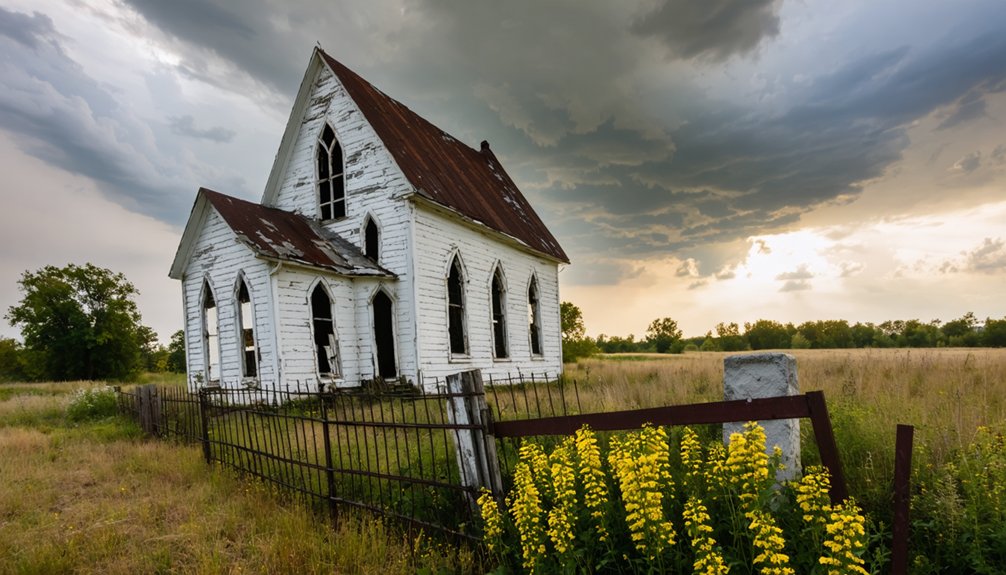
While most Minnesota counties harbor a handful of abandoned settlements, Carver County‘s landscape conceals an extraordinary concentration of lost communities—approximately twenty-one ghost towns scattered across its 376 square miles. You’ll find half of all towns that once existed here became ghost towns, creating more urban legends than documented histories.
The Carver County Historical Society preserves photographs revealing archaeological discoveries at sites like San Francisco, founded in 1854 near Carver Rapids before flooding forced its 1860 abandonment. You can visit this site at Minnesota Valley National Wildlife Refuge today.
Paper towns like St. Clair and St. Lawrence never existed beyond maps, yet planners confidently promoted them. Communities like Helvetia merged with neighbors, while Bongards and Hollywood slowly disappear as neighborhoods absorbed by larger towns.
Exploring Minnesota’s Abandoned Heritage Sites
Beyond the paper towns and absorbed neighborhoods of Carver County, Minnesota’s landscape preserves tangible remnants of industrial ambition and frontier settlement. You’ll discover Banning State Park’s quarry ruins along rushing waters, where operations ceased in 1905 after fires devastated the surrounding town.
Haunted legends surround Wasioja’s crumbling seminary, a monument to Civil War casualties that never returned home. Elcor’s mining company town vanished after 1956, now buried beneath active operations.
Forestville offers the most intact experience—the Meighen family’s 1889 purchase preserved an entire 1850s settlement as a living history park.
In Ely, Tanner Hospital’s castle-like architecture awaits restoration, while spooky tales persist about its century-old corridors. These sites represent your freedom to explore Minnesota’s unvarnished past without commercial sanitization.
Frequently Asked Questions
Are Ghost Towns in Minnesota Safe to Visit Alone at Night?
No, you shouldn’t ghost someone’s Snapchat and wander Minnesota’s abandoned towns solo at night. Nighttime safety demands groups—violent crime soars 252% above average in some areas, while solo exploration risks injury where emergency response can’t reach you.
Can You Legally Take Artifacts From Abandoned Minnesota Ghost Towns?
No, you can’t legally take artifacts from Minnesota ghost towns. Legal concerns include property rights—state historic sites prohibit removal, and abandoned property laws require prior owner notice. Unauthorized taking constitutes theft or vandalism, risking prosecution.
Which Minnesota Ghost Town Has the Most Documented Paranormal Activity?
Mantorville holds the most documented paranormal activity among Minnesota’s ghost towns, with urban legends spanning multiple buildings. You’ll find historical sightings recorded by investigators, tour guides, and journalists who’ve experienced unexplained phenomena firsthand.
Do You Need Permission to Photograph on Ghost Town Properties?
Like crossing invisible boundaries, you’ll need permission before photographing ghost towns. Private property rights trump historical intrigue—trespassing laws protect these abandoned sites. You’re legally liable without owner consent, regardless of whether you’re shooting commercially or recreationally.
What Equipment Should Ghost Hunters Bring to Minnesota’s Abandoned Towns?
You’ll need EMF meters, digital recorders for EVPs, night-vision cameras, and high-lumen flashlights. Take safety precautions with sturdy boots and first-aid supplies. Respect historical artifacts—don’t remove items. Bring weather-appropriate clothing since Minnesota’s abandoned towns lack shelter.
References
- https://thievesriver.com/blogs/articles/ghost-towns-in-minnesota
- https://www.carvercountyhistoricalsociety.org/ghost_towns.php
- https://www.minnesotahauntedhouses.com/real-haunts/places.aspx
- https://quickcountry.com/minnesotas-abandoned-ghost-towns/
- https://kroc.com/9-strange-ghost-towns-within-100-miles-of-rochester-minnesota/
- https://www.youtube.com/watch?v=5bCG6B2rzZY
- https://www.exploreminnesota.com/seasons/fall/spookiest-places-minnesota
- https://www.mngoodage.com/voices/mn-history/2019/07/a-ghost-town-turned-history-site/
- https://kdhlradio.com/forestville-named-the-creepiest-and-coolest-ghost-town-in-minnesota/
- https://www.cbsnews.com/minnesota/news/forestville-southern-minnesota-ghost-town-still-attracting-summer-visitors/