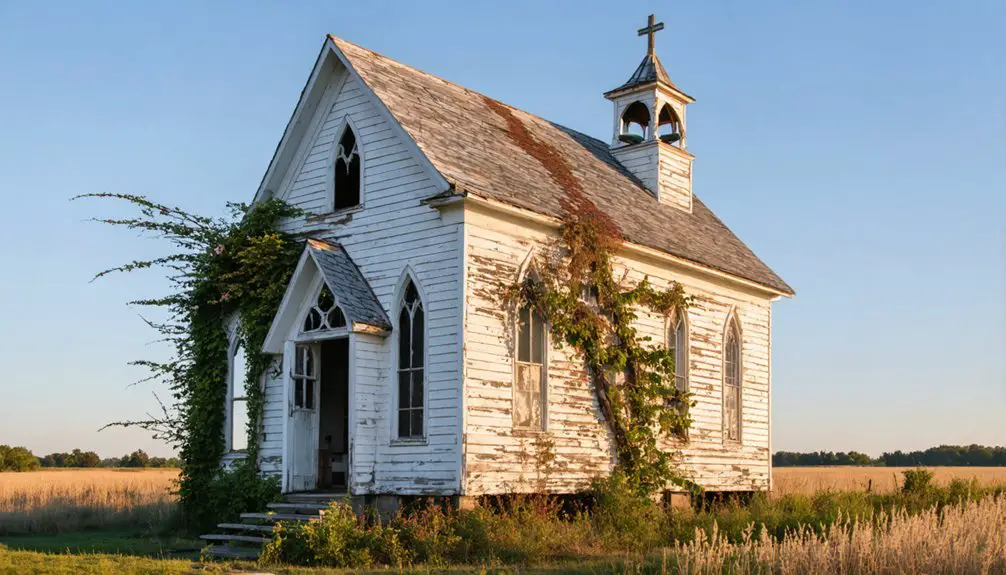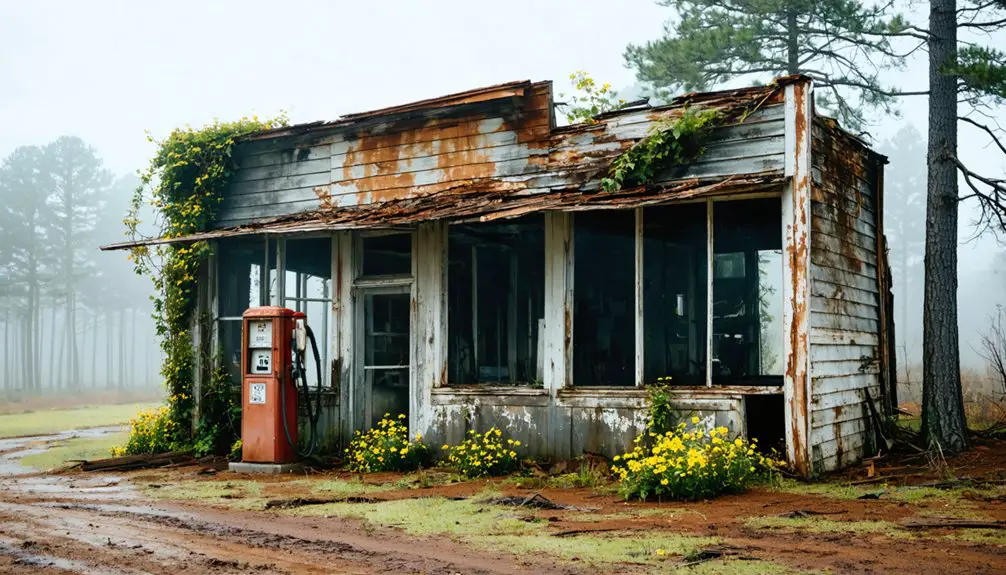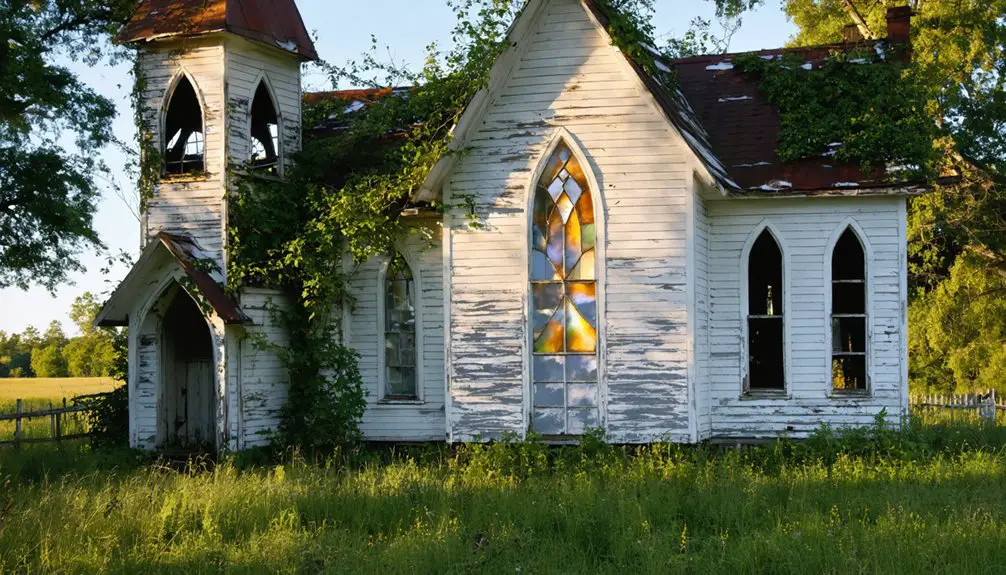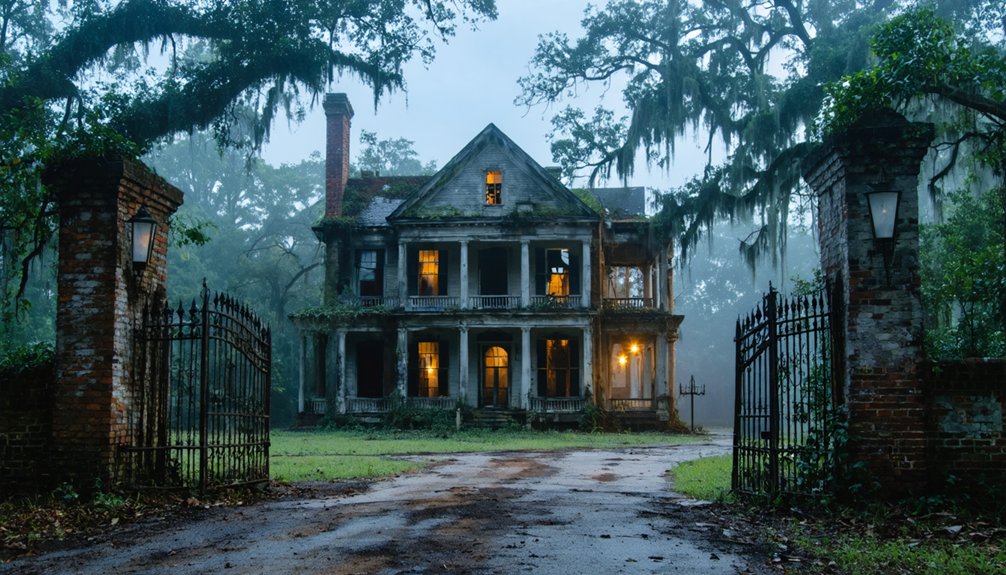
You’ll find Rodney, Mississippi’s most haunting ghost town, where the river abandoned it in 1870 after a sandbar diverted the Mississippi two miles west. Once a thriving cotton port that nearly became the state capital, Rodney now features a Greek Gothic Revival Baptist Church with a silver dome, a Presbyterian Church built in 1832, and a cemetery from 1822 containing disappearing tombstones from the 1700s. Yellow fever epidemics and devastating fires in 1837, 1852, and 1869 compounded its decline, creating ruins that reveal how fluvial dynamics shaped Mississippi’s settlement patterns.
Key Takeaways
- Rodney, Mississippi became a ghost town after the Mississippi River shifted course in 1870, abandoning its once-thriving cotton port economy.
- The 1822 cemetery in Rodney was built over Native American sacred sites, with disappearing tombstones from the 1700s adding to its haunted reputation.
- Multiple devastating fires in 1837, 1852, and 1869 destroyed Rodney’s buildings, leaving behind ruins like the Greek Gothic Revival Baptist Church.
- Yellow fever epidemics caused total depopulation near Vicksburg and 97% mortality in Dry Grove, creating abandoned settlements throughout Mississippi.
- Architectural remnants including churches, a Masonic Lodge, and an intact nineteenth-century grocery store mark Rodney’s eerie, preserved landscape.
The Rise and Fall of Rodney: Mississippi’s Almost-Capital
When General Phineus Lyman led his 1774 expedition to organize a settlement on the Big Black River, he couldn’t have predicted that his frontier outpost would nearly become Mississippi’s capital—only to vanish into legend within a century.
By 1828, Charles Lesueur sketched twenty buildings ascending from river to bluff, and incorporation followed that same year. River trade propelled Rodney’s prosperity—cotton flowed through its strategic Mississippi River port, attracting dignitaries like Andrew Jackson and Zachary Taylor.
Rodney’s riverside location made it a thriving cotton port that welcomed presidents and promised a prosperous future.
The town’s architectural heritage survives in its 1832 Presbyterian Church, featuring Federal design and a bell cast with 1,000 donated silver dollars. Dr. Rushworth Nutt’s steam-powered cotton gin and innovations in contour plowing significantly boosted the region’s cotton economy. Yet yellow fever epidemics in 1843 and 1847 nearly depopulated Rodney.
Devastating fires in 1837, 1852, and 1869 razed most structures. The Presbyterian Church bears a restored cannonball from an 1863 Union shelling, a silent witness to Civil War violence.
When an 1870 sandbar diverted the river two miles westward, Rodney’s fate was sealed.
Historic Fires That Consumed a River Empire
Rodney’s devastating fires of 1837, 1852, and 1869 formed part of a broader pattern of conflagrations that ravaged Mississippi River communities throughout the nineteenth and twentieth centuries.
You’ll find river legends born from catastrophes like St. Louis’s 1849 inferno, when the steamboat *White Cloud* ignited twenty-three vessels and destroyed 430 buildings.
The *Sultana* disaster of 1865 killed 1,800 souls—faulty boiler repairs combined with overcrowding created Mississippi’s deadliest maritime tragedy.
These calamities spawned ghost stories that persist today.
Even twentieth-century Biloxi couldn’t escape the pattern: the Buck Theatre and Community Center both burned in 1966.
The 2017 *Mamie S. Barrett* fire demonstrated this curse’s endurance—the abandoned 1921 steamship burst into flames when Mississippi waters lifted her hull into power lines.
St. Louis’s waterfront catastrophe intensified as the blazing *White Cloud* drifted from its moorings, spreading flames to twenty-two additional boats before the fire leaped to shore and raged for eleven hours.
The Accomo Hotel, Biloxi’s oldest Negro hotel that had hosted legends like Fats Domino and Guitar Slim, succumbed to a faulty space heater on November 22, 1972, gutting the historic blues venue within forty-five minutes.
When the Mississippi Changed Course: Economic Devastation
You’d find it hard to imagine how quickly prosperity vanishes when a river abandons a town. But that’s exactly what happened when a massive sandbar formed in 1876, redirecting the Mississippi’s main channel away from Rodney, Mississippi.
The town’s steamboat landings—once bustling with cotton traders, merchants, and riverboat crews handling thousands of bales weekly—fell silent within months as captains couldn’t navigate the suddenly shallow waters. The Mississippi River is characterized by natural meanders that have shifted its course over centuries, transforming thriving port towns into forgotten relics overnight.
Such disruptions weren’t limited to steamboats; when water levels drop, modern barge transportation suffers similarly, unable to carry full loads and forcing costly delays. Protecting river infrastructure remains critical for preventing the kind of economic collapse that turned Rodney into a ghost town, ensuring that communities dependent on the river maintain stable access to essential goods and trade routes.
Sandbar Diverts River West
The Mississippi River’s capricious nature revealed itself dramatically at the infamous dueling grounds north of Natchez, where a large sandbar once occupied the channel’s middle reaches between Vidalia, Louisiana, and the Mississippi bluffs.
Initially, the river’s main flow coursed along the western bank, rendering this sandy shoal a neutral island beyond state jurisdiction—perfect terrain for the September 19, 1827 duel between Samuel Wells III and Dr. Thomas Maddox that devolved into the legendary Sandbar Fight.
River erosion and sediment buildup soon redirected the Mississippi’s primary channel eastward after 1827, permanently marooning the fight site on what became Giles Island within Mississippi’s borders.
This diversion left the original river path as the state boundary, demonstrating how fluvial dynamics could reshape territorial sovereignty and threaten commercial navigation throughout the region. Similar sediment accumulation occurred near St. Louis, where alluvial deposits created Bloody Island as a towhead in the Mississippi River around 1798.
The violent confrontation drew 17 men total to the sandbar, including duelists, seconds, supporters like Jim Bowie and Major Norris Wright, Dr. Denny as surgeon, and various witnesses from nearby plantations.
Commerce Dies, Population Flees
When Mississippi River channels shift their courses, entire regional economies collapse overnight. You’ll witness industrial decline as factories dependent on river transport shutter their operations, unable to move raw materials or finished goods. Population migration follows swiftly—workers abandon homes when employment vanishes.
The economic cascade unfolds predictably:
- River commerce halts, costing the U.S. economy $295 million daily in lost trade
- Industrial facilities relocate, following the water they need for operations and shipping
- Communities empty rapidly, as 585,000+ navigation and agriculture jobs disappear
- Ghost towns emerge, leaving behind abandoned infrastructure and depleted tax bases
The Mississippi supports $400 billion in economic activity and 1.3 million jobs. When it diverts, you’re watching America’s commercial backbone break, forcing entire populations to flee westward toward opportunity. The loss mirrors Louisiana’s catastrophic land disappearance, where a football field of land vanishes into water roughly every 100 minutes, erasing the coastal infrastructure that once supported thriving port communities. The river’s natural tendency to jump courses every 1,000 years has historically created and destroyed settlement patterns across the delta region, leaving archaeological evidence of abandoned towns in its wake.
Yellow Fever Epidemics and Natural Disasters
You’ll find entire communities erased from maps. Beechland near Vicksburg became a ghost town through total depopulation.
As you delve into exploring haunted locations in Mississippi, you might encounter stories of the restless spirits that once roamed these now desolate places. Each stop along your journey reveals chilling tales that bind the living to the past, making it a unique adventure through forgotten history. The atmosphere is thick with mystery, inviting thrill-seekers and history enthusiasts alike to uncover what lies beyond the veil of the ordinary.
Dry Grove saw 28 deaths from 29 cases. Grenada lost hundreds despite no prior outbreak history.
The devastation was nearly absolute: a 97% mortality rate in Dry Grove while Grenada endured unprecedented loss.
Epidemic containment efforts failed spectacularly when officials delayed reporting cases. Memphis’s hesitation contributed to 5,000+ deaths.
Successful mosquito control wouldn’t arrive until later generations understood transmission mechanics, leaving nineteenth-century Mississippians defenseless against seasonal outbreaks.
Exploring the Ruins: What Remains of Rodney Today
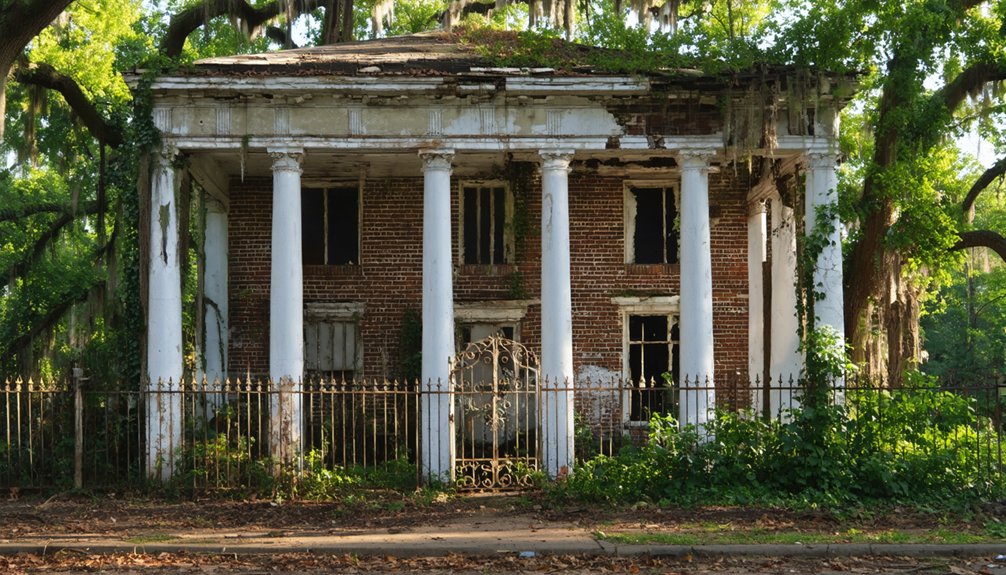
After traversing twelve miles of blacktop and dirt roads from Highway 61 in Lorman, you’ll encounter what remains of Rodney—a haunting tableau of nineteenth-century structures slowly surrendering to Mississippi’s unforgiving landscape.
Despite catastrophic floods in 2011 and 2016, several buildings persist:
- Greek Gothic Revival Baptist Church – Silver-domed structure engulfed by woods, heavily damaged by floodwaters
- Presbyterian Church – Federalist architecture with grand bell tower, elevated position spared interior flooding
- Masonic Lodge – Built after fires of 1839, 1852, and 1869
- Alston’s Grocery Store – Nineteenth-century country store
The Rodney History + Preservation Society, led by Angel Puckett and Mary Duck Pallon, secured architectural restoration funds in 2018, recognizing the cultural significance these ruins hold.
All property remains private—trespassing prohibited.
The Sacred Ground: Cemetery on the Bluff
You’ll discover tombstones dating back to the 1700s gradually disappearing beneath encroaching vegetation and Mississippi River erosion along Natchez City Cemetery’s bluffs.
The cemetery’s establishment in 1822 overlaid what psychics identify as a spiritual vortex—a site where Native American trading paths intersected centuries before European settlement.
Archaeological surveys from the 1960s documented pre-colonial artifacts within the burial ground’s perimeter, suggesting the bluff served as a sacred meeting point for Natchez and Choctaw tribes long before it became hallowed ground for settlers.
Tombstones Lost to Time
Perched on windswept bluffs 200 feet above the Mississippi River, Natchez City Cemetery has guarded the stories of the departed since 1822, when city officials consolidated remains from Memorial Park’s earlier burial ground and scattered plantation graveyards into this four-square-block sanctuary.
Yet time’s relentless march has claimed many markers, leaving forgotten memorials weathered beyond recognition.
Erosion and decay have obscured countless identities:
- Limestone markers from the 1820s-1840s crumbled under Mississippi’s humid subtropical climate.
- Wooden crosses marking slaves’ and paupers’ graves vanished within decades.
- Iron fencing surrounding family plots corroded into rust-stained fragments.
- Sandstone inscriptions wore smooth, erasing names of yellow fever victims.
Despite mid-1950s protective concrete installations at vulnerable sites, countless stories dissolved into anonymity, their occupants’ contributions to Natchez becoming whispers carried away by river winds.
Native American Sacred Crossroads
Long before European settlers claimed the Mississippi River bluffs for their cemetery in 1822, the Natchez people recognized this elevated ground as a sacred crossroads where earth met sky and the physical world touched the spiritual domain.
You’ll find this hallowed terrain at 2 Cemetery Road still commands the Mississippi’s bend, where Native traditions once honored ancestors beneath these same ancient oaks.
The bluffs served as burial grounds long before marble workers Edwin Lyon and Robert Rawes carved their antebellum monuments, before Florence Irene Ford’s mother built that haunting staircase, before the Turning Angel watched over Irish workers’ graves.
Sacred sites don’t lose their power through conquest—they accumulate layers of reverence.
Today’s Angels on the Bluff tours reveal stories spanning centuries, yet the land’s original spiritual significance echoes beneath every tombstone.
Frequently Asked Questions
Are There Any Documented Ghost Sightings or Paranormal Activities in Rodney?
You’ll find documented sightings including Mountain Tom Clark’s ghost pacing Tennessee Street, a lynching victim wandering at night, and a drowning victim’s apparition. Historical legends persist through eyewitness accounts, though formal paranormal investigations remain limited in this abandoned river town.
For those looking to delve deeper into the region’s mysteries, there are opportunities to explore abandoned sites in Mississippi, each with its own chilling tales and haunted histories. These locations often hold artifacts and secrets long forgotten, drawing both history buffs and thrill-seekers alike. The eerie silence of these sites can be a canvas for new stories waiting to be uncovered.
Is It Legal to Visit Rodney and Explore the Ruins?
Tread carefully—you’ll technically trespass since Rodney’s entirely private property after Mississippi unincorporated it in the 1930s. Property ownership restrictions exist, though local regulations aren’t actively enforced, allowing visitors to explore ruins at their own risk.
What Safety Precautions Should Visitors Take When Exploring the Ghost Town?
Wear sturdy closed-toe shoes and long pants as safety gear against snakes in tall grass. Practice wildlife awareness by securing food from raccoons and bears. Travel in groups, avoid unstable structures, and respect all posted warnings for your protection.
Are There Guided Tours Available for Rodney Mississippi?
No guided tours operate in Rodney, Mississippi. You’ll explore independently via unpaved Rodney Road, discovering historical architecture like the 1832 Presbyterian Church and absorbing local legends while wandering the cemetery and ruins at your own pace.
Can You Camp Overnight in Rodney Ghost Town?
No official camping is permitted at Rodney Ghost Town. You’ll find no designated campsites or facilities there. For camping safety and nighttime exploration, consider nearby Delta National Forest’s 57 primitive sites instead, where dispersed camping’s actually allowed.
References
- https://mississippifolklife.org/articles/haunted-by-a-ghost-town-the-lure-of-rodney-mississippi
- https://theforgottensouth.com/rodney-mississippi-ghost-town-history-tour/
- https://www.onlyinyourstate.com/experiences/mississippi/ms-ghost-towns
- https://www.susantregoning.com/blog/rodney-ghost-town
- https://visitmississippi.org/experiences/haunted-history-in-mississippi/
- https://www.mississippihauntedhouses.com/real-haunts/
- https://en.wikipedia.org/wiki/List_of_ghost_towns_in_Mississippi
- https://www.youtube.com/watch?v=z7pw1Q-9s_E
- https://www.tripadvisor.com/Attraction_Review-g28945-d10045204-Reviews-Rodney_Ghost_Town-Mississippi.html
- https://www.legendsofamerica.com/ms-rodney/