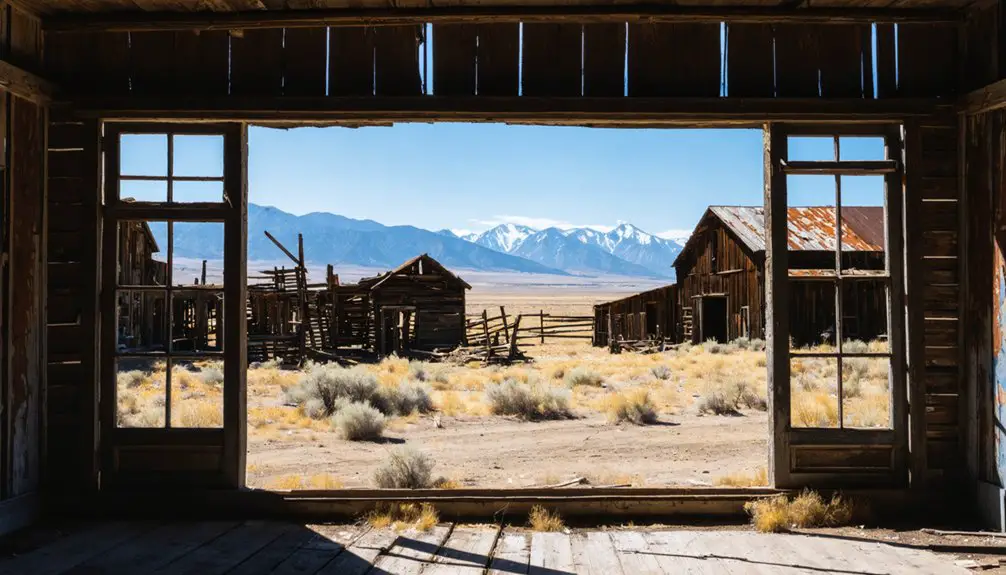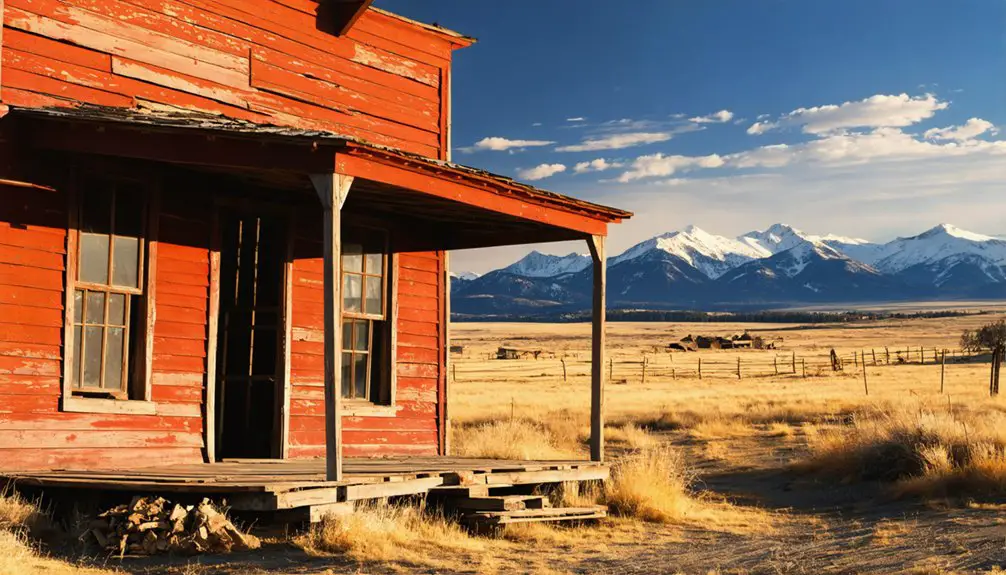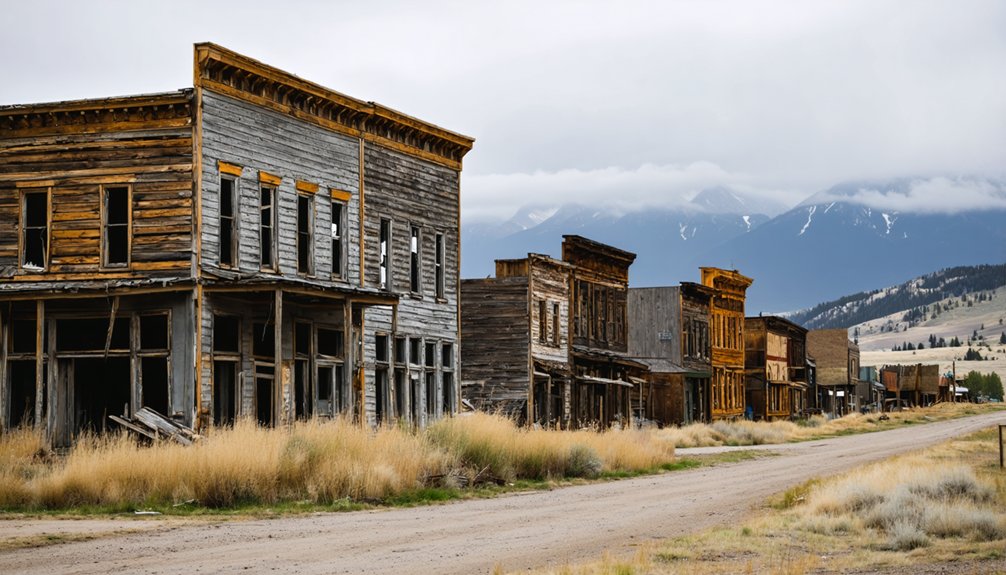
You’ll find Montana’s most haunted ghost towns in Garnet, where spectral music echoes from Kelly’s Saloon, and Bannack State Park, where Sheriff Henry Plummer‘s violent legacy lingers among 50 preserved buildings. Gunslinger Gulch’s 19 relocated structures have documented unexplained voices and shadow figures since 2019, while Butte’s infamous Cabbage Patch district preserves the darker side of frontier lawlessness. These sites aren’t just abandoned—they’re active with paranormal phenomena tied to mining accidents, vigilante justice, and the brutal realities of 1800s Montana life that continue to manifest today.
Key Takeaways
- Garnet Ghost Town features 82 preserved buildings at 6,000 feet elevation, with Kelly’s Saloon reporting spectral music and dancing phenomena.
- Bannack State Park contains over 50 original structures from Montana’s first gold rush, with paranormal activity linked to violent vigilante history.
- Gunslinger Gulch hosts 19 relocated historic structures documented in “Ghost Town Terror” series for unexplained voices and shadow figures.
- Wells Hotel in Garnet, built in 1897 with ornate woodwork, is actively associated with ghost sightings and paranormal occurrences.
- Montana’s ghost towns attract thousands annually, combining preserved mining-era buildings with reported supernatural activity and historical significance.
Garnet Ghost Town: Spirits Among the Ruby Mountains
Deep in the Garnet Mountains of western Montana, forty miles east of Missoula at 6,000 feet elevation, sits one of the state’s best-preserved ghost towns—a place where miners once extracted fortune from gold-bearing quartz and left behind a remarkably intact settlement.
High in Montana’s remote mountains, a perfectly preserved ghost town stands frozen in time, testament to the gold rush that once brought thousands seeking their fortune.
Garnet’s mining history began in the 1860s, exploding when Dr. Armistead Mitchell built his stamp mill at First Chance Gulch in 1895. By January 1898, nearly 1,000 fortune-seekers crowded thirteen saloons and twenty operating mines. The Nancy Hanks mine alone produced approximately $300,000 worth of gold, contributing significantly to the town’s prosperity.
The boom lasted barely a decade before depleted ore forced abandonment by 1905. Today, ghost town preservation efforts by the Bureau of Land Management maintain eighty-two contributing buildings on 134 acres—including the original saloon, jail, and mercantile. Visitors can also explore the restored schoolhouse and cabins that once served the thriving mining community.
This well-preserved site draws 16,000 annual visitors who wander freely through this authentic window into Montana’s frontier past.
Bannack State Park: Where Gold Rush Ghosts Still Roam
When John White and his band of “Pikes Peakers” from Colorado struck gold in Grasshopper Creek on July 28, 1862, they triggered Montana’s first major gold rush and unknowingly established what would become the territory’s most notorious settlement.
Bannack’s mining history reads like a cautionary tale. Sheriff Henry Plummer, elected to uphold the law, secretly commanded the “Innocents”—a gang exceeding 100 men who terrorized southwest Montana’s gold routes.
When citizens discovered their sheriff orchestrated highway robberies using insider knowledge, they formed a Vigilance Committee in December 1863.
Frontier justice arrived swiftly. Twenty-two men, including Plummer and his deputies, swung from gallows without formal trials.
Today, over 50 original buildings stand preserved at this 1954-designated state park, where visitors report unexplained phenomena among structures haunted by its violent past. Among the preserved structures, the Hotel Meade served as both courthouse and social gathering place during the town’s tumultuous years. The park’s 1,154 acres at 5,800 feet elevation offer campgrounds with 28 sites for those brave enough to spend the night.
Gunslinger Gulch: Montana’s Most Paranormally Active Ghost Town
While Bannack’s ghosts emerged organically from genuine frontier violence, a different kind of haunted settlement took shape near Anaconda in the 1990s—one deliberately assembled from Montana’s disappearing architectural past.
Gunslinger Gulch comprises 19 structures dating to 1854, salvaged from demolition and relocated to 52 acres.
Within days of the current family’s 2019 arrival, unexplained voices and shadow figures manifested throughout the property.
Most Active Locations:
- The Saloon and Brothel buildings
- Historic Boarding House
- 1856 log cabin
- Original frontier church
Travel Channel’s 2023 series “The Ghost Town Terror” documented paranormal investigations uncovering connections to unsolved murders.
The exposure transformed this haunted filming location into Montana’s premiere destination for overnight investigations.
Productions including “1923” and “Far Cry 5” utilized these atmospheric structures, where scratching sounds and moving objects remain unexplained.
Investigators Tim Wood, Sapphire Sandalo, and psychic medium Sarah Lemos conducted the six-episode exploration using EVP recordings and night vision equipment.
The property also offers era-appropriate guest units within the historic boarding house and other salvaged buildings for visitors seeking an immersive experience.
Kelly’s Saloon and Old Wells Hotel: Garnet’s Haunted Hotspots
Unlike the manufactured mystique of Gunslinger Gulch, Garnet’s paranormal reputation stems from authentic frontier history preserved in weathered timber and creaking floorboards.
Kelly’s Saloon, constructed before 1898 and one of 13 drinking establishments during Garnet’s boom, generates consistent spectral sightings. Winter visitors arriving by snowmobile or skis report music, chatter, and dancing emanating from the building—sounds that vanish the moment they approach the door.
Montana ghost historian Ellen Baumler documents this haunted history extensively.
The adjacent Wells Hotel, once featuring an ornate carved bannister before souvenir hunters pilfered it post-1947, rounds out Garnet’s paranormal activity. Built in 1897, the hotel served as the most impressive lodging establishment, featuring elaborate woodwork, stained glass, and cloth-backed wallpaper that created modest but elegant accommodations for miners and visitors. The town’s population surged to over 1,000 residents during the height of the gold rush, filling every room and saloon with fortune seekers.
Both structures survived the devastating 1912 fire and now stand among 22 buildings protected by the Bureau of Land Management, their restoration funded by $90,000 in donated artifacts.
Cabbage Patch: Butte’s Darkest and Most Mysterious District
Between 1864 and the 1940s, Butte’s Cabbage Patch district festered across six square blocks as the mining city’s most impoverished and lawless neighborhood—a shantytown so desperate its residents survived on cheap cabbage that gave the area its unforgiving name.
A six-block shantytown where desperation ran so deep that residents survived on cabbage alone, earning the district its bitter name.
You’ll find industrial decay and neighborhood lore woven through its surviving structures:
- Dirt-floor shanties built from scavenged mine timber and pressed tin housed three miners per 12×12-foot cabin.
- Open sewers ran through streets where bootleggers, prostitutes, and down-on-their-luck families coexisted.
- Unclear mine claim ownership turned the district into a squatter’s haven where residents paid no landlord.
- Federal demolition razed 200-250 buildings in 1940-41, though four preserved shacks now stand as testament to Butte’s harshest chapter.
The remaining structures feature makeshift interiors lined with linoleum scraps and loose fabric that served as wallpaper and insulation.
During Prohibition, the district earned notoriety when the self-proclaimed “King of the Cabbage Patch” McNamara allegedly blew himself up with his own moonshine still in the 1920s.
Pat Mohan’s restoration efforts keep this dangerous history alive.
Frequently Asked Questions
What Is the Best Time of Year to Visit Montana’s Ghost Towns?
You’ll find late August through September ideal for exploring ghost town history when mosquitoes vanish and crowds thin. The autumn light creates Montana’s best photography spots, capturing weathered structures against golden foliage without summer’s harsh glare interfering.
Are Overnight Stays Allowed at Any of Montana’s Haunted Ghost Towns?
You’ll be thrilled to discover that Garnet Ghost Town offers incredibly rare overnight cabin rentals from December through April. While exploring this 1890s mining settlement’s ghost town history and haunted legends, you can immerse yourself in authentic frontier solitude year-round.
Do I Need Special Permits to Explore Abandoned Buildings in Ghost Towns?
You don’t need permits for BLM or state park ghost towns, but legal considerations matter elsewhere. Trespassing laws protect private property—many ghost towns sit on private land where exploration without permission means you’re breaking the law and risking prosecution.
What Safety Precautions Should I Take When Visiting Remote Ghost Towns?
A 1920s miner vanished after parking his Model T carelessly—found weeks later. You’ll need parking safety on stable ground, wildlife awareness for bears and rattlesnakes, plus offline maps, sturdy boots, and notification of your whereabouts before exploring Montana’s isolated sites.
Can I Bring Ghost Hunting Equipment to Investigate Paranormal Activity?
You’ll find no documented equipment legality restrictions at Montana’s ghost towns, though you’d better contact property managers directly. Spectral evidence collectors regularly investigate Garnet’s Kelly’s Saloon and Gunslinger Gulch—just respect private property boundaries when hunting.
Exploring ghost towns in Montana offers a unique glimpse into the past, revealing stories of the gold rush and the lives of early settlers. Each abandoned building stands as a testament to a once-thriving community, now silent but full of history. Adventurers and history enthusiasts alike are drawn to these sites, eager to uncover hidden treasures and learn about the region’s rich heritage.
Many visitors are captivated by the allure of abandoned places in Montana, each offering a distinct narrative shaped by the state’s tumultuous history. As you navigate through these forsaken sites, you may stumble upon relics from a bygone era, such as rusted machinery and faded advertisements. The haunting beauty of these locations often inspires photographers and writers to capture their eerie charm, ensuring that the stories of Montana’s past continue to resonate.
References
- https://glaciermt.com/ghost-towns
- https://www.youtube.com/watch?v=BNDINIXiOqw
- https://www.garnetghosttown.org
- https://southwestmt.com/ghosts/haunted-places/
- https://en.wikipedia.org/wiki/List_of_ghost_towns_in_Montana
- https://visitmt.com/things-to-do/ghost-towns
- https://www.distinctlymontana.com/curious-afterlife-montanas-ghost-towns
- https://www.allmissoula.com/history_museums/garnet_ghost_town.php
- https://www.garnetghosttown.org/history.php
- https://en.wikipedia.org/wiki/Garnet