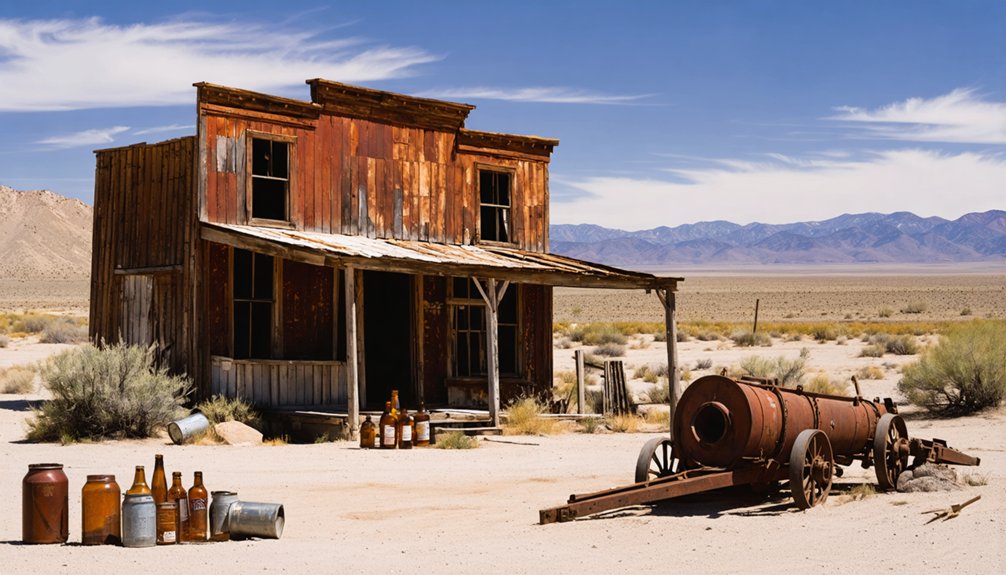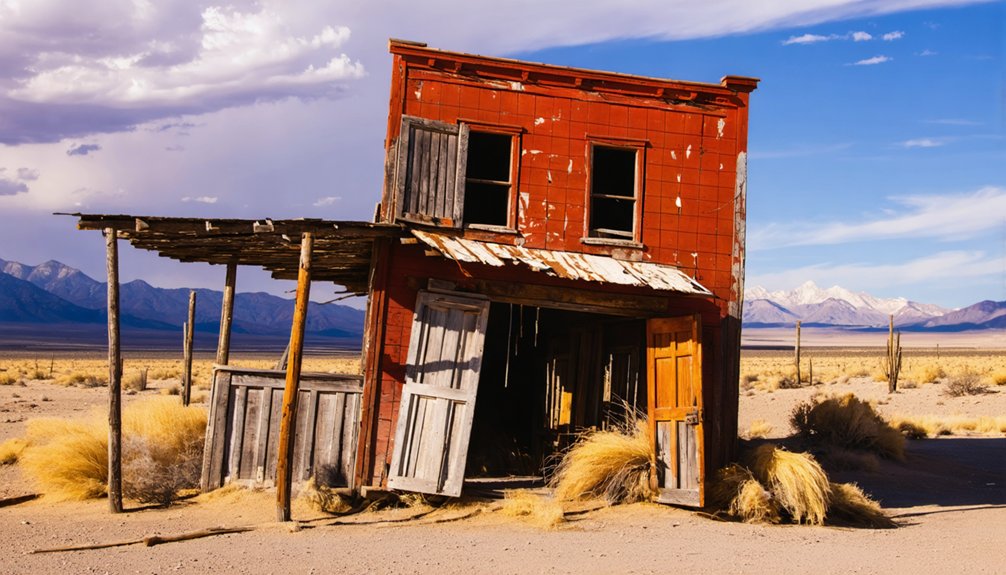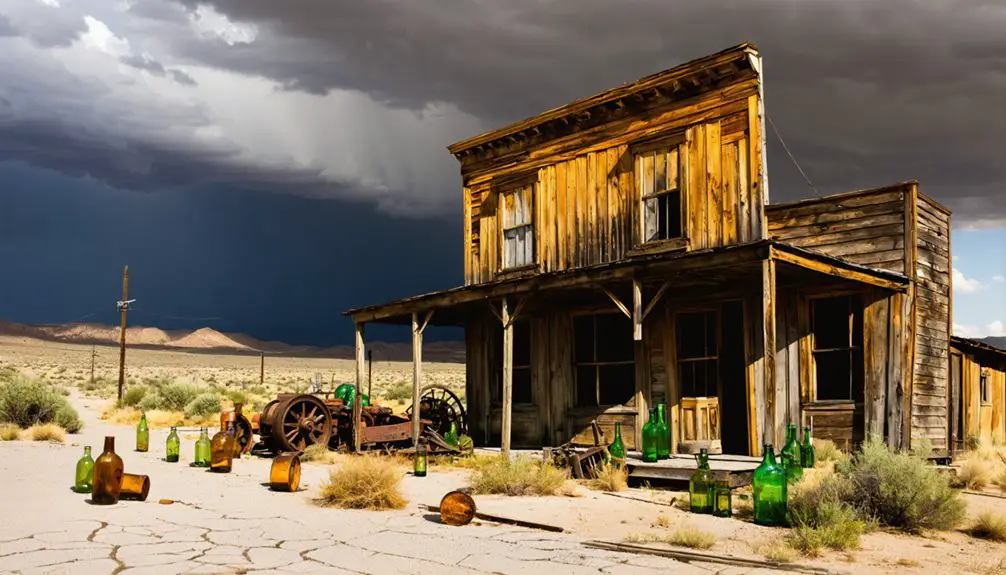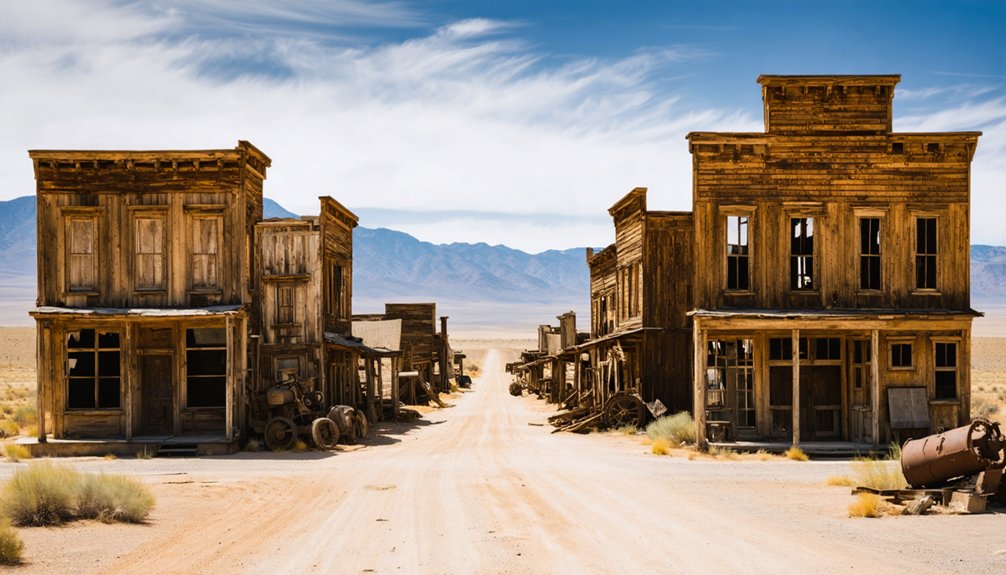
You’ll find Nevada’s most haunted ghost towns scattered across its desert landscape, with over 600 abandoned mining settlements accessible from Reno, Las Vegas, and Elko. Rhyolite’s 1907 ruins harbor heavy air and spectral sightings, while Goldfield Hotel—Nevada’s most haunted—has documented paranormal investigators’ encounters with “Elizabeth” and unexplained phenomena since 1908. Belmont preserves Charles Manson’s courthouse signatures from his failed 1969 camp, and remote Jarbidge connects gold rush history with Shoshone cannibal legends. Each location offers distinct supernatural experiences, historic preservation, and documented evidence that extends far beyond local folklore.
Key Takeaways
- Rhyolite features ruins including Cook Bank and Bottle House, with reports of heavy air, ghostly legends, and paranormal activity since its 1910 collapse.
- Goldfield Hotel, Nevada’s most haunted location, has confirmed paranormal phenomena including “Elizabeth” apparitions, mysterious odors, and poltergeist activity.
- Belmont displays Charles Manson’s courthouse signatures, children’s graves from epidemics, and persistent ghost stories tied to its dark mining history.
- Jarbidge is haunted by T’sawhawbitts cannibal legend, bloody handprints from 1916’s last stagecoach robbery, and continued ghostly encounters.
- Techatticup Mine in Eldorado Canyon, site of 1897 murders, produced $10 million in gold and offers tours of its haunted historical buildings.
Rhyolite: Where Manson’s Shadow Haunts Mining Ruins
On August 4, 1904, prospectors Shorty Harris and Ernest L. Cross discovered high-grade gold in the Bullfrog Hills, sparking a rush that birthed Rhyolite.
By 1907, you’d find over 5,000 residents, three-story banks, electric plants, and 50 saloons in Nevada’s largest town.
The boom collapsed fast—ore depleted, the 1906 San Francisco earthquake disrupted rail service, and mines operated at loss by 1910.
Electricity died in 1916, leaving mining ruins you can still explore today.
The ghostly legends intensified when Charles Manson’s family established a commune nearby in 1969, casting an eerie shadow over the already haunted landscape.
You’ll discover the photogenic Cook Bank walls, restored Bottle House, and remnants of red-light districts where spirits reportedly linger, unable to abandon their desert domain.
Unlike typical mining camps, Rhyolite utilized stone and concrete for its buildings, creating the elite structures that still stand as haunting sentinels in the desert.
Many visitors report experiencing heavy air over the main roadway leading into town, a phenomenon that draws ghost hunters from across the region.
Goldfield: Nevada’s Most Haunted Hotel Still Stands
While Rhyolite’s ruins crumble in silent decay, Goldfield’s most notorious structure still stands—a four-story monument to Nevada’s mining boom and its darkest legends. Built in 1908 by banking magnate George Wingfield, the Goldfield Hotel once featured 150 rooms with electricity and mahogany-adorned lobbies. The hotel was recognized as the most luxurious hotel between Chicago and San Francisco, catering to upper-class clientele with European chefs, steam heating, and an Otis elevator. The elevator’s remarkable speed of 300 feet per minute was claimed to be the fastest west of the Mississippi at the time.
Now it’s known for local legends surrounding “Elizabeth,” allegedly Wingfield’s pregnant mistress whom he reportedly chained to a radiator in room 109.
Supernatural sightings reported include:
- Elizabeth’s apparition wandering hallways while crying sounds echo through empty rooms
- Strong tobacco odors attributed to Wingfield’s ghost throughout the property
- “The Stabber” spirit attacking visitors crossing the Gold Room threshold with a phantom kitchen knife
Central Nevada Museum researchers note inconsistencies in these tales, yet paranormal investigators from *Ghost Hunters* and *Ghost Adventures* continue documenting unexplained phenomena.
Belmont: Silver Town With Roofless Relics and Dark Visitors
Town preservation efforts led to National Register status in 1972, yet Belmont attracts darker attention. Rose Walter once expelled Charles Manson’s group attempting to camp here—his signature still mars courthouse walls.
You’ll find children’s graves throughout, reminders of epidemics that stalked Nevada’s mining camps.
The Belmont Courthouse stands as one of Nevada’s best-preserved 19th-century civic buildings, its stone walls having endured decades of harsh weather and abandonment. During its peak, six operational mills processed the town’s silver ore, contributing to the $15 million worth of ore produced throughout Belmont’s mining lifetime.
Jarbidge: Remote Gold Rush Outpost With Living Souls
Deep in Nevada’s northeastern wilderness, where Shoshone tribes once refused to tread, Jarbidge sprawls across a canyon floor that legend claims belonged to T’sawhawbitts—a cannibal giant who stuffed victims into his basket.
Jarbidge rises from cursed earth where ancient Shoshone feared to walk, haunted by T’sawhawbitts the cannibal giant.
David Bourne’s 1909 discovery transformed this cursed ground into the West’s last major gold rush. By 1911, 1,500 souls crowded the canyon, defying both ancient warnings and isolation. The town boasted schools, roads, and businesses despite its remote location.
Mining legends and ghostly encounters define Jarbidge’s notorious past:
- America’s Last Stagecoach Robbery (1916): A killer left bloody handprints on stolen mail after murdering the Idaho stage driver—the first U.S. conviction using this evidence.
- The Great Fire (1919): A whiskey explosion destroyed 20+ businesses when townsfolk believed Elkoro Mining denied them power.
- The Lost Shepherd’s Curse: Prospector Ross discovered gold near a skeleton, then sickened and died mysteriously.
Today, the quaint ghost town retains its historic charm with a pair of town taxis offering rides along the main drag, drawing visitors who appreciate its rustic atmosphere and connection to the legacy of notable figures like Claude Dallas.
Techatticup and Eldorado Canyon: Spanish Gold and Civil War Ghosts
Spanish conquistadors whispered tales of golden canyons along the Colorado River two centuries before Nevada became a state.
You’ll find El Dorado Canyon’s mining legends rooted in 1775, when Spanish explorers sought gold but discovered only silver, abandoning their claims.
The Techatticup Mine, established in 1861, produced $10 million in precious metals before closing in the early 1940s.
Civil War hauntings plague this canyon where deserters created rival camps—Confederate-sympathizing Lucky Jim and Union-loyal Buster Falls.
With the sheriff’s office 200 miles away, gunfights over claim disputes became commonplace.
In 1897, prospector Charles Nelson and four others were murdered, prompting the town’s name change.
The region dominated southern Nevada’s gold production from the mid-1860s until 1900, earning its reputation as the most successful mining area in the territory.
Nelson’s Landing emerged as a key port on the Colorado River in the 1920s, with Prohibition increasing illegal moonshine operations through the remote outpost.
Today, you can explore restored buildings and mine tours just 45 minutes from Las Vegas, where seedy characters once pursued easy wealth.
Unionville: Mark Twain’s Failed Fortune and Lingering Spirits
You’ll find Unionville’s haunted reputation rooted in Samuel Clemens’s 1862 prospecting failure, when he spent a year mining worthless quartz in a mountainside dugout before abandoning his silver dreams.
The town’s decline from a 1,600-person county seat to fewer than 20 residents left behind structures where visitors report paranormal encounters, particularly at the restored 1861 guesthouse that now serves as Pioneer Garden inn.
Former residents’ spirits allegedly linger in the one-room schoolhouse and original cabins, their presence tied to the economic collapse that followed the 1870 discovery of exhausted ore deposits.
Mark Twain’s Prospecting Days
Before Mark Twain became America’s most celebrated humorist, Samuel Langhorne Clemens arrived in Unionville during 1862 chasing the same silver dreams that lured thousands to Nevada’s remote canyons. Reports of glittering ore “lying all about the ground” proved devastatingly exaggerated.
His three-week prospecting reality:
- Abandoned promising claims – He and his partners left a claim in 1862 that later produced valuable silver, though not millionaire-making fortunes.
- Traded mining equipment for mill work – Insufficient yields forced him into shoveling tailings at quartz operations.
- Witnessed town infrastructure collapse – Arriving after the 1859 rush depleted amateur opportunities, he discovered intense labor requirements incompatible with easy fortune.
The weathered cabin from his prospecting days still stands among Unionville’s sparse remnants, testament to dreams that turned Clemens toward writing instead.
Decline From County Seat
After reaching its peak population of 1,500 residents in 1864, Unionville entered a swift decline as mining realities crushed the exaggerated promises that built the town. You’ll find the Central Pacific Railroad‘s 1870 completion redirected trade through Winnemucca, stripping Unionville of its economic lifeline.
By 1872, an August fire dealt $30,000 in damage, accelerating the exodus. The county seat officially moved to Winnemucca in 1873, ending Unionville’s political relevance.
Today’s abandoned buildings and mining remnants tell this story of collapse. The town relocated from upper to lower canyon, leaving Mark Twain’s cabin site and deteriorating schoolhouse as monuments to failed ambitions.
With fewer than 24 residents, this unincorporated hamlet preserves no formal government—just scattered mill foundations among occupied homes.
Pioneer Garden’s Ghostly Guests
When Samuel Clemens arrived in Unionville during winter 1862, he found what he described as “eleven cabins and a liberty-pole”—five cabins perched on one side of a mountain crevice, six on the other.
Today, you’ll discover Unionville classified as a ghost town with fewer than 20 inhabitants, where cultural legends persist despite minimal preservation efforts.
What remains for freedom-seekers exploring this haunted art of Nevada’s past:
- Mark Twain’s dugout cabin stands in Whitaker Memorial Park, marked by state historic signage
- Restored 1861 adobe guesthouse with two-foot-thick walls where Clemens reportedly dined
- Abandoned one-room schoolhouse and scattered buildings in disrepair along gravel roadways
The town offers no grand ruins or haunted mine stories—just authentic remnants of Twain’s failed prospecting venture before adopting his legendary pen name.
Poeville: Washoe County’s Forgotten Mining Camp
High on the eastern slopes of Peavine Mountain, roughly 10 miles northwest of Reno, John Poe established a mining camp in 1872 that would briefly capture the attention of Nevada’s silver seekers.
You’ll find remnants of what locals called Poeville, Poe City, or even Poedunk—a settlement that swelled to over 300 residents by 1876.
Mining technology of the era included a ten-stamp mill processing ore from the Poe, Paymaster, and Golden Fleece mines, though yields proved disappointingly low at $4.60-$12.00 per ton.
The boom lasted just four years before collapsing by 1880.
Today, ghost town preservation efforts face challenges, as most workings have collapsed into inaccessible shafts and trenches.
You can still explore the site via mountain biking trails through Toiyabe National Forest.
Paranormal Activity: Orbs, Apparitions, and Unexplained Phenomena
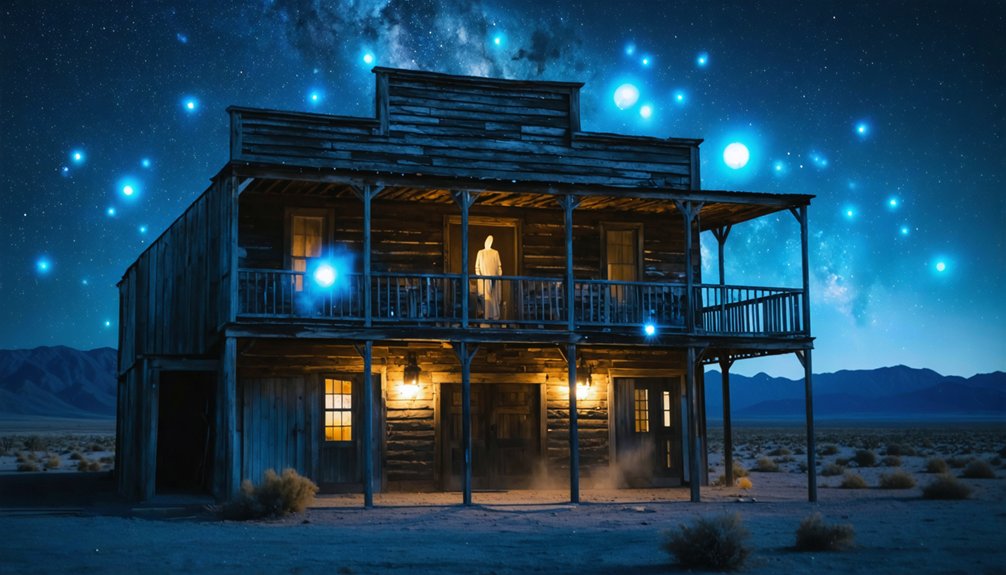
While skeptics dismiss ghost town hauntings as wind through collapsed timbers, Nevada’s abandoned mining camps have documented decades of unexplained phenomena that challenge rational explanation.
You’ll encounter three distinct categories of paranormal activity across these sites:
- Orbs and Light Anomalies: Floating luminous spheres appear in Rhyolite’s saloon ruins, Goldfield’s mining structures, and Nelson’s Eldorado Canyon. Photographers consistently capture these unexplained lights near abandoned equipment and spectral trains once servicing ore operations.
- Apparitions and Shadow Figures: Spectral women haunt Goldfield Hotel’s corridors, while ghostly miners materialize in Nelson’s shafts. Virginia City’s establishments report full-bodied manifestations amid haunted jewelry displays.
- Auditory and Thermal Phenomena: Unexplained cold spots, eerie whispers, and loud bangs plague locations from Belmont’s courthouse to Rhyolite’s depot areas, defying conventional explanation.
Charles Manson’s Nevada Hideouts and Their Eerie Legacies
Nevada’s ghost towns harbor more spectral miners and phantom saloon patrons—some locations bear the physical marks of one of America’s most notorious criminal cults.
At Belmont’s abandoned courthouse in Nye County, you’ll find chilling evidence: “Charlie Manson + Family 1969” scratched into a first-floor door frame, with a peace symbol replacing the “o” in Manson.
Manson’s signature remains carved inside the building itself.
Local accounts confirm Manson and his followers attempted camping inside the courthouse before Rose Walter, Belmont’s unofficial guardian, expelled them.
While spiritual legends and haunted spirits typically dominate ghost town narratives, this tangible connection to evil creates an unsettling atmosphere.
The graffiti serves as a haunting reminder that real-world darkness sometimes eclipses supernatural folklore in Nevada’s abandoned settlements.
Exploring Nevada’s Ghost Towns: What to Expect and Where to Stay
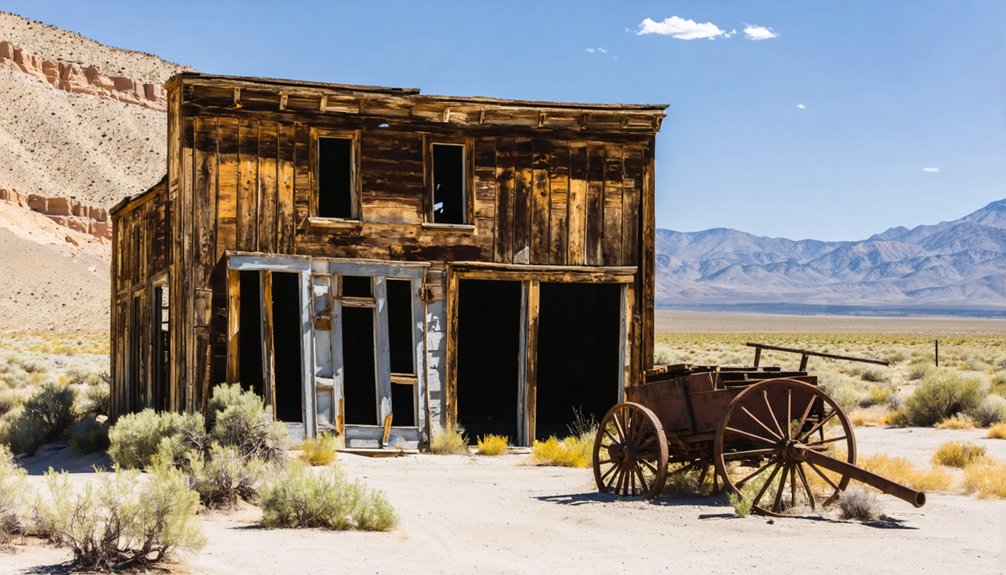
You’ll find Nevada’s 600+ ghost towns accessible from major hubs like Reno, Las Vegas, and Elko. With detailed atlases providing 71 color maps, you can navigate to over 2,200 documented sites.
Berlin-Ichthyosaur State Park offers on-site facilities alongside well-preserved structures. Towns like Jarbidge and Gold Point provide B&B accommodations for overnight stays.
Before venturing to these remote locations, consult interactive maps that link photographs and historical data for 500+ towns. Also, prepare appropriate supplies for off-grid desert conditions.
Best Ghost Towns Access
Exploring Nevada’s 600+ ghost towns requires understanding that access conditions vary dramatically from paved highway stops to remote desert trails demanding high-clearance vehicles.
You’ll find Rhyolite and Goldfield offer the easiest access via main highways, while Jarbidge demands 20 miles of unpaved roads along the Nevada-Idaho border.
Standard vehicles can handle the 3-mile Valley of Fire routes, but remote sites like Tuscarora and Belmont test your navigation skills.
Access categories by difficulty:
- Easy paved access: Rhyolite’s train depot and Goldfield’s historic district sit directly on established routes between Las Vegas and Reno, surrounded by desert flora.
- Moderate unpaved roads: Gold Point lies 65 miles north of Beatty on maintained desert roads near abandoned railroads.
- Challenging remote access: Jarbidge via County Road 754 requires preparation and vehicle clearance.
Historic Lodging Options Available
The ghost town lodging experience transforms historical preservation into overnight adventure, with accommodations ranging from Gold Point’s restored miners’ cabins to Virginia City’s 1876 Silver Queen Hotel. You’ll find authentic Western settings enhanced by modern amenities—Gold Point’s cabins feature WiFi despite their rustic exteriors, while your stay directly funds Nevada’s historical restoration efforts.
Virginia City’s National Historic District delivers the most extensive options, including Gold Hill Hotel’s 150-year legacy and saloon-integrated lodging.
Goldfield’s Stop Inn provides private cabins with hot tub access near the haunted landmark hotel.
These towns host cultural festivals and art installations that complement your overnight experience.
For complete immersion, you can explore Belmont’s Dirty Dick’s Saloon or Tonopah’s reputedly haunted Mizpah Hotel, where history isn’t merely observed—it’s inhabited.
Essential Safety and Supplies
Before venturing into Nevada’s remote ghost towns, prepare your vehicle with all-terrain capabilities and essential recovery gear—self-recovery equipment, earth anchors, and a five-gallon gas can for extended backcountry travel.
Vehicle maintenance proves critical before departure. Don’t rely on cell service; carry printed coordinates, maps, compass, and GPS with backup navigation skills.
Essential Supplies for Ghost Town Exploration:
- Safety manuals and medical resources – Pack wilderness medicine guides and survival manuals for emergencies in areas lacking immediate assistance.
- Food and hydration reserves – Bring substantial water and snacks for hours without facilities, accounting for desert heat and sudden temperature drops.
- Wildlife encounters preparation – Test hot spring temperatures before entering, leash dogs, and stay alert for hazards like abandoned mine shafts.
Travel in groups whenever possible for mutual recovery assistance and safety.
Frequently Asked Questions
Are Ghost Town Visits Safe for Families With Young Children?
Safety concerns exist with 35,000 hazardous abandoned mines statewide. You’ll find child-friendly activities at protected sites like Rhyolite and Nelson, but you must supervise children constantly near unstable structures and hidden shafts in remote locations.
What Is the Best Time of Year to Explore Nevada Ghost Towns?
Fall (September-November) offers you the best conditions: comfortable 40-65°F temperatures perfect for photography opportunities, stable road access to authentic historical sites, minimal wildlife hazards, and fewer crowds—giving you maximum freedom to explore Nevada’s genuine ghost towns independently.
Do I Need Permits or Permissions to Visit These Abandoned Sites?
Most Nevada ghost towns don’t require permits for exterior visits, but you’ll need permission for private property access and interior exploration. Always respect parking restrictions and check ownership status before entering buildings or removing anything from these protected historic sites.
Can I Camp Overnight in Nevada’s Ghost Towns Legally?
You can legally camp overnight at most Nevada ghost towns on BLM land, respecting historical preservation laws and taking wildlife precautions. However, some sites like Rhyolite prohibit overnight stays. Always verify specific location rules before camping dispersed.
What Essential Supplies Should I Bring When Visiting Remote Ghost Towns?
You’ll need water, first-aid supplies, navigation tools, and vehicle recovery gear for safety precautions. Practice responsible tourism by packing out trash, carrying sanitation supplies, and bringing sturdy footwear plus sun protection for Nevada’s harsh conditions.
References
- https://en.wikipedia.org/wiki/List_of_ghost_towns_in_Nevada
- https://www.visittheusa.com/experience/6-nevada-ghost-towns-explore-if-you-dare
- https://vegasghosts.com/nevada-a-ghost-town-state/
- https://savingplaces.org/stories/explore-wild-west-mining-history-in-nevada-ghost-towns
- https://exploreelko.com/things-to-do/uncommon-activities/ghost-towns/
- https://www.loveexploring.com/gallerylist/188812/nevadas-spookiest-places-from-eerie-ghost-towns-to-haunted-hotels
- https://roadtrippers.com/magazine/dark-skies-and-ghost-towns-stops-on-a-spooky-nevada-road-trip/
- https://nvtami.com
- https://travelnevada.com/ghost-town/
- https://www.youtube.com/watch?v=lXyHDThvoLU