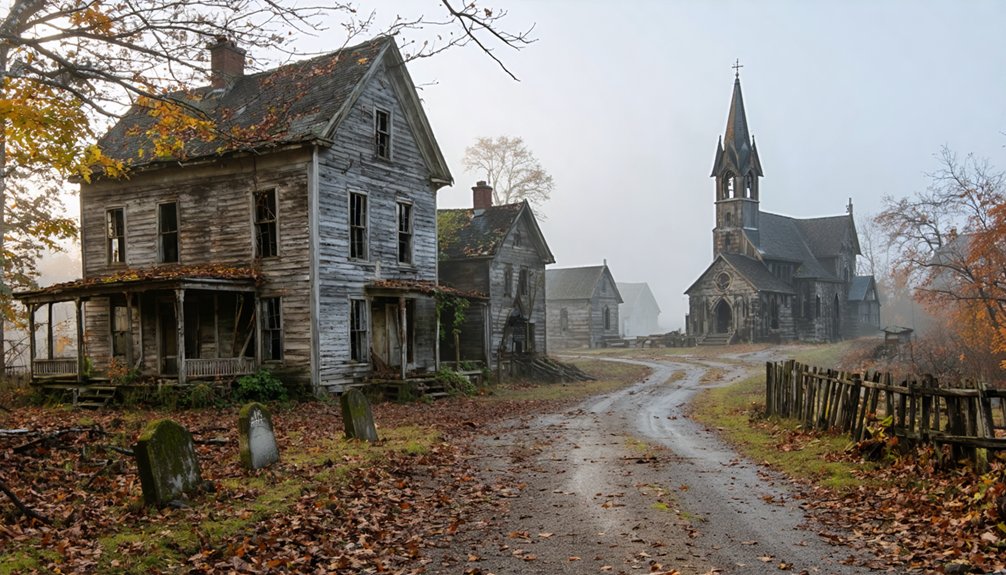
You’ll find New Hampshire’s most haunted ghost towns in the White Mountains, where Livermore—abandoned after devastating fires and a 1927 flood—hides its mill foundations beneath forest overgrowth. Hill Ghost Town, deliberately dismantled in 1941 for the Franklin Falls Dam, leaves behind cellar holes and relocated cemeteries that mark where 200 years of settlement ended. The region’s paranormal activity extends to sites like Three Chimneys Inn (1649) and Blood Cemetery (1769), where witnesses report apparitions and unexplained phenomena that connect New Hampshire’s abandoned settlements to documented supernatural encounters throughout its historic landscape.
Key Takeaways
- Livermore, a logging town incorporated in 1874, was dissolved in 1951 after epidemics, fires, and floods left only foundations remaining.
- Hill Ghost Town was deliberately dismantled in 1941 for Franklin Falls Dam, with residents relocating and leaving accessible cellar holes and markers.
- Three Chimneys Inn in Durham, built in 1649, features paranormal activity including apparitions, moving furniture, and Hannah’s drowning legend.
- Inn at Tilton, surviving three deadly fires since 1875, hosts Laura’s spirit with validated paranormal encounters including rattling glasses and EVP recordings.
- Blood Cemetery in Hollis features the mysterious “Hand That Points Beyond” gravestone that reportedly shifts positions with ghostly children sightings.
Livermore: The Logging Town Lost to Fire and Flood
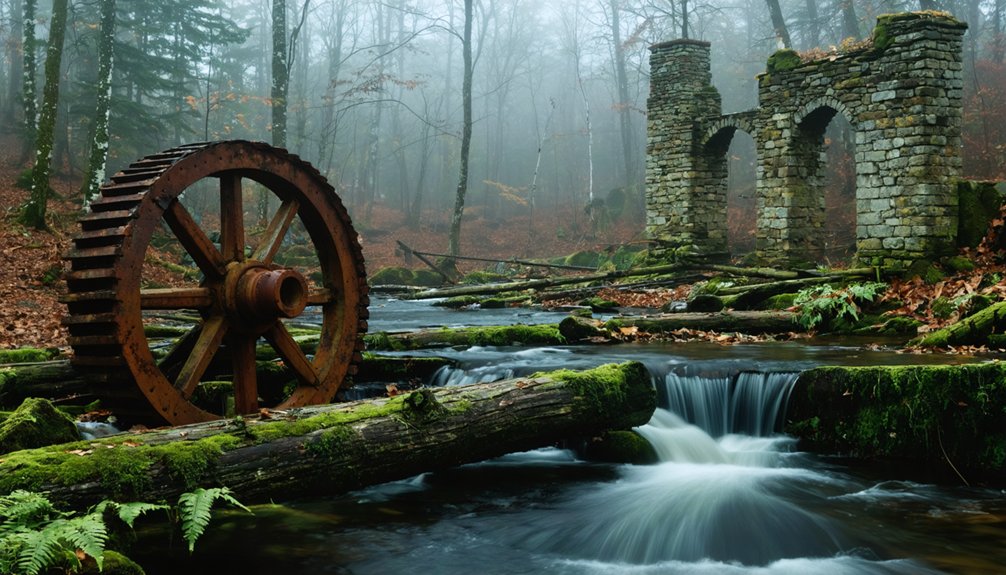
Deep in the White Mountains, where Route 302 winds through Crawford Notch, a forgotten logging empire once thrived in Livermore—a town that rose with unprecedented speed and vanished just as quickly.
The Saunders family incorporated their lumber operation in 1874, investing $150,000 to build two massive mills connected by the Sawyer River Railroad.
By 1880, you’d have found 103 residents living in this company town, producing $44,000 worth of lumber annually.
Nature reclaimed what industry built. A smallpox epidemic killed forty residents in 1880.
Fire consumed mills in 1876 and 1925.
The devastating 1927 flood destroyed everything remaining.
The Sawyer River Railroad was completely destroyed by the November 1927 flood, washing away the critical transportation infrastructure that had sustained the logging operation.
Today’s aerial photography reveals only foundations where prosperity once stood.
Historical artifacts scattered through the forest mark where New Hampshire dissolved this township in 1951. The place name disambiguation reflects how multiple locations across the United States share the Livermore name, making this New Hampshire ghost town one of several forgotten communities bearing the same title.
Hill Ghost Town: A Village Submerged by Progress
Unlike most ghost towns abandoned through economic collapse, you’ll find Hill Village deliberately dismantled in 1941 when the Army Corps of Engineers needed the low-lying settlement as a dry bed reservoir for Franklin Falls Dam.
The government funded relocation of 14 buildings and 30 houses to higher ground nearby, razing everything else to prevent debris in the impoundment area. The village had originally been incorporated as New Chester in 1753 before being renamed Hill in the 1830s to avoid duplicate community names across the state.
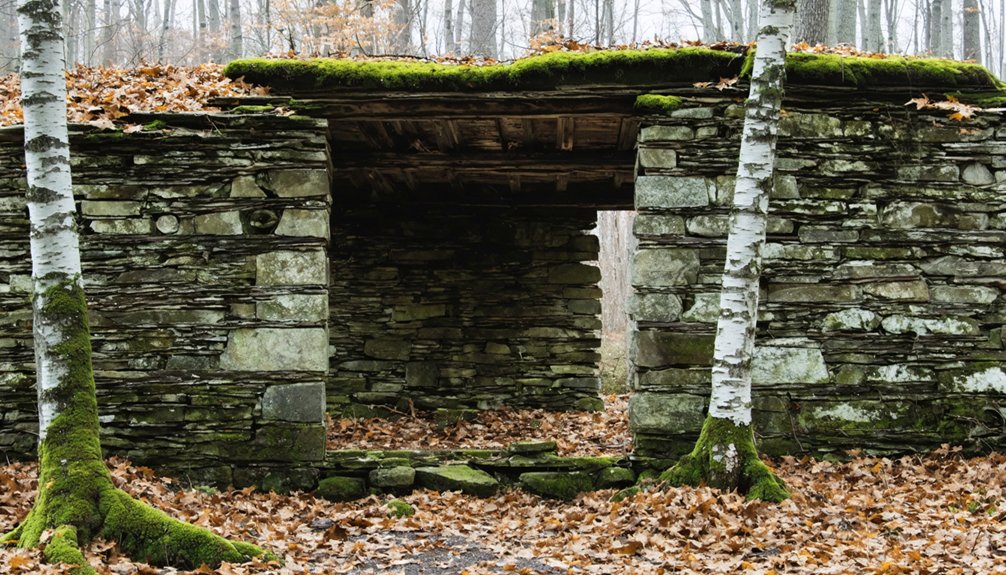
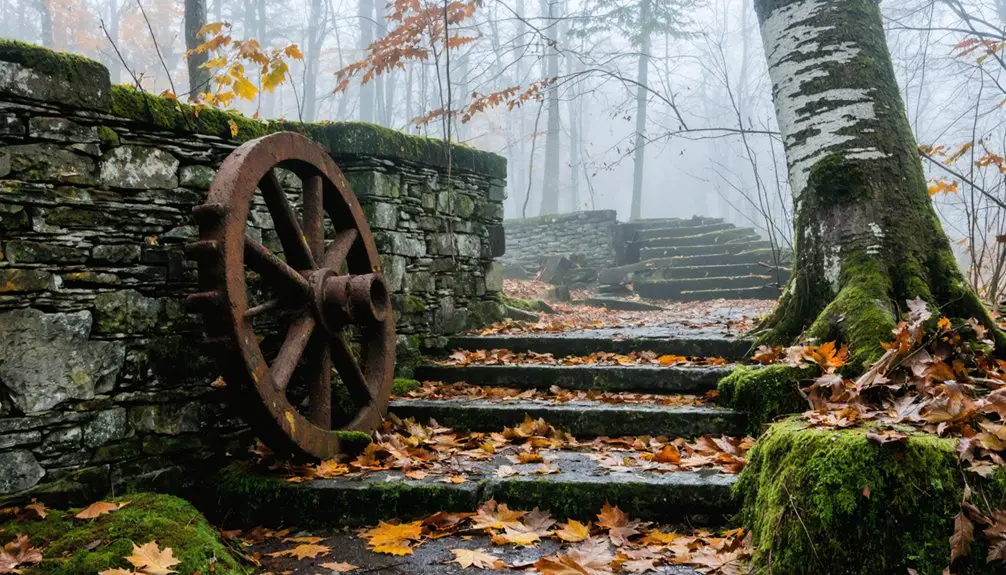
Today you can walk the former main street at Needlebrook Recreation Area, where cellar holes, mill foundations, and historical markers document a community that chose survival over standing its ground—a ghost town created not by failure, but by federal flood control policy. Walkable main street features signs marking where stores, shops, train depots, and hotels once stood in this thriving past community.
Relocated for Dam Construction
When the Army Corps of Engineers proposed a flood control dam in 1937, the residents of Hill faced an unprecedented choice: watch their 183-year-old community vanish beneath a reservoir or undertake the monumental task of relocating an entire town.
The federal government designated their village as a “dry bed reservoir” for the Franklin Falls Dam project, designed to protect downstream communities from devastating floods that had repeatedly struck in 1875, 1916, 1936, 1938, and 1941.
Rather than accept disbandment, Hill’s citizens rejected federal buyout offers and voted to preserve their community through relocation. By January 1940, residents formed an association and purchased land for a new village, rapidly constructing 30 houses, a town hall, school, and complete water system by June 1941. The community preserved their heritage by relocating the 1848 town meeting house, which was later restored in 1992 to serve as a tangible link to their past.
Seasonal Access to Ruins
Today’s Old Hill Village site rests within the Franklin Falls Dam’s dry bed reservoir zone, accessible year-round on foot but subject to periodic flooding during spring runoff and heavy precipitation events.
You’ll find the best exploration conditions during summer and fall months when water levels remain low, revealing the full extent of urban decay scattered across the valley floor.
Winter access requires traversing snow-covered trails, while spring’s unpredictable flooding can submerge architectural relics beneath several feet of water.
The Needlebrook Trail parking accommodates only five vehicles, so you’ll want to arrive early during peak foliage season.
Check river conditions before visiting—these cellar holes and foundation remnants disappear completely when the Army Corps releases water for flood control operations.
Visitors can spot crumbling old sidewalks overgrown with vegetation, demonstrating the infrastructure that once served Hill’s original residents before the town’s relocation in 1941.
Ghost Town Without Ghosts
From its 1754 founding as New Chester through its 1837 rechristening as Hill, this Pemigewasset River settlement occupied a floodplain that would ultimately seal its fate. After devastating floods in 1875, 1916, 1936, 1938, and 1941, federal authorities seized the town in 1937 for Franklin Falls Dam construction.
You’ll find no documented hauntings here, despite rumors of roaming spirits—just the skeletal remains of foundations, rusted sewer pipes, and wrought iron railings consumed by forest growth. The entire community voted to relocate collectively rather than disperse, moving buildings, churches, and even cemeteries to higher ground by 1941.
This urban development sacrifice enabled natural preservation downstream while creating New Hampshire’s authentic ghost town, where plaques mark vanished stores and a solitary tree suggests the former town square. Like other New England sites with rich historical oddities, Hill exemplifies the region’s natural and technological wonders that continue to attract explorers and history enthusiasts. Today, the site remains accessible for winter sports like dogsledding, skiing, and snowmobiling, while spring through fall visitors explore by bike, horseback, canoe, or on foot.
Three Chimneys Inn: Hannah’s Eternal Vigil
Along the windswept shores of Great Bay, where the Oyster River meets the tidal waters of Durham, New Hampshire, stands one of colonial America’s most enduring structures.
Valentine Hill constructed this tavern in 1649, establishing what would become a nexus of haunted history spanning nearly four centuries.
The ghostly legends center on Hannah, whose drowning in the Oyster River behind the property created an enduring supernatural presence. You’ll find furniture mysteriously rearranged, doors locking autonomously, and apparitions drifting through rooms in period clothing.
During one documented incident, a wine glass levitated from a table before shattering mid-air.
Despite these manifestations, no malevolent behavior has been reported. Hannah’s spirit apparently seeks recognition rather than revenge, making this colonial establishment one of New England’s most accessible paranormal destinations. Staff members have witnessed a wispy woman in period attire bidding “good morning” during early hours.
The 1875 Inn at Tilton: Where Laura Still Plays
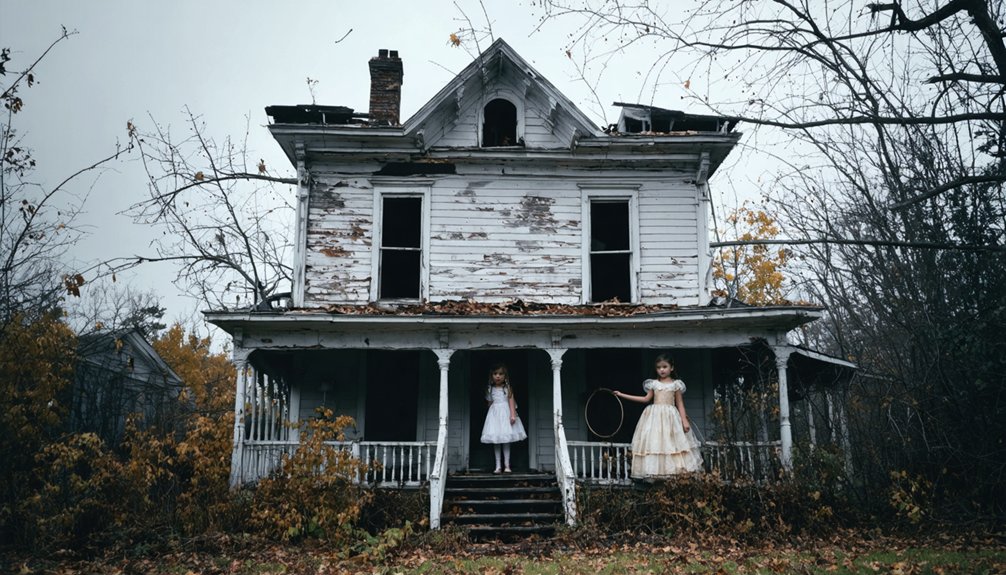
Nestled in the Lakes Region of central New Hampshire, the 1875 Inn at Tilton has survived three devastating fires since its construction—blazes that claimed upward of eight lives and repeatedly reshaped the building’s Victorian architecture.
Among the victims was twelve-year-old Laura, who perished in the Sanborn room during the 1800s. Her spirit reportedly rattles glasses and knocks items from shelves throughout the property, exhibiting playful rather than malevolent behavior.
TAPS Rhode Island confirmed paranormal activity beyond Laura’s presence through EVP recordings and direct encounters. Archaeological excavations unearthed artifacts documenting the inn’s turbulent history, while subsequent renovations preserved its character.
Today, Onions Pub & Restaurant serves guests beneath rafters that witnessed both tragedy and survival—a tribute to resilience amid mountain vistas, far removed from medieval architecture’s European constraints.
Blood Cemetery: The Hand That Points Beyond
While Laura’s playful spirit haunts the renovated halls of a Victorian inn, a more unsettling presence occupies Pine Hill Cemetery in Hollis, New Hampshire—a burial ground where the dead are said to communicate through stone itself.
At Pine Hill Cemetery, whispered legends claim the departed speak not through wind or shadow, but through the ancient stones themselves.
You’ll find this 1769 cemetery along Pine Hill Road, nicknamed “Blood Cemetery” after resident Abel Blood, who died in 1867. Among nearly 300 graves stands the most documented paranormal phenomenon: a carved finger that reportedly points upward by day, then turns downward at night.
Historical artifacts like this pointing hand—known as “The Hand That Points Beyond”—represent traditional cemetery symbolism, yet multiple witnesses claim they’ve observed its position change.
Investigators document ghostly children, disembodied voices, and unexplained anomalies here. Police maintain constant surveillance against vandals drawn to New Hampshire’s most haunted graveyard.
Woodland Cemetery’s Summer Knight Chapel: Echoes of a Child’s Laughter
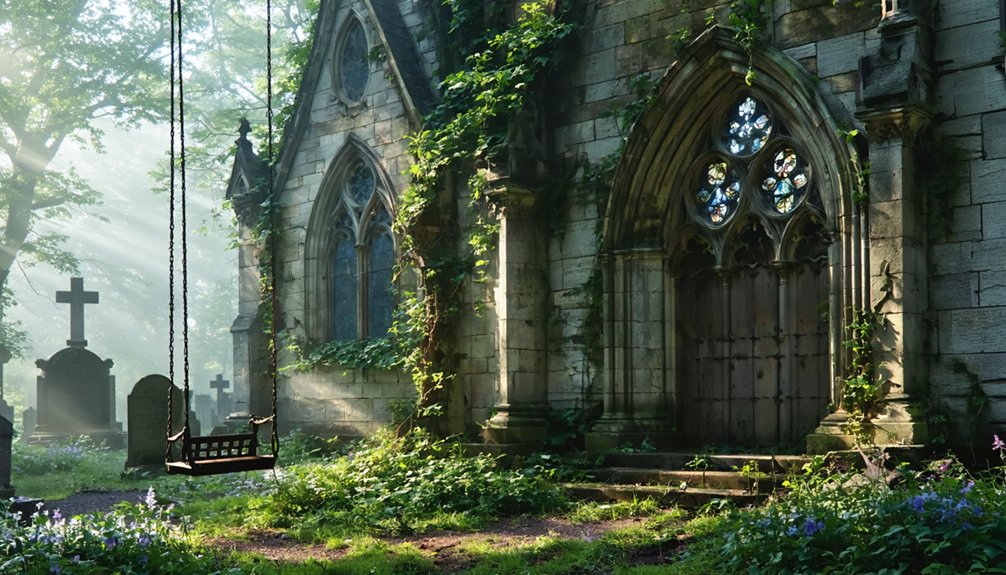
You’ll find Woodland Cemetery in Keene, New Hampshire, where the Sumner Knight and Family Memorial Chapel stands as the city’s most haunted location.
The chapel’s reputation centers on two distinct phenomena: a little girl’s spirit who peers from behind trees and follows visitors with audible giggles.
And a peculiar legend that cursing near the building will leave you tasting soap.
Local witnesses have documented these encounters for years, making the chapel a focal point for paranormal activity in this otherwise peaceful burial ground.
The Giggling Girl Spirit
Among the weathered monuments of Woodland Cemetery’s Northeast Division, visitors have reported encounters with a playful child spirit who peers from behind tombstones and century-old trees. This giggling girl makes herself visible to anyone present, following guests through the grounds with infectious laughter that echoes through the historic burial site.
Her favorite haunts span the area surrounding Sumner Knight Chapel, where she’s become part of local legends passed down through generations.
The cemetery’s historical significance dates to the late 1700s, with expansions reaching from Page Street to North Lincoln Street by 1901.
Unlike the malevolent presence reportedly trapped inside the chapel, this youthful spirit remains outside, drawing photographers hoping to capture orbs and ghostly images near the elevated one-and-one-half-story structure.
Cursing and Soap Legends
The playful giggling outside Sumner Knight and Family Memorial Chapel contrasts sharply with the darker legends surrounding the structure itself. You’ll trigger an unusual phenomenon if you curse near this Woodland Cemetery landmark in Keene’s North District—a faint soap taste materializes on your tongue, accompanied by the scent of lye in the air.
Local legend attributes this spiritual cleansing to a disciplinarian spirit enforcing proper behavior.
However, curse interactions don’t always follow the expected pattern. When one couple tested the legend, they experienced ash instead of soap—a taste like campfire smoke that seized their breath. They felt a bony hand gripping their heads, unable to move.
Inside the chapel at 42.943223543326695, -72.26860426693418, investigators report heavy footsteps and an unfriendly presence with malevolent intent.
Exploring New Hampshire’s Paranormal Past
New Hampshire’s landscape conceals a darker history beneath its scenic mountains and colonial charm, where abandoned settlements and burial grounds have become focal points for documented paranormal activity. Urban legends and folklore mysteries converge with verified investigator reports across ghost towns like Monson Village, where Native American drum beats echo through the woods since 1746.
Beneath New Hampshire’s colonial beauty lies a haunted legacy where documented paranormal encounters merge with centuries-old folklore and Native American mysteries.
You’ll find compelling evidence at these documented locations:
- Pine Hill Cemetery in Hollis features 300+ gravestones from the 1700s, with Abel Blood’s spirit appearing alongside unexplained tapping sounds and floating orbs.
- Three Chimneys Inn (1649) hosts Hannah’s pranking ghost in Durham’s oldest establishment.
- Amos J Blake House Museum reportedly contains 11 spirits plus a phantom cat.
- Monson Village welcomes ghost hunters on easy hiking trails where paranormal investigators recorded unusual phenomena.
Regional ghost-hunting communities continue documenting these historic sites.
Frequently Asked Questions
Are There Guided Paranormal Tours Available at These New Hampshire Ghost Towns?
You’ll find guided paranormal tours exploring Portsmouth’s haunted history, where Roxie Zwicker shares ghost stories through shadowed streets. Deadwick’s Spectral Stroll and New England Curiosities lead you through burial grounds, revealing Revolutionary War spirits and cryptic folklore.
What Is the Best Time of Year to Visit These Haunted Locations?
Fall’s your prime window—mid-September through October offers peak foliage, comfortable 40-60°F temperatures, and fewer crowds. You’ll navigate dry trails safely while seasonal weather minimizes wildlife encounters. Post-Labor Day timing grants unrestricted access to New Hampshire’s abandoned sites.
Do Visitors Need Special Permission to Access Abandoned Ghost Town Sites?
Like trails blazing through old-growth forest, you’ll find most ghost town sites publicly accessible without permission. However, you must respect private property boundaries and legal restrictions prohibiting artifact removal—freedom paired with responsibility guarantees these historical sites remain available for everyone.
Have Any Paranormal Investigators Documented Evidence at These Locations?
No documented paranormal investigations exist for these ghost towns. You’ll find their haunted reputations stem from eerie atmospheres and abandoned structures rather than verified ghostly encounters or spectral apparitions recorded by professional investigators in New Hampshire’s historical archives.
In contrast, abandoned places in New Jersey offer a rich tapestry of urban legends and haunting tales. Some locations, like the infamous Batsto Village, are steeped in history and mystery, drawing the curious and thrill-seekers alike. Visitors often report strange sounds and fleeting shadows, making these sites a focal point for those interested in the paranormal.
Are There Safety Concerns When Exploring Abandoned New Hampshire Ghost Towns?
Yes, you’ll face significant dangers. Livermore’s 1920s flood destroyed infrastructure, creating environmental hazards like unstable bridges and hidden cellar holes. Historical preservation matters, but navigate carefully around collapsed foundations, overgrown debris, and fire-prone woodlands when you’re exploring independently.
References
- https://www.nhmagazine.com/the-most-haunted-places-in-new-hampshire/
- https://outdoorodyssey.net/2022/11/03/the-haunted-ghost-town-of-livermore-nh/
- https://vitabrevis.americanancestors.org/2016/11/new-hampshire-ghost-town
- https://wjbq.com/abandoned-ghost-town-of-livermore-is-new-hampshires-smallest-town/
- https://wokq.com/2-new-hampshire-ghost-town-home/
- https://www.youtube.com/watch?v=mFBYIdURBvQ
- https://www.visitwhitemountains.com/blog/post/spooky-stories-ghost-towns-and-historic-haunted-spots/
- https://en.wikipedia.org/wiki/Livermore
- https://www.lancerspiritonline.com/34775/showcase/forgotten-new-hampshire-episode-1-livermore/
- https://www.whitemountainhistory.org/abandoned-towns/livermore