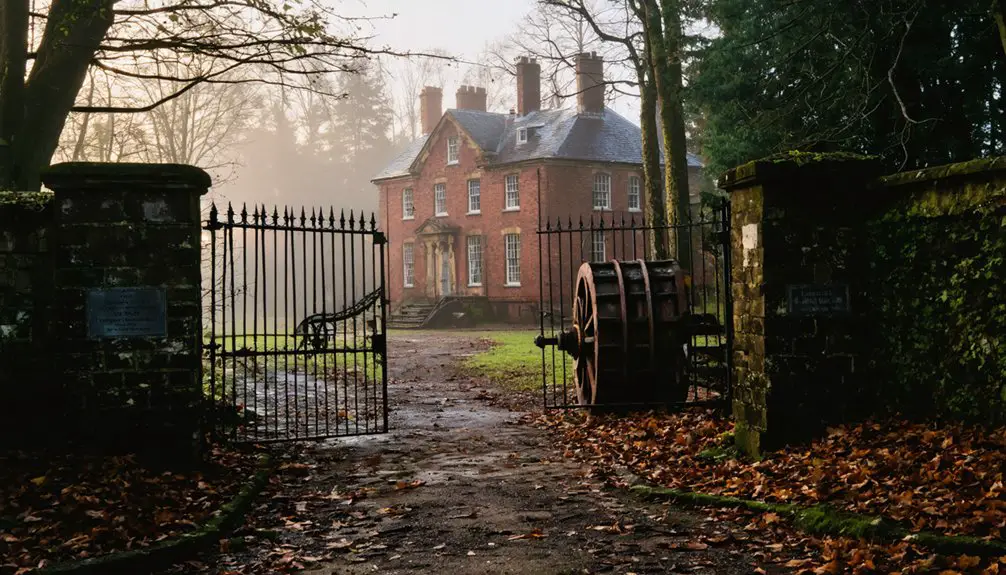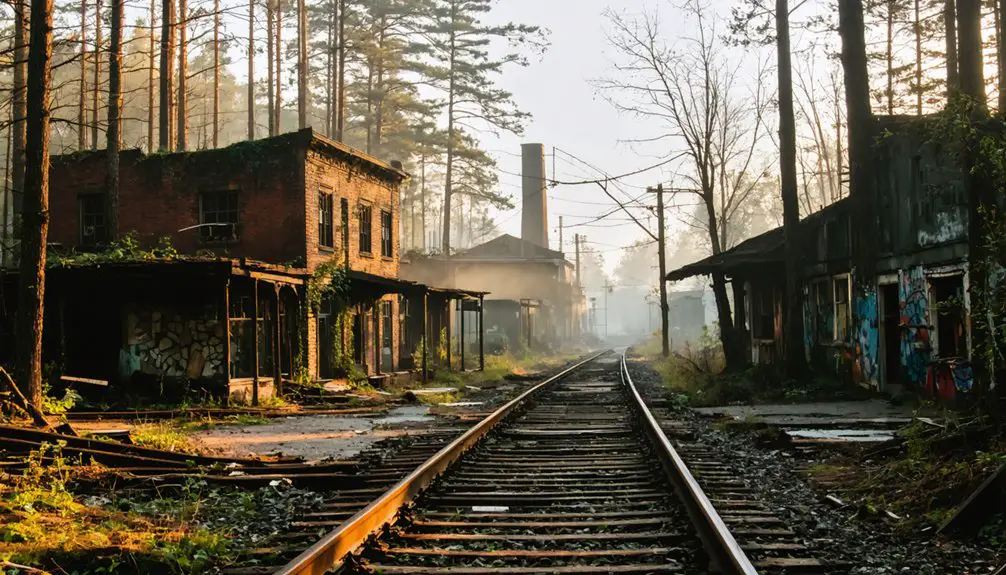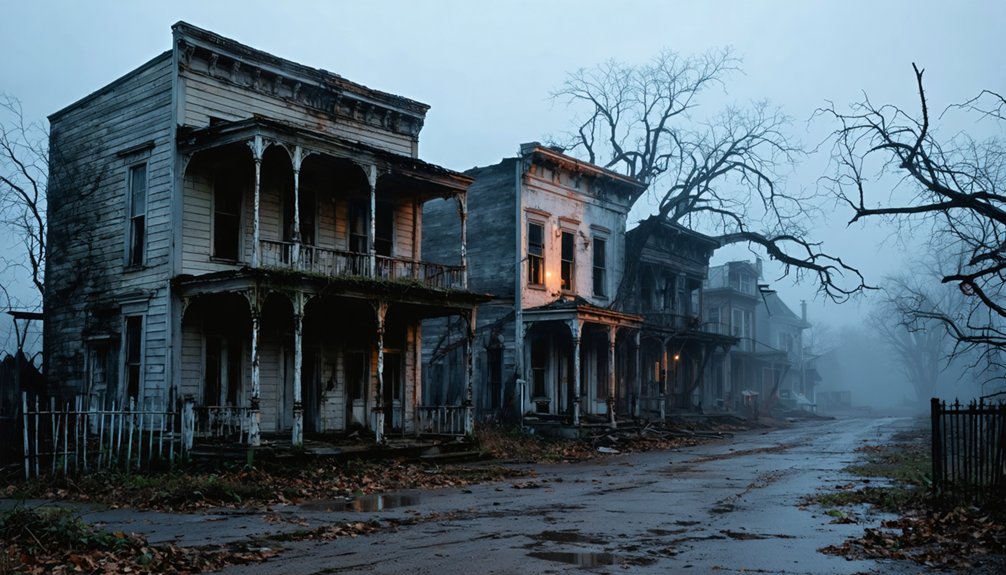
You’ll find New Jersey’s most haunted ghost towns scattered from the Pine Barrens to Morris County, including Batsto Village (founded 1766), where Revolutionary War-era iron furnaces still stand, and Whitesbog, the 1882 cranberry settlement that birthed America’s blueberry industry. Feltville’s abandoned streets tell darker tales—three sisters vanished here in 1912, leaving only their bonnets behind. Waterloo Village and Double Trouble round out these atmospheric ruins, each preserving industrial histories alongside persistent reports of apparitions and unexplained phenomena that continue to draw paranormal investigators to their weathered structures.
Key Takeaways
- Feltville is notorious for hauntings, including the 1912 disappearance of three sisters whose bonnets were found but bodies never recovered.
- Batsto Village reports Revolutionary War-era apparitions and ghostly figures at this former iron production and munitions supply site.
- Blue Hole features paranormal activity, year-round icy waters, unexplained phenomena, and Jersey Devil sightings in the Pine Barrens.
- Waterloo Village, abandoned after 1924, serves as a restored historic site with reported supernatural occurrences from its canal town past.
- White Hill Mansion has documented ghostly voices and shadow figures since 1722, contributing to New Jersey’s haunted heritage locations.
Batsto Village: Iron and Glass Industry Remnants
When Charles Read founded Batsto Village in 1766 along the Batsto River, he established what would become one of New Jersey’s most significant industrial sites. He built a blast furnace using local bog ore, producing pig iron and household items.
John Cox acquired the operation in 1773, supplying the Continental Army with cannons and munitions during the Revolutionary War. Workers at Batsto were exempted from military service due to the village’s essential contribution to the war effort.
The Richards family owned Batsto from 1784 to 1876, constructing most village structures you’ll see today. They shifted from iron to glassmaking in 1846 as demand shifted.
Industrial decline eventually led to bankruptcy in the late 1800s.
Joseph Wharton purchased the property in 1876, transforming it into farmland. New Jersey purchased the Wharton properties in the late 1950s as part of its preservation initiative.
New Jersey’s historical preservation efforts began in the 1950s, making Batsto a nationally recognized historic site.
Whitesbog Village: Cranberry Farming Settlement Frozen in Time
You’ll discover Whitesbog Village deep in the Pine Barrens, where Joseph J. White built New Jersey’s largest cranberry operation starting in 1882.
Eventually, this operation expanded to 3,000 acres of bogs and processing facilities.
Between 1890 and 1925, workers constructed a complete company town with housing, a general store, schoolhouse, and processing buildings that still stand today.
The settlement earned its place on the National Register of Historic Sites as the birthplace of cultivated blueberries, developed here by Elizabeth White and Dr. Frederick Coville in 1916.
Visitors can explore Elizabeth White’s 1923 home Suningive, which now serves as the village headquarters and anchors the self-guided tour experience.
The surrounding acres of berry fields and bogs offer outdoor recreation opportunities for nature enthusiasts eager to experience the preserved agricultural landscape.
Cranberry Industry Heritage Site
Deep in the Pine Barrens of Burlington County, Whitesbog Village stands as New Jersey’s most significant agricultural heritage site—a remarkably preserved cranberry farming settlement that pioneered American berry cultivation.
You’ll discover the legacy of James A. Fenwick, who established cranberry bogs here in 1857 on 490 acres of natural meadows.
His son-in-law Joseph J. White expanded operations until it became New Jersey’s largest cranberry farm by the early 1900s, spanning over 3,000 acres.
The historical cultivation methods Elizabeth C. White employed revolutionized agriculture—she collaborated with Dr. Frederick A. Coville in 1916 to develop America’s first cultivated highbush blueberries.
Elizabeth White, born in 1871 to Joseph J. White and Mary A. Fenwick White, built her home Suningive in 1923 within the village.
The village is listed on both National and State Registers of Historic Sites, recognizing its contributions to understanding American berry cultivation history.
Today, the Whitesbog Preservation Trust maintains this self-sufficient company town’s buildings, trails, and processing facilities, preserving vital agricultural innovation history.
Abandoned Buildings and Structures
Beyond its agricultural innovations, Whitesbog Village preserves an entire company town infrastructure that housed hundreds of workers during the cranberry and blueberry industry’s peak. You’ll find structures spanning 1890 to 1925, including worker cottages, the barrel-making factory, and warehouse facilities that defined this self-sufficient settlement.
The migrant housing areas called Rome and Florence stand as proof to the seasonal workforce that powered J.J. White’s operations.
While urban decay hasn’t claimed Whitesbog like other abandoned sites, the schoolhouse that operated from 1908 to 1918 and weathered water tower evoke an eerie atmosphere. The site originated from wild cranberry bogs that J.J. White’s father-in-law converted to commercial production during the 1850s in New Jersey’s Pine Barrens. The village infrastructure also included a general store and post office that served the self-contained community.
Many visitors report ghost story encounters near the old processing buildings at dusk.
The Whitesbog Preservation Trust maintains these structures, protecting this National Register site where you can explore authentic early 20th-century industrial architecture frozen in time.
Pine Barrens Historical Significance
When James A. Fenwick purchased 490 acres in the mid-1850s, he transformed Browns Mills into New Jersey’s cranberry capital. You’ll find Whitesbog Village nestled within Brendan T. Byrne State Forest, where Pine Barrens folklore meets agricultural innovation.
Fenwick’s son-in-law Joseph J. White expanded operations after 1882, creating the state’s largest cranberry farm. His daughter Elizabeth C. White revolutionized agriculture by collaborating with Dr. Frederick A. Coville in 1916 to cultivate the first commercial blueberries.
This company town housed African-American and Italian-American workers in satellite settlements like Rome and Florence. The 3,000-acre historic site connects you to Native American history and the iron furnace industry’s legacy.
Today, Whitesbog Preservation Trust maintains this frozen-in-time settlement where fifth-generation descendants still farm the land. The nonprofit organization serves as caretaker of the village, which was established in 1857 as a cranberry farming community. The trust has collected oral and video histories from community members over more than 10 years, preserving the stories of workers and farmers who shaped this remarkable place.
Deserted Village of Feltville: The Mysterious Glenside Park
Nestled within New Jersey’s Watchung Reservation lies Feltville, a settlement whose transformation from thriving mill town to abandoned village has spawned generations of ghost stories and paranormal folklore.
Founded by Peter Willcox in the 1730s, the area became David Felt’s industrial village in 1845, housing 175 mill workers under his paternalistic rule. The Panic of 1857 destroyed Felt’s fortune, and he abandoned the town in 1860.
David Felt’s industrial empire collapsed after just fifteen years when the 1857 financial crisis forced him to abandon his namesake mill town.
The site’s haunted reputation stems from documented tragedies and urban legends:
- Three sisters vanished while camping in 1912—only their bonnets were recovered.
- Two factory girls drowned in the mill pond during Felt’s operation.
- Residents report three ghosts haunting the furthest house down the path.
You’ll discover Feltville earned its “Deserted Village” nickname through multiple abandonments across different eras.
Waterloo Village: Morris Canal’s Abandoned Halfway Point
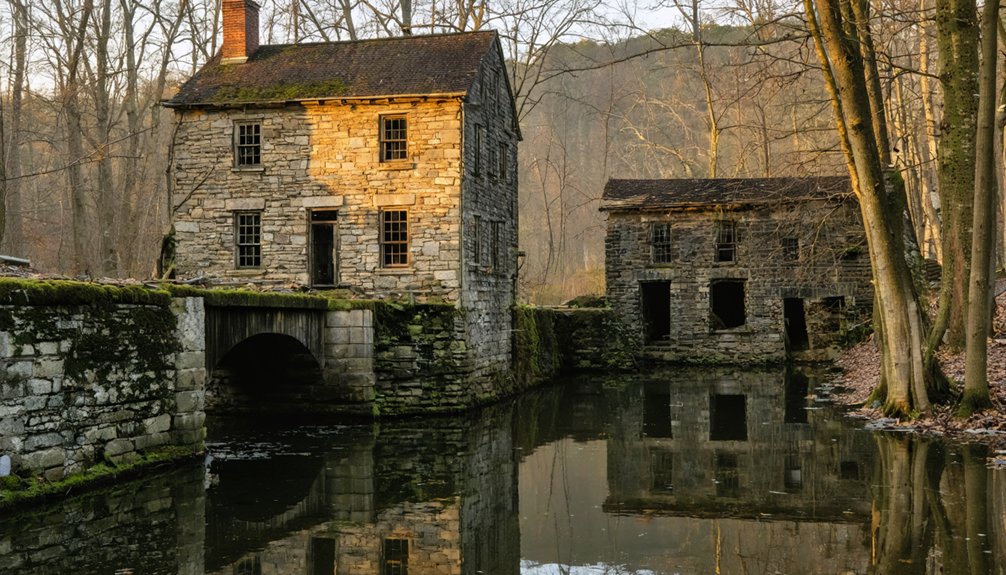
Along the banks of the Musconetcong River in Sussex County, Waterloo Village rose from Revolutionary War-era iron production to become a vital midpoint on the 102-mile Morris Canal connecting Jersey City to Phillipsburg.
The canal’s 1831 opening transformed this former forge site into a bustling transport hub, where mules hauled 70-ton coal barges through locks and inclined planes.
John Smith’s 1830 General Store anchored the community alongside a gristmill, train station, and blacksmith shop.
Railroads eventually strangled the canal’s profitability, leading to its 1924 abandonment.
The Smith family’s foreclosure during the Great Depression left Waterloo Village deserted.
Today, you’ll find this restored ghost town within Allamuchy Mountain State Park, where canal preservation efforts showcase nineteenth-century engineering through its operational lock system and monuments to America’s transportation revolution.
Double Trouble: Pine Barrens Industrial Ghost Town
Deep within the New Jersey Pine Barrens, the ruins of Harrisville tell the story of a once-thriving paper mill community that couldn’t survive the nineteenth century’s economic shifts.
Originally established as McCartyville in 1832, the settlement flourished under Harris family ownership during the 1850s. They modernized operations with:
- Gas-powered street lighting throughout the community
- Updated paper mill machinery and additional worker housing
- A dammed Wading River providing industrial power
Industrial decline hit hard when Pennsylvania’s superior iron ore devastated New Jersey’s economy. Despite desperate mortgage attempts, the Harris brothers faced foreclosure.
Joseph Wharton purchased the abandoned town in 1896, and fires destroyed remaining structures by 1914.
Today, ghost town legends surround the crumbling paper mill foundations—nature reclaiming what industry once dominated.
Ong’s Hat: Burlington County’s Enigmatic Lost Settlement
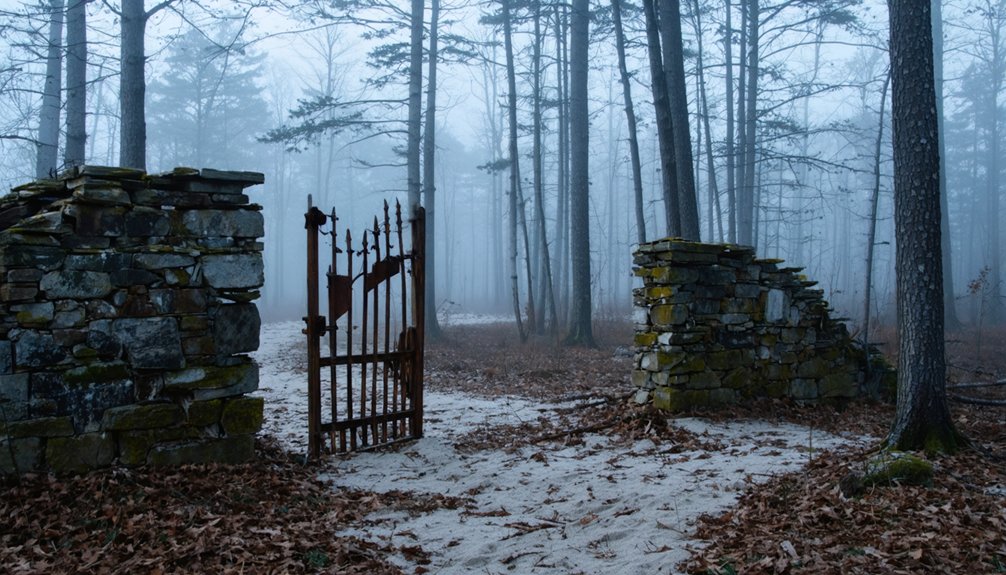
Among New Jersey’s most enigmatic vanished settlements, Ong’s Hat blurs the line between documented history and enduring folklore. You’ll find this Burlington County location first documented on a 1778 Hessian map, where Quaker settler Jacob Ong purchased 100 acres around 1700.
Folklore storytelling explains the name through legends of a trampled silk hat, possibly painted on tavern keeper Isaac Haines’s sign circa 1800 for illiterate travelers.
During the 1860s, you’d encounter a lively social center known for prizefighting and moonshining.
By 1936, only ruins remained.
Modern lantern preservation efforts combat fictional narratives from the 1980s claiming interdimensional experiments occurred here.
Today, you’ll discover descendants denied the town’s existence in 1968, maintaining only a rest hut stood along the cedar swamp route.
Paranormal Activity and Local Legends
Warren County’s Shades of Death Road stretches seven miles through dense woodlands along Jenny Jump State Forest, where its ominous name stems from numerous documented fatalities spanning centuries.
This notorious seven-mile stretch through Jenny Jump State Forest has earned its dark reputation through centuries of tragic deaths and mysterious disappearances.
You’ll find Ghost Lake south of the I-80 overpass, where reports of paranormal activity persist alongside a small cave.
Urban legends throughout New Jersey’s abandoned settlements feature mythical creatures like the Jersey Devil, which allegedly haunts the Blue Hole‘s freezing waters and surrounding Pine Barrens villages.
These locations share common paranormal characteristics:
- Apparitions: Atco’s ghost boy appears on a dead-end street, while Batsto Village’s Revolutionary War-era spirits roam until today
- Unexplained phenomena: White Hill Mansion reports shadow figures and children’s voices since 1722
- Environmental anomalies: Blue Hole’s year-round frigid temperatures defy natural explanation
Exploring the Abandoned Structures Safely
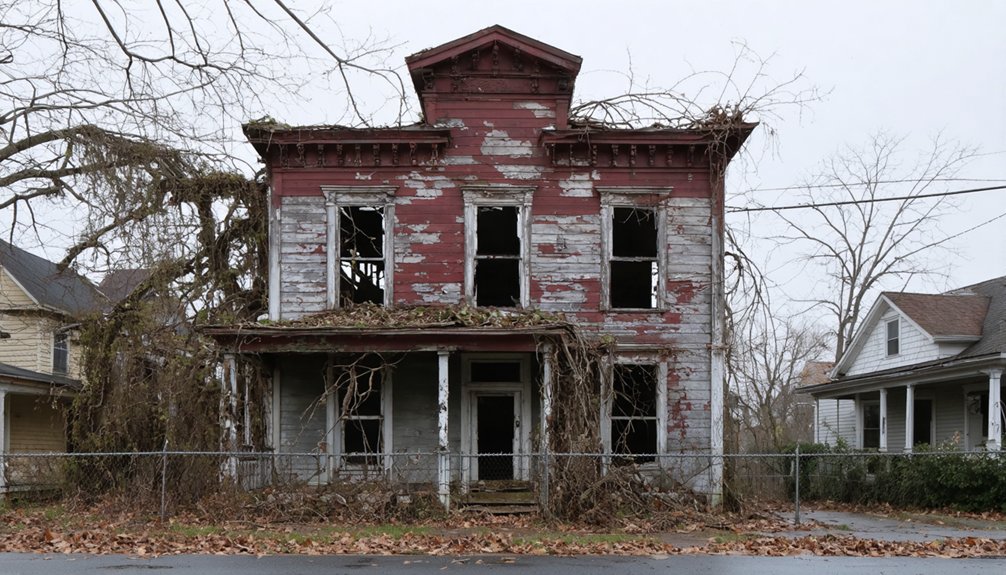
Before you visit New Jersey’s ghost towns, equip yourself with sturdy footwear, a flashlight, and a first-aid kit to navigate uneven terrain and dimly lit structures.
While exploring abandoned places in New Jersey, be sure to keep an eye out for unique artifacts and remnants of the past that tell fascinating stories. It’s important to stay safe and adhere to local regulations, as some sites may be off-limits or require permission to enter. Capturing photographs can be a rewarding way to document your journey through these hauntingly beautiful locations.
In addition to your preparations, consider researching the history of the abandoned towns in New Jersey before your visit. Understanding the stories behind these locations can enhance your exploration and deepen your appreciation for the unique architecture and landscapes. Remember to be respectful of the sites, as they often hold significant cultural and historical value.
You must stay within designated trails at state forest sites like Batsto Village and Harrisville Ruins, as straying into fenced areas risks both structural collapse and trespassing fines.
Always verify whether a location requires prior permission, since sites like Waterloo Village permit public access while others such as Amatol in the Pine Barrens restrict off-trail exploration.
Preparation and Safety Gear
When venturing into New Jersey’s abandoned ghost towns, you’ll need proper protective clothing as your first line of defense against the hazards lurking within decaying structures. Urban exploration demands sturdy boots with thick soles, long pants, and long-sleeved shirts to protect against nails, broken glass, and toxin exposure.
Essential safety protocols include:
- Head and respiratory protection: Wear a hard hat to shield against falling debris and an N95 or P100 respirator to guard against mold and asbestos.
- Hand protection: Use cut-resistant gloves with grip for handling materials and *orienteering* tight spaces.
- Navigation tools: Carry multiple flashlights, headlamps, and a compass to prevent disorientation.
Pack a *detailed* first aid kit with bandages, antiseptic wipes, emergency blanket, and water purification tablets for extended explorations.
Respecting Property Boundaries
Before exploring, verify the site’s designation through your municipal public officer.
Properties meeting N.J.S.A. 55:19-81 criteria face potential eminent domain proceedings or rehabilitation enforcement.
You’ll find owners still shoulder liability for unpaid taxes and security failures, yet unauthorized entry transfers legal risk to you.
Check local ordinances governing vacant property registration—these programs monitor foreclosed sites and regulate exterior maintenance.
Respecting these boundaries protects your freedom while acknowledging legitimate ownership claims.
Preservation Efforts and Historical Significance
New Jersey’s abandoned settlements have earned recognition as invaluable historical resources, with several sites undergoing systematic preservation to protect their architectural and cultural heritage. You’ll find these locations demonstrate remarkable environmental restoration efforts that counteract urban decay while maintaining authentic historical narratives.
Three significant preservation milestones include:
- Batsto Village – Acquired by New Jersey in 1954, featuring 33 historic structures and National Register status.
- Allaire Village – Operating as a living history museum with reenactors demonstrating 19th-century industrial crafts.
- Waterloo Village – Restored as an open-air canal town museum, added to the National Register in 1977.
These sites served critical Revolutionary War-era industrial functions, producing munitions and supplies.
State agencies now protect buildings dating from the 18th century, allowing you unrestricted access to explore authentic American heritage.
Frequently Asked Questions
What Are the Best Times of Year to Visit These Ghost Towns?
Fall and spring offer the best visits with ideal seasonal weather (50-70°F), fewer crowds, and stunning photography opportunities. You’ll capture peak foliage in October or wildflower blooms in April while exploring ruins comfortably without summer’s humidity or winter’s limitations.
Do Any of These Sites Charge Admission Fees for Visitors?
Want to explore abandoned landmarks without breaking the bank? You’ll find these haunted legends offer free admission—Batsto Village, Feltville, Waterloo Village, and Allaire Village don’t charge entrance fees, though you might pay for parking at state parks.
Are Pets Allowed When Exploring New Jersey’s Ghost Towns?
Yes, you can bring pets to New Jersey’s ghost towns like Batsto Village and Feltville on leashed grounds. However, dog friendly tours typically exclude pets for pet safety reasons, though service animals remain welcome everywhere under ADA standards.
Can You Camp Overnight Near Any of These Abandoned Villages?
You can camp overnight near several abandoned villages, but not within them. Wharton State Forest near Batsto and Ong’s Hat offers primitive sites requiring permits. Always research camping safety protocols and ghost town history before your wilderness adventure begins.
Which Ghost Town Is Closest to New York City?
Feltville is your closest ghost town to NYC, just 25 miles west in Berkeley Heights. You’ll find authentic ghost town history dating to the mid-1800s, complete with haunted legends surrounding its deserted buildings and preserved 19th-century structures.
References
- https://en.wikipedia.org/wiki/List_of_ghost_towns_in_New_Jersey
- https://gloribee.com/list-of-haunted-places-in-new-jersey/
- https://www.jerseysbest.com/community/take-a-road-trip-through-n-j-s-spooky-ghost-towns-to-see-peculiar-pieces-of-history/
- https://www.youtube.com/watch?v=ZIp3AYb0ulw
- https://southjerseytrails.org/2017/03/16/six-pine-barrens-ghost-towns-to-explore/
- https://www.newjerseyhauntedhouses.com/real-haunts/places.aspx
- https://njhistoryandsites.org/2024/01/14/historic-batsto-village-in-hammonton-nj/
- https://en.wikipedia.org/wiki/Batsto_Village
- https://batstovillage.org/history/
- https://batstovillage.org/available-here-batsto-jewel-of-the-pines/