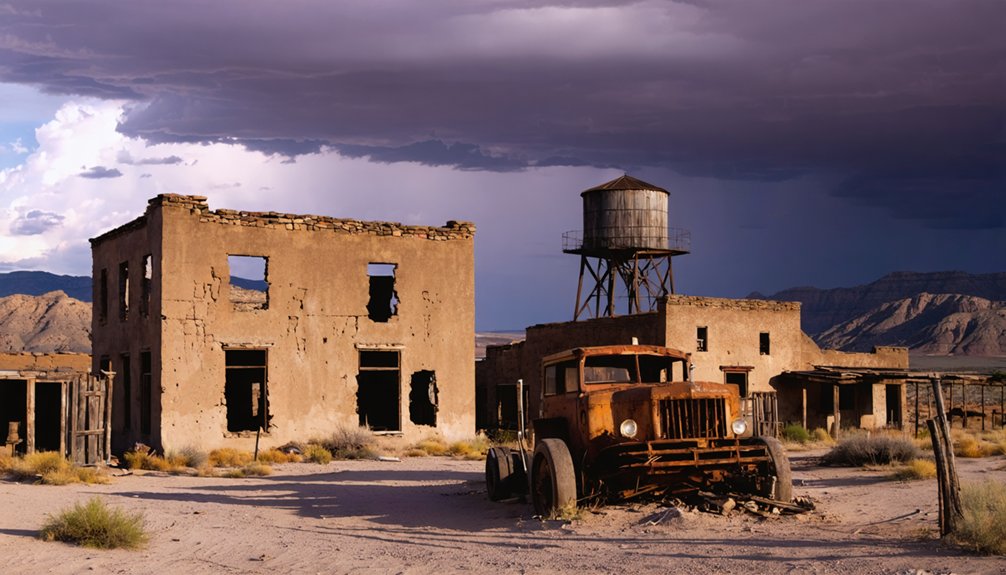
You’ll find New Mexico’s most haunted ghost towns scattered across remote terrain where mining disasters and violent deaths left paranormal legacies. Dawson’s 1913 and 1923 coal explosions killed 386 miners, while Loma Parda earned its “Sodom on the Mora” reputation through countless murders and shootings. White Oaks harbors spirits from its 1880 standoff that killed Deputy Jim Carlyle, and Mogollon’s ruins echo with memories of Victorio’s 1880 raid. These preserved sites offer self-guided exploration where you’ll discover the stories behind each location’s restless spirits.
Key Takeaways
- Dawson suffered two deadly mining explosions in 1913 and 1923, claiming 386 lives, contributing to its haunted reputation and eventual abandonment.
- Loma Parda earned the nickname “Sodom on the Mora” for violence and vice, with haunted legends including murdered James Gay and ghostly saloons.
- Mogollon yielded over $20 million in gold and silver but declined after fires, Native American raids, and the 1893 silver crash devastation.
- White Oaks features Victorian homes and Billy the Kid connections, including an 1880 standoff where Deputy Jim Carlyle was fatally shot.
- Lake Valley’s 1881 Bridal Chamber silver discovery created a boom, but the town declined after the 1893 silver collapse and 1895 fire.
Dawson: The Cemetery of White Iron Crosses
In 1869, John Barkley Dawson established his homestead in New Mexico’s remote Vermejo Valley, unaware that the coal-rich land beneath his feet would transform into one of the state’s most prosperous—and ultimately tragic—mining towns.
After selling his property to Lucien B. Maxwell in 1901, Phelps Dodge Corporation developed Dawson into a bustling community of 9,000 residents, complete with modern amenities and award-winning sports teams. The community featured a 137-mile railway line connecting to Tucumcari, supporting the extensive mining operations. The international workforce included Italian, Chinese, Polish, German, Greek, British, Finnish, Swedish, and Mexican miners laboring in dangerous conditions.
From remote homestead to thriving mining town of 9,000—Dawson’s transformation brought modern prosperity before disaster struck.
Two catastrophic explosions shattered this prosperity.
The 1913 disaster killed 263 miners when a dynamite charge ignited coal dust, violating mining safety regulations.
Ten years later, 123 men perished in a similar blast.
Today, you’ll find only the cemetery remains—rows of white iron crosses marking victims’ graves, listed on the National Register of Historic Places, serving as stark testimony to corporate negligence and abandoned town reconstruction.
White Oaks: Where Gold Rush Dreams Turned to Dust
Long before gold seekers transformed the Jicarilla Mountains into New Mexico’s second-largest city, Piros Indians roamed this arid landscape of lava rock and abundant game until Apache forces drove them out.
When John Wilson discovered gold in 1879, White Oaks exploded from tent city to boomtown, reaching 1,200 residents. Mining legends emerged from Baxter Mountain’s pure gold vein, attracting equal numbers of lawyers and miners. Unlike typical adobe New Mexico settlements, White Oaks showcased pitched roof homes and Victorian architecture, including the notable Hoyle House with its distinctive widow’s walk.
Ghost stories still circulate about Billy the Kid’s sanctuary here, where Deputy Jim Carlyle died during an 1880 standoff—shot by his own posse. The town’s refusal to grant railroad concessions sealed its fate. When the gold resources exhausted, the combination of no gold and no railroad led to complete abandonment.
Today, you’ll find abandoned mines hidden in desert foliage at coordinates 33°44′59.1″N 105°44′14.3″W, three miles north of Carrizozo.
Loma Parda: Sodom on the Mora
Before Fort Union’s construction transformed it into New Mexico’s most notorious vice den, Loma Parda existed as a modest farming village of 500 residents along the Mora River. When soldiers descended from the fort in 1851, everything changed. Officer Hollister dubbed it “Sodom on the Mora”—a lawless playground where shootings, stabbings, and gambling ruled nightly.
The town’s violent reputation spawned haunted legends that persist today:
- James Gay’s murder at a dance hall in 1882
- The priest who fled his locked church, abandoning the dangerous community
- Captain Sykes’ notorious punishment of local women
- Desperados and cowboys haunting saloons until dawn
Fort Union’s 1889 closure sealed Loma Parda’s fate. The settlement had originally been founded along the Santa Fe Trail, serving as a strategic trading post before descending into lawlessness. By 1900, the town was erased, leaving behind only memories of its wickedness. Today, you’ll find crumbling walls and vacant spaces—perfect for ghostly tours exploring New Mexico’s wildest ghost town.
Mogollon: Mining Remnants in the Gila Mountains
Deep within Silver Creek Canyon, nine miles up a treacherous mountain road, the ghost town of Mogollon clings to the Gila Mountains where James Cooney first struck gold and silver in 1870. You’ll find remnants of mining technology from operations that produced over $20 million in ore, with the Little Fanny Mine standing as the district’s most massive operation.
Town legends echo with violence—Chief Victorio’s 1880 raid claimed Cooney’s life along with thirty-seven others in the “Alma Massacre.” Repeated fires between 1894 and 1942 forced residents to rebuild in stone and adobe.
The 1893 silver crash and 1918 Spanish influenza devastated the population that once reached 6,000 miners. Mining ceased entirely by the 1970s, leaving behind weathered structures as testament to Mogollon’s turbulent past. At its 1913 peak, the town produced 40% of New Mexico’s precious metals, establishing it as a major economic force in the region. Today, the narrow, steep road to Mogollon remains mostly one-lane but rewards visitors with scenic views of this preserved historic site.
Chloride: The Ghost Town That Refused to Die
While hauling freight for the U.S. Army to Camp Ojo Caliente in 1879, Harry Pye discovered silver ore that would spark Chloride’s creation.
By the 1880s, you’d find 1,000-2,000 residents pursuing their fortunes despite Apache raids and harsh conditions.
The town’s mining legacy includes:
- Pioneer Store (built 1880), now a museum on New Mexico’s State Register
- Monte Cristo Saloon transformed into an artist co-op
- 12-27 original buildings with false fronts and adobe construction
- Historic log cabin from 1879 operating as vacation rental
The 1893 Silver Panic devastated the community, leading to abandonment by 1923.
Today’s historic preservation efforts by 11-27 residents keep Chloride accessible five days weekly.
You’ll discover authentic mining equipment and frontier artifacts that document this resilient settlement’s refusal to fade completely into history.
Located 2 miles southwest of Winston via Forest Road 226, the ghost town remains easily accessible for visitors seeking to explore its remaining structures.
The museum and gallery welcome visitors daily from 10 am to 4 pm, offering a window into the town’s prosperous mining past.
Lake Valley: Silver Boom Gone Silent
When ranchers George W. Lufkin and Lou McEvers discovered silver ore in 1878, they triggered one of New Mexico’s most spectacular mineral exploration booms.
The 1881 discovery of the legendary Bridal Chamber—a silver-lined cavity yielding 2.5 million troy ounces—transformed Lake Valley into a thriving mining center.
During its heyday from 1881 to 1893, the Sierra Grande Company paid $100,000 monthly dividends while ore assayed at $15,000 per ton.
You’ll find the district produced 5.8 million ounces through 1931.
The 1893 silver price collapse devastated operations, and an 1895 fire destroyed Main Street.
Today’s town preservation efforts maintain structures like the Bella Hotel.
You can explore this authentic ghost town through self-guided tours, though access is restricted to prevent vandalism.
Many visitors seek out ghost towns to explore in New Mexico as they offer a glimpse into the past and tell fascinating stories of the people who once inhabited them. Each site has its unique charm and history, making them perfect for those interested in photography or local history. Don’t forget to check out the surrounding landscapes that often enhance the eerie beauty of these abandoned places.
Frequently Asked Questions
Are Visitors Allowed to Explore New Mexico’s Ghost Towns at Night?
Want to chase local legends and stories after dark? You’re generally discouraged from nighttime exploration due to safety hazards, lack of emergency services, and operational closures—though superstitions surrounding ghosts aren’t what’ll stop you; dangerous conditions will.
What Safety Precautions Should I Take When Visiting Abandoned Mining Towns?
You’ll need sturdy footwear, flashlights, and first-aid supplies while avoiding unstable structures and open shafts. Watch for wildlife encounters like snakes and rodents carrying hantavirus. Respect historical preservation by leaving artifacts untouched and reporting hazardous conditions to authorities.
Do Any Ghost Towns in New Mexico Require Entrance Fees?
Yes, some require fees for ghost town preservation. Shakespeare charges $15 per person for guided tours, while Lake Valley requests $3 admission. However, White Oaks offers free access, letting you explore sites of historical significance without cost.
Can You Camp Overnight Near These Ghost Town Sites?
You’ll find camping opportunities vary by ghost town location and land management. While BLM lands often permit dispersed camping, historical preservation efforts and wildlife concerns may restrict overnight stays near specific sites—always verify current regulations beforehand.
What’s the Best Time of Year to Photograph Ghost Towns?
Fall’s absolutely perfect for capturing ghost towns—you’ll get incredible golden-hour lighting and comfortable 60-70°F temps. Always check photography permissions and respect historical preservation rules, as many sites monitor access to protect these fragile, abandoned structures year-round.
References
- https://newmexicotravelguy.com/new-mexico-ghost-towns/
- https://compaslife.com/blogs/journal/abandoned-enchantment-ghost-towns-of-new-mexico-1
- https://www.atlasobscura.com/things-to-do/new-mexico/ghost-towns
- https://www.newmexico.org/haunted/
- https://www.newmexicomagazine.org/blog/post/abandoned-ghost-towns-new-mexico/
- https://www.treasurenet.com/threads/obscure-new-mexico-ghost-towns.84979/
- https://en.wikipedia.org/wiki/List_of_ghost_towns_in_New_Mexico
- https://www.legendsofamerica.com/nm-dawson/
- https://newmexiconomad.com/dawson-new-mexico/
- https://usghostadventures.com/haunted-places/dawson-ghost-town-and-cemetery/