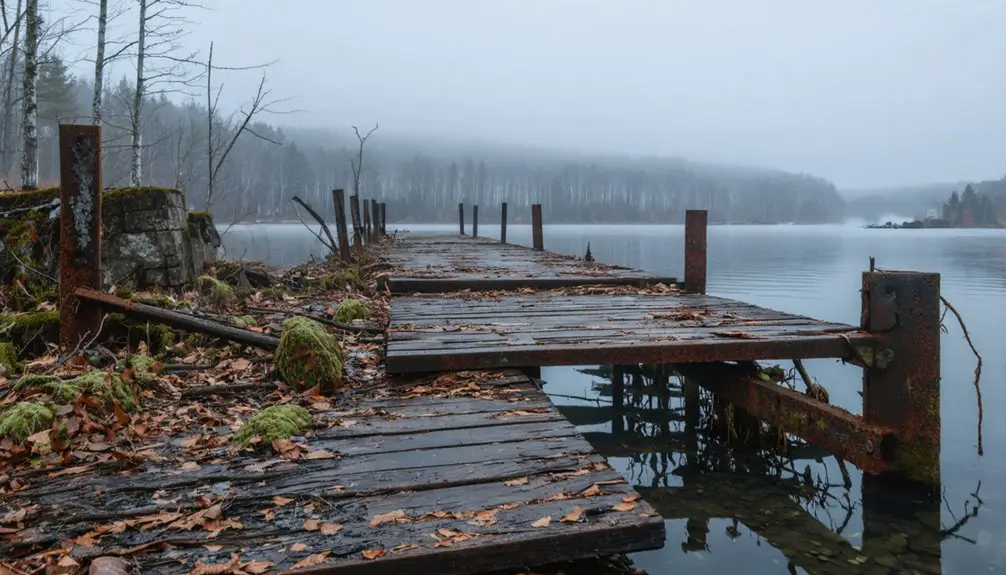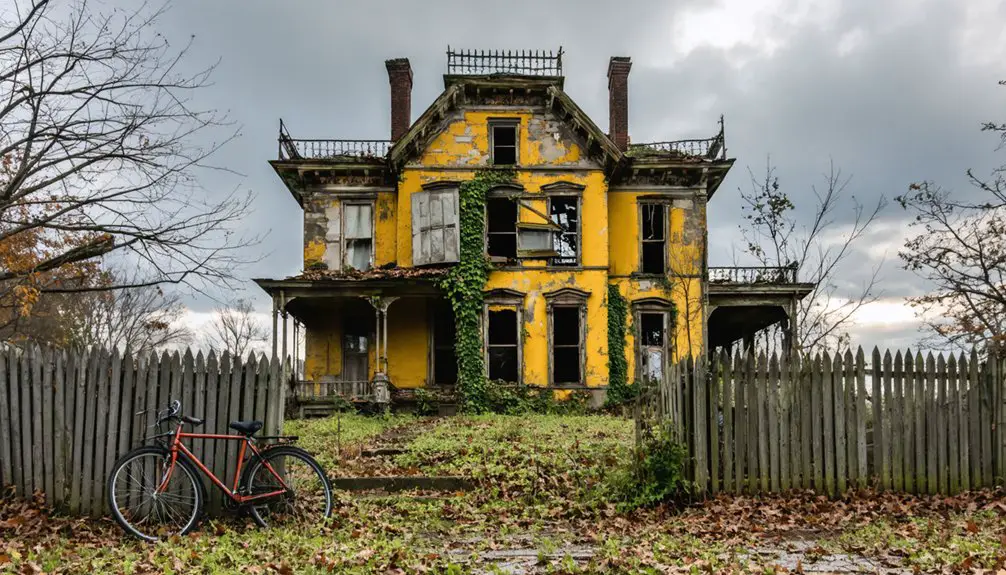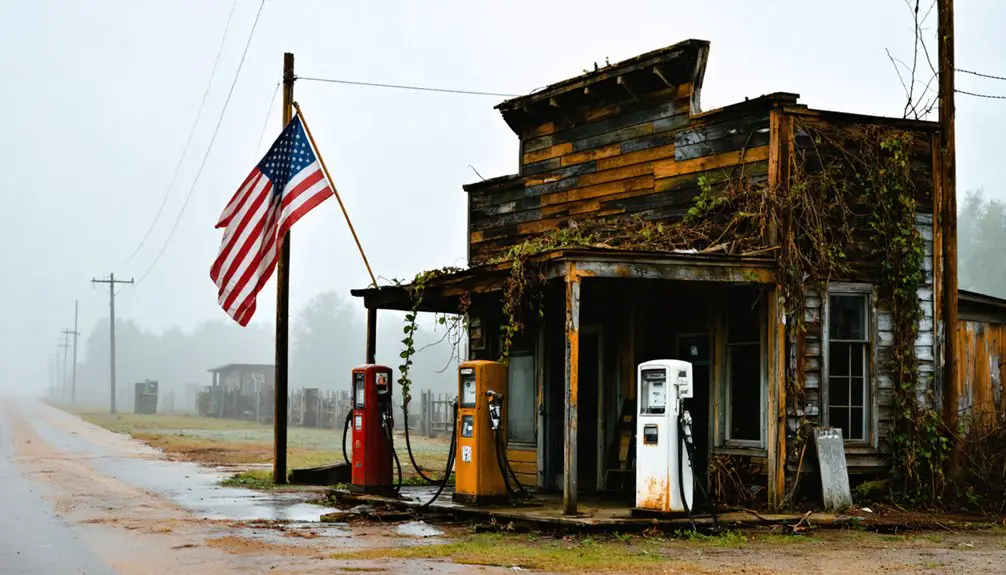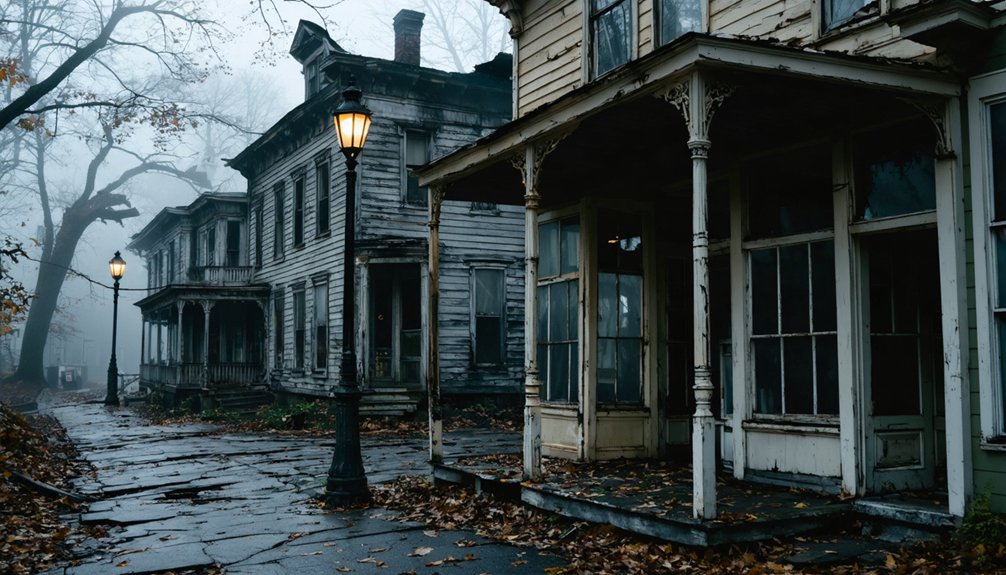
You’ll find New York’s most haunted ghost towns scattered from the Adirondacks to the Catskills, where entire communities vanished through tragedy and forced displacement. North Brother Island imprisoned Typhoid Mary until 1938 while confining disease victims in now-crumbling structures. Doodletown’s 300 residents faced eminent domain eviction in 1965, leaving only stone foundations. Beneath Catskill reservoirs, over a dozen flooded towns displaced 5,500 people—their submerged ruins emerging only during droughts. Pottersville suffered both a catastrophic 1927 flood and murder-suicide before its 2001 demolition. These sites preserve darker histories than their picturesque decay suggests.
Key Takeaways
- Doodletown in Rockland County was abandoned in 1965 after eminent domain evacuation, leaving stone foundations and concrete stairs along hiking trails.
- Pottersville experienced the deadly 1927 flood and a murder-suicide; paranormal investigators report spirits and apparitions at the demolished site.
- North Brother Island features 25 crumbling structures from its quarantine hospital era, including where Typhoid Mary died in 1938.
- Submerged Catskill reservoir towns reveal stone foundations and cemetery walls during droughts after flooding displaced 2,500 residents starting in 1905.
- Parksville in Sullivan County remains overgrown and forgotten, erased by economic decline and accessible only through exploration.
Doodletown: A Vanished Community in Rockland County
Long before Stephanus van Cortlandt purchased 1,500 acres of land in 1683, the Munsee Lenape had inhabited this Hudson River valley territory for 5,000 to 10,000 years.
You’ll find Doodletown’s remnants in Bear Mountain State Park, where French Huguenot settlers established a thriving hamlet that peaked at 300 residents by 1945. The community maintained churches, schools, and businesses until the Palisades Interstate Park Commission condemned remaining homes through eminent domain in 1962. By 1965, the final residents evacuated and the town was demolished, with buildings removed to preserve the natural landscape for park use.
Today, hikers can explore concrete stairs and stone foundations that remain visible along the trail, marking where homes and buildings once stood in this isolated valley between Bear Mountain and the Hudson River.
North Brother Island: Medical Isolation Turned Wilderness
Tucked between the Bronx shoreline and Rikers Island, North Brother Island‘s 20 acres hold over a century of medical exile and forced isolation. You’ll find twenty-five crumbling buildings consumed by urban decay, where Riverside Hospital once quarantined society’s unwanted—smallpox victims, tuberculosis patients, and Typhoid Mary herself.
The island’s forced confinement legacy includes:
- 1904 General Slocum disaster: 1,021 perished when the burning steamship beached here
- 1916 polio epidemic: Infected children separated from families for indefinite treatment
- 1950s-1964: Adolescent drug offenders confined for “rehabilitation”
Mary Mallon remained confined until her death in 1938, having contaminated at least 122 people as an asymptomatic carrier. After decades as a hospital and later home for veterans post-WWII, the facility closed permanently in 1963. Now designated for wilderness preservation as black-crowned night heron nesting grounds, the overgrown ruins remain off-limits. Yet this forgotten sanctuary—visible from LaGuardia—stands as testament to government-sanctioned segregation masked as public health.
Tahawus: The Abandoned Iron Mining Settlement
Deep within the Adirondack wilderness, where the Upper Hudson River carves through Essex County, Tahawus stands as New York’s most persistently failed settlement—abandoned twice across 160 years of boom-and-bust cycles.
Twice abandoned across 160 years, Tahawus remains New York’s most stubborn testament to failed industrial ambition in the Adirondack wilderness.
You’ll find iron ore discovery sparked the 1826 founding, but economic collapse emptied the village by 1858. Wealthy hunters transformed it into an exclusive resort where Vice President Theodore Roosevelt learned of McKinley’s assassination in 1901, ascending to presidency from MacNaughton Cottage.
WWII titanium demand revived operations in 1941. National Lead Industries built 84 structures, extracting 40 million tons before 1989’s final closure.
Today’s historical preservation efforts maintain Roosevelt’s cottage and the 1854 blast furnace as industrial ruins. The Open Space Institute controls 6,000 acres, offering unrestricted wilderness access where mining ambitions repeatedly died.
Pottersville: Tragedy and Terror in Warren County
You’ll find Pottersville’s haunted reputation stems from two catastrophic events that shattered this small Warren County hamlet. In 1927, a devastating flood swept through the community, causing widespread destruction and loss of life that locals claim left restless spirits in its wake.
Historical records also document a family murder-suicide tragedy that compounded the town’s dark legacy, marking Pottersville as one of the Adirondacks’ most troubled settlements. The Pottersville Fire Department responded to numerous devastating fires throughout its history, with recovery efforts often taking months as the community rebuilt from the ashes of major calamities. The hamlet sits along U.S. Route 9 within the vast Adirondack Park, where its isolated location may have intensified the psychological impact of these tragedies on the small community of residents.
The 1927 Devastating Flood
How could a single storm system release such catastrophic destruction across the entire northeastern United States? November 1927’s tempest brought Warren County face-to-face with nature’s fury as Hudson River tributaries—the Batten Kill and Hoosic River—shattered all previous records.
Urban decay followed swift infrastructure collapse, while historical preservation efforts would later document the devastation.
The flood’s terror manifested through:
- Record-breaking discharges: White River peaked at 140,000 cfs, overwhelming communities
- Extreme water levels: Hartford’s Connecticut River crested at 29 feet on November 7
- Simultaneous basin failures: Multiple river systems collapsed within hours across northeastern states
You’ll find Pottersville’s vulnerability stemmed from its Hudson watershed location. The Holyoke Power Dam‘s 15-foot overtopping symbolized humanity’s powerlessness against coordinated natural forces that isolated rural communities throughout the region. October’s above-normal rainfall had already saturated the ground at 150% of typical levels before the hurricane arrived. The catastrophic flood prompted comprehensive flood control measures and federal intervention, leading to long-term planning and engineering responses managed by the U.S. Army Corps of Engineers.
Family Murder-Suicide Tragedy
While Pottersville weathered the 1927 flood‘s physical devastation, a darker chapter emerged when a family annihilation shattered the community’s remaining social fabric.
A man murdered every family member before turning the gun on himself, an event that compounded the mill closure’s economic blow. This tragedy, alongside another murderer’s capture and hanging, concentrated extraordinary violence within the small Warren County settlement near Lundy Road.
The state repossessed Pottersville in 1998 for unpaid taxes, and Wawarsing Highway Department razed remaining structures in August 2001.
Despite demolition, the site draws paranormal investigations reporting floating objects and apparitions along trails. Historical preservation advocates note these restless spirits became synonymous with the location’s abandonment, transforming a working community into legend within Vernooy Kill State Forest.
Camp Santanoni: The Gilded Age Mystery
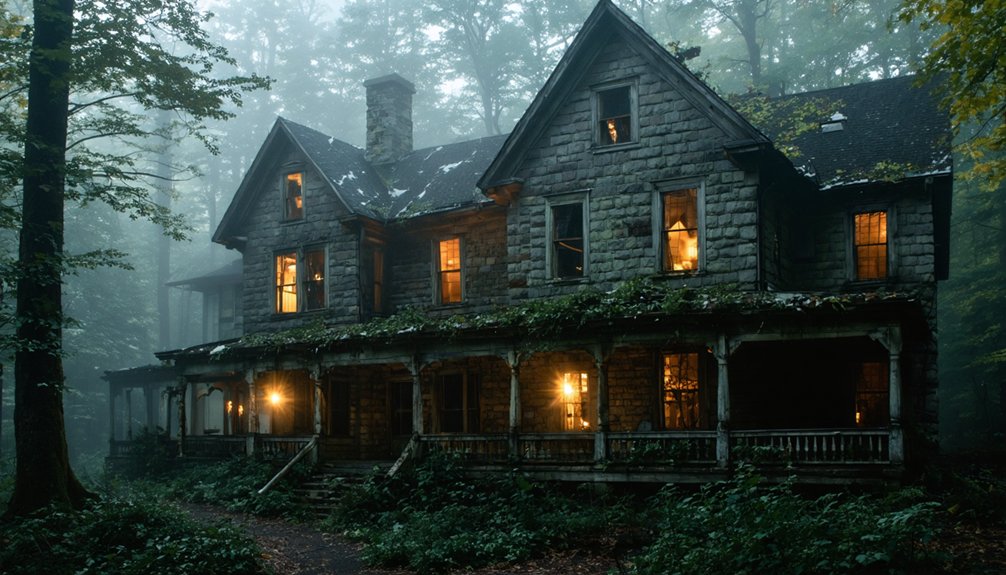
Deep in the Adirondack wilderness, accessible only by a 4.7-mile carriage road, stands Camp Santanoni—a sprawling tribute to Gilded Age ambition that nearly vanished into history.
A monument to Gilded Age excess, miraculously preserved in wilderness isolation after decades of near-certain decay.
Built by banker Robert C. Pruyn between 1892-1893, this National Historic Landmark sprawls across 13,000 acres with 45+ buildings showcasing extraordinary architectural restoration efforts.
The camp’s cultural significance lies in its three distinct complexes:
- Gate Lodge: Delano & Aldrich’s monumental stone arch welcoming visitors
- Farm Complex: 300-acre self-sufficient operation with orchard and livestock
- Main Camp: 5,000+ square feet of porches overlooking Newcomb Lake
After state acquisition in the 1970s, demolition seemed certain until preservation advocates fought back.
Today, you’re free to explore New York’s only fully public Great Camp—a haunting reminder of opulence reclaimed from abandonment.
Submerged Towns Beneath New York’s Reservoirs
You’ll find New York’s most unusual ghost towns submerged beneath the Catskill Mountain reservoirs that supply drinking water to New York City.
Since 1905, the city flooded over a dozen communities through eminent domain, displacing thousands of residents and destroying hundreds of structures to create six major reservoirs.
When water levels drop—particularly in fall—you can still observe stone foundations, cemetery walls, and building remnants from towns like Ashokan’s four hamlets and Cannonsville’s five communities.
Flooded for Water Supply
Between 1905 and 1955, New York City’s insatiable demand for clean drinking water erased entire communities from the map. Through eminent domain, authorities seized 12,000 acres for reservoir engineering projects that submerged a dozen towns across the Catskills.
You’ll find displacement stories marked only by roadside signs where thriving hamlets once stood.
The human cost was staggering:
- 2,500 bodies exhumed from 32 cemeteries, with families receiving just $15 per grave for relocation
- 5,500 residents forcibly relocated across five counties, their properties compensated at below-market rates
- 500 homes, 35 stores, 10 churches destroyed—entire livelihoods eliminated by flooding
Steam whistles wailed for one hour before waters consumed Brown’s Station and neighboring communities. Today, these drowned towns remain off-limits, their foundations visible only when water levels drop.
Towns Still Visible Underwater
When water levels drop during autumn droughts, the skeletal remains of four vanished hamlets emerge from beneath Ashokan Reservoir’s surface. You’ll spot stone foundations and mill walls from bridges—tangible proof that 500 homes once stood where deep water legends now circulate.
Brown’s Station disappeared entirely, its existence marked only by a roadside sign on Route 28A.
These submerged ruins tell a stark story: 2,000 residents were forcibly relocated in 1908 under eminent domain. Their departure was marked by steam whistles blown for one hour before the final flooding.
Beyond Ashokan, you’ll find similar ghost settlements—Neversink town beneath its namesake reservoir, and five communities under Cannonsville. Access restrictions tightened after 9/11, though ridge hikes remain possible for those seeking evidence of government overreach.
Lesser-Known Forgotten Settlements Across the State
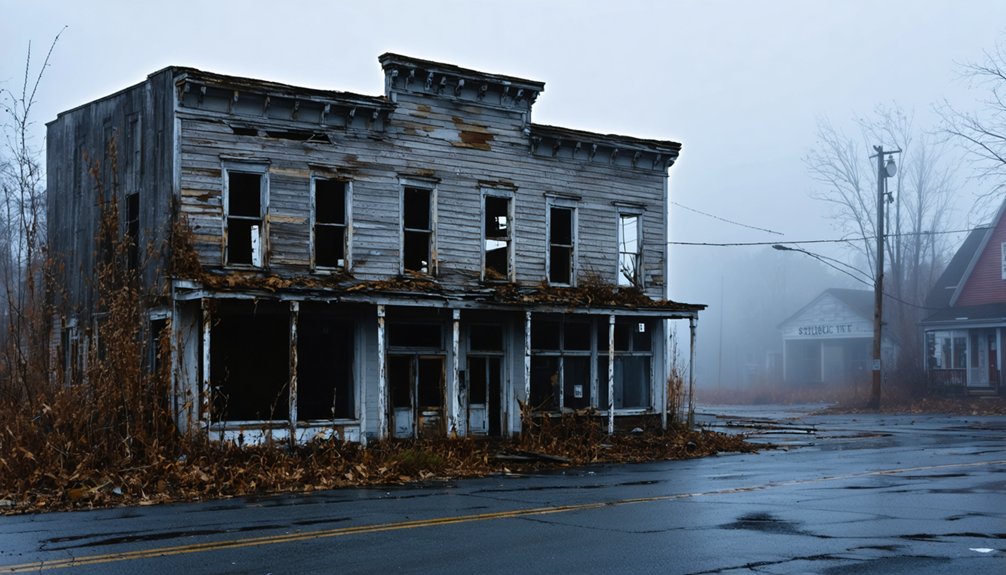
While New York’s major ghost towns often dominate historical discussions, the state harbors dozens of lesser-known settlements that’ve vanished from collective memory. Hidden histories reveal communities erased by economic shifts, natural disasters, and tragic circumstances.
Exploring abandoned towns in New York state can uncover fascinating stories of resilience and decline. Each location carries remnants of human activity and ambition, telling tales of hope that eventually succumbed to the passage of time. Such explorations not only illuminate the past but also foster an appreciation for the present-day communities that thrive nearby.
Among these intriguing sites are numerous abandoned places in New York, each offering a unique glimpse into the lives once led there. Visitors can wander through the remnants of former homes, schools, and businesses that still stand, despite nature’s reclaiming touch. Unearthing their stories allows us to reflect on the transient nature of human endeavors and the lasting impact of our collective history.
Three Forgotten Settlements Worth Exploring:
- Parksville (Sullivan County) – Once-thriving community now concealed within overgrown acres, shocking locals who’ve forgotten its existence.
- New Ireland/Carrollton (Cattaraugus County) – Irish immigrant settlement abandoned when families chased oil wealth westward, leaving moss-covered foundations.
- Pottersville (Warren County) – Devastated by 1927 flooding and marked by family murders, creating one of the state’s most chilling sites.
These locations preserve ghostly legends and archival fragments, accessible to those seeking unmediated encounters with New York’s suppressed past beyond sanitized tourist narratives.
Frequently Asked Questions
Are Ghost Town Visits in New York Legally Permitted or Considered Trespassing?
You’ll likely face trespassing charges visiting New York ghost towns without permission. Property ownership persists despite abandonment, and legal boundaries remain enforceable. Always verify access rights beforehand, as entering posted or fenced areas constitutes unlawful entry under state law.
What Paranormal Activity Has Been Reported at These Abandoned New York Locations?
You’ll find spirit encounters ranging from spectral figures in period clothing to phantom soldiers at these sites. Their haunted history includes documented cold spots, apparitions through windows, and entities that’ve interacted with visitors during investigations.
Can Artifacts or Objects Be Collected From New York’s Ghost Towns?
You can’t collect artifacts from New York’s ghost towns. Historical relics remain protected under state preservation laws at sites like Doodletown and Tahawus. Item preservation mandates prohibit removing objects, ensuring these abandoned locations stay intact for future exploration and documentation.
Which Ghost Towns Offer Guided Tours or Organized Exploration Opportunities?
Coincidentally, New York’s organized ghost tours focus on active neighborhoods rather than abandoned towns. You’ll find Greenwich Village and East Village tours exploring local legends through historical preservation efforts, while Saratoga Springs offers trolley expeditions documenting paranormal activity.
What Safety Precautions Should Visitors Take When Exploring Abandoned New York Sites?
You’ll need proper safety gear including sturdy boots, N95 respirators, and flashlights for urban exploration. Never explore alone, test floor stability, obtain property owner permission, and carry first-aid supplies to minimize legal and physical risks.
References
- https://en.wikipedia.org/wiki/List_of_ghost_towns_in_New_York
- https://943litefm.com/abandoned-ghost-towns-new-york/
- https://www.onlyinyourstate.com/experiences/new-york/ghost-towns-ny
- https://981thehawk.com/haunted-places-in-new-york/
- https://visitadirondacks.com/fall/abandoned-places-ghost-towns
- https://nyghosts.com/the-top-3-haunted-locations-in-new-york/
- https://hauntedhistorytrail.com
- https://www.youtube.com/watch?v=Nw2j2-YSknU
- https://www.atlasobscura.com/things-to-do/new-york-state/ghost-towns
- https://theghostinmymachine.com/2025/01/13/abandoned-the-last-remnants-of-doodletown-new-york/