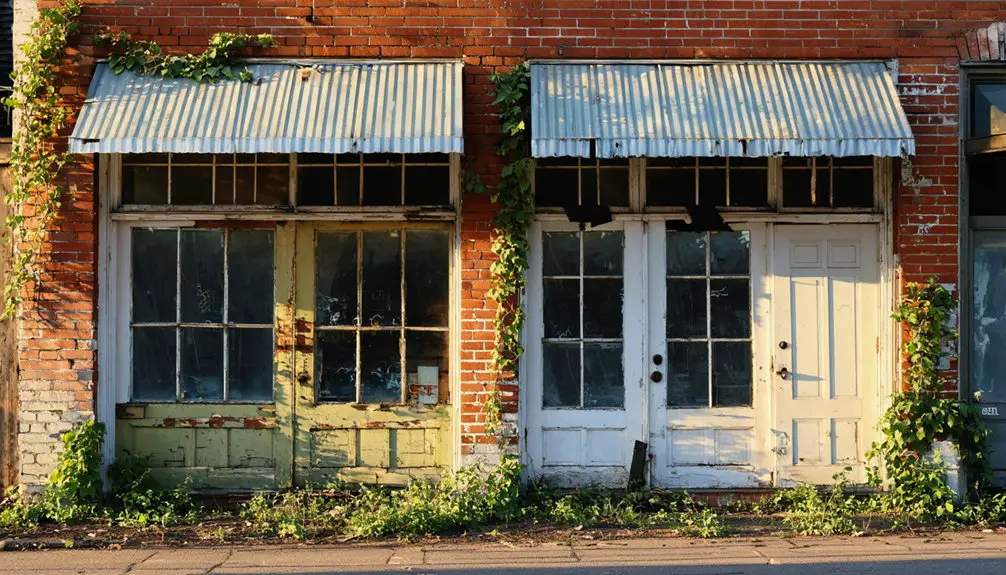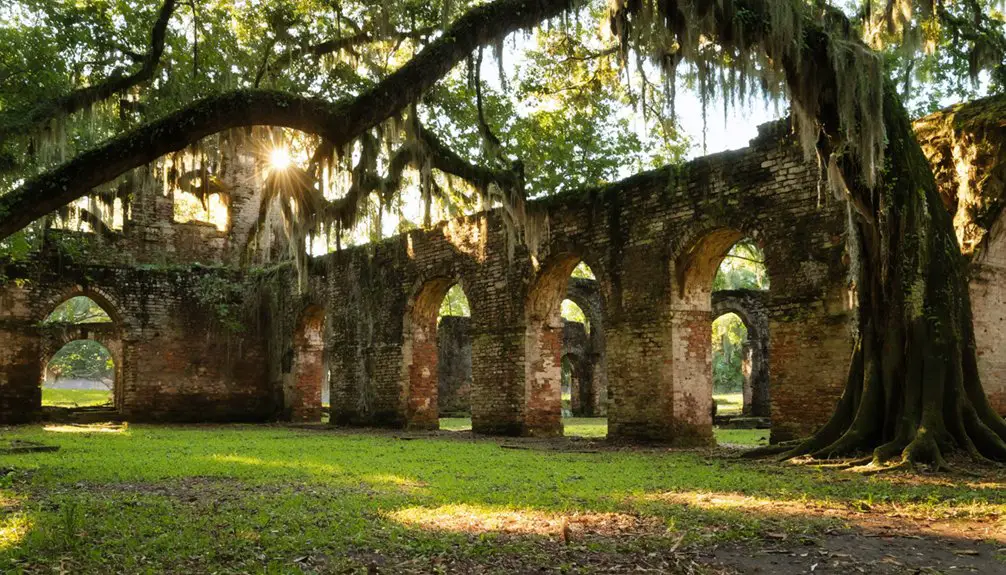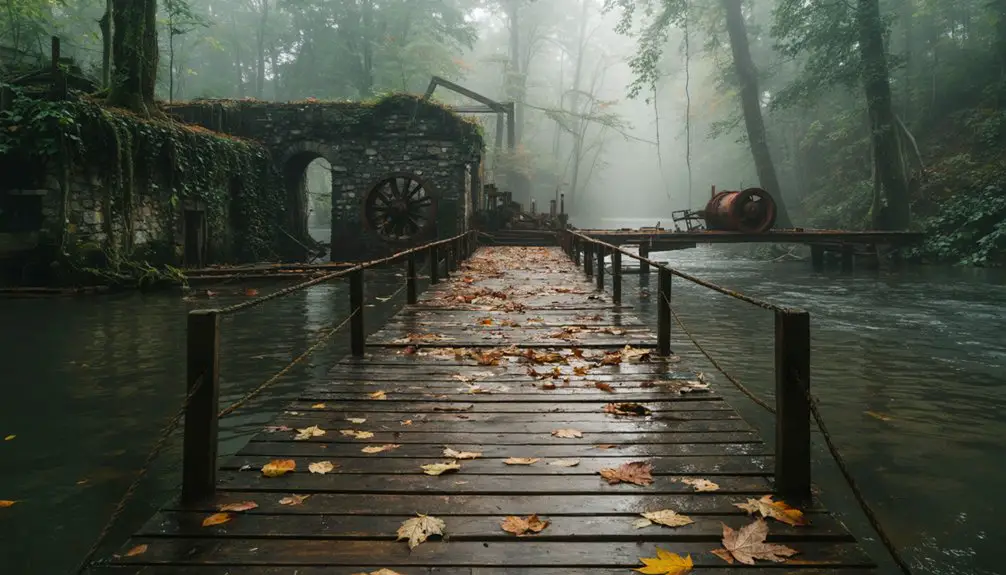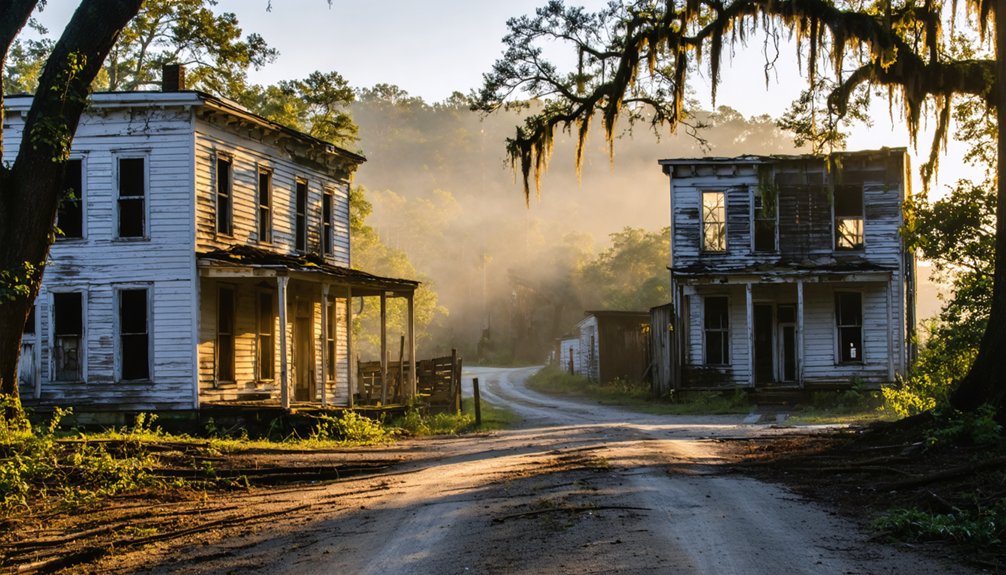
You’ll find North Carolina’s most haunted ghost towns preserve documented histories alongside paranormal reports. Brunswick Town’s 1776 ruins witness Revolutionary War-era phenomena, while Mortimer’s flood-destroyed mill structures harbor persistent unexplained activity. Portsmouth Village’s windswept buildings and Henry River Mill Village’s abandoned textile workers’ homes both report supernatural encounters. Roanoke Colony’s mysterious 1590 disappearance continues generating theories, and Proctor’s drowned lumber town ruins remain largely inaccessible beyond Fontana Lake. Each site combines archaeological significance with preservation efforts, offering insights into the supernatural legends that emerge from catastrophic historical events.
Key Takeaways
- Brunswick Town, destroyed in 1776, features preserved colonial ruins including St. Philip’s Church walls and ongoing archaeological excavations of revolutionary-era artifacts.
- Roanoke Colony mysteriously disappeared in 1587-1590, leaving only “Croatoan” carved on a post, with severe droughts possibly contributing to abandonment.
- Henry River Mill Village, a 1904 textile community abandoned in the 1960s, gained fame as District 12 in “The Hunger Games.”
- Portsmouth Village, founded in 1753, thrived as a maritime hub until its last residents departed in 1971; preserved structures remain accessible.
- Mortimer, a mill town destroyed by catastrophic 1916 and 1940 floods, now features ruins of textile mills overtaken by forest vegetation.
Brunswick Town: Revolutionary War Ruins Frozen in Time
Established in 1726 on the west bank of the Cape Fear River, Brunswick Town emerged as the first successful European settlement in the region and quickly developed into a major colonial port.
Founded in 1726, Brunswick Town became the Cape Fear region’s first thriving European settlement and bustling colonial trading hub.
You’ll find preserved colonial architecture at this site, including St. Philip’s Church‘s standing walls and Russellborough’s foundation—the 56 x 65-foot mansion that housed Governors Dobbs and Tryon.
In 1768, this location witnessed America’s first armed revolt against British taxation, preceding Boston’s famous protest by eight years.
The 1776 British raid by HMS Cruizer destroyed most structures, but archaeological excavations continue revealing revolutionary artifacts.
Ground-penetrating radar recently uncovered a 1730s tavern, while discoveries include British 82nd Regiment buttons and period coins. Archaeologists from East Carolina University found the structure buried under 5 feet of earth at a site previously thought to be empty, with brass taps and liquor bottles indicating its use as a colonial-era drinking establishment.
Built in 1751 by Captain John Russell, Russellborough featured a distinctive round brick indoor well along with a stone fireplace and secret escape passage for residents.
Today’s Brunswick Town/Fort Anderson State Historic Site preserves these tangible remnants of colonial resistance.
Mortimer: The Mill Town Swept Away by Flood
You’ll find Mortimer’s story defined by two catastrophic floods—the 1916 disaster that killed 80 residents and the 1940 hurricane that swelled Wilson Creek to 94 feet deep, permanently erasing the mill town from North Carolina’s map.
These sequential disasters destroyed the narrow gauge railroad infrastructure and textile operations that once sustained 800 workers.
The Ritter Lumber Company shut down the town following the devastating 1916 flood and fire, though Cotton Mills Company briefly revived operations in 1922.
Today, you can document what remains: rusted machinery half-buried in forest undergrowth, collapsed mill buildings, and crumbling foundations that mark where the Laurel Inn ballroom and company store once anchored this Pisgah National Forest community. Visitors can store device information through cookies when accessing historical records and interactive maps documenting the town’s remains on various heritage websites.
Catastrophic Flood’s Devastating Impact
When fire swept from Grandfather Mountain to Wilson Creek in 1916, no one anticipated the catastrophic flood that would immediately follow, transforming Mortimer from a thriving mill town of 800 residents into a scene of devastation. The deluge demolished Lake Rhodhiss Dam and Ritter Lumber Company’s operations, killing 80 people in what became Caldwell County’s worst recorded flood. The town’s name derives from Mortemer village in Normandy, where the surname originated from geographical features associated with stagnant water or ponds.
You’ll find that flood recovery efforts began when the Cotton Mills Company revitalized operations in 1922, and the Civilian Conservation Corps overhauled damaged structures during the Great Depression. The CCC established Camp F-5 to coordinate reconstruction and repair buildings throughout the town.
Yet nature struck again in 1940 when hurricane-driven waters reached 94 feet, engulfing everything. This second catastrophe proved final—most families fled permanently, leaving behind mill machinery and collapsed buildings now reclaimed by Pisgah National Forest.
Exploring the Overgrown Ruins
Today’s visitors approaching Mortimer through Pisgah National Forest will discover a landscape where concrete ruins emerge from dense vegetation like archaeological fragments. The environmental impact of decades-long abandonment has transformed this industrial site into a natural sanctuary.
Though urban exploration remains possible through established trails.
What You’ll Find at the Mortimer Ruins:
- Cotton mill skeleton – Intact concrete walls stand windowless and roofless, with scattered machinery rusting among the undergrowth.
- CCC white building – The sole flood survivor from the 1940s era remains accessible for examination.
- Foundation networks – Building remnants and railroad bridge structures reveal the town’s original layout.
Multiple parking areas provide freedom to explore at your own pace, though nature’s reclamation continues erasing traces of Mortimer’s industrial past. The nearby campground offers hot showers for those planning extended exploration of the area’s numerous hiking trails and waterfalls.
Roanoke Colony: America’s Greatest Vanishing Mystery
You’ll find America’s oldest unsolved mystery at Roanoke Island, where John White established the colony in 1587 with 117 settlers before departing for England.
When he returned three years later—delayed by the Anglo-Spanish War—he discovered only abandoned structures and the cryptic word “Croatoan” carved into a post.
The colonists’ fate remains debated among historians who’ve examined evidence ranging from severe drought records to archaeological artifacts suggesting assimilation with nearby Native American tribes. Tree-ring data reveals that the settlers faced the most extreme drought in 800 years between 1587 and 1589, a climate crisis linked to the Little Ice Age that likely caused devastating subsistence shortages.
White also found the letters “CRO” carved separately, another cryptic clue that has fueled centuries of speculation about whether the colonists relocated to Croatoan Island or moved inland to other indigenous settlements.
The Lost Colony’s Founding
In spring 1584, Queen Elizabeth I granted Sir Walter Raleigh letters patent authorizing him to discover and possess “remote heathen and barbarous Lands” unclaimed by Christian princes—launching what would become America’s most enduring colonial mystery. Raleigh’s charter demanded establishment by 1591 or forfeiture, pressuring rapid colonization.
Sir Richard Grenville’s expedition arrived at the Outer Banks in June 1585, establishing Ralph Lane’s settlement with 108 men. You’ll find colonial artifacts from this period scattered across Roanoke Island, documenting their desperate struggle.
Native alliances quickly deteriorated due to English aggression and resource demands. The outbreak of epidemics like influenza among Native towns rapidly impacted food supplies and altered indigenous society, leading to increased suspicion and political shifts that further destabilized relations.
Three Critical Expeditions:
- 1585 reconnaissance – Lane’s men explored Chesapeake Bay and interior rivers
- 1586 abandonment – Drake evacuated the starving colony
- 1587 “Cittie of Raleigh” – John White led 117 settlers, including women and children
White’s Delayed Return
John White’s departure from Roanoke in late 1587 marked the beginning of an agonizing three-year separation from his colony—a delay that would seal the settlement’s fate and create America’s most perplexing historical enigma.
White left 115 colonists behind, including his granddaughter Virginia Dare, intending a brief supply run to England. The Spanish Armada’s 1588 threat shattered those plans. Queen Elizabeth requisitioned all vessels for defense, trapping White while his family remained vulnerable across the Atlantic.
When he finally returned in August 1590, he discovered only abandonment and questions. The fortified settlement stood empty, houses dismantled, with “CROATOAN” carved on a post—suggesting relocation rather than catastrophe.
Yet hurricane winds and his captain’s privateering ambitions prevented White from investigating the Croatoan mystery further, leaving White’s disappearance from historical records as mysterious as his colony’s vanishing.
Theories Behind the Disappearance
Over four centuries after 115 colonists vanished without a trace, historians and archaeologists continue wrestling with competing explanations for Roanoke’s fate—each theory supported by fragments of evidence yet none conclusively proven.
The leading interpretations include:
- Native integration through voluntary relocation—supported by the “CROATOAN” carving and archaeological discoveries at Salmon Creek, 50 miles inland, where Algonquian village artifacts suggest European presence.
- Catastrophic natural events—hurricanes, famine, or disease that forced colonists to abandon their settlement, though no bodies were recovered.
- Violent elimination—either through Native American conflicts or Spanish attacks, despite no physical evidence at the original site.
Recent excavations and 2012 British Museum map analysis reveal colonists likely dispersed into multiple groups, complicating singular explanations for their disappearance.
Henry River Mill Village: From Textile Hub to Hunger Games Backdrop
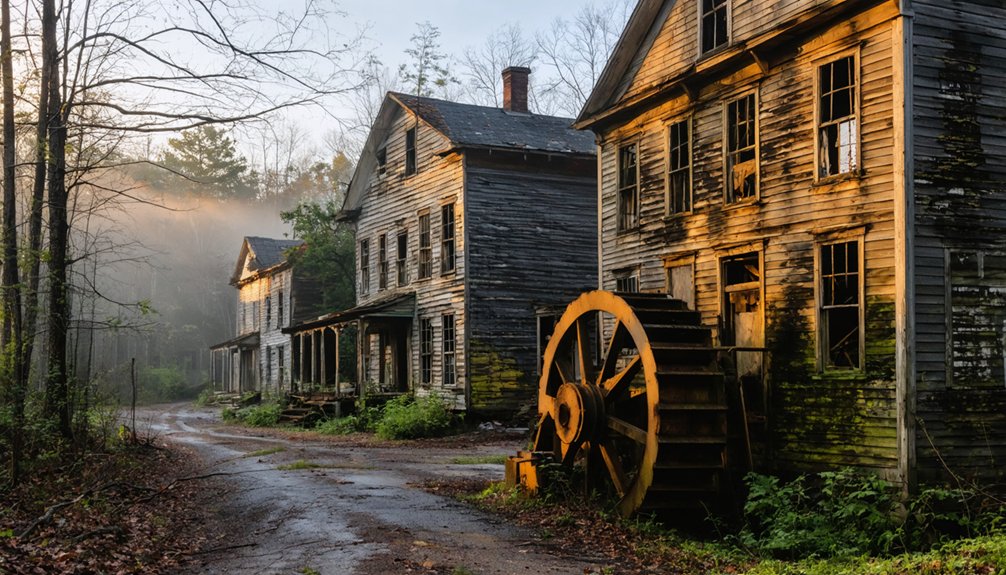
Nestled along the banks of the Henry River in Burke County, the Henry River Mill Village stands as a meticulously preserved proof of North Carolina’s textile manufacturing heritage.
Founded in 1904-1905, this planned community housed 450 workers across 35 cottages, supporting a three-story brick mill that produced fine cotton yarns.
The industrial history reveals remarkable adaptability—transitioning from water to steam to electric power while expanding from 4,000 to 12,000 spindles.
Community life centered around the company store, where workers spent “doogaloo” coins, creating a self-contained ecosystem with its own school and church.
Operations ceased in the late 1960s amid overseas competition, and lightning destroyed the main mill in 1977.
Today, you’ll find renewed interest thanks to its 2011 role as District 12 in The Hunger Games.
Portsmouth Village: The Windswept Island Settlement
While Henry River Mill Village represented inland industrial ambition, Portsmouth Village claimed its place in history through maritime commerce on North Carolina’s treacherous Outer Banks. Established in 1753 on Portsmouth Island, this settlement mastered the art of lightering—transferring cargo between ocean vessels and shallow-draft boats steering Ocracoke Inlet.
Peak Maritime History Achievements:
- 1,400+ vessels passed through annually by 1842
- Two-thirds of North Carolina’s exports handled through the port
- Population reached 685 residents at its 1860 zenith
The Civil War triggered its decline. By 1971, the last residents departed. Today, the National Park Service preserves approximately 20 structures showcasing island architecture across 250 acres.
The Methodist church and schoolhouse stand as proof of this windswept community’s resilience.
Proctor: Hidden Mountain Ruins Deep in the Forest
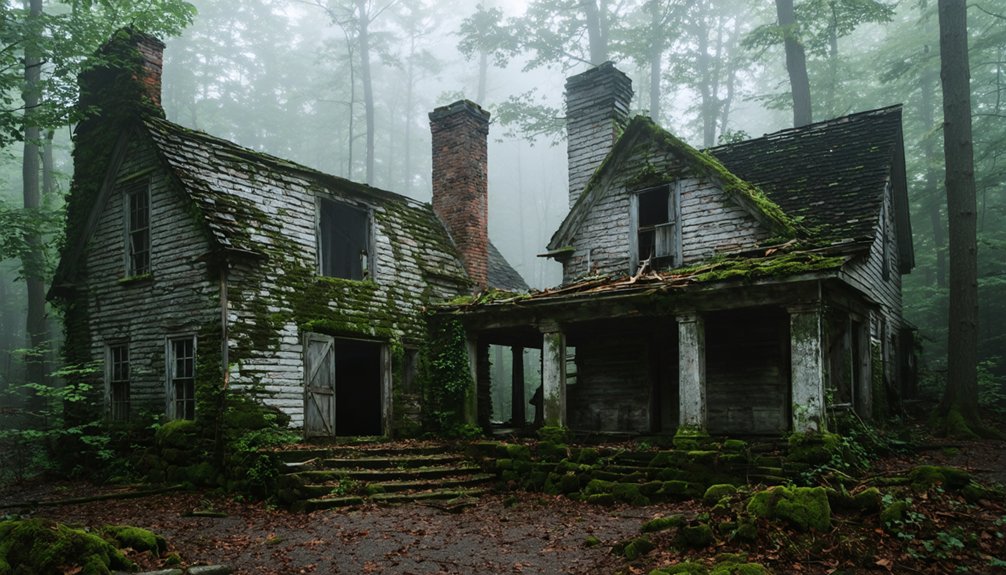
Deep within the Great Smoky Mountains National Park lies Proctor, a lumber town that met an unusual fate—drowning beneath the waters of Fontana Lake in 1943. When the Tennessee Valley Authority built Fontana Dam for wartime aluminum production, 1,200 families abandoned their homes.
You’ll find only fragments now: the Calhoun House, Ritter Lumber Mill ruins, and foundations scattered through forest concealment.
The government promised displaced residents a 30-mile road for cemetery access—they built seven miles ending in a tunnel to nowhere.
Twenty-six cemeteries remain unreachable except by boat or a 22-mile hike through mountain isolation.
Today, you can explore these remnants as a backcountry campsite, though most structures were razed post-flooding.
The drowning of Proctor remains an unfulfilled promise written in water.
Paranormal Activity and Supernatural Legends
These documented occurrences include:
- Brown Mountain Lights: Unexplained luminous phenomena dating to 1200 AD Cherokee battles, visible from multiple overlooks.
- Piney Grove Church: Four distinct entities manifesting alongside autonomous door movements and airborne objects.
- Ghost Ship Carroll A. Deering: Empty vessel with meals laid out, haunting Cape Hatteras since 1921.
You’re free to investigate these sites yourself—evidence speaks louder than skepticism.
Visiting These Abandoned Sites: What to Know Before You Go
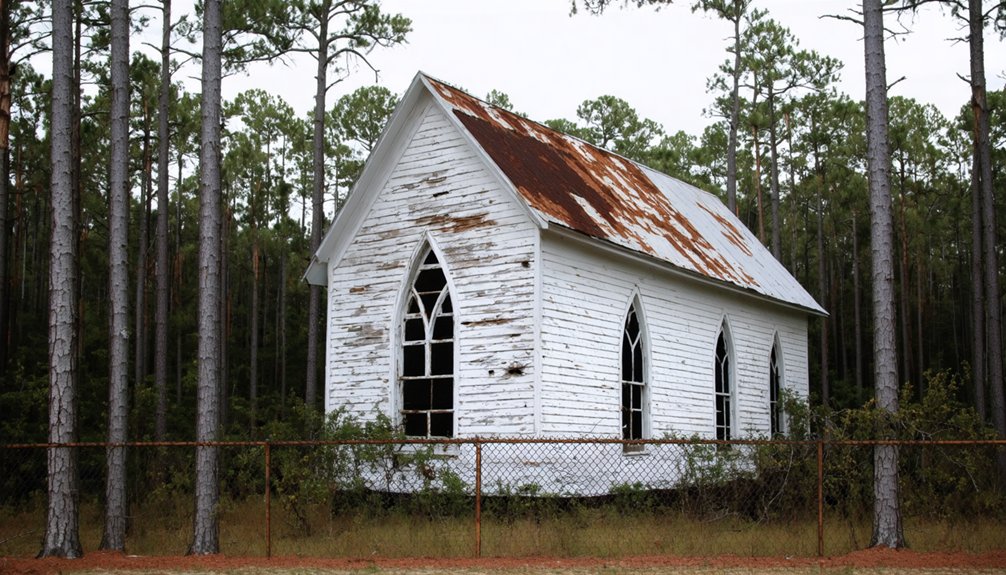
Before venturing into North Carolina’s abandoned settlements, you’ll need to assess each location’s accessibility level and required preparation.
Henry River Mill Village offers straightforward access off I-40 with paid admission and guided tours.
Henry River Mill Village stands as North Carolina’s most accessible ghost town, welcoming visitors with convenient highway access and professionally guided exploration.
While Proctor, Mortimer, and Judson demand serious hiking equipment through difficult terrain.
Mountain sites face increasing forest reclamation, making ruins harder to locate each season.
Portsmouth Village provides established visitor infrastructure through Fort Raleigh National Historic Site.
In contrast, remote locations require navigation skills and awareness of animal encounters in overgrown areas.
For photography tips, candlelit tours in Greensboro and self-guided lantern experiences at Old Salem create atmospheric documentation opportunities.
Tours typically cost $89-$109 with 24-hour cancellation policies.
Pack specialized gear for backcountry exploration and verify seasonal accessibility before departure.
Preserving North Carolina’s Ghost Town Heritage
While North Carolina’s ghost towns face constant threats from weather, vegetation, and structural decay, dedicated preservation organizations have mobilized substantial resources to protect these vanishing historical landscapes.
The haunting history of ghost towns reveals the stories of communities that once thrived but were ultimately left in the past. By uncovering these narratives, preservation efforts can foster a deeper appreciation for the cultural heritage embedded within these silent landscapes. It is essential to recognize their significance not just as remnants, but as vital pieces of the tapestry that formed our society.
exploring the history of gold hill offers a glimpse into the mining boom that once fueled the local economy. As visitors walk through the remnants of this once-bustling town, they can almost hear the echoes of miners’ laughter and the clinking of tools against rock. Each abandoned structure tells a story, reminding us of the resilience and spirit of those who called gold hill home.
Restoration techniques employ meticulous carpentry matching original materials and authentic paint shades. At Elkmont, single cabin restorations required three years each.
Preservation challenges demand creative funding—Friends of the Smokies established a $9 million endowment after assessments revealed only 19 of 60 structures were salvageable.
Key preservation achievements include:
- 850+ endangered properties saved through Preservation North Carolina’s statewide program, generating $350 million in private investment since 1939
- 4,000+ protected acres under restrictive covenants preventing inappropriate development
- Strategic acquisitions like SAHC’s 95-acre Lost Cove tract, destined for permanent Pisgah National Forest protection
You’ll find these efforts revitalize communities while maintaining architectural authenticity for future exploration.
Frequently Asked Questions
Are There Any Ghost Towns in Western North Carolina Worth Visiting?
Looking for authentic remnants of mountain heritage? You’ll discover historic architecture at Henry River Mill Village and Cataloochee’s pioneer structures, while local legends surround Proctor’s submerged ruins. These sites offer genuine freedom to explore North Carolina’s preserved past independently.
Which Abandoned Town Is Easiest to Access With Young Children?
Brunswick Town offers the easiest children-friendly exploration with maintained paths and protected ruins. You’ll find family safety tips posted throughout, plus restrooms and flat terrain. It’s ideal for independent discovery without restrictive barriers or strenuous hiking requirements.
Can You Camp Overnight at Any North Carolina Ghost Towns?
You can’t legally camp overnight at most North Carolina ghost towns without permits, as they’re on protected land. However, you’ll find night photography opportunities and historical significance worth documenting through permitted backcountry camping nearby these abandoned settlements.
What Safety Equipment Should I Bring When Exploring These Sites?
You’ll need safety gear essentials including sturdy boots, long sleeves, helmet, respirator, flashlight, and first aid kit. Emergency preparedness equipment like backup lighting, communication devices, and navigation tools guarantees you’re protected while exploring independently.
Are Guided Ghost Hunting Tours Available at These Locations?
Like treasure hunters seeking different riches, you’ll find guided paranormal investigations only at Battleship North Carolina through Haunted Rooms America. The other sites require self-guided exploration, respecting historical preservation while you pursue your independent ghost-hunting freedom.
References
- https://www.onlyinyourstate.com/experiences/north-carolina/nc-ghost-towns
- https://queencityghosts.com/the-top-ten-haunted-spots-in-north-carolina/
- https://northcarolinaghosts.com
- https://www.youtube.com/watch?v=iWhjTfCyUpY
- https://www.northcarolinahauntedhouses.com/real-haunts/
- https://www.atlasobscura.com/itineraries/explore-north-carolina-s-spooky-hidden-histories
- https://www.visitnc.com/list/ncs-mysterious-disappearances-and-abandoned-places
- https://www.livescience.com/65734-brunswick-town-colonial-tavern-maybe-brothel.html
- https://emergingrevolutionarywar.org/2016/03/01/the-ruins-of-russellborough/
- https://en.wikipedia.org/wiki/Brunswick_Town