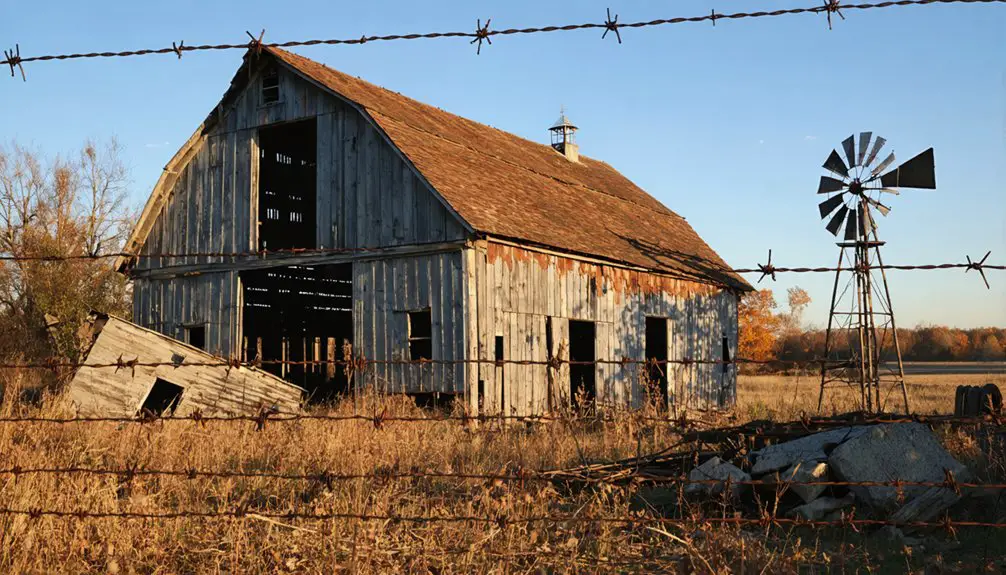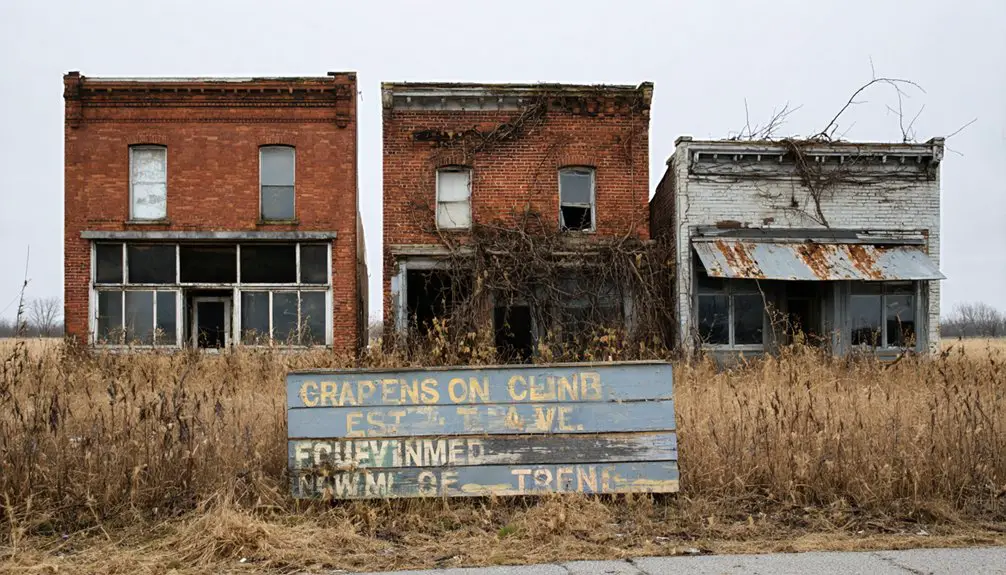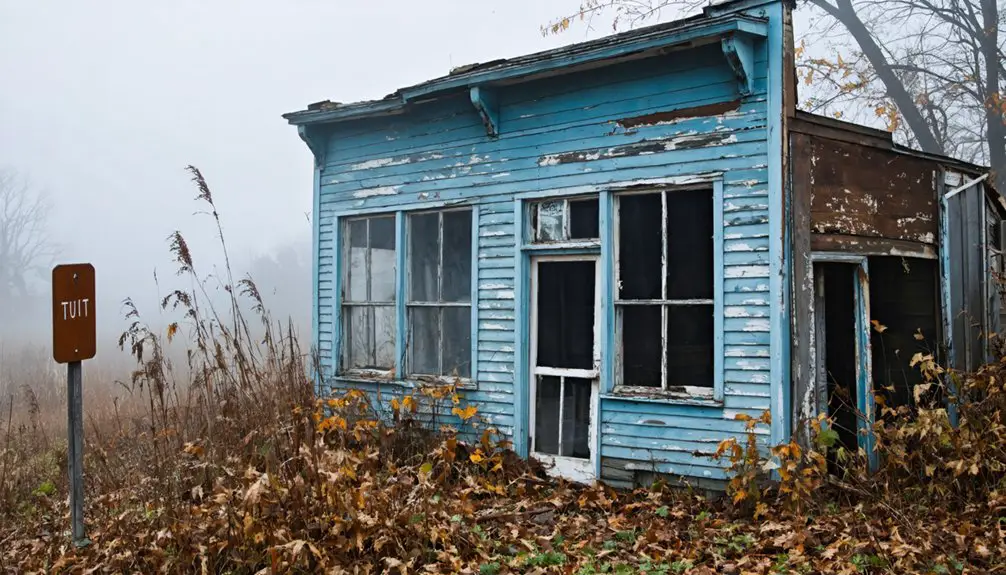
You’ll find Ohio’s most haunted ghost towns in the southeastern hills, where coal mining and iron industry collapses left behind documented paranormal activity. Moonville, founded in the 1850s, features a railroad tunnel with over 21 recorded deaths and persistent reports of lantern-swinging apparitions. San Toy, abandoned in 1931 after violent labor disputes, hosts legends of spectral figures near its remaining jailhouse. Haydenville, Ohio’s last company-owned town (listed on the National Register since 1973), and Orbiston’s iron furnace ruins offer additional exploration opportunities where industrial tragedy intersects with supernatural folklore.
Key Takeaways
- Moonville Tunnel, built in 1856, is Ohio’s most haunted site with lantern-swinging apparitions and over 21 documented deaths.
- Paranormal investigators report EMF anomalies, shadow figures, mysterious lights, and electronic voice phenomena at Moonville Tunnel.
- San Toy, abandoned in 1931 after labor violence and mine fires, features legends of a spectral woman among ruins.
- Orbiston, once a thriving iron furnace town with 500 residents, now contains haunted cemetery markers and foundation ruins.
- Ohio’s 70+ ghost mining towns emerged from coal industry growth between 1850s-1920s, creating numerous abandoned haunted locations.
Moonville: The Isolated Railroad Town Lost to Time
When the Marietta and Cincinnati Railroad constructed its line through southeastern Ohio in the mid-1850s, it carved a path through some of the state’s most remote Appalachian terrain.
Samuel Coe provided land in 1856 to ship coal and clay, and the town that emerged peaked at 100 residents during the 1870s-1880s.
You’ll find Moonville’s name came from full moons illuminating its tunnel on certain nights.
The isolated community housed coal miners and railroad workers among scattered homes, featuring a depot, schoolhouse, general store, and saloon.
When coal mines closed in the early 1900s, the economy collapsed.
The last family abandoned Moonville in 1947.
Today, you can explore its abandoned structures within Zaleski State Forest’s enchanted forests, where only the tunnel, cemetery, and foundations remain along the developing Moonville Rail-Trail. The Moonville Rail Trail Association has maintained the site since 2001, preserving this historic location for visitors and outdoor enthusiasts. The name Moonville has been applied to multiple geographical locations, making this southeastern Ohio ghost town one of several places sharing this evocative designation.
The Moonville Tunnel and Its Century of Supernatural Encounters
The Moonville Tunnel’s haunted reputation stems from multiple documented fatalities throughout its operational history, beginning with an 1859 newspaper report of a brakesman fatally crushed by train wheels.
You’ll find the most prominent apparition is a lantern-swinging figure—attributed to either a decapitated brakeman from the late 1800s or engineer Frank Lawhead, killed in an 1880 head-on collision—that reportedly caused such frequent train stoppages that the railroad installed an automated signal in 1981.
The tunnel was part of a railroad built in 1856 to transport coal from the mines that supported nearby Hope Furnace, which produced weapons during the Civil War. Paranormal investigators have documented numerous encounters, including a dim candlelike light photographed at the tunnel’s east end and the January 23, 1895 sighting of a white-robed figure with a lantern before freight train No. 99, as reported by the Chillicothe Daily Gazette. Modern investigations have recorded high EMF readings and electronic voice phenomena inside the tunnel, with June 2003 recordings capturing voices saying “Come closer” alongside sightings of shadow figures and mysterious lighting effects.
Tragic Deaths and Apparitions
Around 1859, Moonville Tunnel claimed its first recorded victim when a brakeman fell asleep during his night shift near the station depot and stumbled onto the tracks, where a train’s wheels crushed him. The McArthur Democrat reported on March 31, 1859, that the collision ground one leg into a “shapeless mass.”
You’ll find tragic accidents continued throughout the tunnel’s operational history. In November 1880, engineer Theodore Lawhead died in a head-on collision when a dispatcher failed to notify him of an oncoming train on the single track.
The Chillicothe Gazette documented ghost sightings on February 17, 1895, describing Lawhead’s apparition as a white-robed figure with “eyes like fire balls.” Today, visitors report seeing a ghostly lantern appearing during stormy nights, carried by the spirit of the original brakeman as he stumbles down the tracks.
The railroad line became known as the most desolate 8 miles between Parkersburg, West Virginia, and St. Louis, contributing to the tunnel’s dangerous reputation. Over 21 deaths eventually occurred near the tunnel, with the last trestle fatality happening in 1986.
Paranormal Photography Evidence
Since digital cameras became widely accessible in the early 2000s, visitors to Moonville Tunnel have documented unexplained phenomena that investigators classify as potential paranormal evidence.
Michelle Schrader’s October 2004 photograph captured a translucent figure in period clothing matching the legendary brakeman’s description, submitted to Ohio Exploration Society in June 2005.
TJ Smith’s September 2006 video recorded a balding apparition emerging from foliage near the tunnel entrance.
Digital anomalies accompany equipment malfunctions—four fresh batteries drained simultaneously during one investigation. Witnesses report that recordings often malfunction or cease unexpectedly when attempting to document activity inside the tunnel.
EMF evidence includes multiple detector spikes witnessed by 150 program participants, correlating with dousing rod responses at specific tunnel locations. Compass needles exhibited wild spinning behavior in participants’ hands at these same spots during the investigation.
Investigators documented vortex-like light formations alongside electromagnetic field fluctuations, though alternative explanations like camera straps remain possible for some captures.
San Toy: Where Labor Violence Led to Abandonment
Deep in southeastern Perry County’s Bearfield Township, San Toy emerged as a coal boomtown after the New England Company incorporated it in 1902, though the Sunday Creek Coal Company wouldn’t acquire the settlement until 1915.
Founded by the New England Company in 1902, San Toy became a bustling coal town before Sunday Creek Coal Company took ownership in 1915.
By 1920, roughly 2,500 residents enjoyed amenities including the area’s only hospital, theater, and stores—alongside a Wild West reputation featuring daily violence.
Labor disputes devastated this thriving community:
- September 25, 1924: Disgruntled miners rolled burning railroad ties into Mine 1.
- Fire destroyed the hospital and theater; Sunday Creek never rebuilt.
- Population plummeted from 2,500 to 128 by 1930—the nation’s largest per capita decline.
- 1931 vote: 17 of 19 residents chose complete abandonment.
Today, ghostly legends surround the intact jailhouse and forest ruins, where witnesses report a spectral woman walking above the roadway.
Haydenville: Ohio’s Last Corporate-Owned Mining Settlement
You’ll discover over 120 contributing properties constructed from locally fired dark red brick across Haydenville’s 20-acre historic district, which earned National Register of Historic Places designation in 1973.
The town’s architectural legacy includes two-story houses with one-story side wings, slate roofs, and distinctive brick corbelling above arched front windows, alongside the rows of red brick company houses in Redrow Holler (Hopperville) built on the hillside.
Though factories and kilns were demolished following the 1964 sale, the remaining residential structures stand as tangible evidence of Ohio’s last entirely company-owned town.
The Haydenville Mining and Manufacturing Company controlled every building from its 1882 establishment until the early 1960s.
Company Town Architecture Legacy
When Peter Hayden established the Haydenville Mining and Manufacturing Company in 1882, he created more than just a business—he built an entire settlement where corporate control extended to every brick-and-mortar structure.
The company town architecture served as both housing and marketing showcase, with buildings constructed entirely from company-produced fire clay bricks and ceramic tiles.
This strategic design demonstrated product durability while maintaining absolute control over residents’ lives.
The architectural legacy reveals stark realities of corporate dominance:
- Workers couldn’t own homes until the 1960s acquisition by National Fireproofing Company
- Job termination meant immediate eviction from company-owned housing
- Scrip-based wages trapped families within the company’s economic system
- Zero competition existed—the company owned both stores
Today’s industrial heritage preservation through the 1973 National Register listing recognizes 120 contributing properties across 20 acres.
Industrial Era Building Remains
Although the clay factories and kilns were demolished following the 1964 sale, Haydenville’s 120 contributing properties across 20 acres preserve tangible evidence of Ohio’s last entirely company-owned town.
You’ll find worker housing that once required employment for residency, reflecting the extractive industries’ grip on coal, clay, and iron operations throughout Hocking Valley.
The National Register listing in 1973 recognized these structures’ significance before urban decay could erase this corporate control chapter.
While architectural ruins of Plants No. 1 and 2 vanished after NATCO’s ownership ended, the residential buildings remain.
These homes, purchased by workers in the early 1960s after decades of company ownership, document the shift from corporate dominance to individual property rights—a freedom denied since Peter Hayden’s 1852 founding.
Orbiston: The Iron Furnace Town That Rose and Fell in a Decade
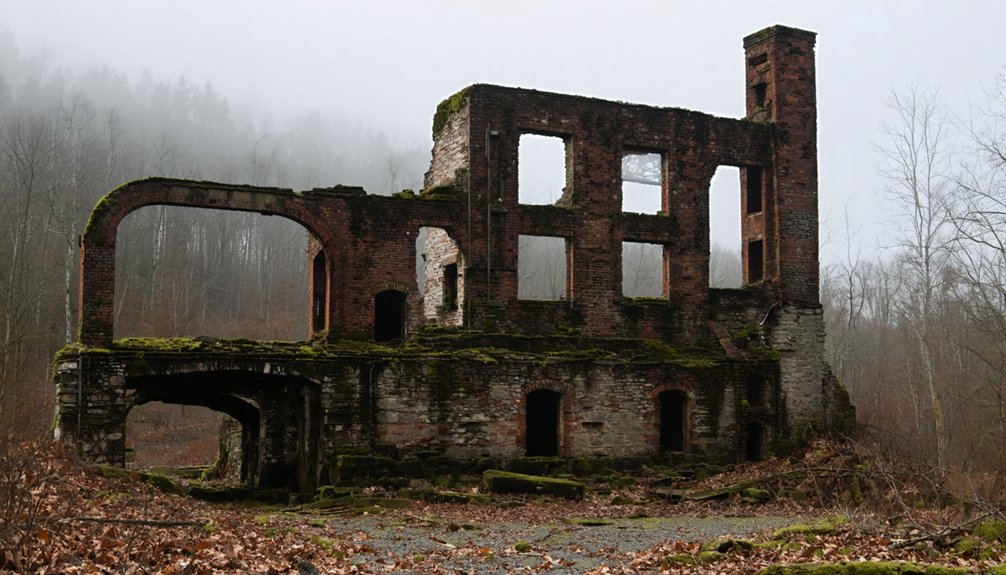
Deep in Hocking County, the iron blast furnace that sparked Orbiston’s existence rose in 1877 as the Ogden Furnace, constructed by the Ogden Iron Company to melt iron ore into usable metal through extreme heat.
Within six years, you’d find 500 residents here, complete with a post office, school, and thriving community infrastructure.
The Hocking Iron Company later renamed it Helen Furnace.
Industrial archaeology reveals Orbiston’s dramatic trajectory:
- Population peaked at 500 by 1883
- Post office operated 1877-1924
- School remained functional until 1930
- Complete abandonment followed iron industry collapse
You’ll discover foundation structures, furnace remnants, and grave markers at Bethel Ridge Cemetery today.
This ghost town exemplifies America’s first regional deindustrialization, where community ghost stories now echo through ruins that once represented prosperity and independence.
The Coal Mining Legacy Behind Ohio’s Abandoned Communities
As Ohio’s iron industry faded, coal mining surged to dominate southeastern Ohio’s economy, transforming the landscape from 1 million tons of annual production in 1850 to 30-40 million tons by the 1920s. Over 70 mining towns flourished across Athens, Hocking, Perry, and Morgan counties, where companies built entire communities—housing, stores, and infrastructure—near rich coal seams.
You’ll find miners worked brutal 10-12 hour shifts, six days weekly, paid only by tonnage extracted. Mining accidents and labor disputes plagued these communities, culminating in San Toy’s violent 1924 incident where workers pushed flaming logs into the mine shaft. This destroyed the mine, hospital, and theater.
Exploring the Remnants: What You Can Still Find Today

Today’s adventurers can explore five significant ghost town sites across Ohio, each offering tangible connections to the state’s industrial past.
These abandoned towns across Ohio reflect the rise and fall of communities that once thrived. From crumbling storefronts to overgrown railways, each site tells a story of economic shifts and population changes. Exploring these remnants provides a unique glimpse into the state’s rich history and the resilience of its people.
Ohio’s abandoned settlements stand as weathered monuments to nineteenth-century industry, their crumbling structures inviting modern explorers to witness forgotten prosperity.
Notable Remnants You’ll Discover:
- Moonville Tunnel (1850s) – Graffiti-covered railroad structure with overgrown cemetery and hiking trails. Local legends persist about train accident victims.
- San Toy’s Jailhouse – Perry County’s lone standing structure from the mining era, abandoned in 1931.
- Boston Mills – Summit County’s “Helltown” within Cuyahoga Valley National Park. Features include abandoned homes and the infamous “Highway to Hell” road.
- Tadmor’s Stone Foundations – Miami Erie Canal remnants accessible via Buckeye Trail in Taylorsville MetroPark.
Preservation efforts have transformed these sites into accessible historical landmarks.
Vinton Furnace’s 1826-1849 buildings and Bethel Ridge Cemetery showcase iron production history along Stone Quarry Road trails.
Frequently Asked Questions
Are There Guided Tours Available for Ohio’s Haunted Ghost Towns?
You’ll find guided tours across Ohio exploring local legends, with Columbus Ghost Tours operating over 10 years specializing in historical preservation. These experiences feature paranormal historians covering 200+ years of haunted history through exclusive location access.
What Safety Precautions Should Visitors Take When Exploring Abandoned Mining Sites?
Never enter abandoned mines—they’re deadly traps with structural collapses, toxic gases, and drowning risks. If you must explore nearby areas, maintain hazard awareness, wear proper gear, stay outside barriers, and keep a 500-foot distance from all openings.
Can You Legally Enter the Buildings in These Ghost Towns?
Legal access varies considerably—you can freely explore 23 buildings at Whitewater Shaker Village (purchased 1991), but trespassing laws strictly prohibit entering evacuated Cuyahoga Valley homes and privately-owned sites without explicit legal permissions from property owners.
What Is the Best Time of Year to Visit Ohio’s Ghost Towns?
Visit Ohio’s ghost towns during fall for peak haunted experiences and historical preservation tours, or choose daylight hours in spring when you’ll safely explore local legends without hunting season risks or unstable building dangers in low light.
Are There Any Hotels or Accommodations Near These Abandoned Settlements?
You’ll find hotels 30-90 minutes from most ghost towns. Near Moonville’s haunted history, Hocking Hills offers cabins and lodges. Boston Mills’ abandoned architecture connects to Cuyahoga Valley accommodations. Rural settlements require advance booking in nearby county seats for your exploration freedom.
References
- https://hockingvacations.com/blog/exploring-the-ghost-towns-of-ohio-unearthing-forgotten-histories
- https://en.wikipedia.org/wiki/List_of_ghost_towns_in_Ohio
- https://www.ohiotraveler.com/moonville-its-a-ghost-town/
- https://wrkr.com/ohio-ghost-towns/
- https://ohioghosttowns.org/top-10-ghost-towns/
- https://www.youtube.com/watch?v=ONB5GV9T-GI
- https://www.youtube.com/watch?v=QWTtG6njIDs
- https://ohio.org/travel-inspiration/articles/haunted-ohio-must-visit-places
- https://www.ohioexploration.com/paranormal/hauntings/
- https://en.wikipedia.org/wiki/Moonville