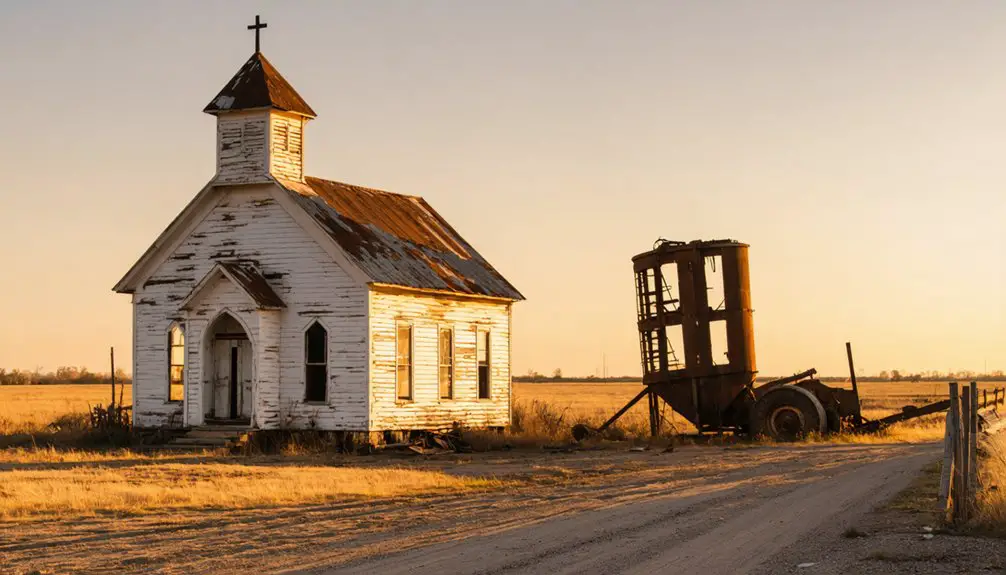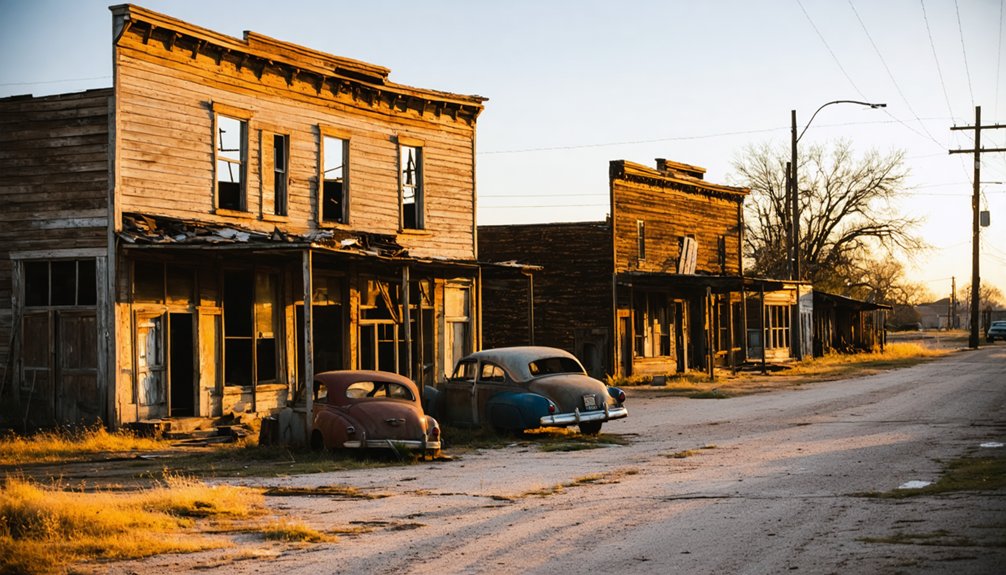
You’ll find Oklahoma’s most haunted ghost towns in Picher, where toxic lead mines left behind spectral miners near collapsed tunnels and 70 million tons of waste, and Ingalls, where the deadly 1893 Battle of Ingalls still echoes through abandoned streets. Picher’s underground labyrinth destabilized 86% of structures before the EPA declared it uninhabitable, while mining disasters from 1917-1947 created conditions locals associate with restless spirits. Several towns now lie submerged beneath reservoirs, their foundations re-emerging during droughts to reveal what was left behind.
Key Takeaways
- Picher features spectral miner sightings near collapsed tunnels and toxic Chat piles from decades of lead-zinc mining devastation.
- Ingalls hosts haunted replicas of the O.K. Hotel tied to the deadly 1893 Battle of Ingalls shootout.
- Picher’s 14,000 abandoned mineshafts and unstable underground labyrinths create eerie conditions for reported paranormal activity.
- Submerged towns beneath Oklahoma reservoirs reveal ghostly foundations and gravestones during droughts, creating haunting landscapes.
- Boggy Depot offers abandoned Civil War-era structures and historic buildings as a preserved ghost town site.
The Toxic Legacy of Picher and Its Lingering Spirits
The EPA eventually declared Picher uninhabitable. Underground tunnels destabilized 86% of structures, creating sinkholes that swallowed the town’s foundation.
After a 2008 tornado killed six and devastated 20 blocks, residents accepted buyouts.
At its peak in 1926, Picher’s population reached 14,000, with thousands employed in mining-related businesses before the industry’s collapse.
The town was incorporated in 1918 amid rapid growth as mining operations expanded to meet wartime demands.
Today, you’ll find only abandoned infrastructure: boarded buildings marked “Keep Out,” overgrown foundations, and spray-painted warnings on government property—a proof to unchecked industrial devastation.
Ingalls and the Ghosts of Outlaw Gunfights
While Picher’s toxic legacy stems from environmental catastrophe, Ingalls met its fate through bloodshed and bullets.
Founded during the 1889 land rush, this town became notorious for harboring the Doolin-Dalton Gang.
You’ll find ghostly legends centered around the Battle of Ingalls on September 1, 1893, when twelve U.S. Marshals confronted the outlaws in a shootout that killed three deputies and two residents.
The town’s criminal reputation drove away travelers and railroads, sealing its demise. The main streets numbered First to Fourth ran east-west, while Main, Walnut, Ash, and Oak stretched north-south across the sixteen-block layout.
Today, you can explore haunted landmarks including replicas of the O.K. Hotel where “Arkansas Tom” Jones holed up, and original stone monuments commemorating fallen lawmen. The Wilson General Store, which historically supplied goods to townspeople and outlaws alike, still stands among the dust-covered foundations.
With streets named for outlaws and a population of just two dozen, Ingalls stands as a testament to frontier justice gone wrong.
Mining Disasters and Trapped Souls of the Pitcher Area
Unlike Ingalls where violence came swiftly through gunfire, Picher’s devastation unfolded across decades of industrial exploitation that transformed this corner of Ottawa County into America’s most toxic ghost town.
Between 1917 and 1947, you’ll find mining legends emerged from operations that extracted $20 billion in lead-zinc ore, employing 14,000 miners at peak production. But this prosperity came at devastating cost—over 14,000 abandoned mineshafts and 70 million tons of toxic waste created an underground labyrinth where 34% of children suffered lead poisoning by 1996. The tunnels extended multiple miles deep, hollowing out the ground and weakening surface stability throughout the town.
Today, ghostly sightings reportedly occur near collapsed tunnels and Chat piles, where locals claim they’ve witnessed spectral miners eternally wandering the contaminated landscape. The 2008 EF4 tornado and subsequent abandonment left these restless spirits undisturbed in their poisoned domain. The name Picher refers to multiple locations, though this northeastern Oklahoma mining town remains the most infamous bearer of the designation.
Bathsheba: The Mysterious All-Female Town’s Dark Fate
Among Oklahoma’s most enigmatic ghost towns, Bathsheba stands apart not for confirmed tragedies but for its disputed existence entirely. You’ll find scholars debating whether this alleged all-female settlement ever stood between Enid and Perry after the 1893 Cherokee Strip land run.
Unlike most ghost towns mourned for their demise, Bathsheba’s greatest mystery is whether it ever existed at all.
The sole documentation traces to a Kansas reporter who claimed 33 women established this radical experiment, banning all males— including livestock. He reported being shot at by the female police chief before the settlement supposedly vanished within weeks.
Modern researchers can’t locate Bathsheba in county records, leading experts like Dr. John W. Morris to question its authenticity. The name itself echoes the biblical figure Bathsheba, whose story of power dynamics and political influence has resonated through centuries of cultural interpretation. Professor Douglas Werden calls it a derogatory stereotype rather than legitimate history.
The story contrasts sharply with documented female pioneers like Kentucky Daisy (Nannitta Daisy), who verifiably participated in Oklahoma land runs and worked as a journalist and activist. Whether genuine female utopias or fabricated ghost town myths, such stories reveal more about frontier anxieties than documented reality.
Boggy Depot’s Haunted Trading Post History
The Civil War amplified its importance as a Confederate supply depot, where bloody skirmishes occurred nearby.
Haunted legends now cling to the abandoned stone structures remaining from its commercial peak—when apothecaries, hotels, and mills thrived.
The 1872 railroad bypass sealed its fate, creating the ghost town that stands today as evidence to frontier ambition and inevitable decline. Jerry Cantrell’s father grew up in this desolate Oklahoma settlement, later inspiring the musician to name his 1998 solo album after the abandoned depot.
Today, visitors find only open fields and markers where bustling businesses once stood, alongside the historic cemetery that serves as the primary visible remnant of Boggy Depot’s vanished past.
Submerged Towns Beneath Oklahoma’s Reservoirs
While ghost towns typically conjure images of weathered buildings standing sentinel against the prairie sky, Oklahoma harbors an entirely different category of abandoned settlements—those resting beneath thousands of acres of reservoir water. Oklahoma’s 38 major man-made lakes submerged entire communities between 1944 and 1980, prioritizing flood control over historical preservation.
Lake Texoma drowned Woodville’s 360 residents and neighboring Aylesworth in 1944. Kaw Lake’s 1976 completion forced evacuations of Uncas, Washunga, and original Kaw City. Lake Altus-Lugert consumed tornado-battered Lugert in 1947.
These government-mandated relocations offered property buyouts while bulldozers demolished neighborhoods. Today’s reservoir ecology occasionally reveals these forgotten places—droughts expose foundations, gravestones, and farm tools, transforming recreation areas into unexpected archaeological sites where displaced communities once thrived.
Frequently Asked Questions
What Paranormal Equipment Is Recommended for Ghost Hunting in Oklahoma’s Abandoned Towns?
You’ll need paranormal investigation equipment essentials including EVP recorders, EMF meters, infrared cameras, and spirit boxes. Don’t forget flashlights, digital recorders, temperature monitors, and backup batteries for Oklahoma’s remote abandoned locations where electrical sources aren’t available.
Are There Guided Ghost Tours Available at Any Oklahoma Ghost Town Sites?
You won’t find guided ghost tours at Oklahoma’s rural ghost towns. Tourist attractions focus on urban sites like Oklahoma City and Tulsa, while historical preservation efforts at places like Shamrock and Ingalls remain self-guided only.
Exploring ghost town history in Oklahoma offers a unique perspective on the state’s past, showcasing the remnants of once-thriving communities. These sites tell stories of resilience and change, providing insight into the lives of those who once called them home. Travelers often find themselves captivated by the silent streets and crumbling buildings that echo the heritage of the Sooner State.
Among these hauntingly beautiful oklahoma ghost towns, visitors can uncover hidden gems like the faded remains of Devol and the eerie charm of Hennessey. Each site offers a glimpse into a bygone era, where the whispers of history linger in the air. As dusk falls, the landscapes transform, inviting adventurers to experience the enchanting aura that captivates the imagination.
Which Oklahoma Ghost Town Reports the Most Frequent Supernatural Activity?
Downtown Lawton reports Oklahoma’s most concentrated supernatural activity, with historical sightings spanning decades and consistent witness testimonies. You’ll find urban legends supported by documented paranormal investigations identifying it as the state’s priority location for ghost research.
Can Visitors Legally Explore and Photograph Oklahoma’s Abandoned Ghost Town Buildings?
Oklahoma’s 2,000 ghost towns tempt adventurers, but you’ll face legal restrictions requiring owner permission before exploring. Property ownership persists despite abandonment, making unauthorized entry trespassing. You’re free to photograph exteriors from public roads without risking prosecution.
What Time of Year Experiences Peak Paranormal Activity in Oklahoma Ghost Towns?
Oklahoma ghost towns don’t show seasonal paranormal peaks. You’ll find year-round hauntings documented across abandoned sites. While fall brings tourist surges to attractions, actual ghost town activity lacks climate influence or seasonal legends tying spirits to specific months.
References
- https://kids.kiddle.co/List_of_ghost_towns_in_Oklahoma
- https://en.wikipedia.org/wiki/List_of_ghost_towns_in_Oklahoma
- https://www.youtube.com/watch?v=5d-wHDTIbb0
- https://www.okhistory.org/publications/enc/entry?entry=GH002
- https://abandonedok.com/class/disappearing-town/
- https://pocketsights.com/tours/tour/Shamrock-Oklahoma-Ghost-Towns-Creek-Lincoln-Payne-and-Pawnee-Counties-2749
- https://allthatsinteresting.com/picher-oklahoma
- https://adamthompsonphoto.com/the-sad-tale-of-picher-oklahoma/
- https://www.okhistory.org/publications/enc/entry?entry=PI002
- https://en.wikipedia.org/wiki/Picher