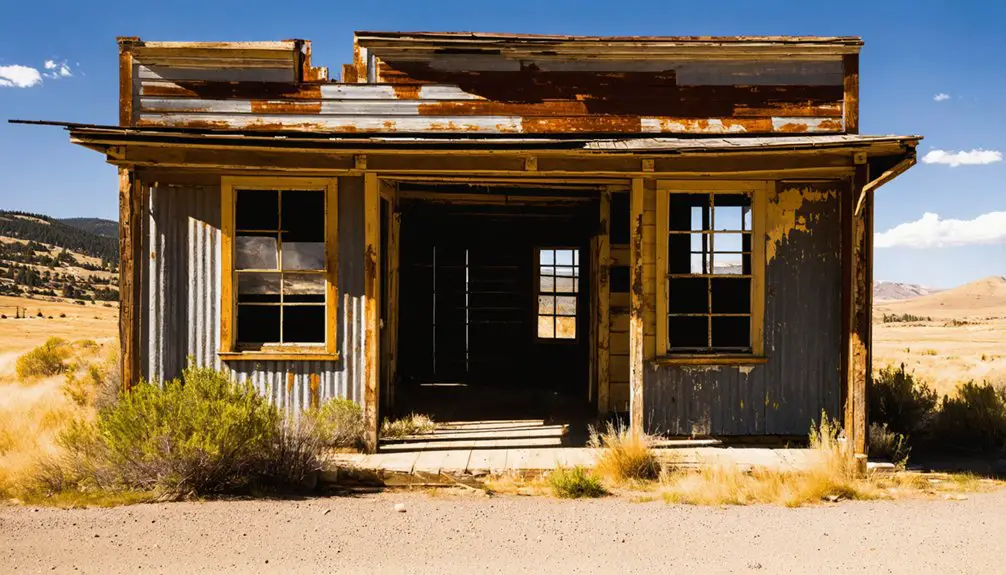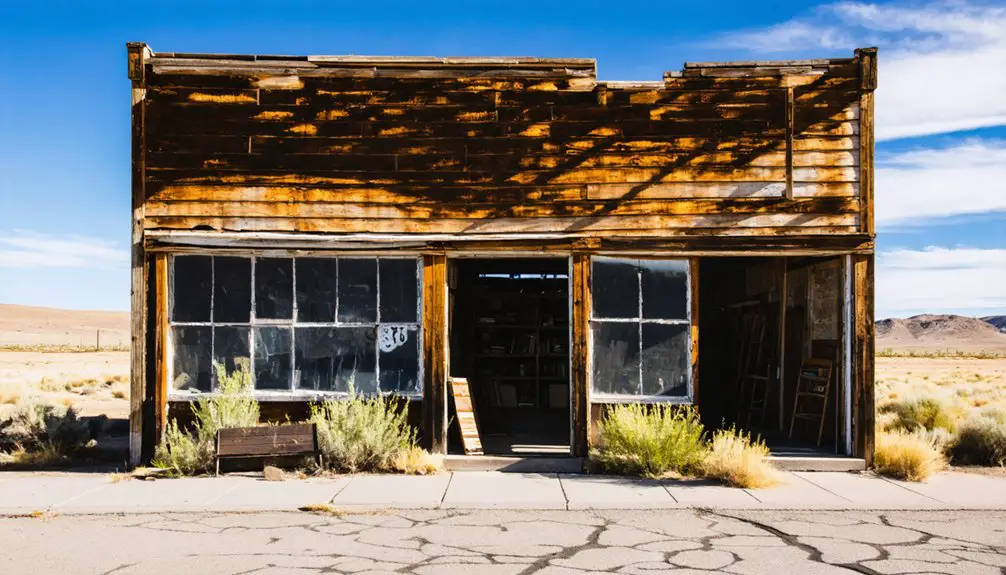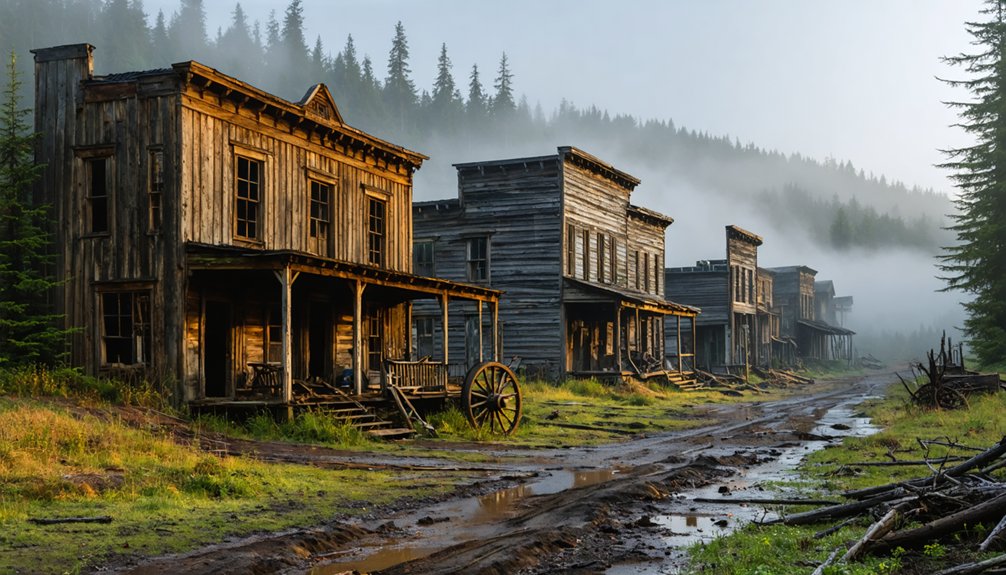
Oregon’s haunted ghost towns combine mining history with paranormal activity. You’ll find Golden’s historic 1892 Campbellite church drawing investigators to its peaceful woodland site, while Millican’s dark past includes the 1988 murder of William Mellin that marked its final decline. Shaniko’s abandoned tunnels connect buildings where “Wool Capital” workers once toiled, and Sumpter’s weathered jailhouse stands among underground passages from its gold mining days. Each location preserves both architectural remnants and ghostly tales from Oregon’s frontier era that continue attracting those seeking supernatural encounters.
Key Takeaways
- Golden’s historic Campbellite church attracts paranormal investigators interested in its 1892 architecture and mining-era history at the Heritage Site.
- Canyon City survived multiple disasters since 1862, with remaining structures and resilient community creating an atmospheric historic settlement.
- Sumpter features abandoned mining tunnels, a weathered jailhouse, and decaying structures from its gold rush era before the 1917 fire.
- Millican’s violent history includes a 1988 murder, with deteriorated buildings and abandoned equipment marking its eerie desert decline.
- Shaniko’s abandoned streets, underground tunnels connecting buildings, and weathered jailhouse reflect its decline from Oregon’s “Wool Capital.”
Golden: The Religious Mining Settlement Near Coyote Creek
The Coyote Creek area first attracted gold miners in the 1840s, though the settlement that would become Golden didn’t take shape for nearly half a century. After the Salmon River gold strike drew away early prospectors, Chinese miners moved in before white miners forced them out.
Hydraulic mining transformed the landscape in the 1870s, and William Ruble‘s purchase of claims in the mid-1880s established permanence.
By 1890, a proper town emerged, reaching over 150 residents by 1892. The Ruble brothers’ invention of the Ruble Elevator revolutionized mining efficiency and earned recognition at the Lewis and Clark Exhibition.
Religious influences shaped Golden’s character distinctly. Teetotaler William Ruble banned saloons, ensuring miners seeking alcohol traveled to neighboring Placer or Wolf Creek.
His Campbellite church, built in 1892, became Free Methodist and featured historical architecture that later attracted paranormal investigators.
Ministers worked mining claims while leading congregations, embodying the settlement’s dual nature. Today, visitors can explore the Golden State Heritage Site, where four structures remain standing in the peaceful woodlands.
Buncom: Southern Oregon’s Best-Preserved Mining Ghost Town
You’ll find Buncom 20 miles southwest of Medford, where Chinese miners first struck gold in Sterling Creek back in 1851. The settlement evolved from a mining camp into a supply center for the Little Applegate Valley before the post office closed in 1918.
Residents abandoned the town after exhausting its gold, silver, chromite, and cinnabar deposits. Today, three early 1900s buildings—a post office built in 1910, a bunkhouse, and a cookhouse—stand as Southern Oregon’s best-preserved ghost town.
These buildings have been maintained since 1990 by the Buncom Historical Society through roof replacements and structural restoration. Each May, the town hosts Buncom Day with music, food, crafts, and a parade celebrating its mining heritage. You can reach the town via a five-mile unpaved road on Griffin Creek Lane that winds through dense madrona forests.
Historic Mining Operations Legacy
Deep in Southern Oregon’s mountainous terrain, Buncom stands as the region’s best-preserved mining ghost town, twenty miles southwest of Medford at the intersection of Sterling Creek Road and Little Applegate Road.
Chinese miners founded this settlement in 1851 after discovering gold in Sterling Creek, establishing historical mining techniques that evolved from simple creek gravel extraction to sophisticated hydraulic operations.
Early settler stories center on mining boss Gin Lin, who purchased claims in 1864 and constructed the five-mile Gin Lin Ditch to power hydraulic nozzles that blasted hillsides.
The Buncom Mining District, established in 1867, extracted gold, silver, chromite, and cinnabar until depletion in 1918.
Today, three early 1900s structures remain—the post office, cookhouse, and bunkhouse—testifying to this once-thriving operation that attracted over 150 residents. The town’s General Store and Livery Stable once served the daily needs of miners and their horses, forming the commercial heart of this bustling frontier community. The Buncom Historical Society, founded in 1991, has replaced roofs and restored porches to preserve these remaining structures as a historical landmark.
Current Preservation Status
Since 1990, the Buncom Historical Society has safeguarded the town’s three surviving structures—the post office, cookhouse, and bunkhouse—on private land where Sterling Creek Road meets Little Applegate Road.
Restoration challenges have tested the society’s commitment, requiring complete roof replacements by 1991 and subsequent porch repairs.
The post office received new galvanized sheeting in January 2025 after its cedar shakes deteriorated.
You’ll find these preservation features when you visit:
- All three early 1900s buildings remain locked to protect their interiors
- Exteriors are viewable on unfenced property 20 miles southwest of Medford
- Foundation remnants mark where other structures once stood
- Empty interiors visible only through broken windows
The site is accessible via a well-paved road, making it easy for visitors to reach by car despite its remote ghost town setting.
Despite visitor engagement efforts, including the annual Buncom Day fundraiser, revival attempts remain unsuccessful as of 2025.
The town’s structures include buildings originally constructed by the Federal Mining Company in 1926, which were later moved upstream to their current location.
Shaniko: Oregon’s Legendary Wool Shipping Hub Turned Ghost Town
Along the windswept high desert plateau of north-central Oregon, Shaniko stands as one of the state’s most fascinating ghost towns. Its story is inextricably tied to the wool industry that once made it internationally famous.
Shaniko: where windswept plateau meets wool empire legacy, a ghost town frozen in time on Oregon’s high desert frontier.
You’ll discover a place that earned the title “Wool Capital of the World” in 1903, when sheepmen sold $5 million worth of wool through its warehouses.
The Columbia Southern Railroad’s 1900 arrival transformed this frontier outpost into the world’s largest inland wool shipping center, with freight wagons arriving from Northern California. The same year, financiers Laughlin and Lord constructed the largest wool warehouse in Oregon to accommodate the booming trade.
Ancient legends whisper through Shaniko’s abandoned streets, where hidden tunnels once connected buildings during its 600-person heyday. The weathered jailhouse still stands among the remaining structures, a testament to the town’s once-vibrant community that included banks, saloons, and a schoolhouse.
Today, you’ll find only 20-25 residents maintaining this high desert monument to Oregon’s entrepreneurial past.
Sumpter: The Blue Mountains Boomtown Destroyed by Fire
From the high desert plateau to the evergreen-clad Blue Mountains, Oregon’s ghost town legacy shifts dramatically when you encounter Sumpter, a once-thriving gold mining metropolis that earned the nickname “Queen City.” Before a catastrophic fire reduced it to ruins in 1917.
Founded by South Carolinians in 1862, Sumpter exploded after the railway arrived in 1896. Mining technology transformed everything—electric-powered dredges weighing 2.5 million pounds carved waterways, while 12 miles of tunnels snaked underground.
By 1900, the town boasted impressive architecture:
- 150 business establishments with opera house and brewery
- 25 hotels serving nearly 4,000 residents
- Three newspapers documenting $9 million in gold production
- Electric lights illuminating wooden sidewalks
The August 1917 fire destroyed 100 buildings across 12 blocks, leaving 250 homeless and ending the boomtown era forever.
Canyon City: Grant County’s Still-Inhabited Gold Rush Settlement
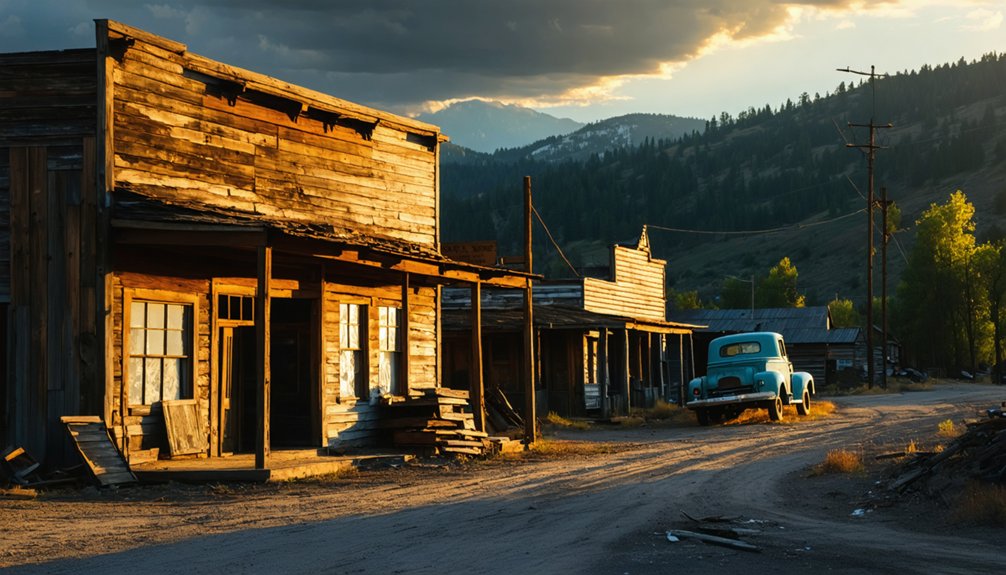
Unlike Sumpter’s complete destruction, Canyon City survived fire and flood to remain inhabited for over 160 years, making it one of Oregon’s most remarkable gold rush settlements still functioning as a living community.
Canyon City stands as Oregon’s most enduring gold rush town, weathering disasters while remaining continuously inhabited for over 160 years.
Your journey through Canyon City’s settlement history begins June 7, 1862, when William A. Allard struck gold on Canyon Creek, yielding $18-$20 per pan. Within ten days, 1,000 miners arrived.
The gold rush exploded to 10,000 residents—Oregon’s largest population at times—as miners extracted an estimated $26 million from Oregon’s richest placer diggings.
The townsite was laid out July 20, 1862, and became Grant County’s seat in 1864. Though three devastating fires (1870, 1898, 1937) and an 1896 flash flood struck hard, Canyon City persisted.
Today, 703 residents maintain this living monument to frontier resilience.
Millican: The Ghost Town With a Dark Murder History
You’ll find Millican’s weathered store and gas station still standing in the high desert between Bend and Burns, silent monuments to one of Oregon’s most tragic ghost towns.
When Bill Mellin was murdered by his employee David Wareham in March 1988, the town achieved the grim distinction of a 100% murder rate—its sole resident killed in cold blood.
The killing marked the final chapter in decades of heartbreak for the Mellin family, who’d already lost three members to violent accidents before Bill’s death ended human habitation altogether.
Millican Store Still Stands
The Millican Store emerged as the central hub of this remote high desert community in 1913, shortly after the post office opened to serve homesteaders attempting cattle ranching and dry land wheat farming in the area. Located on the Bend-to-Burns route, it provided essential fuel and supplies to travelers crossing deserted landscapes.
The store’s ownership journey reveals its resilience:
- Billy Rahn (1920-1945): Self-appointed mayor who single-handedly maintained the town
- Bill Mellin (1945-1988): Operated the business with his wife Helen for over 30 years
- Multiple owners (1991-2005): Various attempts to revive operations ended in closure
- Current status: Abandoned structure with old storefronts slowly collapsing in the desert
You’ll find this ghost town 26-30 miles east of Bend on US 20, though entering isn’t recommended.
William Mellin’s Tragic Death
In March 1988, tragedy struck when David Wareham, a 41-year-old parolee recently released from Oregon State Penitentiary, shot 70-year-old William Mellin in the back of the head inside the store’s kitchen.
Wareham, whom Mellin had employed shortly after his prison release, committed what authorities determined was a robbery-turned-murder.
The Mellin murders marked the devastating end of an era for this already-struggling settlement.
You’ll find this crime particularly heartbreaking when you consider Mellin’s prior losses.
His wife Helen died in 1976, daughter Tina in a 1971 car accident, and son William Jr. in a 1980 plane crash.
He’d been operating the store alone, having already listed the town for sale before his death.
Following Wareham’s conviction, Mellin’s granddaughter Valerie Cornford briefly managed the property before selling it, cementing Millican’s ghost town transformation with a population of zero.
Oregon’s Most Violent Town
Mellin’s murder represents just one chapter in Millican’s surprisingly violent history for such a remote settlement. You’ll find this ghost town’s architecture tells stories of isolation that bred desperation. The abandoned mining equipment and deteriorating structures stand as silent witnesses to decades of conflict.
Millican’s violent timeline includes:
- 1920s disputes over water rights and grazing land among the dwindling population
- World War II tensions when Billy Rahn served as chief air raid warden in this isolated outpost
- 1971 tragedy when Bill Mellin’s daughter Tina died in a Los Angeles car accident
- 1988 murder that finally reduced the population to zero permanently
The town’s remoteness didn’t protect residents from violence—it amplified it, creating an environment where conflicts festered without outside intervention.
Frequently Asked Questions
Are Guided Ghost Tours Available at Any of These Oregon Ghost Towns?
While you’ll find organized ghost tours in Portland and Oregon City, Oregon’s remote ghost towns don’t offer guided tours. You’re free to self-explore these sites, though tourist safety and historical preservation mean most remain outdoor-only experiences without formal paranormal guides.
What Paranormal Activity Has Been Reported at These Abandoned Mining Settlements?
You’ll encounter unexplained phenomena including white-clad apparitions making physical contact, mysterious hooded figures with lanterns, green fog, phantom fires, and disembodied voices. Historical legends tie these hauntings to mining tragedies, asylum deaths, and suicides throughout Oregon’s abandoned settlements.
Can Visitors Stay Overnight in Accommodations at These Historic Ghost Towns?
Step back in time—you’ll find overnight stays available at these historic sites. Shaniko Hotel, Hot Lake Lodge, Cornucopia Lodge, and Wolf Creek Inn offer visitor amenities while preserving authentic ghost town history for your independent exploration.
Which Oregon Ghost Town Is Considered the Most Haunted by Locals?
Shaniko’s considered the most haunted by locals, with spiritual encounters reported throughout the hotel and town. Historical legends from its 1900-1910 wool capital era fuel its reputation as Oregon’s liveliest ghost town with definite paranormal activity.
Are There Specific Times of Year Best for Visiting These Locations?
Summer’s splendid sunshine offers the best time for seasonal visiting between April-September, when you’ll find open attractions and accessible trails. However, winter’s eerie atmosphere authentically amplifies haunted experiences, though you’ll need proper preparation for harsh conditions.
References
- https://en.wikipedia.org/wiki/List_of_ghost_towns_in_Oregon
- https://www.visitoregon.com/oregon-ghost-towns/
- https://www.travelmedford.org/southern-oregon-ghost-towns-
- https://www.deviantart.com/austinsptd1996/journal/Six-Iconic-Ghost-Towns-Within-Oregon-1109696435
- https://www.youtube.com/watch?v=8HrSsE_MNZ0
- https://oregonoutdoorfamily.com/golden-oregon-a-ghost-town/
- https://www.pdxmonthly.com/travel-and-outdoors/oregon-ghost-towns
- https://www.explorersue.com/haunted-places-in-oregon/
- https://traveloregon.com/things-to-do/culture-history/ghost-towns/
- https://www.nationaldaycalendar.com/lists/12-oregon-ghost-towns