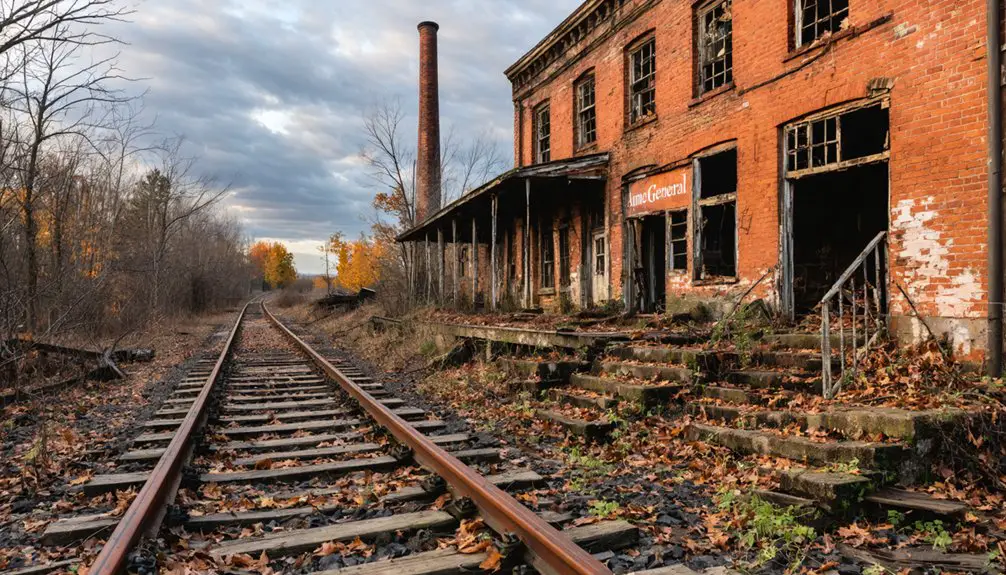
You’ll find Pennsylvania’s most haunted ghost towns aren’t just legends—they’re real places with documented tragedies. Centralia’s underground coal fire has burned since 1962, forcing out nearly everyone. Pithole collapsed from oil boom to ruins in months during the 1860s. Rausch Gap’s mining community vanished by 1900, while Frick’s Lock was sacrificed for nuclear power in the 1980s. Yellow Dog Village faced abandonment after a deadly E. coli outbreak. Each site preserves darker chapters of industrial America’s history.
Key Takeaways
- Centralia burns continuously since 1962 with underground coal fires, toxic fumes, and ground collapses creating an apocalyptic landscape.
- Pithole boomed to 20,000 residents in 1865 before fires and economic collapse left it abandoned within two years.
- Rausch Gap features coal mining ruins along the Appalachian Trail, abandoned by 1900 after resource depletion.
- Frick’s Lock residents were displaced for Limerick Nuclear Power Plant; remaining structures are rumored to be haunted.
- Yellow Dog Village offers paid tours through its abandoned company town, deserted after 2008 due to contaminated water.
Centralia: The Town Consumed by Underground Fire
Beneath the streets of what was once a thriving Pennsylvania coal town, an inferno has burned for over six decades. Centralia’s nightmare began May 27, 1962, when borough personnel ignited trash in an abandoned strip pit near Odd Fellows Cemetery.
The fire spread through carbonaceous refuse into underground coal workings, eventually consuming 3,700 acres across an eight-mile stretch.
Underground fires now rage up to 300 feet deep, advancing 75 feet annually through abandoned mine tunnels.
Deadly gases seep from ground fissures, and sudden collapses threaten anyone who ventures near.
The original strip pit, excavated around 1935, measured approximately 75 feet wide and 50 feet deep.
Town abandonment accelerated through the 1980s after a sinkhole nearly swallowed a child.
Pennsylvania condemned the entire borough in 1992.
Centralia’s population plummeted from 1,500 residents to just five by 2017.
Experts predict the blaze will continue another 250 years.
Pithole: From Oil Boom to Abandoned Ruins
While Centralia’s destruction came slowly through underground fire, Pennsylvania witnessed another town vanish in the span of just 500 days. You’ll find Pithole’s story in Venango County, where 1865 oil strikes transformed Thomas Holmden’s farm into a boomtown of 20,000 residents.
The settlement boasted 54 hotels, Pennsylvania’s third-largest post office, and the world’s first oil pipeline. Yet this prosperity proved fleeting.
Economic collapse struck in March 1866 when bank failures burst the oil bubble. Production plummeted from thousands to under 1,000 barrels daily.
Devastating fires consumed entire blocks. An August 2 blaze destroyed parts of the town and oil wells, accelerating the decline. By 1870, virtually everyone had abandoned Pithole.
Today, archaeological excavations and interpretive trails mark where 900 buildings once stood, offering you a stark lesson in boom-and-bust economics. The site was listed on the National Register of Historic Places in 1973 and features a visitor center with exhibits explaining the town’s dramatic rise and fall.
Rausch Gap: Coal Mining Remnants Along the Appalachian Trail
Deep within St. Anthony’s Wilderness, you’ll discover Rausch Gap’s haunting industrial relics scattered across Sharp Mountain’s southern slopes.
Founded in 1828 by the Dauphin & Susquehanna Coal Company, this settlement thrived as a coal mining hub with nearly 1,000 residents by 1860.
The railroad history here tells a compelling story—tracks connected Dauphin to Rausch Gap in 1851, establishing it as a crucial rail center with repair shops and company offices.
However, poor coal quality and depleting resources triggered its downfall. By 1872, operations relocated to Pine Grove, leaving the town virtually abandoned by 1900.
Today, you can explore foundation ruins and an old cemetery along the 21-mile Stony Valley Rail-Trail, where freedom seekers walk paths once traveled by miners and railroad workers. The trail features concrete track repair pieces that once held spare railroad components, marking your journey through this industrial ghost town. The trail extends from north of Dauphin Borough all the way to north of Fort Indiantown Gap, offering access to multiple ghost town sites along its length.
Frick’s Lock: The Village Sacrificed for Nuclear Power
Along the Schuylkill Canal’s eastern banks, Frick’s Lock emerged in the early 1800s as a commercial hub serving the canal’s bustling traffic, though some of its structures date back to the 1700s when the area functioned as family farmland.
The village thrived shipping over one million tons of coal by the 1850s, but railroads triggered industrial decline that drained the canal and scattered residents.
The final blow came in the 1960s when Limerick Nuclear Power Plant required the land. Power company acquisitions forced out remaining inhabitants by the early 1980s, leaving eighteen acres of empty buildings under surveillance.
Today, you’ll find community preservation efforts have partially restored the site. The imposing power plant remains visible from the abandoned town, creating an unsettling juxtaposition between industrial infrastructure and decaying structures. East Coventry Historical Commission offers limited tours, while trespassing faces prosecution. Rumored hauntings add to the village’s eerie reputation as former residents guide visitors through this monument to progress’s cost.
Yellow Dog Village: Pennsylvania’s Most Accessible Ghost Town
Unlike Frick’s Lock, where nuclear progress erased a community, Yellow Dog Village earned its ghostly status through economic forces and environmental catastrophe. Built in 1912 near Worthington, Armstrong County, this Pittsburgh Limestone Corporation town housed workers who signed “Yellow Dog Contracts” forbidding unionization.
Yellow Dog Village rose as a company town in 1912, binding workers through anti-union contracts that would define its controversial legacy.
The community thrived for decades until the mine’s 1950s closure triggered mass exodus.
After multiple ownership transfers and renaming attempts, an E. coli outbreak in tainted wells forced final abandonment around 2008-2012. Vandals stripped the settlement bare during 2010-2014.
You’ll find hope in retired teacher Joe Meyer’s 2014 purchase. His historic preservation efforts and community revitalization plans transformed Yellow Dog into a semi-abandoned attraction offering paid tours and 1920s living experiences, making it Pennsylvania’s most accessible ghost town.
Frequently Asked Questions
Are Any of Pennsylvania’s Ghost Towns Actually Haunted With Paranormal Activity?
You’ll find haunted legends surrounding Centralia’s toxic ruins, but documented paranormal sightings lack verification. Most Pennsylvania ghost towns—Rausch Gap, Yellow Dog Village, Frick’s Lock—have no substantiated supernatural activity beyond folklore and visitor speculation.
Can You Legally Explore and Take Photographs Inside These Abandoned Towns?
You can legally explore public roads in towns like Centralia, but venturing onto private property risks trespassing charges. Historic preservation and property ownership laws still apply—even when buildings appear abandoned, so always respect posted boundaries and photograph responsibly.
What Safety Precautions Should Visitors Take When Exploring Ghost Towns?
You’ll need sturdy footwear, walking sticks for unstable ground, and masks against toxic gases from coal fires. Stay on marked paths, respect private property, and practice Leave No Trace principles while documenting urban decay for historical preservation.
Are Guided Tours Available for Pennsylvania’s Abandoned Ghost Town Sites?
Yes, you’ll find guided tours at Pennsylvania’s ghost towns prioritizing historical preservation and tourist accessibility. Local historians lead walks through Clarion-Little Toby Trail’s abandoned settlements, while Yellow Dog Village and Lausanne offer structured explorations of authentic ruins.
How Many Total Ghost Towns Exist Throughout Pennsylvania Today?
You’ll find countless ghost towns scattered across Pennsylvania—Geotab documented 105 sites facing urban decay. Historical preservation efforts can’t track every abandoned settlement, as many Western Pennsylvania locations remain undocumented, making exact totals impossible to verify definitively.
Explorers often venture into these abandoned towns in Pennsylvania, intrigued by the stories and history lingering in the crumbling structures. Each site serves as a haunting reminder of the past, drawing urban adventurers and history buffs alike. As more people become interested in preserving these remnants of history, there is hope that some may be restored or at least documented before they fade away entirely.
References
- https://en.wikipedia.org/wiki/List_of_ghost_towns_in_Pennsylvania
- https://uncoveringpa.com/ghost-towns-in-pa
- https://pabucketlist.com/the-spookiest-sounding-destinations-in-pennsylvania/
- https://www.atlasobscura.com/things-to-do/pennsylvania/ghost-towns
- https://www.visitpa.com/blog/post/haunted-places-pennsylvania/
- https://www.pahauntedhouses.com/real-haunts/
- https://www.youtube.com/watch?v=yxFuqGq-FJ8
- https://www.pa.gov/agencies/dep/programs-and-services/mining/abandoned-mine-reclamation/aml-program-information/centralia-mine-fire-resources
- https://en.wikipedia.org/wiki/Centralia_mine_fire
- https://www.britannica.com/video/coal-mine-fire-Pennsylvania-Centralia/-207717