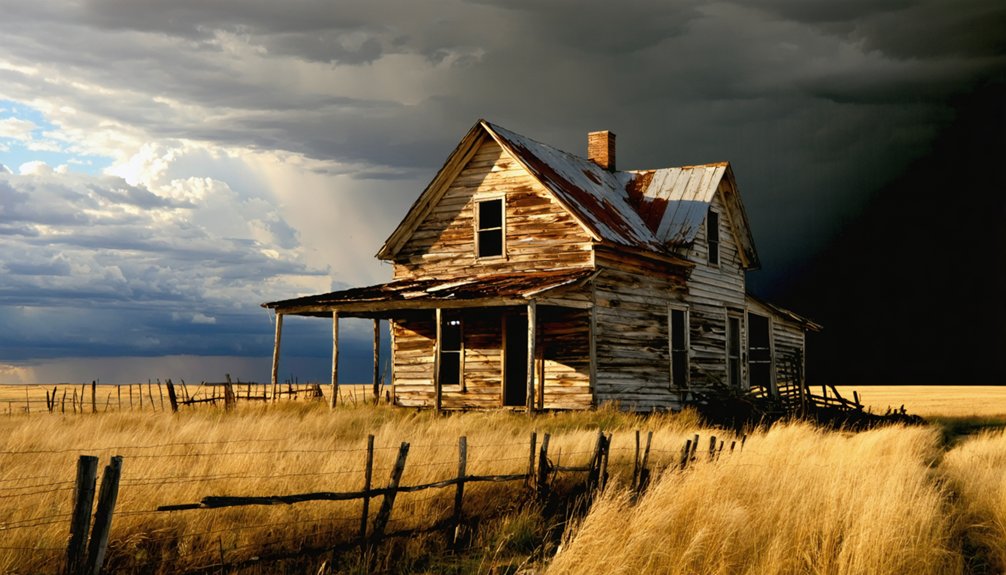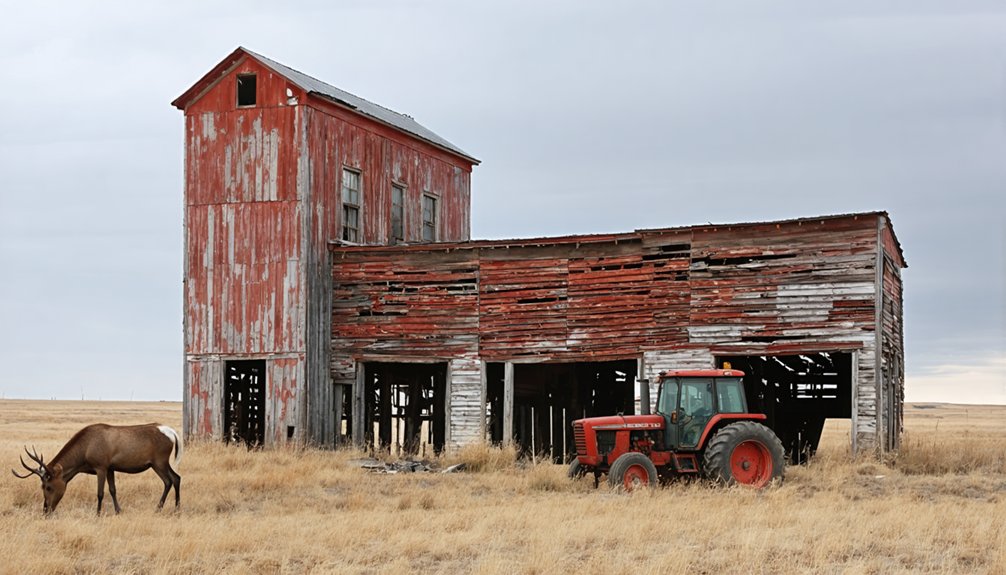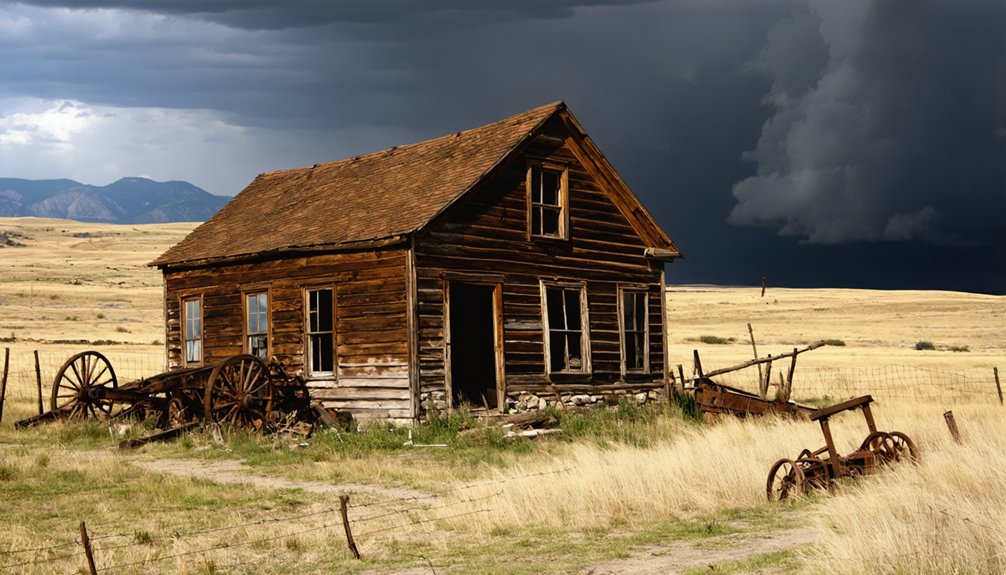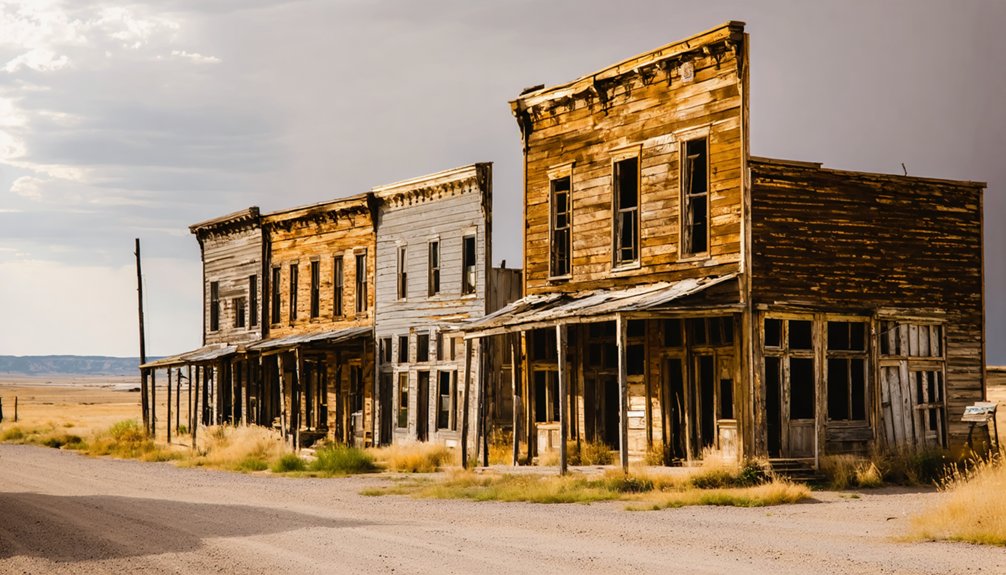
You’ll find South Dakota’s most haunted ghost towns scattered across the Black Hills, where gold rush settlements from the 1870s left behind more than abandoned buildings. Deadwood’s Lucky Nugget Casino, built on Wild Bill Hickok’s murder site, reports shadow figures and disembodied voices, while Spokane’s 1908 claim-jumping murder still echoes through empty structures. The former Sioux San Hospital conceals unmarked Native American graves, and Carbonate Camp’s cemetery harbors spectral sightings near eleven documented burials. These locations preserve documented tragedies, violent deaths, and restless spirits that continue drawing investigators to their crumbling foundations.
Key Takeaways
- Deadwood’s Lucky Nugget Casino reports shadow figures, disembodied voices, and apparitions including Wild Bill Hickok’s ghost at Saloon No. 10’s original site.
- Spokane ghost town experienced paranormal activity after the 1980s, linked to James Shepard’s 1908 murder during a claim-jumping dispute.
- Mount Rushmore Brewing’s crematorium basement features autonomous objects and apparitions near the original intact cremation furnace from its funeral home era.
- Black Hills contains over 600 abandoned mining towns from the 1874 Gold Rush with scattered ruins and deteriorating structures.
- Canyon City’s abandoned mine shafts and equipment mark illegal prospecting sites, with some structures now submerged under Lake Pactola.
The Eerie Silence of Canyon City’s Abandoned Mining Camps
When prospectors flooded into South Dakota’s Black Hills during the 1870s Gold Rush, Canyon City emerged as one of dozens of mining camps that promised fortune but delivered only temporary hope.
You’ll find this Pennington County settlement was tied to the East Sioux Gold mill operations near Central City, part of illegal prospecting that violated the Laramie Treaty of 1868.
By the late 1870s, exhausted deposits forced abandonment. Today, gaping mine shafts and waste piles mark the landscape—geological formations transformed into badlands through erosion.
Historical artifacts remain scattered: shaft house foundations, trapped machinery in valleys, ore bins, and cyanide vats.
The exact location has been lost to time, but the silence surrounding these crumbling structures captures the isolation that defines freedom-seeking prospectors’ failed dreams. Like the submerged structures beneath Lake Pactola, many mining settlements met their end through abandonment and the relentless march of time. Identification methods involve researching old maps and newspapers, piecing together often-frail clues to confirm the locations of these vanished settlements.
Homestake Opera House: Where Spirits Still Take the Stage
Unlike Canyon City’s desolate mining remnants, the Homestake Opera House in Lead survived its brush with destruction to become one of South Dakota’s most architecturally significant buildings—and allegedly one of its most haunted. You’ll find this 1914 venue, gifted by Phoebe Hearst, nearly succumbed to a catastrophic 1984 fire.
The theater sat empty for eleven years before restoration began. Today’s visitors report theater ghosts wandering the restored spaces where heated floors now warm the 500-seat auditorium. Spectral performances allegedly occur near the returned cherub sculptures and golden murals. You can investigate during Tuesday-Saturday tours from Memorial Day through mid-October.
The building’s evolution from 1,000-seat performing arts center to fire-damaged shell to partially restored venue creates layers of history—and persistent reports of supernatural activity among its 24,000 square feet. The original venue included a library, billiards hall, bowling alley, and swimming pool, making it a comprehensive hub for miners and their families. While most original facilities have been repurposed, only the theatre remains in its original use today.
Okaton Ghost Town: Railroad Ruins Along the Prairie
Along South Dakota’s windswept prairie, Okaton’s abandoned structures mark where the Chicago, Milwaukee & St. Paul Railroad workers established their settlement in 1906.
Windswept prairie ruins whisper tales of 1906 railroad ambitions, where Chicago, Milwaukee & St. Paul workers once carved civilization from South Dakota’s unforgiving landscape.
You’ll discover railroad relics scattered across this desolate landscape—overgrown tracks, a weathered grain elevator, and the collapsed remnants of what once housed thriving homesteaders.
The town’s decline accelerated when construction crews moved westward, followed by the Great Depression’s devastating impact.
The railroad’s 1980 closure sealed Okaton’s fate.
What remains for prairie preservation:
- Faded “Westlake’s Ghost Town” signage from failed 1970s roadside attraction
- Abandoned schoolhouse and deteriorating residences
- Unused grain elevator repainted for unreleased film production
Located near Interstate 90 exit 183, only 31 residents remain.
The 2020 census counted just 31 current residents, most living on surrounding farms rather than in the crumbling townsite.
The Westlakes once operated a general store and petting zoo to attract tourists before abandoning their ghost town venture.
Most structures sit on private property, limiting exploration of these haunting railroad ruins.
Lucky Nugget Casino and Deadwood’s Phantom Visitors
You’ll find the Lucky Nugget Casino at 622 Main Street in Deadwood, now permanently closed but still featured on ghost tours for its paranormal reputation.
The building stands near the original site of Saloon No. 10, where Wild Bill Hickok was shot during a poker game on August 2, 1876, while holding aces and eights—the infamous “Dead Man’s Hand.”
The casino’s haunted legacy connects directly to its former life as a brothel serving Deadwood’s notorious figures.
Its later transformation into a gambling hall followed South Dakota’s 1989 legalization of gaming.
The original Saloon No. 10 was lost to fires in Deadwood’s early years, though the modern Lucky Nugget was believed to occupy the historic site.
Paranormal investigators and former employees have reported phantom footsteps, shadow figures, and disembodied voices throughout the building’s interior.
Paranormal Activity Inside Casino
When the Black Hills Paranormal Investigators received a call from Lucky Nugget Casino management about disturbances in their second-floor storage area, they documented what would become one of Deadwood’s most extensively investigated hauntings.
Casino security footage couldn’t explain the heavy boot steps echoing through empty hallways or employees refusing solo upstairs assignments after unexplained encounters.
Investigators captured compelling evidence:
- EVP recordings preserved children’s voices, men bargaining over cards, and a woman’s shouts
- Photographs revealed a small boy’s apparition at the staircase top
- A dark mass charged at investigators, nearly making physical contact
Gaming anomalies occurred alongside phantom perfume scents and aggressive physical sensations.
One employee reported being pinned against a wall by an invisible force, while shadow figures appeared in doorways during multiple independent investigations. The casino’s haunted reputation stems from its history as a former brothel, where residual paranormal activity continues to manifest decades after its original purpose ended. The Lucky Nugget Casino stands among Deadwood’s numerous historic buildings that contribute to the entire town’s renowned reputation for paranormal activity.
Historic Deadwood Mining Legacy
John B. Pearson’s 1875 gold discovery in Deadwood Creek launched a mineral extraction boom that transformed the northern Black Hills.
You’ll find that spring 1876 brought seven mining camps, with populations exploding from 5,000 to 25,000 during the rush. Fred and Moses Manuel’s April 1876 strike near Lead became the Homestake Mine—operating until 2002 as America’s deepest gold operation, reaching 8,000 feet.
Placer mining shifted to hard-rock processes by 1880, introducing stamp mills and cyanide extraction by 1894.
The September 1879 fire prompted stone reconstruction, leading to Deadwood’s 1976 National Historic Landmark designation.
Today’s historic preservation efforts blend the town’s mining heritage with casino tourism, particularly after 2001’s Homestake closure redirected the economy toward gaming and preservation-focused attractions.
Reported Ghostly Encounters
Beyond Deadwood’s documented mining history lies a darker legacy that persists in its preserved buildings. The Lucky Nugget Casino became a focal point for paranormal investigators before its closure. The Paranormal Investigation Bureau documented encounters that challenge rational explanation.
You’ll find cultural folklore intertwined with documented evidence—heavy boot steps on vacant upper floors, children’s voices captured on EVP recordings, and shadow figures photographed charging at investigators.
Documented paranormal activity includes:
- Casino workers physically restrained by unseen forces in storage areas
- Apparitions of children appearing on staircases, captured in photographic evidence
- Dark masses and phantom scents emerging despite architectural deterioration
The building’s layered past as a brothel and its proximity to Wild Bill Hickok’s murder site fuel theories about residual energy manifestations that continue drawing ghost tour visitors seeking authentic frontier mysteries.
Spokane Ghost Town: Failed Dreams Near Hermosa
You’ll find Spokane Ghost Town twelve miles northeast of Custer, where the Judd family’s silver mining operation ran from 1890 to 1940 before economic failure forced complete abandonment.
The town produced nearly $150,000 annually at its 1927 peak, but after the mine petered out in the late 1930s, residents left behind houses, businesses, and the grave of James Shepard—murdered in 1908 over a claim-jumping dispute at the Spokane Mine.
Today’s ruins include structural remains and mining equipment, though reports of paranormal activity have emerged since the last watchman departed in the mid-1980s.
Mining Ventures Gone Wrong
What transforms a promising silver discovery into a half-century saga of boom and bust? You’ll find answers in Spokane’s mining ventures that went catastrophically wrong.
The Judd family’s 1890 claim near Hermosa initially showed promise—geological surveys revealed silver, lead, zinc, and mica in productive veins. By 1927, operations peaked at $150,000 annually, supporting a thriving community with stamp mills and hoisting equipment.
Critical Failure Points:
- Ore depletion by late 1930s forced complete closure in 1940
- 1950s reopening attempts failed, with one company illegally dumping waste
- Forest Service destruction of unsafe structures eliminated redevelopment potential
Today’s eco tourism growth brings freedom-seeking explorers to remaining structures near Iron Mountain Road. You’ll discover glory holes, tailings, and the manager’s house—testament to one of 200 failed Black Hills mining communities.
Paranormal Activity and Legends
The violent death of James Shepard in 1908 established Spokane’s dark legacy that persists among paranormal researchers today.
Historical disputes over mining claims culminated in Frank Cox shooting Shepard, though insufficient evidence led to Cox’s acquittal despite his dying confession.
The community’s rejection of the Cox family left emotional scars that some believe linger in the abandoned structures.
As community decay accelerated after the 1940s’ closure, visitors reported unexplained phenomena near the deteriorating watchman’s house and schoolhouse.
The root cellar’s empty shelves and graffiti-marked walls create an unsettling atmosphere for explorers hiking near Forest Service Road 330.
Multiple mining pits and foundation remnants serve as physical reminders of Spokane’s violent past, drawing ghost hunters seeking evidence of restless spirits from this failed Black Hills settlement.
Scenic’s Crumbling Structures and Forgotten Souls
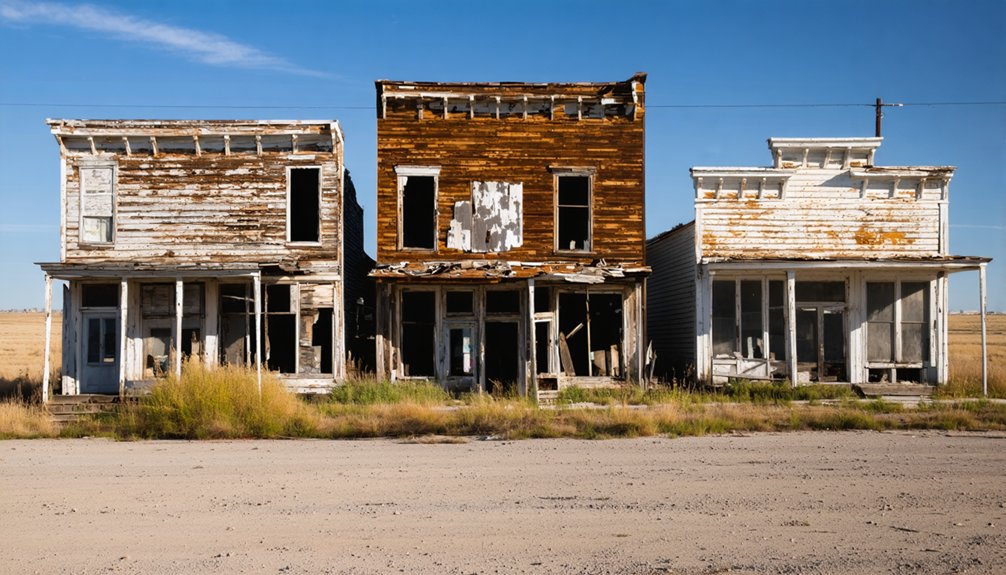
Founded in 1889 just one mile north of the South Dakota-Nebraska border, Scenic emerged as an agricultural settlement that would witness both remarkable resilience and eventual abandonment.
The town survived the Great Depression without a single family on welfare, but agricultural industry changes triggered a population collapse from its peak to just 16 by 1980.
Today’s deserted structures tell stories of vanished independence:
- Original buildings stand as hollow monuments, their interior decor stripped by time and weather
- The old fire station hosts biennial reunions where former residents share memories of local cuisine and community gatherings
Population declined to one resident before 2004’s ghost town designation.
You’ll find crumbling homes and abandoned facilities frozen in time, representing economic freedom lost to modernization and water scarcity.
Mount Rushmore Brewing Company’s Crematorium Basement
Nestled in Hill City’s commercial district, a building with an unsettling past has cycled through three distinct incarnations since its origins as a funeral home and crematorium. The structure later housed Mount Rushmore Brewing Company, where employees reported pool balls clacking autonomously and objects relocating without explanation.
Today’s Black Hills Harley-Davidson dealership maintains the original cremation furnace in its basement—a centerpiece of ongoing cremation mysteries that refuse resolution.
Basement apparitions manifest through unexplained noises and independent object movements, concentrated near the furnace remnants. Former restaurant staff documented frequent paranormal activity during their tenure, particularly in lower levels.
Investigators believe restless spirits from the building’s funeral operations remain tethered to the crematorium equipment. The site’s accessibility allows ghost hunters to explore Hill City’s most documented haunted location within South Dakota’s Black Hills region.
For those seeking thrills beyond Hill City, there are numerous ghost towns to explore in South Dakota that hold tales of the past and glimpses of the unknown. Each of these abandoned places offers a unique adventure, inviting explorers to experience the eerie silence and history that lingers in the remnants of once-thriving communities. As night falls, the stories of the spirits said to roam these ghost towns come alive, creating an atmosphere that is both haunting and captivating.
Sioux San Hospital: Unmarked Graves and Child Apparitions

Rapid City’s Sioux San Hospital operated from 1898 until 1965, serving Native American tuberculosis patients across the northern Plains.
Historical documentation reveals unmarked Native American burial sites on the property, where patients who died during treatment were interred without proper markers or family notification.
Archaeological investigations and tribal research have uncovered:
- Records showing children from boarding schools and adult tuberculosis patients buried in unmarked plots
- Documentation of death rates during peak epidemic years when traditional burial practices weren’t followed
- Tribal efforts to identify and memorialize those in historical graves through ground-penetrating radar surveys
These Native American burial sites represent a painful chapter where families lost members far from home.
Many graves remain unidentified despite ongoing tribal advocacy for proper recognition and repatriation protocols.
Carbonate Camp: Lawrence County’s Haunted Mining Legacy
You’ll find Carbonate Camp’s origins in 1877, when prospectors established claims in the Portland area despite encountering refractory ore that limited early operations.
The camp’s mining boom peaked during the Black Hills gold rush era, with the Iron Hill mine producing substantial lead and silver until the 1880s silver price collapse forced operations to halt.
Today, the abandoned site contains remnants of the replacement deposits in Deadwood Formation dolomite, deteriorating structures from the former townsite and smelter, and reports of unexplained phenomena tied to its century-old mining legacy.
Carbonate’s Mining Boom Origins
Around 1880, James Ridpath settled in Lawrence County and established the West Virginia Mine, where he discovered carbonate ore—a valuable mix of silver and lead.
Following a newspaper article about the rich ore deposits in July 1881, the camp was officially founded. Initially called Virginia after Ridpath’s home state, it was later renamed Carbonate.
The mining technology and ore processing capabilities attracted fortune-seekers rapidly.
- By August 1881, 200 men arrived and constructed a wagon road to Spearfish.
- The West Virginia Mine’s carbonate ore fueled the camp’s initial prosperity.
- A smelter was built to process the silver-lead ore locally.
You’ll find the boom peaked in 1886, when Carbonate transformed from a tent settlement into a thriving camp with substantial buildings and infrastructure.
Paranormal Activity and Legends
When smelter fumes killed every cat in Carbonate during the late 1880s, rats overran the camp and spread a devastating diphtheria outbreak between 1888 and 1889.
You’ll find “Keep out: Black Diphtheria!” signs remained posted until 1910, though most residents fled after 1891.
The cemetery near coordinates 44.399984, -103.868537 holds at least eleven graves, including John Tripp who died winter 1888.
Eerie legends persist around these faded wooden markers, where mining accidents, infant mortality, and suicides claimed countless lives.
Spectral sightings reportedly occur among remaining structures where Raspberry Brown lived as the final resident until 1939.
Frank B. Bryant captured it perfectly: “Diphtheria, mine accidents, suicide, infant mortality… heartache… but what a rip roaring camp.”
The wind still whispers through abandoned foundations.
Exploring the Abandoned Remains
Today’s Carbonate Camp stands as one of Lawrence County’s most desolate mining ruins, with only a single deteriorating house and one Iron Hill Mine structure surviving from what was once Dakota Territory’s grandest hotel town.
Modern exploration reveals scattered foundations and crumbling walls where William Hugginson’s three-story Black Hills Hotel once dominated the landscape before its 1900 dismantling.
Adventurers venturing onto this private property encounter:
- Open mine shafts from operations that ceased in the 1930s
- Mining camp materials and remnants along Squaw Creek
- Foundation traces of the bank, church, and businesses that served 380 residents
Historical preservation efforts remain minimal here. The site’s abandonment following Raspberry Brown’s 1939 death created an untouched time capsule.
Though, hazardous conditions demand careful navigation through these authentic mining-era remains.
The Vanishing Towns of the Black Hills Region
During the Black Hills Gold Rush of 1874, prospectors and miners flooded into the region, establishing hundreds of communities that would flourish briefly before fading into abandonment. Mineral extraction drove this explosive growth, with hard rock mining creating most settlements across the territory.
Hundreds of Black Hills mining communities surged to life during the 1874 Gold Rush, only to vanish as quickly as they appeared.
Towns like Spokane reached peak production in 1927, generating over $144,000 before closing in 1940. When ore deposits depleted or became unprofitable, entire communities emptied within years.
You’ll find ghost town architecture ranging from complete ruins to mere foundations. Carbonate’s Cleopatra Mine crumbles near Squaw Creek, its machinery still trapped underground. Rochford’s Standby Mine mill broods over Irish Gulch.
Pactola housed 300 miners before the 1950 abandonment—now it rests beneath 150 feet of reservoir water. Over 600 ghost towns dot the Black Hills, marked by gaping shafts and eroded tailings.
Frequently Asked Questions
What Precautions Should Visitors Take When Exploring Abandoned Ghost Towns in South Dakota?
You’ll need sturdy footwear and emergency supplies while respecting historical preservation laws. Watch for safety hazards like rotting structures, unstable ground, and wildlife. Don’t enter buildings or remove artifacts—view sites from designated paths to avoid legal consequences.
Are Ghost Tours or Guided Paranormal Investigations Available at These Locations?
Where there’s smoke, there’s fire—you’ll find ghost tours at Deadwood’s Bullock Hotel and Lucky Nugget Casino, plus Lead’s Homestake Opera House. These guided investigations document historic architecture and local legends through paranormal encounters you’re free to experience firsthand.
Which South Dakota Ghost Towns Are Safe to Visit Year-Round?
You’ll find year-round access at Deadwood, Hill City, and Galena, where historical preservation maintains safe infrastructure. Local legends thrive in these documented settlements, established 1870s-1890s, offering freedom to explore authentic structures through maintained roads and volunteer-guided experiences.
Do I Need Permission to Access Private Property Ghost Town Sites?
Like the Old West’s respect for boundary lines, you’ll need owner permission before entering private ghost town sites. Private property laws protect landowner rights, and trespassing penalties apply. Always obtain consent first—it’s your responsibility to respect ownership.
What Equipment Is Recommended for Documenting Paranormal Activity in Ghost Towns?
You’ll need paranormal gear like EMF detectors, SLS cameras, and spirit boxes to capture evidence. Don’t forget basic documentation tools—digital recorders, infrared thermometers, and cameras. Respect historical artifacts while investigating; they’re irreplaceable primary sources of these sites’ past.
References
- https://en.wikipedia.org/wiki/List_of_ghost_towns_in_South_Dakota
- https://www.atlasobscura.com/things-to-do/south-dakota/ghost-towns
- https://www.hauntedrooms.com/south-dakota/haunted-places
- https://b1027.com/south-dakota-has-an-abundance-of-ghost-towns/
- https://kxrb.com/the-creepiest-ghost-towns-in-all-of-south-dakota/
- https://www.blackhillshikingbikingandmore.com/old-mining-ghost-towns
- https://www.tripadvisor.com/Attractions-g28962-Activities-c47-t14-South_Dakota.html
- https://www.travelsouthdakota.com/trip-ideas/haunted-indoors-eastern-south-dakota
- https://www.sdpb.org/rural-life-and-history/2023-08-21/some-black-hills-ghost-towns-and-their-origins
- https://www.sdhspress.com/journal/south-dakota-history-2-2/some-black-hills-ghost-towns-and-their-origins/vol-02-no-2-some-black-hills-ghost-towns-and-their-origins.pdf