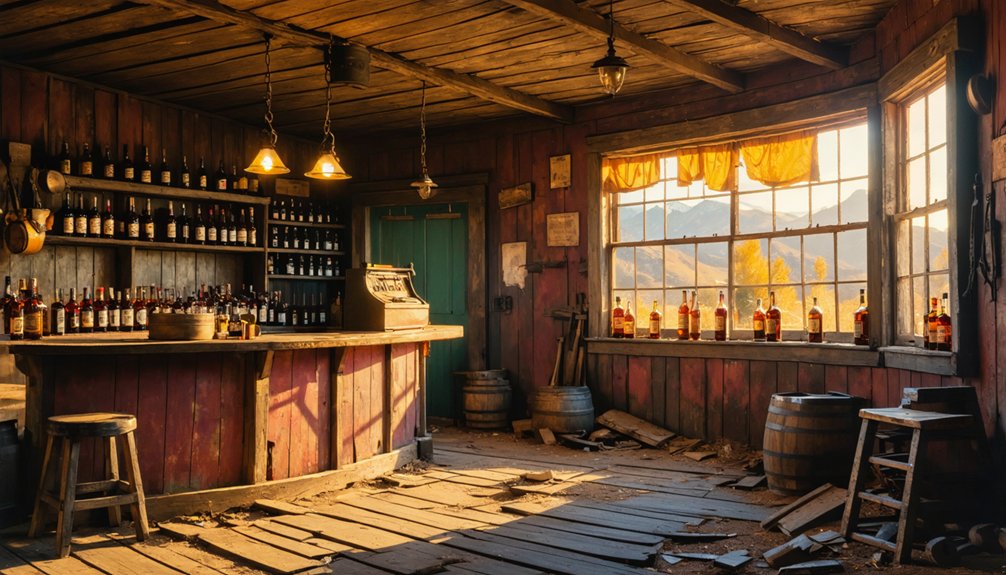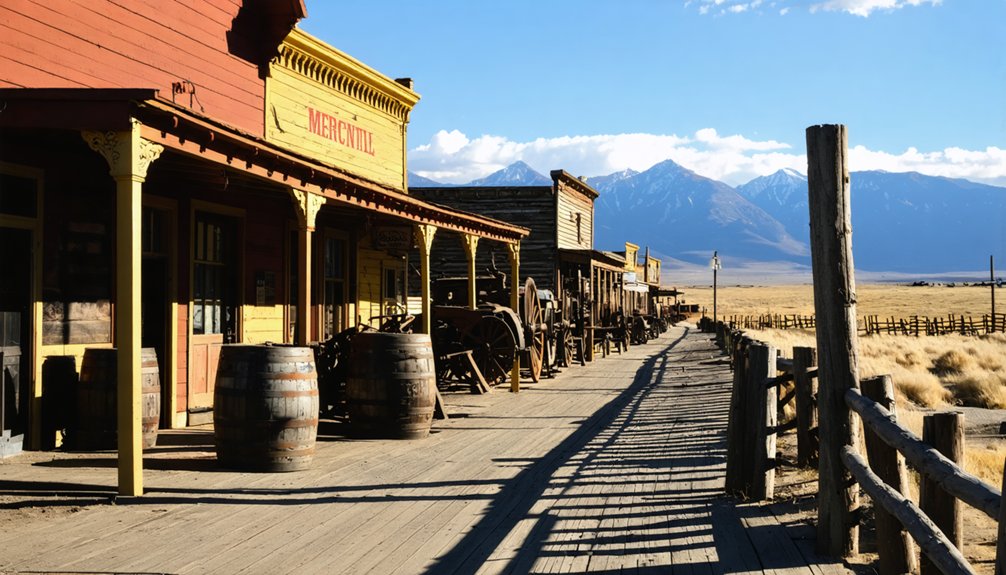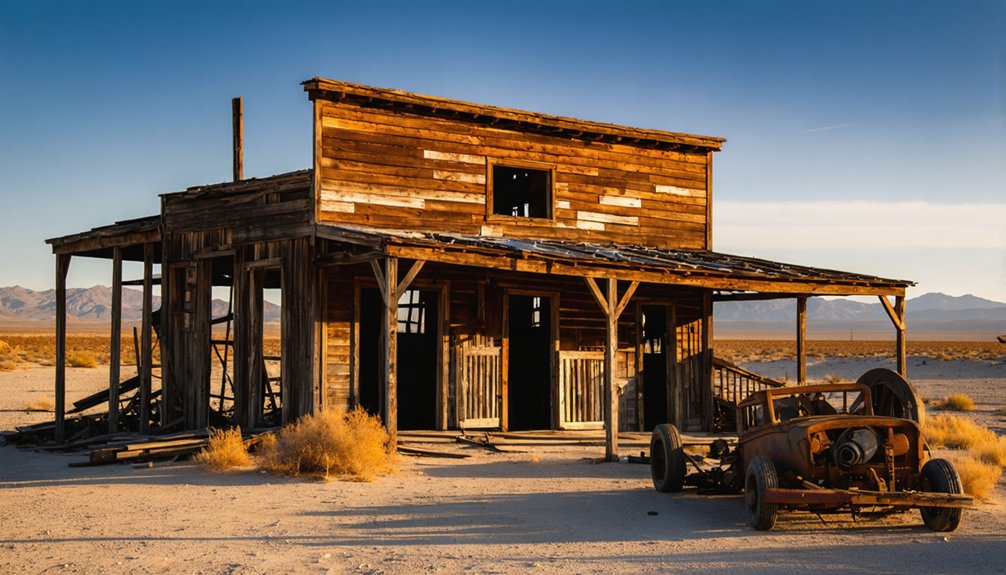
You’ll find Southern California’s most haunted ghost towns scattered across the Mojave Desert and surrounding valleys, where 19th-century mining and oil boom settlements now stand in atmospheric decay. Calico‘s restored 1880s structures, Bodie’s preserved buildings, and Amboy’s iconic neon sign offer documented paranormal encounters alongside authentic architectural remnants. These sites—including Mentryville’s oil baron mansion and Randsburg’s crumbling facades—require permits and adherence to California Penal Code § 602. Winter mornings and October evenings provide ideal atmospheric conditions while protecting fragile structures, and ranger-guided tours reveal the historical context behind reported supernatural phenomena.
Key Takeaways
- Calico Ghost Town, founded in 1881, features reported paranormal activity and is designated as California’s official Silver Rush Ghost Town.
- Bodie State Historic Park preserves an authentic mining town with frequent reports of ghostly apparitions and unexplained noises in abandoned structures.
- Vallecito Stage Station hosts reported sightings of crying children, footsteps, and apparitions reflecting human tragedies from its historic past.
- Best visitation times for experiencing haunted atmospheres include winter mornings, late September evenings, and October with minimal lighting conditions.
- Ghost town cemeteries and abandoned structures create eerie environments where visitors commonly report paranormal encounters and unexplained phenomena.
Calico Ghost Town: Silver Rush Spirits in the Mojave
When prospectors John Peterson, John McBride, Larry Silva, and Charlie Mecham filed their silver claim in March 1881, they couldn’t have predicted their discovery would transform a desolate stretch of Mojave Desert into California’s largest silver-producing operation.
Four prospectors staking a single claim in 1881 unknowingly launched California’s most productive silver mining operation in the harsh Mojave Desert.
The Silver King Mine and over 500 surrounding operations extracted $86 million in silver across three decades, sustaining 1,200 residents at peak population.
Silver mining ended following the 1890s financial panic, and borax operations ceased in 1907. Complete abandonment arrived by 1935.
Walter Knott’s 1951 purchase initiated meticulous ghost town preservation—one-third of structures remain original, restored using 1880s photographs. The town’s name came from Calico Peak’s colorful striations, which miner John Peterson described as “calico-colored” in 1881, reminiscent of a pioneer woman’s skirt pattern.
His 1966 donation to San Bernardino County secured public access. Today, you’ll find California’s Official State Silver Rush Ghost Town operating as a living monument to Western independence. Governor Schwarzenegger officially designated it California’s Silver Rush Ghost Town in 2005.
Amboy: Desert Silence and Eerie Isolation
You’ll find Amboy’s population has dwindled to zero permanent residents by 2024, transforming this 1883 railroad settlement into a stark monument of abandonment.
When Interstate 40 bypassed the town in 1972, businesses shuttered overnight and the iconic 50-foot Roy’s neon sign went dark, leaving ten surviving structures scattered across the Mojave silence.
The nighttime desert here amplifies isolation—no streetlights illuminate the decaying motel cottages, and the restored Roy’s Cafe stands as the sole operational building against miles of empty highway.
Amboy once thrived as a vital watering town with water tanks supplying steam engines along the Southern Pacific Railroad route.
An extinct cinder cone volcano looms near the abandoned town, adding to the otherworldly landscape that defines this desolate stretch of desert.
Population of Four Remains
The official 2016 census documented Amboy’s population at precisely four residents—a stark contrast to the 700 who once sustained this Route 66 community at its peak. By 2024, that number dropped to zero, cementing Amboy’s status as a genuine ghost town.
You’ll find urban decay throughout the abandoned school (shuttered in 1999), church, and silent residential structures that mark Interstate 40’s devastating 1972 impact. The town’s explorable remnants include an old airport and graveyard, adding to the eerie atmosphere of abandonment.
Albert Okura’s 2005 purchase for $425,000 launched targeted preservation efforts—he’s restored the gas station, lobby, and iconic motel cabins while maintaining Roy’s neon sign from 1959. A classic Packard Clipper sits parked behind the bungalow units, frozen in time as a relic of the town’s prosperous past.
The preservation challenges remain formidable: operating a post office with no residents, keeping gas flowing to desert travelers, and preparing for Route 66’s 2026 centennial celebration amid complete depopulation.
Nighttime Atmosphere Turns Eerie
After sundown, Amboy’s atmosphere shifts from merely abandoned to genuinely unsettling. You’ll witness the restored 50-foot neon sign from 1959 glowing against complete desert darkness, creating an isolated beacon amid vast Mojave emptiness.
The Googie-style architecture stands illuminated while surrounding structures—the closed motel lobby, shuttered cafe, and deteriorating church—fade into darkened silhouettes.
Urban decay becomes palpable as you encounter minimal operational infrastructure: three mechanical pumps, no municipal services, and zero ambient light from nearby development.
Desert silence dominates, broken only by occasional aircraft on the dirt airstrip. The atmospheric eeriness intensifies through stark contrasts—white mid-century buildings against purple mountain ranges, pale survey markers from 1934 scattered through shadows. The nearby volcanic crater looms in darkness, its ancient lava flows barely visible against the night sky.
Without human presence, you’re left with architecture slowly surrendering to time. Chinese guardian lions stand sentinel along the eastern road, their origins mysterious, watching over the desolate landscape in complete darkness.
Highway Bypassed the Town
When Interstate 40 opened ten miles north in 1972, Amboy’s economic lifeline severed overnight. Route 66 traffic—once exceeding 200 daily stops—vanished, triggering immediate urban decay as businesses shuttered and residents fled.
By the 1980s, population plummeted from over 200 to near zero.
The bypass transformed this 1920s boomtown into desert silence:
- Roy’s iconic 50-foot neon sign went dark by the mid-1980s
- Thirteen thriving businesses collapsed within months
- The $3 million townsite listing attracted only exploitative lessees
- Foreclosure in 2005 marked complete economic failure
Today’s isolation attracts those seeking freedom from crowds, though crumbling structures now serve as wildlife habitats. The town sits 48 miles from Twentynine Palms through unforgiving desertscape, alongside Bristol Dry Lake’s vast salt flats. Originally established in 1883 as part of an alphabetical railroad station network across the Mojave Desert, Amboy had evolved from mining camp to Route 66 destination before its abandonment.
Albert Okura’s 2005 purchase for $425,000 sparked preservation efforts, reopening Roy’s Cafe after 2008 renovations—yet the town remains fundamentally uninhabited, a monument to infrastructure’s power over community survival.
Mentryville: Oil Boom Echoes in Pico Canyon
You’ll find California’s petroleum industry birthplace nestled in Pico Canyon, where Charles Mentry’s 1876 oil strike at well No. 4 launched a 114-year operation and created the state’s first successful oil boomtown.
The site preserves thirteen original structures from the 1880s settlement, including Mentry’s mansion, the region’s first schoolhouse, and operational remnants that housed over 100 residents during peak production.
Access requires ranger accompaniment for protected buildings, though hiking trails now wind through this 850-acre conservancy where wooden derricks once dominated the canyon landscape.
Charles Mentry’s Oil Discovery
Deep in Pico Canyon, Charles Mentry brought Pennsylvania drilling expertise to California’s untested oil fields in 1875. The French-born wildcatter transformed the region through relentless innovation, pioneering California’s first steam-powered drilling operations.
Oil industry innovations emerged rapidly:
- Pico No. 4 struck oil at 370 feet in September 1876, flowing 30 barrels daily.
- Deepening to 617 feet in 1877 created a gusher reaching the 65-foot derrick’s crown.
- California’s first pipeline stretched seven miles to Newhall’s refinery by 1879.
- Production sustained 114 years until capping in 1990.
Mentryville’s historical significance reshaped California’s economy, spawning Pacific Coast Oil Company and attracting Standard Oil’s acquisition.
You’ll find California Historical Landmark No. 516-2 marking where Mentry’s vision freed an industry from geographical constraints.
Historic Canyon Structures Remain
Mentry’s drilling success spawned a thriving settlement whose physical remnants tell the story of California’s petroleum origins. You’ll find the 13-room Mentry Mansion, restored with redwood in 1966 by Carol Lagasse, standing alongside the original red barn and chicken coop.
The Felton School and Pico Cottage gained recognition as filming locations for productions like Highway to Heaven.
This industrial archaeology site once housed over 100 residents in boarding houses and supported a bakery during peak operations.
Preservation challenges mounted after the 1994 Northridge Earthquake rendered structures unsafe, followed by a 2003 wildfire and 2004 flood.
The Mountains Recreation and Conservation Authority received the property in 1995, while Friends of Mentryville nonprofit initiated restoration efforts, offering docent-led tours to protect this petroleum heritage.
Accessing the Ghost Town
Located four miles west of the Lyons Avenue exit from I-5, Mentryville sits at the terminus of Pico Canyon Road in Santa Clarita’s Santa Susana Mountains. You’ll find this preserved oil boom settlement accessible through Mentryville Park, managed by the Mountains Recreation and Conservation Authority since Chevron’s 1995 donation.
Current Access Protocols:
- Hiking trails remain open for independent exploration.
- Certain structures require ranger accompaniment due to earthquake and fire damage.
- Friends of Mentryville offers docent-led tours through restored buildings.
- The 13-room Mentry mansion and red barn need supervised entry.
While urban legends and reports of ghostly apparitions draw paranormal enthusiasts, you’re actually experiencing authentic 1876 architecture. The structures survived California’s 1994 Northridge earthquake, 2003 wildfires, and 2004 flooding—testament to their original construction quality.
Randsburg: Living Among the Restless Past
When prospectors John Singleton, F. M. Mooers, and Charlie Burcham struck gold on Rand Mountain’s slope in 1895, they couldn’t foresee their discovery would create California’s most authentic living ghost town.
The history of Havilah, California ghost town is marked by the rise and fall of mining endeavors, as well as the dreams that inspired countless individuals to seek their fortunes. Today, remnants of the town serve as a testament to the adventurous spirit of the late 19th century, with many visitors drawn to its storied past. Amidst the fading structures, one can almost hear the echoes of miners bustling about, hoping to strike it rich in the rugged wilderness.
Three fortune-seekers changed California history in 1895, unknowingly founding a town that would outlive its own demise.
You’ll find Randsburg’s 69 residents dwelling among structures that witnessed devastating fires in 1898, when flames twice consumed the burgeoning camp of 1,500 souls. Haunted stories emerge from the preserved jail that once held rowdy miners, and the Wine House Saloon where fortunes changed hands.
Preservation challenges mount as visible ruins—collapsed houses, exposed tailing piles, and structures still displaying 1906 calendars—face time’s relentless assault.
The town’s resistance to modernization maintains its old West aesthetic, offering you an unfiltered glimpse into California’s mining heritage without commercial intrusion.
Ballarat: Forgotten Panamint Valley Settlement
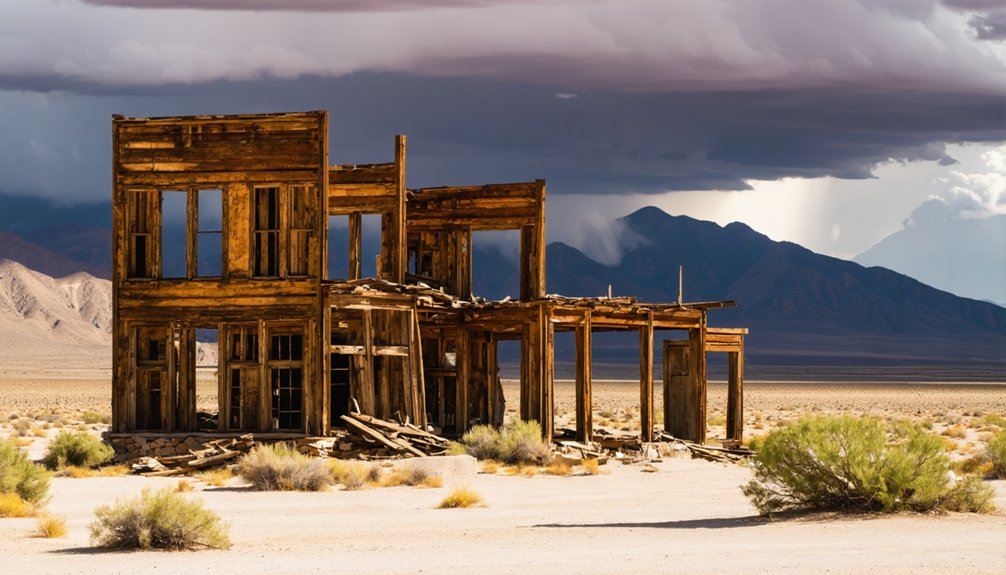
Deep within Panamint Valley at 1,079 feet elevation, Ballarat emerged in 1897 as an essential supply settlement for the mines carved into surrounding Panamint Mountain Range canyons.
Australian immigrant George Riggins named it after Victoria’s goldfields, establishing a frontier hub that peaked at 500 residents by 1905.
The town’s infrastructure served unrestricted prospecting lifestyles:
- Seven saloons and three hotels for relaxation
- Wells Fargo station facilitating ore transport
- Post office, school, and jail—no churches
- Ratcliff Mine producing 15,000 tons of gold ore
Lost artifacts and abandoned machinery now mark this landscape where legendary “Shorty” Harris prospected until 1934.
The 1917 post office closure sealed Ballarat’s fate, though die-hard desert rats remained.
Today’s two full-time residents maintain what freedom-seekers built generations ago.
Allensworth: California’s Historic Black Pioneer Town
In 1908, Colonel Allen Allensworth and four Black investors—William Payne, Dr. William H. Peck, J.W. Palmer, and Harry Mitchell—established California’s first exclusively African American town in Tulare County’s Central Valley. This cultural heritage site embodied Booker T. Washington’s self-sufficiency principles, creating psychological emancipation beyond the 1863 legal freedom.
You’ll find remnants of community resilience in the schoolhouse, businesses, and agricultural structures that housed nearly 300 residents by the 1920s. The colony’s decline began after Allensworth’s 1914 death, accelerated by Pacific Water Company’s discriminatory well allocation and Santa Fe Railroad’s route diversion.
Designated Colonel Allensworth State Historic Park in 1974, the site preserves buildings representing America’s first Black-governed California municipality, though flooding and underfunded cemetery restoration threaten its architectural legacy.
Supernatural Encounters and Local Legends
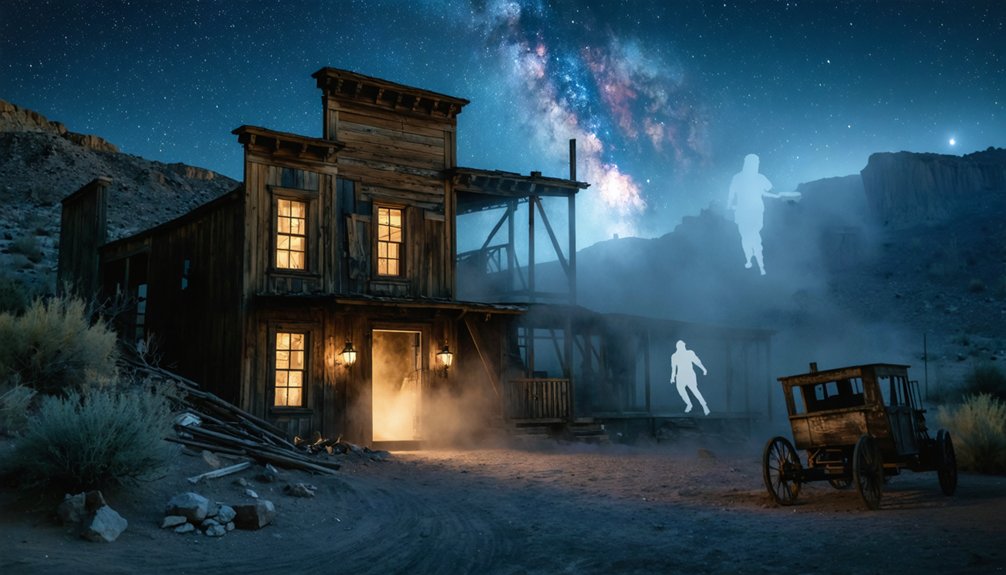
Beyond the documented historical narratives of California’s abandoned settlements lies a parallel archive of supernatural testimonies that have shaped these sites’ cultural identities. You’ll find these spectral sightings consistently reported across multiple locations:
California’s ghost towns preserve more than physical ruins—they archive decades of supernatural testimony woven into their cultural identity.
- Bodie’s Mendocino House emanates cooking smells while a woman watches from Dechambeau’s window.
- Cemetery encounters include children’s laughter near ancient burial sites where mining accidents claimed young lives.
- Calico’s isolation amplifies paranormal experiences tied directly to its mining-era deaths.
- Vallecito Stage Station preserves the bedroom where a child succumbed to 1850s travel hardships.
These accounts transcend mere folklore—they’re architectural memory embedded in preserved structures.
Whether you’re examining footsteps echoing through Bodie’s deserted buildings or investigating Cerro Gordo’s elevated hauntings, each supernatural claim reflects the human tragedy inseparable from Western expansion’s physical remains.
Exploring Safely: What to Expect When Visiting
While supernatural legends draw many visitors to Southern California’s ghost towns, your physical safety depends on thorough preparation before departing paved highways. High-clearance vehicles navigate unpaved approaches to sites like Bodie and Cerro Gordo effectively. Pack essential safety gear: sturdy footwear, water, recovery equipment, and layers for temperature extremes.
Watch for unstable structures, open mine shafts, and desert wildlife throughout your exploration.
Legal access requires understanding property boundaries—public sites like Bodie State Historic Park permit exploration within posted guidelines, while privately owned towns demand owner permission.
California Penal Code § 602 penalizes unauthorized entry with fines reaching $1,000. Respect preservation principles: removing artifacts, even historic nails, violates state law.
Leave no trace, avoid using structures as anchor points, and travel during daylight hours. Your responsible conduct ensures these architectural remnants endure.
Best Times to Experience These Abandoned Places
Timing your visit strategically transforms a simple excursion into the ideal ghost town experience that balances atmospheric conditions, crowd levels, and structural preservation.
Optimal scheduling for historical preservation and visitor experiences:
1. Winter mornings at Calico (9AM-12:30PM)
February’s 70°F temperatures protect fragile structures while crowds remain minimal, allowing unrushed architectural documentation before afternoon heat stress.
2. Late September evenings at Bodie (extended to 10PM)
Post-twilight darkness enhances ghost stories without moon interference, preserving the authentic 1880s atmosphere through reduced daytime visitor impact.
3. October at Silver City
Cooler autumn conditions minimize environmental stress on 1850s mining remnants while Halloween themes amplify the eerie aesthetic you’re seeking.
4. Saturday ghost tours
Calico’s Maggie Mine programs provide structured access without compromising daily preservation protocols.
Avoid summer’s extreme heat—it degrades both historic materials and your exploration freedom.
Frequently Asked Questions
Are Overnight Camping or Paranormal Investigations Allowed at These Ghost Towns?
You can camp overnight at Calico with permits, but you’ll need to respect campfire safety regulations and the historical significance of structures. Paranormal investigations aren’t explicitly mentioned, though you must avoid disturbing preserved buildings and mines.
What Photography Equipment Works Best in Low-Light Desert Ghost Town Conditions?
Like capturing whispers before they fade, you’ll need fast prime lenses (f/1.4-2.8), full-frame cameras with excellent high-ISO performance, sturdy tripods for long exposures, and portable LED lighting gear. Master manual camera settings to preserve these architectural remnants authentically.
Do Any Ghost Towns Charge Admission Fees or Require Advance Reservations?
Yes, you’ll pay admission fees at most preserved ghost towns. Calico charges $8 for adults, Bodie costs $8-$10, and Silver City requests $7. Historical preservation efforts depend on these fees funding visitor amenities and ongoing restoration work.
Which Ghost Towns Have Cell Phone Service for Emergency Communications?
You’ll find cell service coverage remains spotty at most Southern California ghost towns. Cerro Gordo installed specialized WiFi infrastructure for emergency communication options, while other authentic sites maintain limited connectivity, preserving their isolated character and off-grid independence.
Are There Guided Ghost Tours Available at These Southern California Locations?
You’ll find guided ghost tours at Calico’s Maggie Mine featuring Saturday spectacles, while Bodie’s barren beauty requires self-exploration. Historical preservation prioritizes authentic experiences over commercial tours. Local legends live through Calico’s costumed docents, honoring architectural integrity and your independent discovery.
References
- https://en.wikipedia.org/wiki/List_of_ghost_towns_in_California
- https://whimsysoul.com/must-see-california-ghost-towns-explore-forgotten-histories/
- https://secretlosangeles.com/ghost-towns-los-angeles/
- https://www.visitcalifornia.com/road-trips/ghost-towns/
- https://www.tripadvisor.com/Attractions-g28926-Activities-c47-t14-California.html
- https://www.youtube.com/watch?v=cr3jaq8nR3o
- https://dornsife.usc.edu/magazine/echoes-in-the-dust/
- https://alyeskeea.com/calico-ghost-town/
- https://www.historynet.com/ghost-town-calico-california/
- https://californiathroughmylens.com/calico-ghost-town/