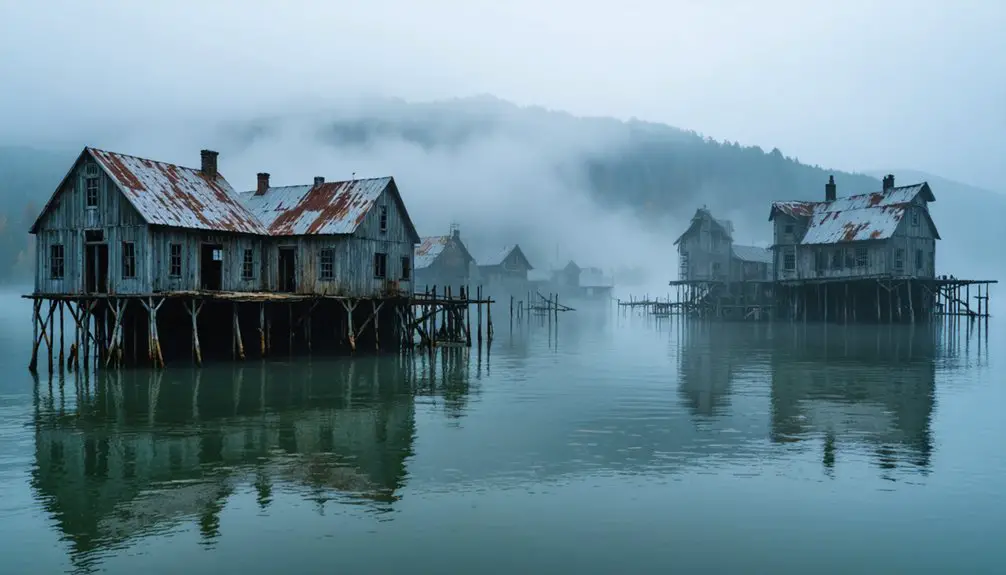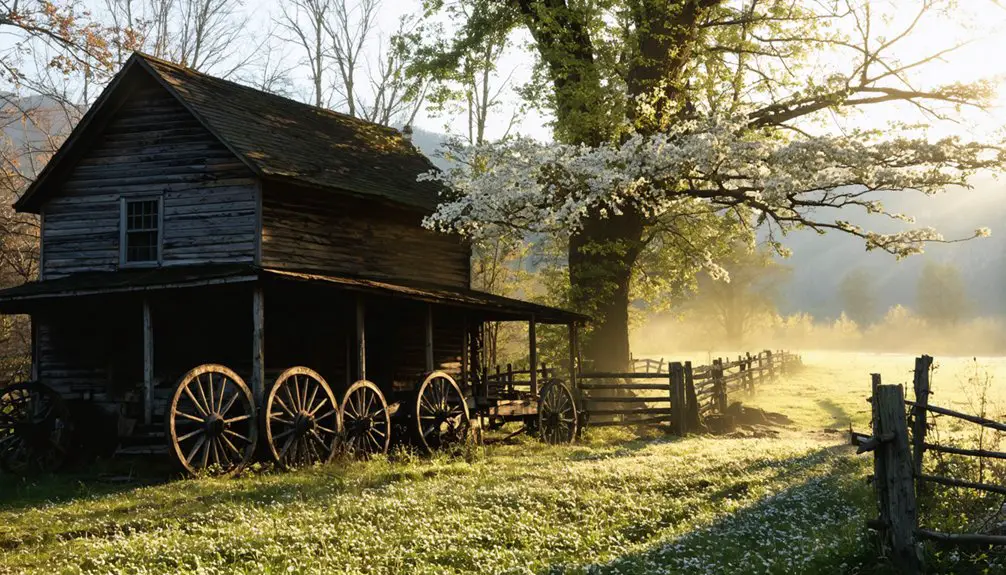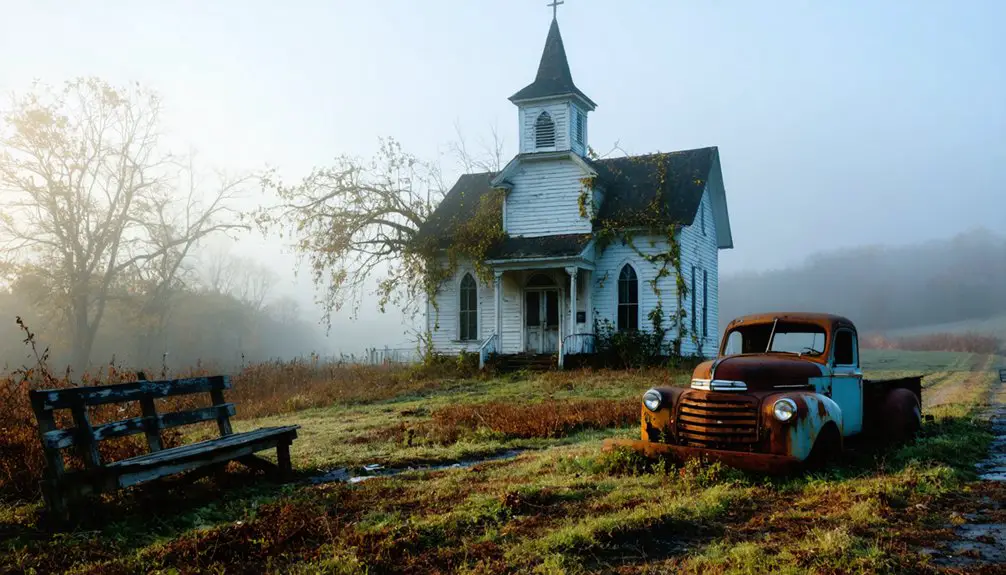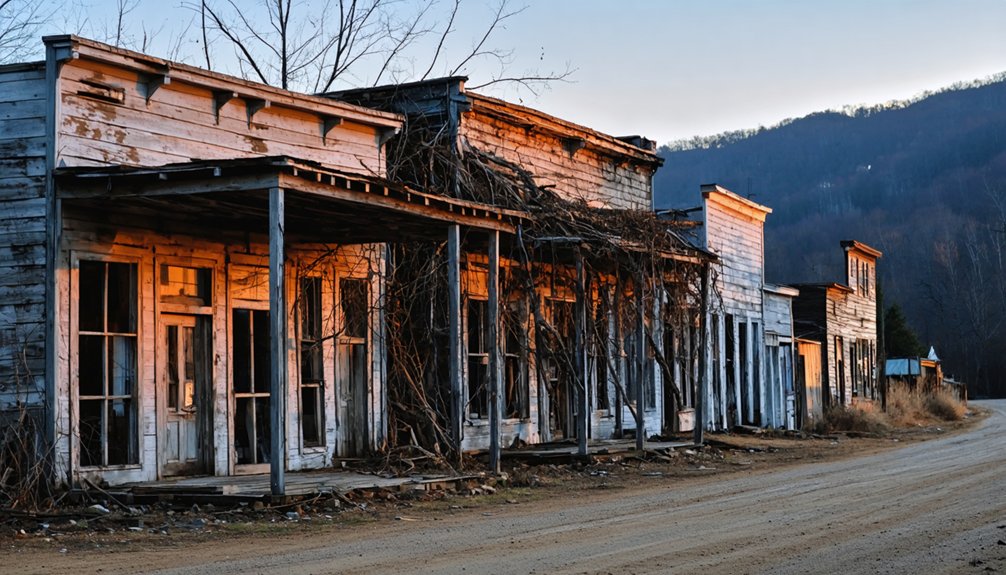
Tennessee’s most haunted ghost towns include Elkmont in the Smoky Mountains, where 70 abandoned buildings from a former lumber town and resort community decay among hiking trails, and Old Jefferson, burned by authorities in the 1960s for a flood that never came. You’ll also find Hales Bar Dam, which drowned a cemetery of Spanish Flu victims beneath its cursed waters, and Rugby, where typhoid victims from the 1880s still reportedly haunt Victorian structures. The histories behind these supernatural legends reveal stories of displacement, disaster, and government projects gone wrong.
Key Takeaways
- Elkmont features abandoned cabins, stone foundations, and the iconic Troll Bridge, with remnants from its lumber town and luxury retreat history.
- Hales Bar Dam is linked to Chief Dragging Canoe’s 1775 curse, with drowned graves and a flooded cemetery beneath the reservoir.
- Cades Cove preserves 19th-century homesteads where families were forcibly removed after 1927, leaving historic structures and settlement ruins.
- Old Jefferson’s burned ruins remain largely exposed after 1960s demolition, symbolizing destruction from miscalculated federal dam project flooding.
- Port Royal declined after the 1859 railroad bypass, leaving traces of its early frontier political significance and tobacco trade era.
Elkmont: Where Millionaires Once Vacationed Among the Smokies
Deep in the Great Smoky Mountains, Elkmont stands as a haunting reminder of Tennessee’s Gilded Age excess. You’ll find this abandoned settlement where Colonel Wilson B. Townsend’s Little River Lumber Company once thrived, processing timber from 86,000 acres starting in 1901.
Elkmont: where Tennessee’s lumber empire transformed into an elite mountain retreat, now frozen in time as a crumbling monument to forgotten prosperity.
By 1918, over 1,500 workers populated this bustling company town.
The logging history gave way to luxury when Knoxville’s elite discovered the area’s beauty. The Wonderland Hotel opened in 1912, attracting wealthy industrialists and politicians who built summer cottages along the hillsides.
Historical architecture remains visible throughout the deteriorating structures. The cabins rest on stacked stone foundations, reflecting the personal histories of families who once summered here.
When the National Park Service purchased the land in 1934, they offered lifetime leases. After these expired between 1992 and 2001, seventy buildings stood empty—creating Tennessee’s most exclusive ghost town. Today, visitors can explore hiking trails that wind past stone walls, chimneys, and the iconic Elkmont Troll Bridge.
Hales Bar Dam: A Drowned City Beneath the Tennessee River
Beneath the Tennessee River’s murky waters lies one of the South’s most ambitious engineering failures—a cursed dam built on crumbling limestone and Cherokee sacred ground.
Construction began in 1905, plagued immediately by foundation leaks and worker deaths. The site’s haunted legends trace to Chief Dragging Canoe’s 1775 curse following the Treaty of Sycamore Shoals.
You’ll find reservoir mysteries tied to the flooded cemetery containing hundreds of graves—mostly children from the 1918-1919 Spanish Flu epidemic, left undisturbed beneath the water.
Despite persistent engineering problems, the dam operated until 1968 when TVA replaced it with Nickajack Dam. The structure featured a lock with a 41-foot lift—the highest in the world at that time—demonstrating both engineering ambition and hubris. Workers desperately attempted repairs using “rag gang” crews who stuffed leaks with asphalt, hay bales, mattresses, blankets, and even corsets as the limestone foundation continued to collapse. Today, only the powerhouse remains above water as a marina boathouse, while drowned graves and the submerged town rest below—a testament to ambition’s limits against nature and history.
Cades Cove: The Largest Abandoned Settlement in Plain Sight
Unlike most ghost towns hidden by forest or buried underwater, Cades Cove sprawls across 6,800 acres of preserved valley floor in the Great Smoky Mountains—a complete 19th-century settlement frozen in time by the federal government.
When John Oliver arrived in 1818, Cherokee families had already established seasonal camps, honoring Native traditions at their “Otter Place.” The 1819 Treaty of Calhoun erased indigenous claims, triggering land conflicts that would define the valley’s future.
The government’s systematic erasure unfolded through:
- Population boom from zero to 271 residents by 1830
- Confederate bushwhackers terrorizing Union sympathizers during the 1860s
- Federal seizure beginning in 1927 via eminent domain
- Forced removal of families who’d farmed there for generations
Oliver himself had fought at the Battle of Horseshoe Bend in 1814 before establishing his homestead in the valley. Today’s tourists drive loops where families once fought courts to keep their homesteads. The community’s final chapter closed when the post office shuttered in 1947, three years after the school had already ceased operations.
Old Jefferson: The Town That Destroyed Itself for a Flood That Never Came
In 1963, the U.S. Army Corps of Engineers seized Old Jefferson through eminent domain to make way for the J. Percy Priest Dam, forcing residents to relocate their homes or watch them burn and be bulldozed to the ground.
By the mid-1960s, the once-thriving 19th-century settlement near Smyrna had been systematically demolished in anticipation of flooding that engineers projected would submerge the entire town.
When Percy Priest Lake filled in 1968, the water never reached predicted levels—underground cave systems diverted the flow, leaving the razed townsite exposed above the waterline, a wasteland of burned remnants and concrete foundations where a community had unnecessarily destroyed itself.
Founded in 1802 as Rutherford County’s first county seat, Old Jefferson had served as a strategic frontier hub at the fork of the Stones River for over 160 years before its demolition.
Today, the site is federal property managed by the Army Corps of Engineers, where visitors can explore the overgrown landscape and reflect on the town’s tragic miscalculation.
Demolished for Percy Priest
The U.S. Army Corps of Engineers acquired Old Jefferson through eminent domain in the early 1960s, preparing for the J. Percy Priest Dam‘s completion in 1963.
You’ll find that engineers projected the reservoir would completely submerge the town, prompting systematic demolition beginning in the mid-1960s.
Residents faced difficult choices:
- Relocate your home at personal expense
- Accept government compensation and watch it burn
- Witness bulldozers raze multi-generational properties
- Abandon centuries-old farmland without adequate recompense
The environmental impact proved far different than predicted.
Underground caves absorbed water, leaving town sites mostly dry.
When filling began in 1968, you’d have witnessed a ghost town created by human destruction, not flooding.
Today’s overgrown forest stands as a testament to miscalculation—a community demolished for waters that never came.
The site now serves primarily as a horse trail, with roads overgrown and the federal property managed by the Army Corps of Engineers.
Scattered throughout the woods, you’ll discover broken bottles, bricks, and building remnants that mark where Jefferson’s structures once stood.
Burned Remnants and Ruins
Bulldozers and controlled burns erased Old Jefferson from the Tennessee landscape between 1965 and 1968, creating one of the state’s most unusual ghost towns. You’ll find scant physical evidence today—the Army Corps of Engineers methodically demolished or burned every structure.
Residents watched their homes torch the sky, while others dismantled buildings board by board for relocation. The Lenoir House survived through Lee Victory’s determined preservation efforts, moved piece by piece to Smyrna.
What remains defies simple explanation: a townsite destroyed for flooding that never occurred, its cave systems creating natural drainage the engineers never anticipated. The irony carries a quantum entanglement of governmental oversight and geological reality, where time dilation separates promise from outcome.
Old Jefferson’s burned remnants whisper warnings about unchecked authority and miscalculated progress.
Tharpe Community: Remnants of Tennessee’s Iron Empire
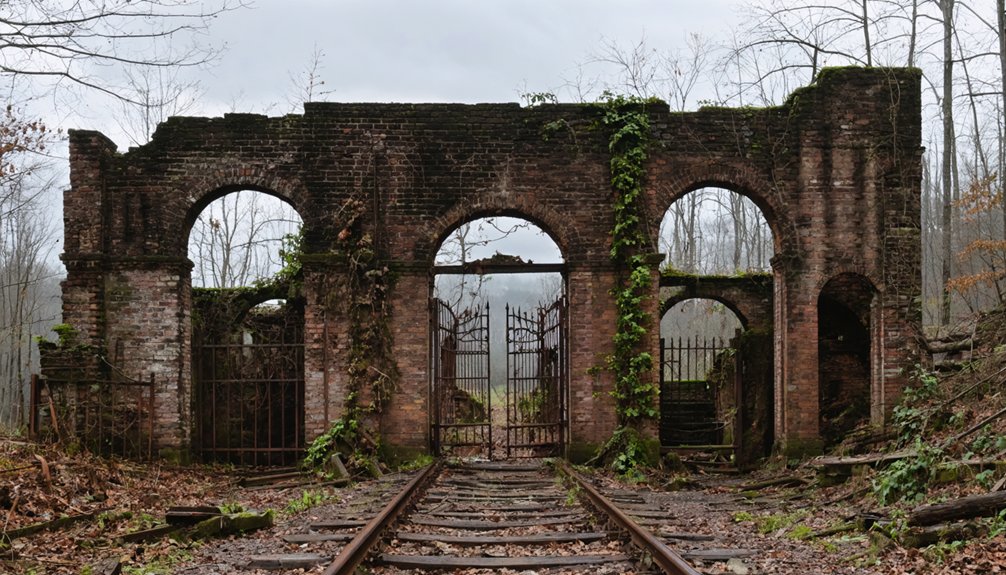
Deep within Stewart County’s wooded hills, the discovery of iron ore deposits in the early 1850s transformed a quiet settlement along Barrett Creek into a thriving industrial community. Iron Mountain Furnace anchored this prosperity until industrial decline forced its closure, though subsequent owners revived operations.
By 1886, the town honored businessman Ham Tharpe with its new name.
The community’s evolution reveals Tennessee’s resource-driven heritage:
- Cincinnati Copperage Company consolidated multiple furnaces after the Civil War
- Mills, factories, and commercial infrastructure supported several hundred residents by 1915
- The Great Depression and flood destruction accelerated population exodus
- TVA’s 1960s acquisition created Land Between the Lakes, erasing the settlement
Today, you’ll find scattered foundations and the original doctor’s clinic along Woodlands Trace, where pines reclaim this forgotten industrial outpost.
Port Royal: A Founding Settlement Lost to Time
You’ll find Port Royal’s significance rooted in Tennessee’s earliest days, when four of its delegates helped draft the state’s first constitution at the 1796 Constitutional Convention.
The town thrived as a tobacco hub and river crossing for decades until railroads bypassed it in the mid-1800s, setting Port Royal on an irreversible path to abandonment.
Today, you can explore this forgotten settlement as Port Royal State Park, where low-profile black signs mark building foundations and the preserved Trail of Tears section stands as proof of the town’s complex history.
Tennessee’s Constitutional Convention Delegates
Before Tennessee achieved statehood in 1796, Port Royal stood as one of the state’s earliest settlements along the Red River in Montgomery County. This strategic location attracted influential pioneers who shaped Tennessee’s political landscape through their architectural styles and governmental frameworks.
The settlement’s founding delegates left enduring marks through:
- Log cabin courthouses that demonstrated frontier self-governance and independence from distant authority
- Town square layouts reflecting democratic ideals where citizens gathered for open political discourse
- Defensive stockades protecting individual liberty against external threats
- Meeting halls where early constitutional debates established precedents for state sovereignty
Political influences from Port Royal extended beyond its geographic boundaries, as delegates carried frontier principles to Tennessee’s constitutional conventions. These pioneers championed limited government and personal autonomy—values embedded within Tennessee’s founding documents that continue resonating today.
Railroad Bypass Sealed Fate
For over six decades following its 1797 incorporation, Port Royal thrived as Montgomery County’s premier commercial hub, where the Great Western Road intersected with one of the Red River’s easiest fording points.
You’d find flatboats carrying dark-fired tobacco downstream while stagecoaches brought steady traveler traffic through town.
However, technological advancements proved devastating when railroads arrived in 1859—seven miles northeast at Red River Station.
Port Royal wasn’t selected as a railroad destination, and commerce immediately shifted toward communities with rail access.
Like modern interstate highways, railroads became the era’s most efficient transportation mode.
Urban decay followed swiftly as the town lost its strategic advantage.
Compounding this decline, floods destroyed Port Royal’s bridges in 1866 and 1903, eliminating reliable crossings.
The once-prosperous settlement couldn’t compete without rail infrastructure.
State Historic Park Today
Though Port Royal’s commercial prominence ended more than a century ago, the Tennessee State Parks system preserves its legacy at a 34-acre historic site along the Red River in Montgomery County.
You’ll discover the restored 1859 Masonic Lodge housing exhibits on historic commerce and river transportation that once sustained this vanished settlement.
When you explore Port Royal State Historic Park today, you’ll encounter:
- The 1890 Sulphur Fork Bridge, a rare Platt truss design
- Brick structures bearing thumbprints from enslaved laborers
- Interpretive displays on flatboat construction for tobacco transport to New Orleans
- A 300-yard portion of the Trail of Tears National Historic Trail
Ranger-led tours help you imagine the thriving town that existed here until 1984, connecting Tennessee’s founding generation to a complex past of commerce, agriculture, and forced removal.
The Ghostly Legends Behind Tennessee’s Abandoned Places
Tennessee’s abandoned places harbor some of the most chilling supernatural legends in American folklore, where historical tragedy and paranormal activity intertwine across centuries-old sites.
The Bell Witch haunting remains America’s only death officially attributed to a supernatural entity, with Kate Batts’ spirit tormenting John Bell until his mysterious 1820 poisoning.
At Rugby’s Victorian ghost town, typhoid victims from 1880 still wander Laurel Dale Cemetery, their haunted memories preserved in unchanged architecture.
Loretta Lynn’s Hurricane Mills mansion echoes with Civil War soldiers and a grieving mother’s apparitions.
Even submerged Willow Grove creates an underwater ghost town, deliberately flooded in 1942 yet never forgotten.
Meanwhile, Old Jefferson stands as a cautionary tale—demolished for a flood that never came, its supernatural legends born from preventable destruction.
Exploring the Preserved Ruins: What Visitors Can See Today
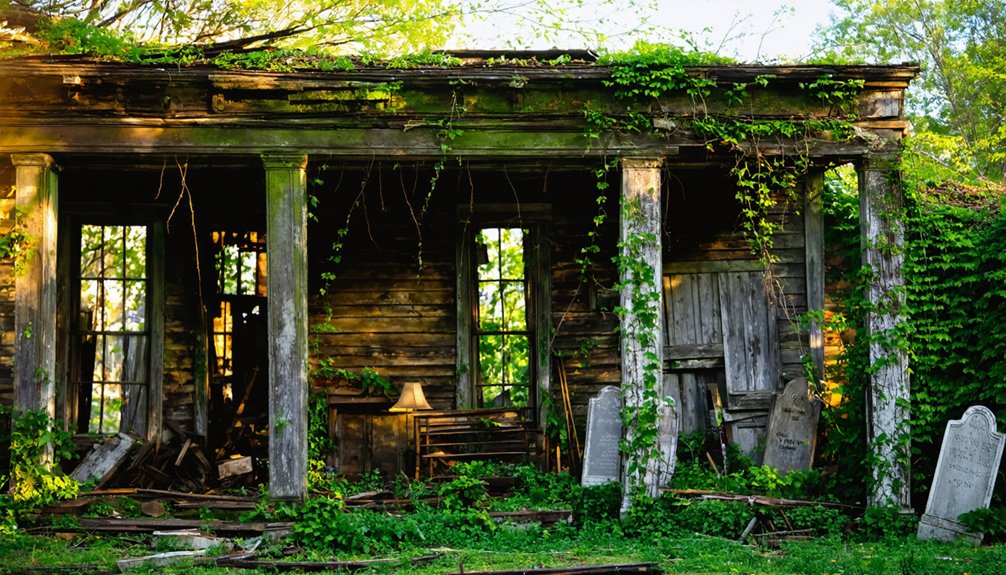
Beyond the supernatural tales and tragic histories, Tennessee’s ghost towns offer tangible remnants that visitors can explore today.
the haunted history of old franklin is particularly intriguing, as it boasts a rich tapestry of events from the Civil War era. Visitors can stroll through the streets where soldiers once marched and encounter eerie sites that echo the past. Each corner of this charming town whispers stories of love, loss, and lingering spirits that continue to captivate those who are brave enough to listen.
At Elkmont, you’ll discover 16 preserved buildings showcasing restoration techniques that saved structures from complete demolition. The National Park Service’s preservation work transformed what could’ve been lost forever into accessible history.
What awaits your exploration:
- Period-appropriate furnishings inside restored Daisy Town cottages revealing early 1900s resort life
- Levi Trentham cabin, relocated and restored as one of the region’s oldest surviving structures
- Stone walls and crumbled foundations scattered along Jakes Creek and Little River trails
- Walking tours through preserved vacation cottages offering authentic visitor experiences
You’ll find these sites approximately 7 miles from Sugarlands Visitor Center, with parking near Elkmont Nature Trail providing convenient access to this once-thriving logging community.
The Stories of Those Left Behind in Tennessee’s Ghost Towns
When the Tennessee Valley Authority and Army Corps of Engineers drew their maps for new reservoirs in the 1940s and 1950s, they marked entire communities for extinction. You’ll find maritime mysteries beneath Tennessee’s lake surfaces, where approximately 70 displaced residents left behind submerged businesses, schools, and churches that remain underwater today.
Willow Grove families gathered for one final community picnic in their school yard in 1942 before demolition crews arrived. Old Jefferson’s story reveals even darker hidden histories—engineers burned the entire town in the 1950s for a flood that never came due to miscalculations.
These weren’t voluntary departures. Residents either sold immediately or accepted discounted prices with temporary leases, watching their ancestral lands disappear beneath rising waters or government acquisition for the Great Smoky Mountains National Park.
Frequently Asked Questions
Are Overnight Stays or Camping Allowed Near Tennessee’s Ghost Town Sites?
You’ll need to check specific regulations for each ghost town location, as camping isn’t automatically permitted. Consider booking local accommodations nearby or joining guided tours that include authorized camping experiences at designated sites following Tennessee’s camping rules.
What Safety Precautions Should Visitors Take When Exploring Abandoned Structures?
You’ll need proper safety gear including respirators, gloves, and flashlights before entering. Never explore alone—bring a buddy and establish emergency plans. Test floors carefully, stay near walls, and always identify clear exit routes before proceeding inside.
Do Any Ghost Towns Charge Entrance Fees or Require Permits?
Most Tennessee ghost towns don’t charge fees since they’re on private or unregulated land. However, Elkmont Ghost Town requires a $5 daily parking tag. You’ll find no permits needed for exploring its abandoned structures and ghost town history.
Which Ghost Town Is Easiest to Reach for Families With Children?
Like discovering a hidden treasure map, you’ll find Elkmont Ghost Town near Gatlinburg offers the most accessible location for families. It’s among Tennessee’s most family-friendly spots, featuring flat paths, restored cabins, and just a short, scenic drive.
Can Visitors Take Artifacts or Souvenirs From These Abandoned Sites?
No, you can’t take anything from these sites. Federal artifact preservation laws and strict souvenir regulations protect all historic items, rocks, and structures. Violations bring fines from National Park Service rangers who actively enforce these rules.
References
- https://www.tnvacation.com/trip-inspiration/articles/ghost-towns-tennessee
- https://www.wanderingsmokymountains.com/smoky-mountain-ghost-towns-in-tennessee/
- https://www.tnmagazine.org/19-ghost-towns-in-tennessee-that-are-not-underwater/
- https://www.tn.gov/tourism/news/2024/9/19/spooky-season-at-tennessee-s-historic-haunted-places.html
- https://www.tennesseehauntedhouses.com/real-haunts/
- https://www.loveproperty.com/gallerylist/91679/tour-the-abandoned-tennessee-ghost-town-where-millionaires-vacationed
- https://smokymountainnationalpark.com/popular-places-smoky-mountains/elkmont/
- https://www.youtube.com/watch?v=XeA56UhNlJg
- https://www.visitmysmokies.com/blog/smoky-mountains/about-elkmont-ghost-town/
- https://en.wikipedia.org/wiki/Elkmont