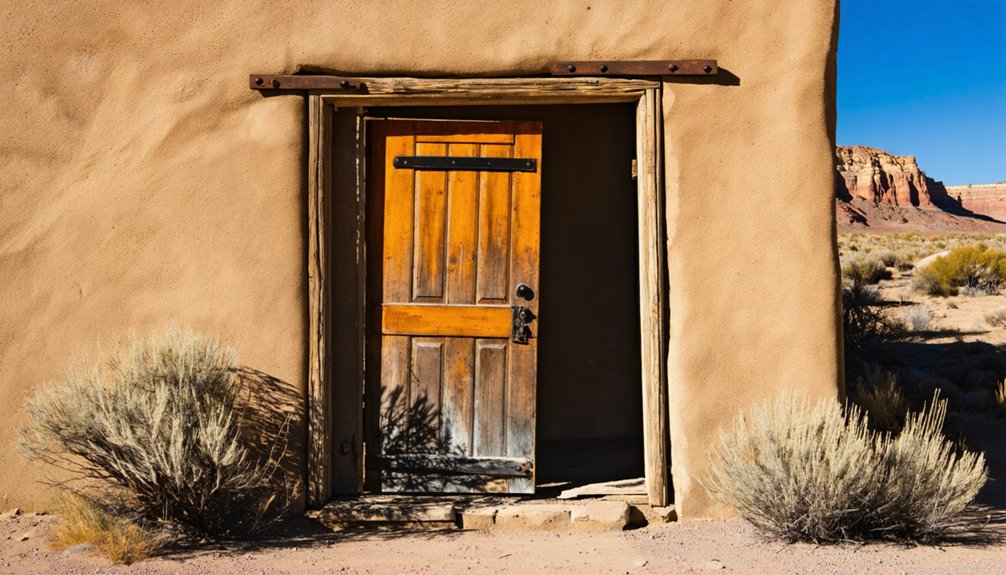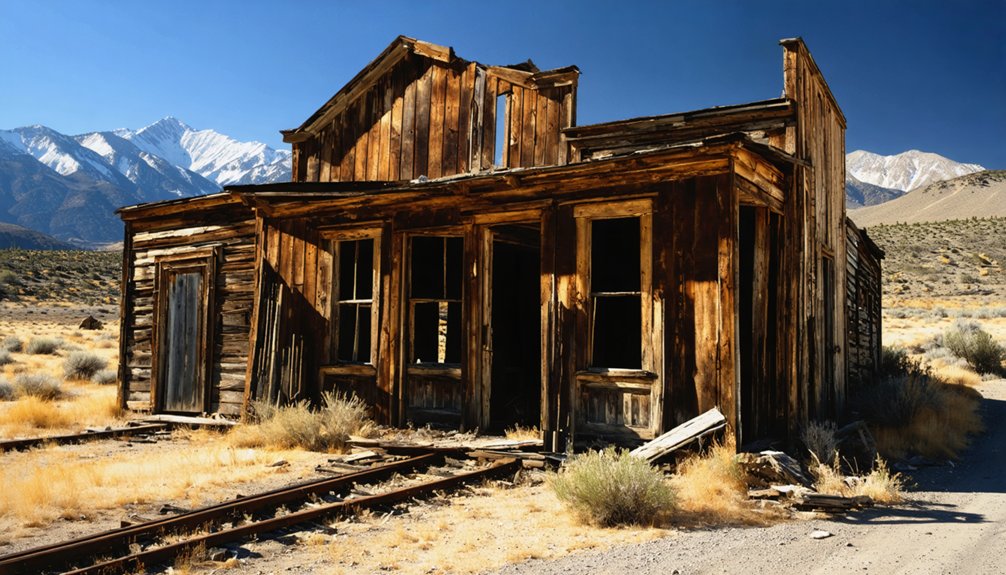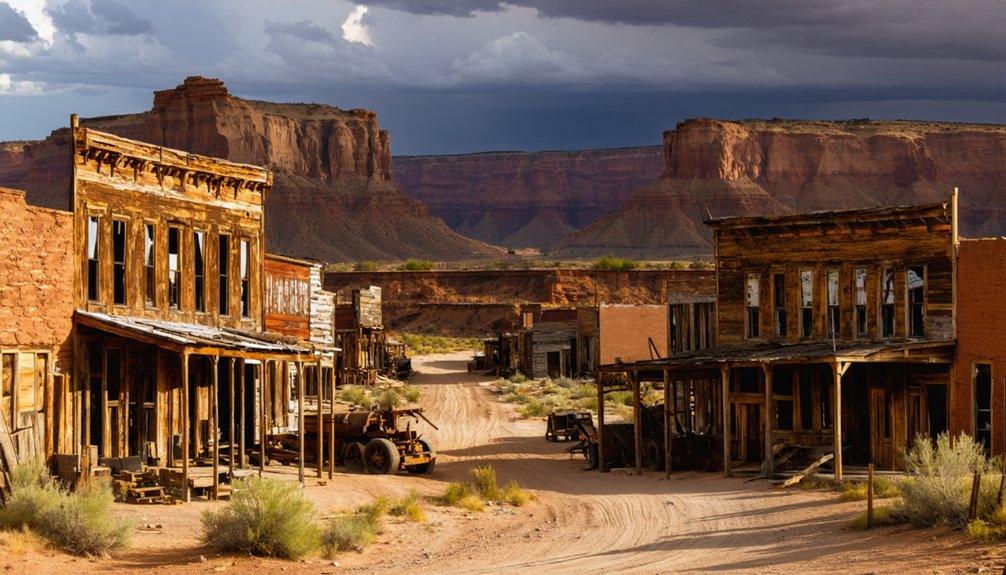
You’ll find documented paranormal activity at several Utah ghost towns, particularly Grafton, where spirit sightings have been reported since young Vilo Demille’s 1927 encounter among the cottonwoods. Silver Reef‘s Sister Mary Dominic remains restless near the ruins where 7.5 million ounces of silver were extracted from sandstone, while Frisco’s lawless past—23 saloons and frequent shootouts—left lingering presences. These abandoned settlements combine genuine historical tragedy with unexplained phenomena, from Grafton’s 1862 flood evacuation to mining disasters that claimed numerous lives, creating locations where Utah’s pioneer and industrial heritage intersects with the supernatural.
Key Takeaways
- Grafton, established 1859, features ghost sightings among cottonwoods and reports dating to 1927 near its preserved church and cemetery.
- Silver Reef’s haunting legends include Sister Mary Dominic’s restless spirit, drawing visitors to its museum and historic sandstone mining ruins.
- Frisco was Utah’s wildest mining camp with 6,000 residents, 23 saloons, frequent murders, and deadly marshal-enforced justice by 1885.
- Old Irontown, founded 1868, now stands as eerie ruins with remnants of Utah’s failed iron production and early industrial infrastructure.
- Sego coal camp, once producing 1,500 tons daily, declined after 1949 fires, leaving behind abandoned buildings and ghostly structures.
Grafton: Where Pioneers and Spirits Remain
In 1859, Mormon pioneers arrived in Utah’s Virgin River Valley with a mission from Brigham Young to establish a cotton-growing settlement they initially called Wheeler.
You’ll find this community grew to 168 residents before the Great Flood of 1862 forced relocation upriver, where it was renamed after Grafton, Massachusetts.
The Black Hawk War brought devastating attacks in 1866, including the killing of three Berry brothers, forcing temporary evacuation.
By 1944, the last residents departed, leaving behind abandoned architecture including an 1886 church, John Wood’s 1877 home, and a weathered cemetery.
The settlement briefly achieved fame when it hosted the first outdoor talking movie “Old Arizona” in 1929, which earned five Academy Award nominations.
Today, haunted legends persist—in 1927, young Vilo Demille reported seeing ghosts of two girls who died in an 1866 accident.
Visitors continue reporting strange apparitions among the cottonwoods.
The Grafton Heritage Partnership now leads stabilization efforts to protect the remaining structures and preserve the site’s historical integrity for future generations.
Old Irontown: Echoes of Utah’s Industrial Past
When Brigham Young launched his ambitious “Iron Mission” in the 1850s to achieve Mormon self-sufficiency, early efforts at Cedar City yielded disappointing results—only 25 short tons of pig iron over three years.
Undeterred, settlers founded Old Irontown in 1868 as a second attempt, establishing charcoal kilns and foundries at Iron Mountain‘s base. By 1870, 97 residents worked these haunted landscapes, producing 400 pounds of pig iron by 1874. The small community sustained itself with a schoolhouse and post office, along with a boarding house, general store, and butcher shop. The operation supplied ore for Utah Western Railroad, Pioche mining companies, and the St. George LDS temple.
Yet economic forces crushed their dreams. The 1873 railroad arrival brought cheaper eastern iron, while the Panic of 1873 triggered devastating depression.
Frisco: The Wildest Mining Camp in the West
You’ll find Frisco’s reputation as one of the wildest towns in the Great Basin wasn’t mere legend—by 1885, this mining camp of 6,000 people supported 23 saloons fueled by the Horn Silver Mine’s extraordinary output of $13 million.
The mine’s discovery on April 5, 1875, by prospectors James Ryan and Samuel Hawkes transformed isolated desert into what the United States Annual Mining Review and Stock Ledger called “unquestionably the richest silver mine in the world now being worked” by 1879. Located 17 miles west of Milford in Beaver County, the camp developed as a transportation hub when the Utah Southern Railroad extended its line to serve the booming district. The early claim sold for $25,000 would eventually produce over $50 million in silver, making it one of Utah’s most valuable mining operations.
But Frisco’s lawless prosperity ended abruptly on February 12, 1885, when inadequately timbered tunnels collapsed in a cave-in so violent it shattered windows in Milford, ten miles away.
Horn Silver Mine Era
On April 5, 1875, prospectors James Ryan and Samuel Hawks discovered what would become one of Utah’s most profitable silver mines in the San Francisco Mountains.
You’ll find that by 1882, the Horn Silver Mine had shipped $6 million in ore, averaging 70-200 ounces of silver per ton.
The operation’s mining technology advanced rapidly—by 1900, Samuel Newhouse developed it to the 900-foot level with a 1,000 ton-per-day concentrator.
The mine paid $54 million in dividends over its lifetime, shipping 150 tons daily via the Utah Southern Railroad.
Railroad service reached Frisco in June 1880 via Utah Southern Railroad Extension from York, facilitating ore shipping that would transform the remote mining camp into a bustling boomtown.
Yet on February 12, 1885, inadequate timbering caused a catastrophic cave-in that destroyed the richest sections—an earthquake felt ten miles away.
Following the disaster, operators sank a new shaft to 1,600 feet depth to access deeper mineral deposits.
Today’s ghost town preservation efforts protect what remains of this once-thriving operation.
Lawless Town’s Violent Legacy
While silver ore built Frisco’s economy, violence defined its character. You’ll find accounts describing this mining camp as “Dodge City, Tombstone, Sodom and Gomorrah all rolled into one.”
At its peak of 6,000 residents, murders occurred so frequently the city contracted a wagon for daily body removal to Boot Hill.
Twenty-three saloons lined the streets alongside gambling dens and brothels, fueling legendary shootouts between outlaws.
Miner disputes often ended in gunfire with little law enforcement intervention.
The town developed 17 miles west of Milford, near the Horn Mine that made Frisco’s wealth possible.
The chaos ended when Marshal Pearson arrived from Pioche, Nevada.
He declared he’d make no arrests—only shoot lawbreakers on sight.
Six outlaws died his first night.
His iron-fisted approach gave remaining criminals two options: leave town or face his gun.
Before Frisco’s decline, the town infrastructure included homes, stores, schools, and churches.
Silver Reef: Sandstone Silver and Forgotten Souls
You’ll find Silver Reef’s story begins with an 1866 accident—John Kemple sheltering in Leeds noticed silver gleaming from an overheated rock, defying the era’s geological certainty that sandstone couldn’t harbor the precious metal.
By 1877, this impossibility had drawn over 1,000 fortune-seekers to a mile-long Main Street lined with 100 businesses, from Wells Fargo’s express office to Chinese opium dens, all sustained by 7.5 million ounces extracted from the Springdale sandstone.
The 1879 fire that consumed half the district—$250,000 in damage including the Harrison House Hotel—accelerated a decline already underway from flooding mines and plummeting silver prices, leaving today’s visitors with museum remnants and reports of Sister Mary Dominic’s restless spirit near the old Catholic hospital.
Discovery and Boom Years
The discovery of silver in sandstone defied everything geologists believed possible in 1866. When John Kemple found silver near Harrisburg, skeptics dismissed his claims outright.
Yet Kemple persisted, digging an exploratory shaft on White Reef in 1870 and organizing the Harrisburg Mining District by 1871. The Smithsonian Institute’s 1874 assay confirmed high horn silver concentrations, with samples showing over $200 per ton.
News spread rapidly by 1876, triggering the Pioche Stampede as Nevada’s declining mines sent unemployed workers flooding into Rockpile. Entire houses arrived with the miners.
Within three months, 1,000 people populated the renamed Silver Reef City. By 1879, 2,000 inhabitants filled a mile-long business district.
Farming ruins and railroad ghosts now mark where mines produced $8 million in silver by 1884—the world’s only commercial sandstone silver operation.
Fire, Decline, and Remnants
Silver Reef’s prosperity collapsed as quickly as it had risen. On May 30, 1879, fire erupted beneath a restaurant, spreading to the Harrison House Hotel and Main Street businesses. Residents fought desperately with buckets from Leeds Creek and wet blankets, but the Salt Lake Tribune reported the town had been “Chicagoed.”
That same year, silver prices plummeted while labor disputes and flooding paralyzed the mines.
You’ll find evidence of urban decay everywhere—most operations shuttered by 1884, the population crashed below 200 by 1890, and the last mine closed in 1891.
Yet this cultural heritage endures: 450 mine openings scar the hills, having produced $25 million in ore.
Today, the Wells Fargo building stands as a museum, preserving photographs and artifacts from those thirty volatile years.
Sego: Coal Mines and Abandoned Dreams
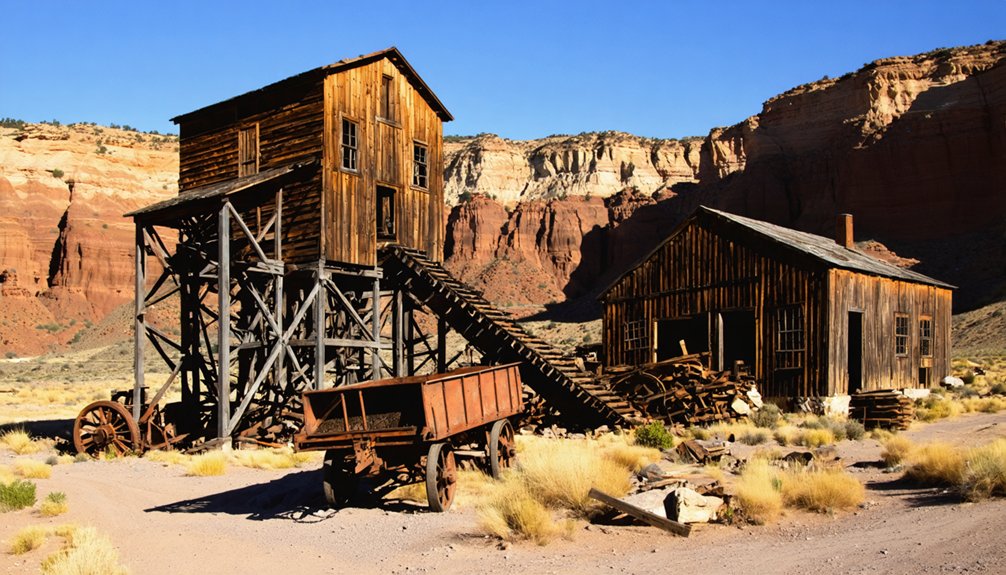
When Harry Ballard stumbled upon a coal vein in the early 1890s near Thompson Springs, he couldn’t have imagined the boom-and-bust saga that would unfold over the next six decades. His small wagon mine evolved into Sego, Utah’s busiest coal camp by 1928, where 150 miners extracted 1,500 tons daily.
The mining history tells of constant danger, unpaid wages, and scrip payments trapping workers in company store debt. You’ll find remnants of their struggle scattered across the canyon—a tipple destroyed by fire in 1949, abandoned railroad bridges, and empty buildings relocated to Moab.
Ghostly legends now haunt this desolate landscape where diesel locomotives eliminated Sego’s market in the 1950s, transforming ambitious dreams into windswept ruins.
Promontory: Where the Golden Spike Changed History
On May 10, 1869, Leland Stanford’s hammer struck a 17.6-karat gold spike at Promontory Summit, telegraphing the single word “done” across the nation and completing America’s first transcontinental railroad. You’ll find where Central Pacific’s 690 miles from Sacramento met Union Pacific’s 1,086 miles from Omaha, connecting a divided country.
On May 10, 1869, a golden spike united 1,776 miles of iron rails, telegraphing one word that transformed a nation: done.
Chinese laborers blasted through mountains while crews raced for federal subsidies, grading parallel tracks over 200 miles.
The 1903 Lucin Cutoff bypassed Promontory by 43 miles, transforming this historic junction into forgotten landmarks.
Rails were salvaged in 1942 for wartime steel, and both original locomotives—Jupiter and No. 119—met the scrapyard.
Today you’ll explore these abandoned railroads at Golden Spike National Historic Site, where working replicas resurrect America’s transformative moment.
Exploring Utah’s Ghost Towns Safely
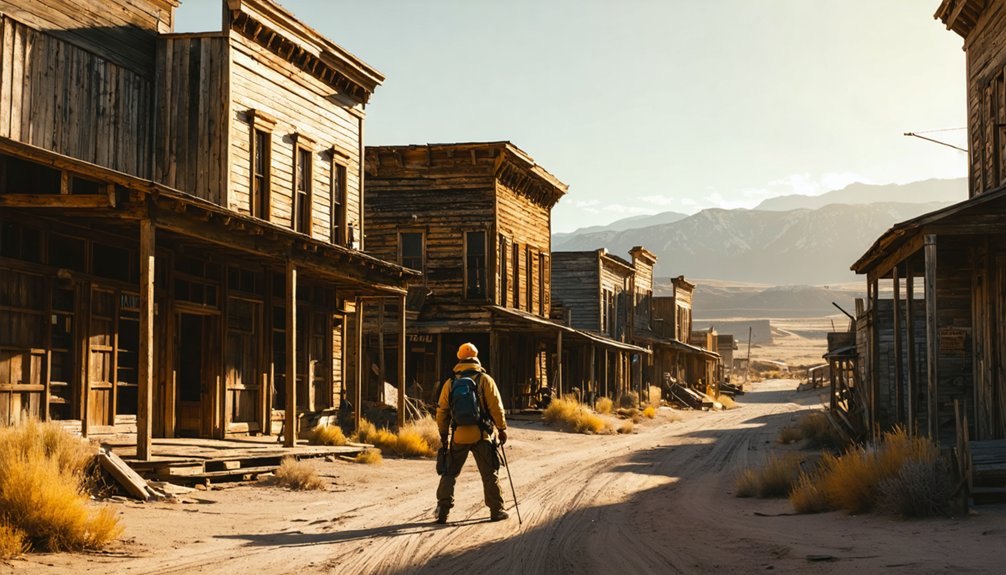
Before you venture into Utah’s abandoned settlements, you’ll need proper preparation to navigate both accessible landmarks and remote ruins safely. Start with Utah Geological Survey maps and GPS coordinates from trail guides covering 95 accessible sites like Grafton and Eureka. Check Route 6 conditions and weather forecasts, since southern desert washes face flash flood risks near Old Irontown and Stateline.
Respect private property boundaries at Iosepa’s cemetery and follow Bureau of Land Management permissions for sites like Harrisburg’s Orson B. Adams Home, where preservation efforts maintain historic structures.
Pack high-clearance vehicles, ample water, and sturdy boots for uneven terrain. Avoid unstable mine structures in Eureka and Latuda—these aren’t just urban legends about danger. National Register guidelines and no-trespassing signs protect both you and these historical remnants from further decay.
Frequently Asked Questions
Are Paranormal Investigations or Ghost Tours Available at These Utah Ghost Towns?
You won’t find official ghost tours or paranormal investigations at these locations. However, you’re free to explore independently with your own paranormal equipment to investigate the haunted legends surrounding Grafton, Frisco, Thistle, and Old Iron Town’s dark histories.
What Is the Best Time of Year to Visit Utah’s Ghost Towns?
You’ll find fall offers the best conditions for exploring Utah’s ghost towns, with cooler temperatures perfect for investigating Historical Preservation sites and uncovering Local Legends without extreme heat or crowds limiting your independent adventures.
As you wander through these abandoned settlements, you’ll uncover ghostly tales from Juab County that speak of the past. Each location is steeped in mystery, inviting brave explorers to learn about the lives of those who once called these places home. From whispered stories to eerie encounters, the rich history of these ghost towns promises an adventure unlike any other.
Can You Camp Overnight Near Any of These Abandoned Utah Towns?
You’ll find overnight camping possible near most sites through BLM dispersed camping, though access restrictions vary. Ghost town history buffs should verify current land management rules—Grafton has private property limits while Sego offers remote BLM freedom.
Do You Need a 4-Wheel Drive Vehicle to Reach These Locations?
Vehicle requirements vary by location. You’ll need 4-wheel drive for Grafton’s off road trails through Gooseberry Mesa. Frisco requires no technical driving, while Old Irontown’s accessible via standard touring cars on Type 1 backways.
Are There Any Reported Ghost Sightings or Haunting Stories From These Towns?
While cemetery records document eight deaths in Grafton alone, no primary sources verify ghost sightings at these locations. You’ll find urban legends and cryptid sightings remain undocumented folklore rather than recorded historical accounts from Silver Reef, Sego, or Thistle.
References
- https://www.valleyjournals.com/2024/10/02/507818/exploring-utah-s-ghost-towns-seven-abandoned-settlements-with-fascinating-histories
- https://en.wikipedia.org/wiki/List_of_ghost_towns_in_Utah
- https://www.utahlifemag.com/blog/post/4-ghost-towns
- https://www.visitutah.com/things-to-do/history-culture/ghost-towns
- https://film.utah.gov/spooky-rural/
- https://www.utahvalley.com/plan/day-trips-itineraries/history-buff/ghost-towns-and-haunted-places/
- https://www.grandcountyutah.net/388/Ghost-Towns-Communities
- https://www.youtube.com/watch?v=ON-iB3vXTQE
- https://graftonheritage.org/history-settlement/
- https://www.zionredrock.com/post/a-block-away-from-mystery-grafton-ghost-town