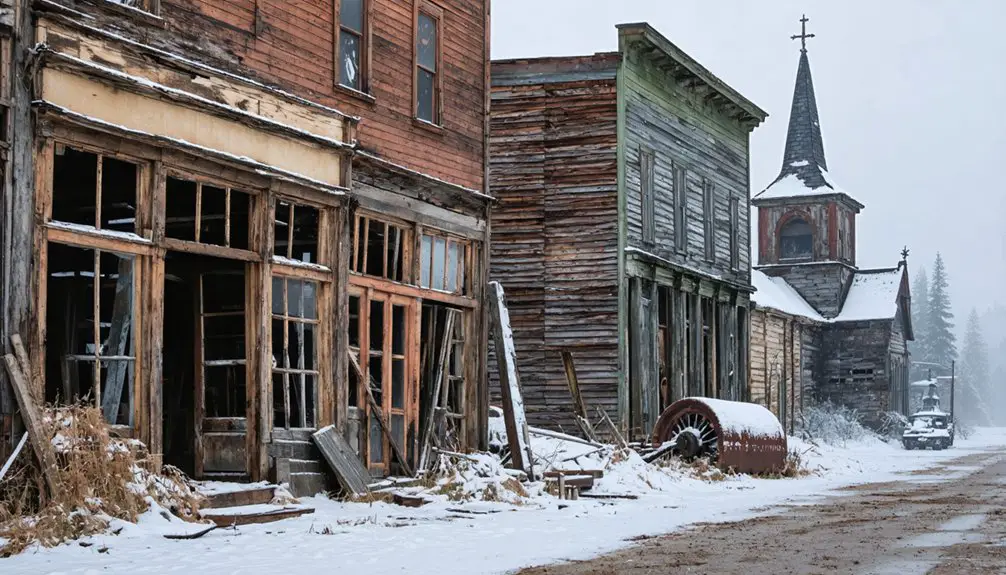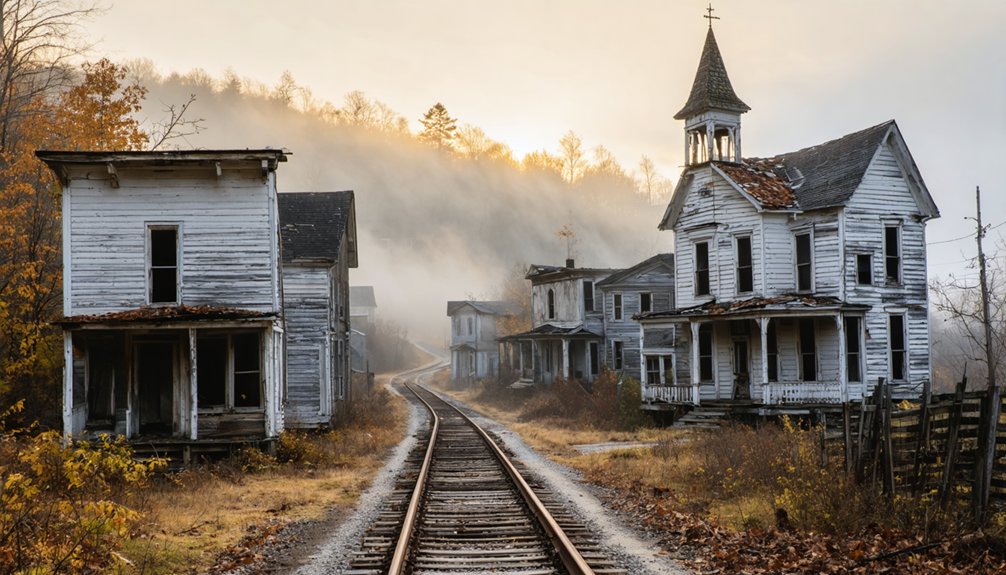
You’ll find West Virginia’s most haunted ghost towns in abandoned coal communities like Nuttallburg and Kaymoor, where rusted coke ovens and industrial ruins date back to 1873. Thurmond, once handling more freight than Cincinnati, now houses just five residents and an active Amtrak station. Harpers Ferry changed hands twelve times during the Civil War, leaving documented paranormal activity throughout its 19th-century buildings. The Trans-Allegheny Asylum, North America’s largest hand-cut stone building, operated for over 130 years treating thousands of patients. Below, you’ll discover the complete stories behind these haunted locations.
Key Takeaways
- Nuttallburg features preserved 1873 coke ovens and rusted machinery from coal operations, creating an eerie atmosphere among abandoned industrial ruins.
- Kaymoor’s 821-step staircase descends to sealed mine entrances, with scattered artifacts and processing facilities from 1873-1958 operations.
- Winona remains partially inhabited today, with reported ghost sightings near the 1899 Roebling suspension bridge and reclaimed industrial foundations.
- Thurmond transformed from a bustling rail hub with 18 train lines to a near-ghost town with only five residents.
- Harpers Ferry hosts America’s oldest ghost tour since 1978, exploring Civil War trauma sites with documented paranormal activity and ghostly legends.
The Abandoned Mining Communities of Fayette County
Deep in the ravines of Fayette County, coal companies carved entire communities from the wilderness, building camps that clung to hillsides for direct access to rich coal seams. You’ll find remnants of this coal camp architecture scattered throughout the New River, Kanawha, and Greenbrier Coalfields—places like Nuttallburg, Kaymoor, and Fayette Station that once housed thousands of workers.
These company towns strategically positioned operations so coal dropped downhill to valley railway lines.
Nuttallburg alone boasted 100 houses and 80 coke ovens by 1873. Founded by John Nita around 1870, the settlement operated as a thriving mining community for approximately 85 years before its decline. Today, historical preservation efforts by the National Park Service protect sites like Nuttallburg and Kaymoor, where you can still climb 821 stairs to explore intact mine buildings. At Fayette Station, you’ll discover artifacts from the coal era, including a Gibson West Virginia bottle dating to 1923 among scattered foundation ruins.
These ghost towns represent dozens of abandoned communities including Sewell, Stotesbury, and Quinnimont—each telling stories of exploitation and vanished livelihoods.
Thurmond: A Living Ghost Town on the Rails
Where the C&O Railway carved its path through the New River Gorge in the late 1800s, Captain William Thurmond established what would become one of West Virginia’s most paradoxical settlements—a town that handled more freight than Cincinnati at its peak yet never housed more than a few hundred residents.
Eighteen converging train lines made Thurmond the sole refueling station across 73 miles of track.
Banks, hotels, and the notorious Dun Glen Hotel—featuring a legendary 14-year poker game—served miners and rail workers until diesel locomotives rendered coal towns obsolete by 1949. A devastating 1899 fire destroyed the original depot and hotel, forcing the town to rebuild its downtown core with stone and brick for greater durability.
Today, you’ll find just five residents among preserved structures. The Thurman Depot functions as an active Amtrak station, offering passengers a glimpse into history while providing modern train travel through the gorge.
Modern tourism and preservation efforts by the National Park Service maintain this ghost town‘s authenticity, where spiritual energy reportedly manifests in a red-dressed apparition and unexplained phenomena.
Nuttallburg and Kaymoor: Industrial Ruins Along the New River
You’ll find Nuttallburg’s most striking remnants in its remarkably preserved coke ovens, which converted coal into the higher-grade fuel that powered America’s steel industry from the 1870s through the early 1900s.
At nearby Kaymoor, a steep 821-step stairway descends from the canyon rim to the mine entrance, retracing the daily commute miners made to reach the underground coal seams. Henry Ford leased these coal mines for approximately 8 years until 1928, implementing his vertical integration strategy by upgrading facilities to control coal supply for his steel manufacturing operations. Ford’s innovations at Nuttallburg included installing four continuous mining machines to replace traditional pick mining methods, dramatically increasing extraction efficiency.
Both sites contain extensive mining artifacts and structural remains—from rusted machinery and foundation ruins to company store buildings—that document the New River Gorge‘s transformation into one of Appalachia’s most productive coalfields.
Nuttallburg’s Preserved Coke Ovens
Among the most remarkable industrial remnants at Nuttallburg are the eighty coke ovens constructed in 1873. These ovens stand as proof of the site’s coal-processing heritage.
You’ll find these ovens positioned at Short Creek’s mouth on New River’s north side, where workers once shoveled coal into chambers to produce high-carbon coke for eastern pig-iron blast furnaces.
The industrial preservation effort here showcases one of America’s most complete coal-related complexes, with oven foundations still visible alongside what may have been a company store or coke storage facility.
Nuttallburg’s coke gained widespread reputation for quality, shipped via C&O Railway to industrial centers throughout the eastern United States.
While coke oven reconstruction hasn’t occurred, the remaining ruins offer you authentic glimpses into nineteenth-century coal-processing operations that fueled America’s industrial expansion. The beehive-shaped ovens, built from rough cut stone, could each hold approximately five tons of coal during operations. The National Park Service acquired the site from the Nuttall estate in 1998, ensuring its preservation as part of New River Gorge National River.
Kaymoor’s Steep Stairway Descent
The descent reveals rusted machinery, crumbling power stations, and moss-covered coal processing ruins at river level.
You’ll pass barred mine entrances and daily safety record boards that echo the site’s industrial past.
The grueling ascent back demands endurance, but you’re rewarded with authentic access to an abandoned world where independent miners once risked everything. The challenging 821-step staircase was recently restored in October with help from National Park Service personnel, Appalachian Conservation Corps crew members, and volunteers from an Indiana Amish community who replaced worn treads and stringers.
The site sits along the 8.6-mile trail that runs parallel to the New River between Fayetteville and Cunard, following old roads and dormant rail beds through Fayette County.
Mining Artifacts and Structures
Scattered across Nuttallburg’s 40-acre site, industrial artifacts tell the story of three distinct operational eras spanning 1873 to 1958. You’ll discover remnants from John Nuttall’s original operations, Henry Ford’s 1920s mechanization period, and the final Maryland New River Coal Company phase.
The most striking feature is Ford’s 1923 incline tipple—once the world’s largest—which doubled production capacity and revolutionized coal transport down the steep gorge.
Notable mining technology remains include:
- Company-owned housing foundations for 110 dwellings that sheltered over 300 residents
- Seven-mile railroad infrastructure climbing the canyon to Keeney’s Creek headwaters
- The massive 1923-1924 tipple structure that enabled 171,000-ton annual production peaks
- Processing facilities from the Nuttallburg Coal & Coke Company’s 500-ton daily operations
These industrial ruins stand as monuments to America’s coal-powered expansion.
McDowell County’s Forgotten Coal Camps
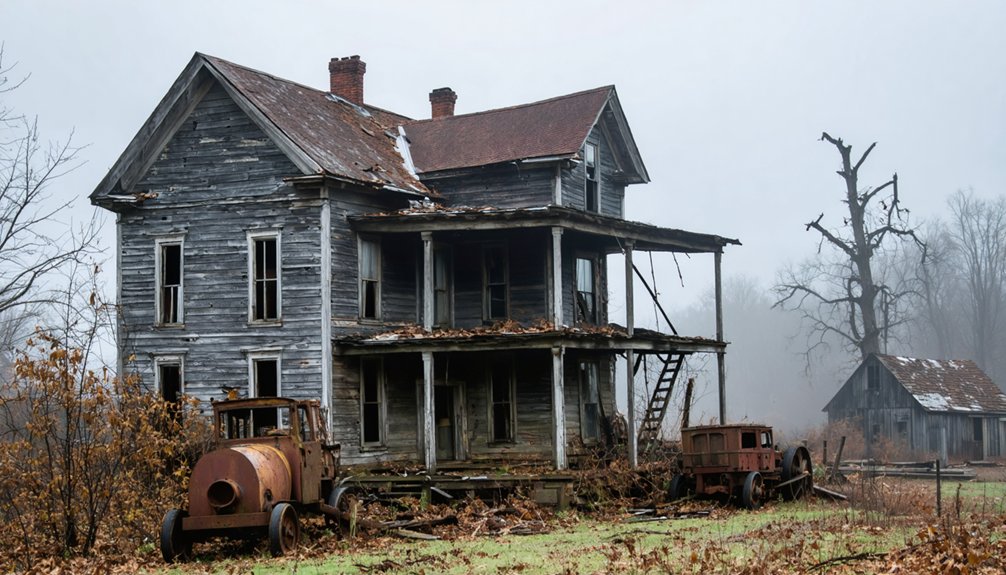
Deep in the Appalachian coalfields, McDowell County’s forgotten coal camps tell a story of industrial ambition that reshaped an entire region. You’ll find remnants of Caretta, Coalwood, and Gary—coal town settlements established by operators like George L. Carter in the early 20th century.
These camps housed over 100,000 residents at their 1950s peak, when McDowell led U.S. coal production.
The labor history reveals both prosperity and control. Miners earned quality wages through United Mine Workers negotiations, yet faced company-owned housing and stores.
Eckman’s African American community built churches and social organizations despite segregation.
Harpers Ferry: Where History and Spirits Collide
You’ll find Harpers Ferry stands apart from West Virginia’s abandoned coal camps—this living museum town changed hands up to 12 times during the Civil War, creating layers of trauma that visitors and staff report encountering today. The concentrated violence from John Brown’s 1859 raid and years of military occupation left six citizens dead initially and countless soldiers wounded in makeshift hospitals like St. Peter’s Catholic Church.
America’s oldest ghost tour, operating since approximately 1978, guides you through 100 restored 19th-century buildings where apparitions of soldiers, Brown himself, and dying men allegedly manifest with documented consistency.
Civil War’s Dark Legacy
Where the Potomac and Shenandoah Rivers converge, Harpers Ferry stands as one of America’s most blood-soaked grounds, its strategic importance ensuring repeated devastation throughout the Civil War.
The town’s dark legacy stems from relentless military occupation:
- Eight ownership changes between 1861-1865 left destruction in each army’s wake
- 12,500 Union soldiers surrendered in September 1862—America’s largest capitulation until WWII
- Artillery bombardment from three surrounding heights pulverized the trapped garrison
- 15,000 muskets burned when Federal troops torched the arsenal in 1861
Civil War reenactors report unexplained phenomena near the engine house where John Brown made his stand.
Urban legends persist about phantom soldiers marching through fog-shrouded streets, their presence a memorial to violence that consumed this transportation hub repeatedly throughout America’s bloodiest conflict.
Ghostly Encounters and Tours
The centuries of violence that saturated Harpers Ferry‘s soil created what paranormal researchers consider ideal conditions for supernatural manifestations—and in 1970, Shirley Dougherty recognized an opportunity to document them. She founded America’s oldest ghost tour, compiling spectral sightings from locals and National Park sources.
Today, Rick Garland continues this 53-year legacy through two-hour walking tours that explore historical haunts like St. Peter’s Roman Catholic Church, where a priest’s spirit reportedly tends his flock, and the Harper Museum with its rumored buried treasure.
You’ll encounter Civil War ghosts so convincing they’re mistaken for reenactors, and hear documented accounts from a 1980s apartment where a father witnessed a crying baby’s apparition.
Tours operate year-round from 100 Church Street, meeting at St. Peter’s courtyard.
Trans-Allegheny Asylum: A Monument to the Paranormal
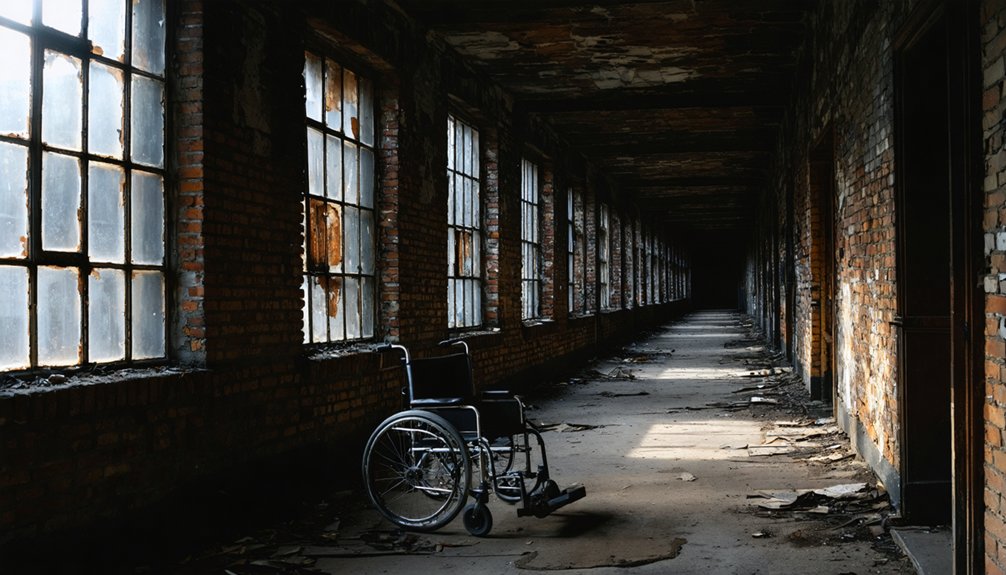
Perched on a hillside in Weston, West Virginia, the Trans-Allegheny Lunatic Asylum stands as North America’s largest hand-cut stone masonry building—a Gothic Revival fortress whose 200-foot clock tower has overlooked the region since 1871. You’ll discover a structure built from local blue sandstone by German and Irish stonemasons.
Designed to house 250 patients but eventually holding over 2,400 during its darkest years, this historic site has undergone preservation efforts, transforming it into a destination for paranormal investigations.
Here, you can explore:
- Civil War disruptions, including military occupation by Union forces at Camp Tyler
- Kirkbride Plan architecture emphasizing therapeutic sunlight and cross-ventilation
- Overcrowded corridors where seven patients once slept in single hallways
- 130 years of operation treating conditions ranging from legitimate illness to “laziness”
Winona: the Ghost Town With a Beating Heart
Along the remote highlands of Keeneys Creek, north of the lower New River Gorge, Winona emerged from pre-Civil War farmland into a thriving coal community that defied the typical ghost town narrative. You’ll find this settlement, originally owned by pioneer Robert M. Holliday Sr., transformed when John Nuttall purchased mineral rights in 1870.
He anticipated the Chesapeake and Ohio Railroad’s arrival, developing 100 houses and 80 coke ovens by 1873.
While local legends surround the abandoned Nuttallburg mine sealed in 1958, and ghost sightings persist near the 1899 Roebling suspension bridge, Winona remains inhabited. You can explore its legacy at African American Heritage Driving Tour Stop 3, where Carter G. Woodson‘s presence—founder of Black History Month— echoes through rusted tipples and nature-reclaimed foundations.
Planning Your Haunted Ghost Town Adventure

Before you pack your ghost-hunting equipment or camera, you’ll need to understand that West Virginia’s abandoned coal towns present unique logistical challenges. Cell phone reception vanishes on narrow access roads, and some sites like Nuttallburg require steep hikes through dense forest.
West Virginia’s ghost towns demand preparation: expect zero cell service, challenging terrain, and rugged forest hikes to reach remote sites.
The National Park Service manages several locations, ensuring legal access to explore haunted folklore and local legends.
Essential Planning Steps:
- Book guided tours in advance at smalltownghosttours.net for Shepherdstown or Moundsville’s Gothic Revival site.
- Download the Paranormal Trail’s digital passport for spooky prizes across multiple locations.
- Prepare for remote conditions: narrow roads, no passing space, and absent signage.
- Schedule private paranormal investigations at Martinsburg or overnight ghost hunts at Weston.
Nine ghost towns cluster within Fayette County’s coal-rich terrain, offering concentrated exploration opportunities.
Frequently Asked Questions
Are There Any Other Haunted Locations in West Virginia Besides Ghost Towns?
Yes, you’ll find numerous haunted locations beyond ghost towns, including asylums, prisons, and amusement parks with historical legends. Spectral sightings occur at Trans-Allegheny Lunatic Asylum, West Virginia State Penitentiary, and Lake Shawnee—all offering tours for independent investigation.
What Safety Precautions Should Visitors Take When Exploring Abandoned Mining Sites?
Never explore abandoned mines—over 50% of mine fatalities involve explorers, not miners. You’d need professional hazard identification skills and protective gear. Instead, report locations to authorities who’ll assess structural collapses, toxic gases, and drowning risks safely.
Can You Camp Overnight at Any West Virginia Ghost Town Locations?
You can’t camp at West Virginia ghost towns without designated sites and camping permits. Most abandoned locations lack official campgrounds. You’ll need proper safety gear and must follow state land regulations requiring permitted areas only.
Exploring abandoned mines in West Virginia can be a thrilling experience, but it’s essential to prioritize safety and awareness of the area’s history. The remnants of these mines often serve as a reminder of the region’s rich industrial past, attracting adventurers and history enthusiasts alike. Always ensure you’re equipped with the necessary tools and information before venturing into these forgotten sites.
While delving into the fascinating history of abandoned towns in West Virginia, you may come across intriguing stories of the people who once lived there. These towns often showcase remnants of their vibrant past, with hauntingly beautiful structures standing as testaments to bygone eras. Embracing the unknown can unveil hidden gems, but it’s crucial to navigate these areas with respect and caution.
Which Ghost Town Offers the Most Paranormal Activity Year-Round?
You’ll find Trans-Allegheny Lunatic Asylum offers year-round paranormal investigations with restless spirits from its 1800s patient population and Civil War era. It’s documented through primary sources and featured on multiple paranormal television programs investigating its continuous supernatural activity.
Are Professional Ghost Hunting Equipment Rentals Available Near These Locations?
Equipment availability for paranormal investigations near West Virginia’s ghost towns remains undocumented in primary sources. You’ll need to research rental options independently, as verified information about professional ghost hunting equipment services in these areas isn’t currently established.
References
- https://kids.kiddle.co/List_of_ghost_towns_in_West_Virginia
- https://www.wvlogcabins.com/news/west-virginia-haunted-places/
- https://www.letsroam.com/explorer/haunted-places-in-west-virginia/
- https://wvtourism.com/5-wv-ghost-towns/
- https://minskysabandoned.com/2015/07/30/west-virginia-ghost-towns-part-1-nuttallburg/
- https://www.youtube.com/watch?v=-EeLwLa2t90
- https://www.tripadvisor.com/ShowTopic-g28971-i892-k15381055-Paranormal_or_haunted_locations-West_Virginia.html
- https://en.wikipedia.org/wiki/Coal_camps_in_Fayette_County
- https://www.youtube.com/watch?v=Q9wfOJlb3Zs
- https://www.youtube.com/watch?v=YOBavqDRTuI