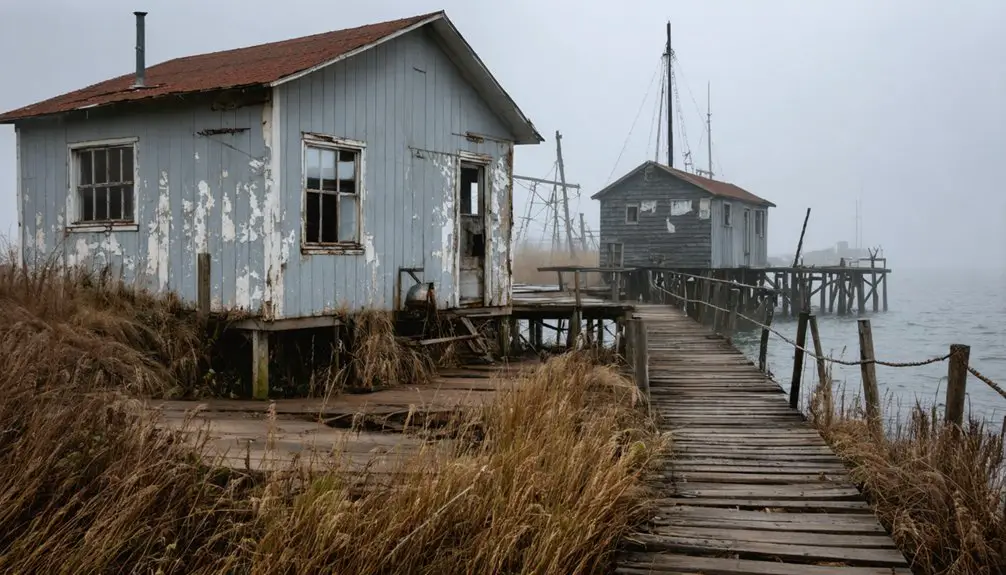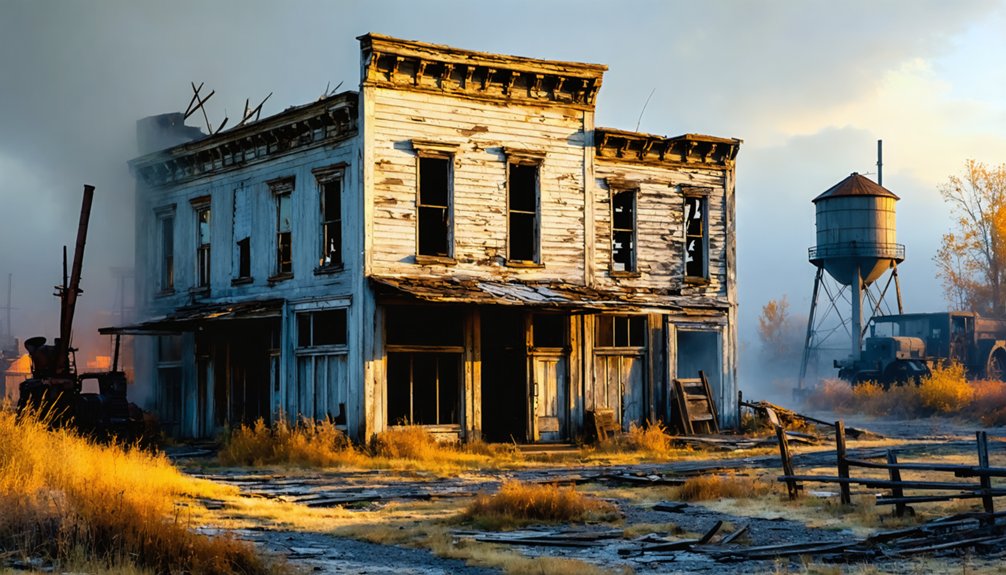
Wisconsin’s haunted ghost towns blend tragic history with unexplained phenomena you won’t find in typical guidebooks. You’ll discover St. Nazianz, where Father Oschwald’s 1854 commune reported faith healing miracles before mysterious pounding sounds emerged after 1873. Ridgeway’s Military Road once hosted a shapeshifting headless horseman until fire destroyed the town in 1910. Sinipee became a mass burial ground after malaria killed 60 residents in 1839, while Doveland allegedly vanished completely in the 1990s—though some claim they’ve visited it. The stories behind these settlements reveal even stranger details.
Key Takeaways
- St. Nazianz features unexplained pounding sounds, mysterious lights, and faith healing legends dating back to its 1854 founding as a Catholic commune.
- Ridgeway’s Military Road was haunted by a shapeshifting headless horseman linked to an 1840s murder until the town burned in 1910.
- Gratiot’s Grove, an 1826 lead mining settlement, now features only one remaining limestone house amid archaeological remnants of its abandoned past.
- Sinipee became a mass burial ground after an 1839 malaria epidemic killed 60 residents, leaving it abandoned and reputedly haunted.
- Doveland mysteriously vanished near Green Bay in the 1990s, spawning conspiracy theories about government cover-ups and dimensional rifts.
St. Nazianz: Where Faith Healing and Paranormal Activity Converge
In 1854, Father Ambrose Oschwald led his entire German Catholic parish across the Atlantic Ocean to establish St. Nazianz in Wisconsin’s Manitowoc County.
The exiled priest, who’d fled persecution for his mystical teachings, purchased 3,840 acres at $3.50 per acre and founded a utopian commune.
Medical miracles soon defined the settlement—crutches and medical aids accumulated at Loreto Chapel from those cured through Oschwald’s faith healing gift.
The community operated on principles of shared resources, with members contributing their labor and possessions to the collective.
Spiritual legends intensified after his 1873 death, when mysterious pounding shook houses across town and unexplained light flooded buildings.
His body reportedly remained incorrupt for 53 years.
Later, the Salvatorian Seminary spawned darker tales of abusive nuns and tortured students.
The former seminary became known as JFK Prep, where restless spirits allegedly haunted students and staff.
Town historian Bob Domagalski’s two-decade investigation found no proof, yet St. Nazianz remains among Wisconsin’s most allegedly haunted communities.
The Phantom Travelers of Military Road in Ridgeway
During the 1840s lead mining rush, when 10,000 miners from Cornish, Welsh, Irish, and German backgrounds flooded southwestern Wisconsin’s farmlands, travelers along Old Military Ridge Road reported encounters with a dark, silent figure that defied explanation.
Historical sightings described a shapeshifter appearing as a headless horseman riding backwards, sometimes jumping onto buggy tongues to stare at passengers. These paranormal encounters turned deadly—the entity attacked travelers, stole wagon wheels, and allegedly killed the living. Doc Cutler of Dodgeville, who traveled to Ridgeway for house calls, experienced such frightening encounters that he changed his route to avoid the Phantom.
For 25 years, people avoided the road at night without armed escorts. The terror stemmed from a gruesome 1840s murder: a mother and her two teenage sons killed at a saloon, one boy burned alive in a fireplace. The entity became known as the Ridgeway Phantom, acting more as a troublemaker and trickster than a traditional vengeful spirit.
The hauntings ceased after Ridgeway burned in 1910.
Gratiot’s Grove: A Lead Mining Settlement Frozen in Time
Long before Wisconsin achieved statehood, two brothers from St. Louis transformed Lafayette County into a bustling lead mining hub. Henry and Jean P.B. Gratiot established their frontier settlement in 1826 after purchasing mining rights from the Ho-Chunk tribe. You’d have witnessed sixty Frenchmen operating six furnaces, creating the region’s first successful smelting operation.
At its peak, 1,500 residents called this place home. The settlement thrived with a post office, school, church, and Berry Tavern—where an 1842 murder occurred. Henry Gratiot’s massive limestone house, built in the 1830s, still stands today as Gratiot House Farm.
Wars stunted growth. When lead supplies dwindled by the 1890s, residents abandoned everything. Only Gratiot’s house remains—a frozen monument to Wisconsin’s mining rush. After a six-year restoration effort, the second-oldest home in Wisconsin now operates as a bed and breakfast. Recent archaeological excavations uncovered ceramics, glass, and animal bones that reveal intimate details of daily life in this multiethnic frontier community.
Sinipee’s Deadly Malaria Outbreak and Its Aftermath
While lead mining drove Gratiot’s Grove into obscurity, a far more sinister force would doom the river town of Sinipee. Spring floods in 1839 left stagnant pools that bred malaria-carrying mosquitoes, releasing an epidemic that infected nearly everyone in this prosperous Mississippi River port.
The outbreak’s devastating toll included:
- At least 60 deaths among the 1,000 residents
- The bluff transformed into a mass burial ground
- All but two families fleeing by early 1840
- Buildings dismantled for mine shaft lumber
This historical migration represented mid-19th century epidemic response when disease origins remained mysterious.
Even after survivors abandoned their 25 commercial buildings and stone hotel, Sinipee’s deadly reputation persisted. Theodore Rodolf, a member of the Louisiana Company, later described the town’s ghostly state in his account of the deserted settlement. The stone hotel survived until 1904 when it burned, with its remaining walls later used as dam fill.
Wildcat currency bearing “Sinipee, Wisc.” circulated until 1844, but fear prevented resettlement despite property sales attempts.
Doveland: The Mystery Town That May Never Have Existed
Could an entire Wisconsin town vanish without leaving a single trace on any map, record, or piece of land? Doveland’s story challenges everything you think you know about reality.
During the 1990s, this alleged town near Green Bay supposedly disappeared completely—no buildings, cemeteries, or official records remained. Yet people claim they visited relatives there, bought souvenirs, and remember its existence vividly.
Urban legends suggest it was a 1960s military installation tied to Cold War projects like ELF. Conspiracy theories range from sinkholes and flooding to government cover-ups and dimensional rifts. Some believers even suggest a curse or vengeful spirit caused the town to shift into another dimension where former residents still linger.
Google autocorrects searches to “Doveland, Wisconsin” but shows nothing.
The evidence? T-shirts, postcards, and collective memories that might prove mass delusion or something far stranger lurking in Wisconsin’s forgotten corners. This lost town mystery has become part of Wisconsin’s growing collection of digital folklore and modern urban legends.
Among these tales are accounts of abandoned sites in northern Wisconsin, where remnants of the past blend with eerie landscapes. Locals often share stories of strange occurrences linked to these forgotten places, igniting curiosity and fear alike. Some even venture into these sites, seeking answers or perhaps just the thrill of experiencing the unknown.
These abandoned places in Wisconsin serve as a canvas for local legends and unexplainable happenings. Enthusiasts and thrill-seekers alike are drawn to explore these haunting remnants, hoping to capture a glimpse of the past or an encounter with the unexpected. Each visit often leads to new stories, adding layers to the already rich tapestry of Wisconsin’s mysterious folklore.
Frequently Asked Questions
Are There Guided Ghost Tours Available at These Wisconsin Ghost Towns?
You’ll find ghost tours in Whitewater exploring spiritualist hauntings, though actual ghost towns like Nelsonville lack guided tour availability due to historical preservation challenges and remote locations. Most organized paranormal experiences focus on accessible haunted buildings rather than abandoned settlements.
What Legal Restrictions Exist for Visiting Abandoned Town Sites in Wisconsin?
You’ll face trespassing laws if you enter without permission, even at abandoned sites. Private property rights persist despite deterioration. You need written owner consent for legal access. Posted signs, fences, or padlocks prove prosecution cases against unauthorized visitors.
Which Ghost Town Is Easiest to Access for Families With Children?
Ironically, the “ghost” town least haunting for kids is Pendarvis—you’ll find maintained paths, restored cabins with guided tours, and zero rugged terrain. Its child-friendly accessibility near Mineral Point makes family exploration effortless, requiring no special permits.
Can You Camp Overnight at Any of These Haunted Locations?
You can’t legally camp overnight at Wisconsin’s haunted locations due to safety concerns and private ownership restrictions. Most sites don’t issue camping permits, though some offer supervised ghost tours. Contact property managers directly for special investigation permissions.
Have Paranormal Investigators Conducted Official Studies at These Sites?
Yes, you’ll find ghost hunters have left no stone unturned. Historical lore attracted multiple paranormal investigations by Wisconsin Paranormal Research Society, Wausau Paranormal Society, and Chad Lewis, who documented voices, apparitions, and unexplained phenomena at these haunted sites.
References
- https://www.nbc26.com/manitowoc/the-most-haunted-town-in-wisconsin-father-oschwald-ambrose-and-st-nazianz
- https://en.wikipedia.org/wiki/List_of_ghost_towns_in_Wisconsin
- https://www.ridgewaywi.gov/community/page/village-history
- https://pbswisconsin.org/news-item/southern-wisconsins-ghost-towns-leave-behind-vital-stories/
- http://shunpikingtoheaven.blogspot.com/2016/05/a-wisconsin-ghost-town.html
- https://usghostadventures.com/haunted-stories/the-legend-of-doveland-wisconsin-the-vanishing-town/
- https://www.travelwisconsin.com/article/museums-history/haunted-history-11-ghost-tours-throughout-wisconsin
- https://www.youtube.com/watch?v=Q-j0MCBWB9M
- https://grantcountyhistory.org/wp-content/uploads/2016/01/GhostTownsGrantCountyTLundeen.pdf
- https://www.thementalshed.com/st-nazianz/