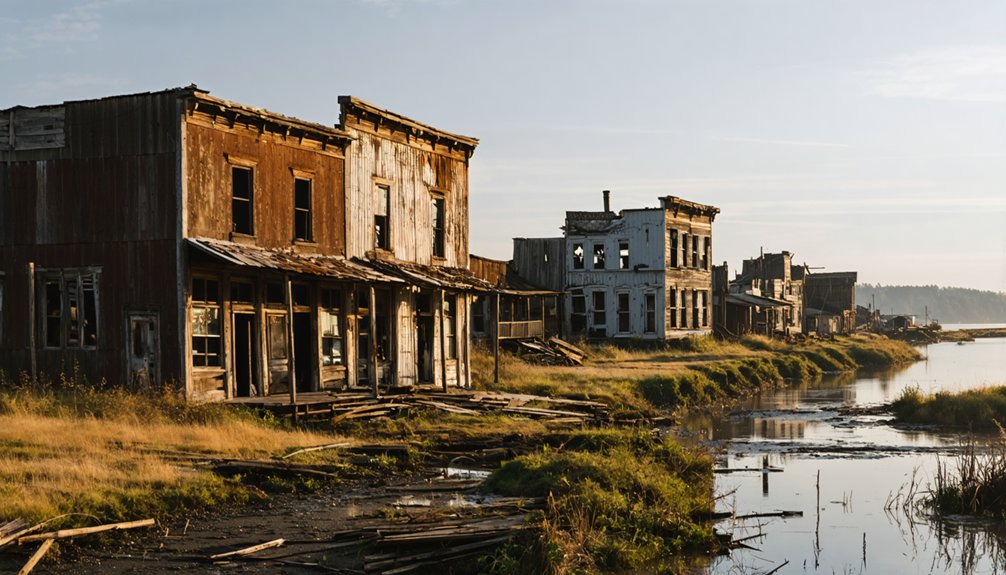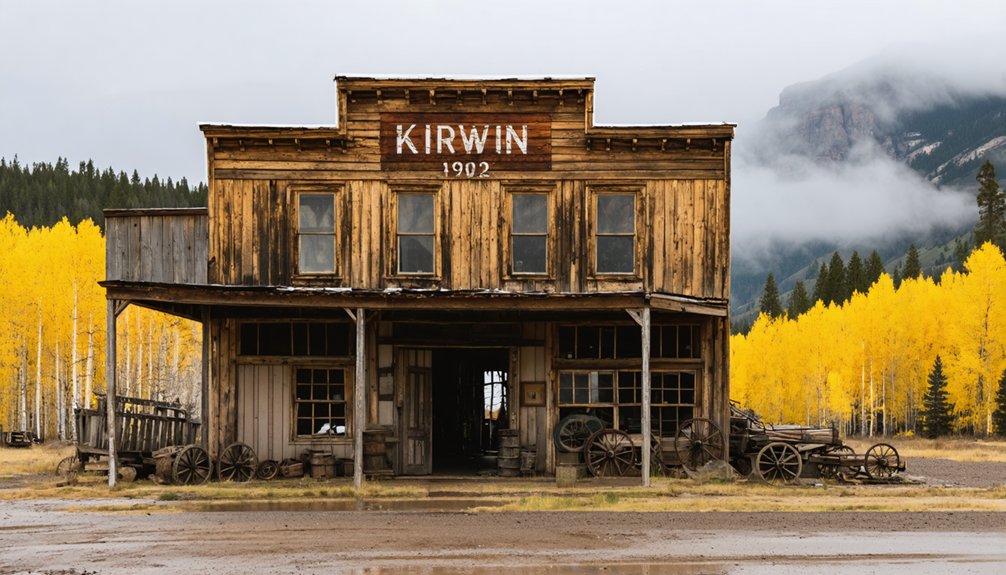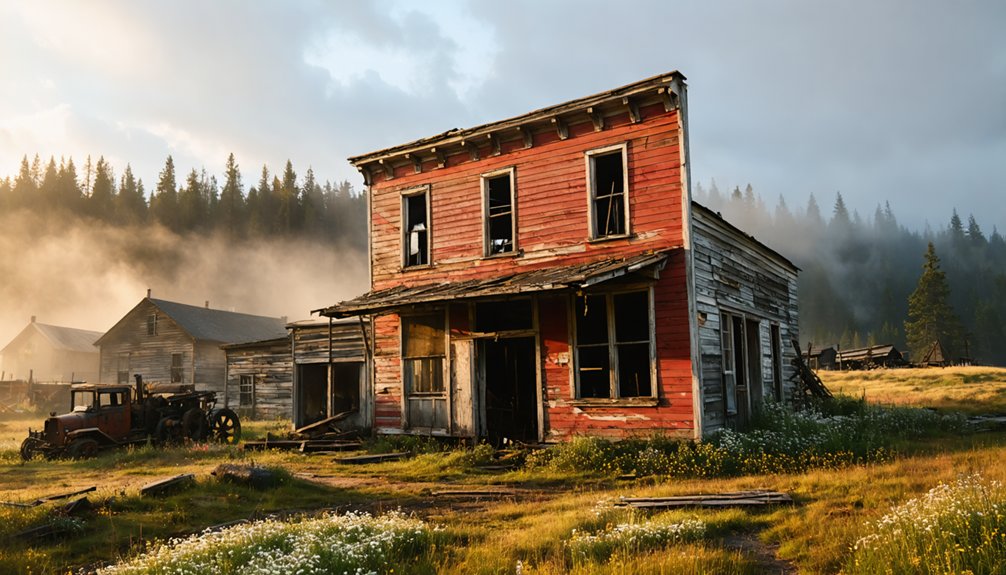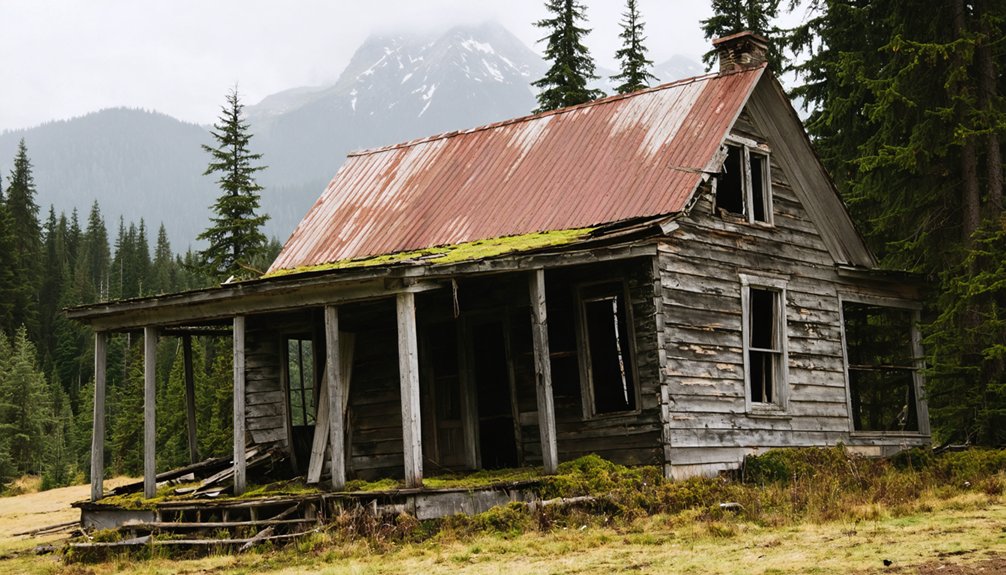
Within a day’s drive from Seattle, you’ll discover several haunted ghost towns with macabre histories. Monte Cristo offers Rockefeller-funded mining ruins and ghostly lodge tales, while Govan harbors unsolved axe murders and a haunted schoolhouse. Don’t miss Liberty, Washington’s only “living ghost town,” or Franklin’s tragic coal mining past. The Northern State Asylum’s abandoned grounds tell stories of mysterious deaths and patient mistreatment. These forgotten communities reveal the darker chapters of our regional history.
Key Takeaways
- Monte Cristo, located in the Northern Cascades, features remnants of a mining town with ghost stories related to a burned-down lodge.
- Govan, near Wilbur, is known for unsolved axe murders and ghostly apparitions at its abandoned 1905 schoolhouse.
- Liberty, Washington’s only “living ghost town,” preserves 1890s buildings with a small population still practicing mining.
- Franklin, 32 miles southeast of Seattle, experienced a catastrophic 1894 mine disaster claiming 37 lives.
- Northern State Asylum, 60 miles north of Seattle, has a dark history including the unsolved murder of John Shellack.
Monte Cristo: A Mining Legacy in the Cascades
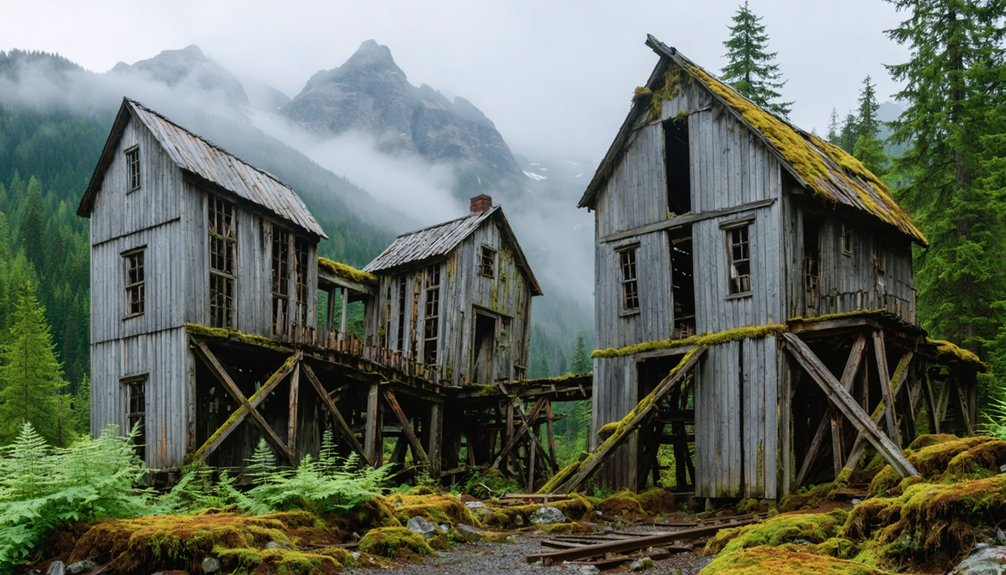
Nestled in the rugged folds of the Northern Cascades, Monte Cristo stands as one of Washington’s most atmospheric ghost towns, inviting Seattle-area adventurers to step back into the region’s mining heyday.
You’ll find this historic site just east of Granite Falls via an 8-mile roundtrip hike from Barlow Pass.
Once home to over 1,000 residents and backed by Rockefeller money, Monte Cristo’s mining techniques extracted silver and gold from 1889 until its abandonment in 1907.
Today, you can explore remnants of the post office, schoolhouse, and mining equipment while contemplating the boom-and-bust cycle that defined frontier life. The Monte Cristo Preservation Association maintains the site with interpretive signs that help visitors understand the historical significance of the remaining structures.
Local ghost stories surround the burned-down Monte Cristo lodge and the former hotel operated by Frederick Trump.
The relatively flat hike makes this journey accessible for families enthusiastic to connect with Washington’s mining legacy. Much like Liberty, which was added to the National Register in 1974, Monte Cristo offers a genuine glimpse into the state’s rich mining history.
Govan’s Chilling Past: The Unsolved Axe Murders
Located three hours east of Seattle near the tiny town of Wilbur, Govan remains one of Washington’s most spine-chilling ghost towns, haunted by a series of brutal murders that have never been solved.
The infamous Govan murders began in 1902 when Judge J.A. Lewis and his wife were savagely killed with an axe in their home, a case that shocked the state and remains unsolved to this day.
- The abandoned 1905 schoolhouse stands as the town’s eerie centerpiece, where visitors report ghostly apparitions of a former teacher.
- Multiple killings plagued the small community, including the 1903 saloon shooting of C.S. Thennes.
- In 1941, another gruesome chapter unfolded when Lillie Lesneww was murdered and her son disappeared.
The town’s violent past, combined with devastating fires, gradually emptied Govan of its residents. Today, explorers can still witness the rolling hills surrounding the abandoned structures, creating a hauntingly beautiful backdrop for this forsaken place. Two significant wildfires in the early 1970s destroyed much of what remained of the once-thriving community.
More recently, historic flooding events in New Orleans have drawn attention to the vulnerabilities of similar towns across the country. As climate change continues to worsen, the memories of these natural disasters linger in the minds of the survivors, reminding them of the fragility of their environments. The scars left by such events serve as a cautionary tale for communities striving to rebuild and protect their heritage.
Liberty: Washington’s Living Ghost Town
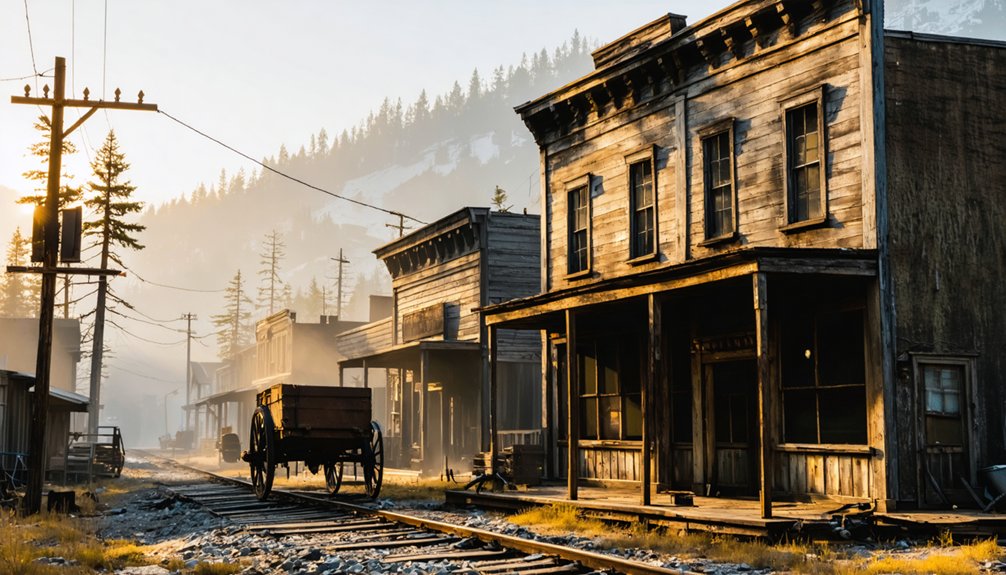
You’ll step back in time at Liberty, Washington’s only “living ghost town,” where gold was first discovered in Swauk Creek in 1873, establishing the state’s oldest mining townsite.
The town preserves its 1890s appearance with log cabins and original-style buildings along Main Street, while showcasing mining equipment including a working replica of a 1930s arrastra with a rare horizontal undershot water wheel.
Unlike abandoned ghost towns, Liberty maintains its mining heritage through active residents who continue the century-old tradition of searching for the area’s famous crystalline gold and large nuggets. Initially established as two separate townsites, Meaghersville and Old Liberty, the current town received its name in 1892 when a post office was established. Located approximately 80 miles east of Seattle, this historic site attracts visitors from around the world despite having no formal advertising.
Historic Gold Rush Origins
Just a short drive from Seattle’s bustling streets, Liberty stands as a symbol of Washington’s vibrant gold rush era, where the 1872 discovery of gold in Swauk Creek transformed this quiet valley into a thriving mining community.
Originally named Meaghersville after its first pioneer settler, this historic township was officially established in 1880 and quickly became one of Kittitas County’s most active gold mining centers.
- The area is renowned for producing rare crystalline gold nuggets, attracting miners who built a community that reached 200 residents at its peak.
- Mining operations continued through the 1960s, sustaining Liberty’s economy despite typical boom-and-bust cycles.
- Town preservation efforts saved Liberty from complete abandonment, maintaining its historic structures.
Today, it’s recognized as Washington’s only “living ghost town,” where small-scale mining still continues. Local historian Wes Engstrom has extensively documented the town’s rich history through self-published works. With a current population of just 12 people, Liberty preserves its rich history through its log cabins and original structures along its single Main Street.
Preserved Mining Artifacts
Liberty’s enduring legacy as Washington’s only living ghost town shines through its remarkably preserved mining artifacts, offering visitors a tangible connection to the area’s gold rush heritage.
You’ll witness the only working historic mining equipment in town—a meticulously constructed arrastra replica built in 1974 that demonstrates traditional ore processing methods from the 1930s Virden mining camp.
This water-powered crusher, featuring a horizontal undershot wheel mechanism, shows exactly how miners separated precious metals from ore.
Throughout the town, interpretive signs provide context for the artifact preservation efforts that earned Liberty its National Register of Historic Places designation.
Original mining machinery displays showcase tools that processed the region’s unique crystalline wire gold deposits, maintaining the authentic character of this freedom-loving community where small-scale prospecting continues today. The site was originally established after the Goodwin brothers discovered gold in 1867, leading to a mini gold rush that shaped the town’s mining history. Like discoveries in Snohomish County mines, historical assays here revealed impressive mineral content with high gold values that attracted prospectors from across the region.
Molson: Mannequins and Mining Memories
Nestled less than two miles from the Canadian border in remote Okanogan County, the ghost town of Molson stands as a fascinating relic of Washington’s gold rush era, where life-sized mannequins now populate the preserved structures of this once-thriving mining settlement.
Founded in 1898 and financed by Canadian investor John W. Molson, this town’s boom-to-bust saga unfolds through its eerily preserved buildings.
- The Old Molson Ghost Town Museum features mannequin sightings that create an unsettling atmosphere as they’re staged in pioneer cabins.
- Mining artifacts including original tools tell the story of the town’s brief prosperity before mines dried up by 1901.
- The bitter land dispute forced residents to relocate, creating two competing Molsons for nearly two decades.
- You’ll find the schoolhouse museum nearby, offering a deeper glimpse into frontier life.
Franklin’s Tragic Coal Mining History
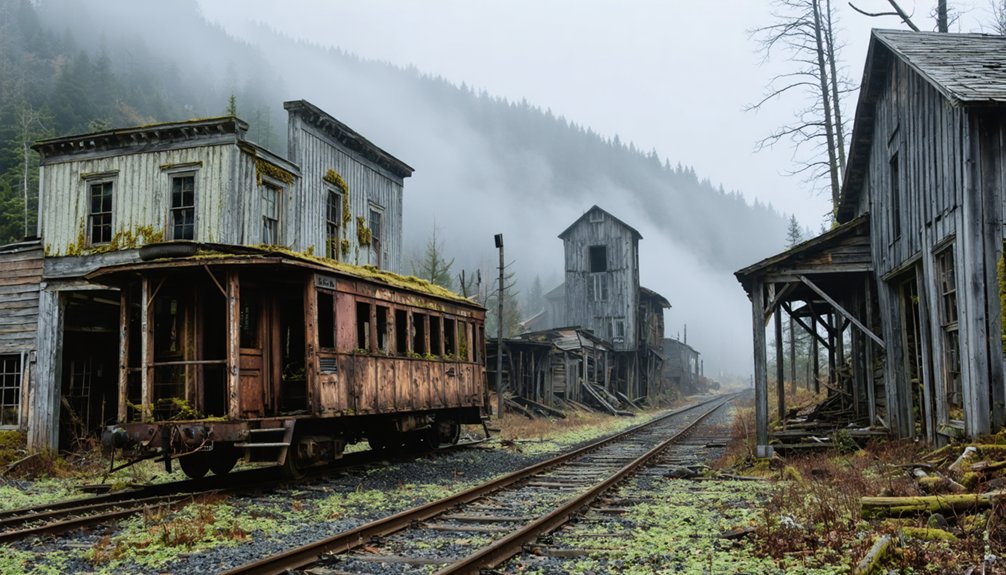
Located just 32 miles southeast of Seattle in King County, Franklin stands as a somber monument to Washington’s coal mining legacy, where the ruins of this once-prosperous company town still whisper stories of tremendous sacrifice and tragedy.
At its peak in the 1890s, Franklin’s mines produced nearly 200,000 tons of coal annually, shipped via the Columbia & Puget Sound Railroad to markets as far as San Francisco.
But this prosperity came at a terrible price. The catastrophic 1894 mine disaster claimed 37 lives when fire erupted in the sixth north level, becoming Washington’s second-worst mining catastrophe.
Franklin also witnessed bitter labor disputes, including the infamous 1891 strike where company owners deliberately fueled racial tensions by recruiting African American strikebreakers.
Northern State Asylum: Where Mental Health Meets the Macabre
Approximately 60 miles north of Seattle, the imposing Spanish Colonial Revival buildings of Northern State Asylum stand as haunting sentinels over a troubled past in mental health treatment.
Opened in 1912 near Sedro-Woolley, this sprawling 1,100-acre facility once housed over 2,700 patients during its 1950s peak.
The asylum history reveals a complex community where patients worked farm fields, played baseball, and even organized Easter egg hunts for local children.
Life at Northern State wasn’t all darkness—patients cultivated community through farm work, sports, and hosting local celebrations.
Yet darker aspects of patient experiences can’t be ignored:
- Unsolved murder of John Shellack, killed in his bed with a razor in 1922
- “Redlighting” practices where unwanted patients were abandoned in distant locations
- Cemetery operations from 1911-1952, with many burial locations now unknown
- Minimal security that led to frequent escapes, some patients traveling as far as Seattle
Planning Your Haunted Ghost Town Tour From Seattle
For adventurous spirits seeking encounters with Washington’s spectral past, Seattle serves as an ideal launching point for ghost town explorations across the region.
When planning your excursions, consider seasonal access—Monte Cristo and Franklin are best visited during dry months when their hiking trails are most navigable.
Proper tour preparation means researching each destination’s specific challenges. Pack sturdy footwear for Franklin’s uneven terrain and prepare for Monte Cristo’s log crossings and arsenic contamination zones.
Liberty and Molson offer year-round access but check for limited off-season services.
Essential safety tips include watching for unstable structures in Govan, staying on marked paths near sealed mine shafts, and bringing navigation tools.
Early planning lets you verify trail conditions and any access restrictions on protected lands.
Frequently Asked Questions
Are Ghost Towns Safe to Visit During Winter Months?
You’ll find winter visits challenging but possible with proper safety precautions. Harsh winter weather creates hazards from icy trails, unstable structures, and limited daylight, so always bring emergency supplies and check conditions beforehand.
Can I Bring Children to These Ghost Town Locations?
Dreaming of family friendly activities that spark curiosity? You can absolutely bring children to most ghost towns, which offer rich historical education opportunities. Just supervise closely at Monte Cristo due to contamination concerns.
Are Any Ghost Towns Accessible for Visitors With Mobility Limitations?
Northern State Asylum offers your best accessible location, with wide pastoral trails accommodating mobility challenges. Franklin’s gentle railroad grade provides limited access, while Monte Cristo and Govan remain inaccessible for wheelchair users.
Do Any Locations Offer Guided Night Tours or Paranormal Investigations?
Imagine stepping through Northern State Asylum’s shadowy corridors at midnight! You’ll find guided ghost tours and paranormal experiences there during Halloween season, requiring registration due to safety concerns. Other ghost towns don’t offer official night investigations.
What Photography Restrictions Exist at These Abandoned Sites?
You’ll need photography permits for commercial shoots at all ghost towns. Flash restrictions apply inside historic buildings at Monte Cristo, near mine shafts at Franklin, while Northern State allows flash in public areas.
References
- https://stateofwatourism.com/ghost-towns-of-washington-state/
- https://en.wikipedia.org/wiki/List_of_ghost_towns_in_Washington
- https://www.seattlepi.com/local/seattlenews/article/exploring-ghost-towns-in-washington-state-16095136.php
- https://okanogancountry.com/ghost-towns
- https://www.seattlemet.com/travel-and-outdoors/2019/09/ghost-towns-washington-state
- https://www.wta.org/go-outside/seasonal-hikes/fall-destinations/hidden-history-ghost-town-hikes
- https://www.cascadeloop.com/ghost-towns-and-haunted-places-in-the-washington-cascades
- https://www.youtube.com/watch?v=FVveO9uJBvc
- https://www.wta.org/go-hiking/hikes/monte-cristo-143
- https://www.onlyinyourstate.com/nature/washington/chilling-history-location-wa