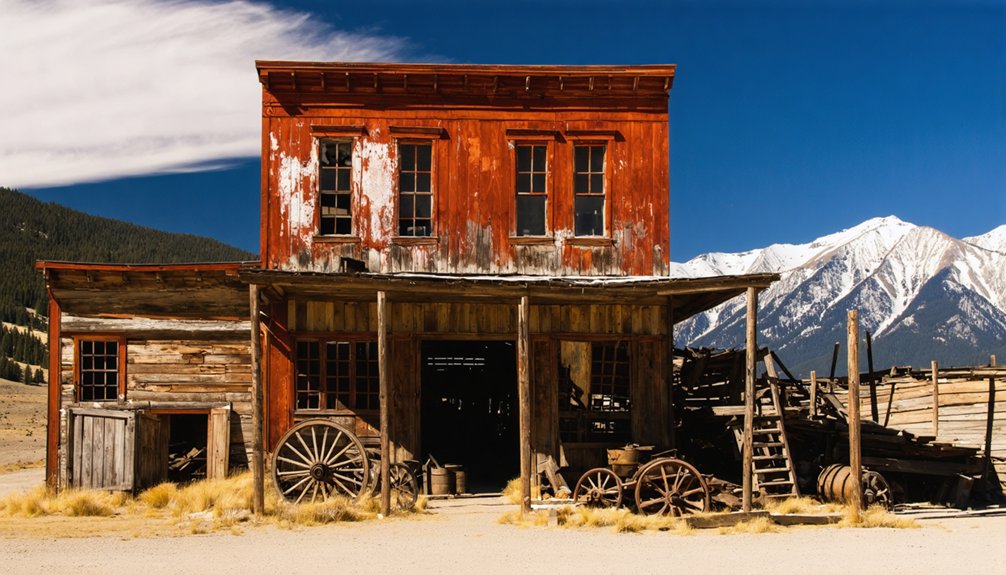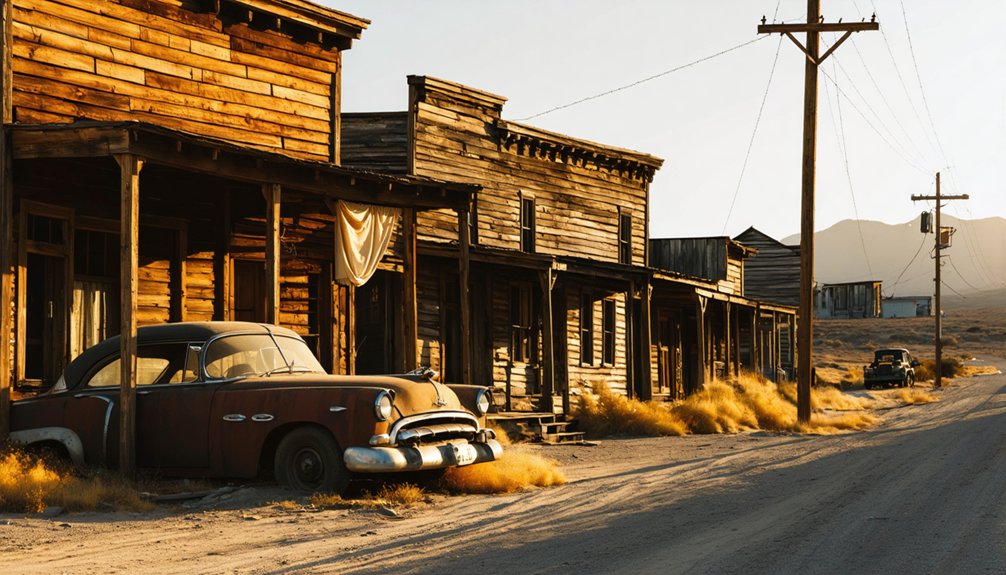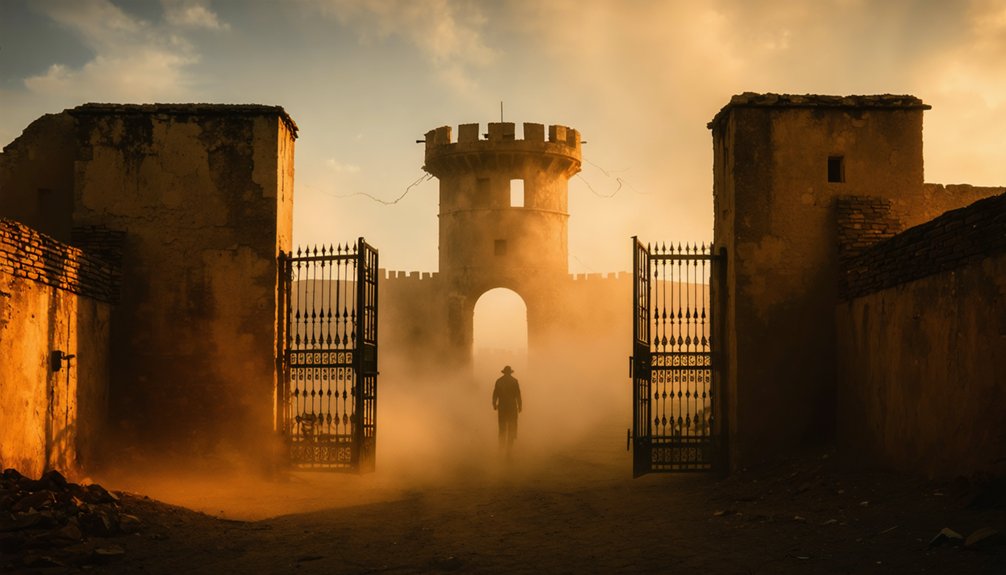
America’s frontier forts harbor spectral remnants of their violent pasts. You’ll encounter the Six Diablos with flaming swords at the Alamo, Fort Leavenworth’s Lady in White who terrorizes night wanderers, and faceless Civil War soldiers performing eternal drills. Military outposts like Fort Bowie and the Disciplinary Barracks feature dramatic temperature drops, phantom footsteps, and disembodied voices. These haunted installations offer night tours where your skepticism may quickly dissolve into belief.
Key Takeaways
- The Alamo houses six spectral figures with flaming swords who appeared after the 1836 battle.
- Fort Leavenworth contains 36 documented haunted sites, including the infamous Lady in White who terrorizes nighttime visitors.
- Disciplinary Barracks report disembodied voices, footsteps of former inmates, and dramatic temperature drops signaling spectral presence.
- Revolutionary War echoes manifest as phantom footsteps, faceless soldiers in period uniforms, and distant cannon fire during anniversaries.
- Abandoned military installations like Fort Bowie offer paranormal tours with evidence including sightings of period ghosts and cold spots.
The Alamo: Six Diablos and Their Flaming Swords
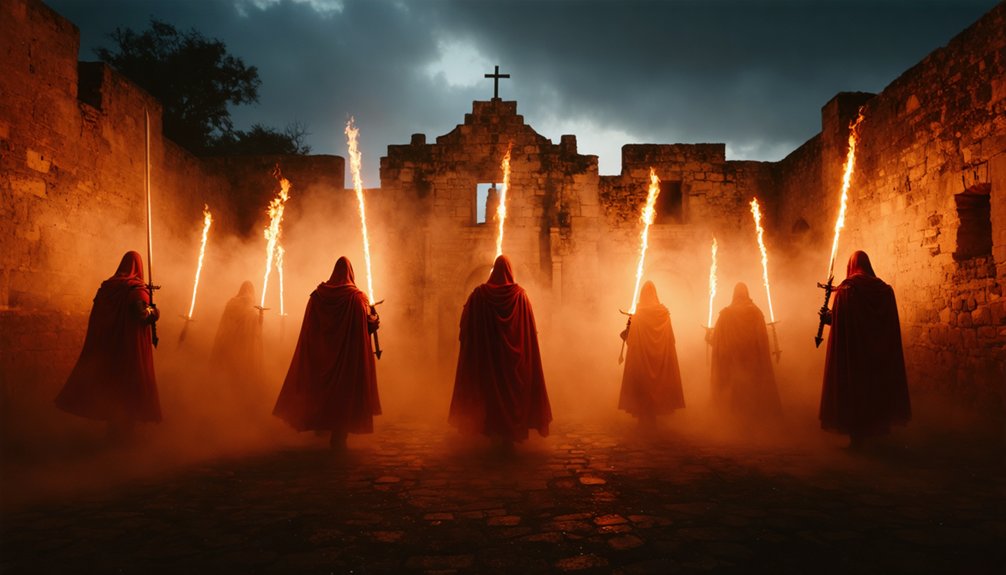
Among the many haunted military sites of the American West, the Alamo stands as perhaps the most infamous spiritual battleground, where the legend of the Six Diablos has persisted for nearly two centuries.
Following the 1836 battle that claimed 189 defenders against overwhelming Mexican forces, soldiers sent to destroy the mission encountered something extraordinary. Six spectral figures wielding flaming swords appeared, frightening troops who refused to burn the sacred site despite their commanders’ threats. These diablo sightings saved the former mission from destruction.
Security personnel continue to report encounters with these spiritual guardians, alongside phantom footsteps, gunfire, and apparitions of fighters like Davy Crockett. The Mission San Antonio de Valero, as it was originally named, underwent a significant transformation from a religious institution to a military fortress by 1803. The eerie atmosphere intensifies after dark, which explains why many of the 4 million visitors annually avoid staying late at the historic site.
Whether former monks or fallen defenders, these six diablos represent the unresolved tension between the site’s religious origins and its bloody history as a symbol of Texas freedom.
Fort Leavenworth’s Lady in White and Other Spectral Residents
Fort Leavenworth’s most famous spectral resident, the Lady in White, terrorizes anyone awake at night in the Rookery with her screams and chases, having allegedly been tortured and killed while soldiers were away.
You’ll also encounter the tragic Lady in Black, Catherine Rich, who wanders the National Cemetery with a lantern calling for her lost children who disappeared near the river in 1880. What makes her story particularly heartbreaking is that her children Ethan and Mary were eventually rescued by Fox Indians, but Catherine died of pneumonia before learning of their safety.
The fort’s 36 documented haunted sites include the Disciplinary Barracks where disembodied voices of former inmates persist, and other entities like Major Edmund Ogden who walks the halls in spurred boots and the mysterious Whistling Child Rose. Located at 290 Grant Ave, Fort Leavenworth stands as the oldest active military post west of the Mississippi River.
The Infamous Lady
Wandering the historic grounds of Fort Leavenworth, you’ll likely encounter stories of its most infamous spectral resident—the Lady in White. This apparition, believed to be either a cavalry soldier’s wife killed during Native American attacks or Catherine Rich who died searching for her lost children in the 1880s, manifests in various forms across the fort.
Lady sightings concentrate at the Rookery (particularly Room 4714) and the General’s Residence, where she’s known for floating through walls and manipulating physical objects. Visitors and staff have documented numerous ghostly encounters throughout the fort’s long history.
Ghostly encounters typically include screams echoing through empty hallways, sudden temperature drops, and glimpses of an elderly grey-haired woman in white or Catherine in her calico dress carrying a lantern.
The fort’s establishment in 1827 provides historical context for these hauntings, cementing the Lady in White as Fort Leavenworth’s most persistent supernatural inhabitant. Another famous entity, the Lady in Black, is known to perform benevolent acts like reading to children and helping with household chores.
Whistling Child Rose
Visitors to the historic Rookery, Fort Leavenworth’s oldest residence built in 1832, often report encounters with a spectral duo quite different from the infamous Lady in White. Here, you’ll find Rose, a child ghost known for her distinctive whistling that echoes through the hallways.
She’s typically accompanied by her spectral nanny, creating an eerie child-care dynamic that spans generations of military families.
Rose’s whistling isn’t the only paranormal phenomenon you’ll experience in America’s oldest active military post. The fort is famously known as the U.S. Army’s most haunted post with over 30 documented ghost stories. The Rookery hosts numerous entities, including Major Edmund Ogden, who died in 1855 and still patrols in spurred boots.
Tower 8, a notorious guardhouse within the fort, continues to generate mysterious phone calls to the guard control room long after a soldier’s tragic suicide there.
Witnesses report vanishing objects, unexplained footsteps, and full apparitions within these historic walls. The persistent presence of child ghosts like Rose contributes to Fort Leavenworth’s reputation as one of the most haunted military installations in the country.
Disciplinary Barracks Spirits
Among the most chilling spirits haunting Fort Leavenworth’s grounds, the Lady in White stands as the most infamous resident of the Disciplinary Barracks. This grey-haired apparition, believed to be a cavalry soldier’s widow killed during a Native American attack, screams and chases those brave enough to wander the Rookery at night.
The disciplinary barracks hauntings include:
- Room 4714, where the Lady floats in and out, disturbing bedding and personal belongings.
- Dramatic temperature drops of approximately 1 degree per minute, signaling spectral presence.
- Disembodied voices and footsteps of former inmates who never truly left.
You’ll also encounter Catherine Rich, the “Lady in Black,” eternally searching the cemetery for her children with lantern in hand. The oldest building on the base, the Rookery has become notorious for paranormal activity since its establishment in 1827.
Sometimes engaging in ghostly interactions with the living through unexplained pushes in nursery areas.
Phantom Footsteps and Faceless Men: Fort Mifflin’s Haunted Legacy
You’ll encounter William Howe’s vengeful spirit wandering the grounds where he once commanded British troops during the Revolutionary War. His presence is often accompanied by disembodied cannon fire and musket reports that echo across the fort.
The nightly paranormal patrols at Fort Mifflin frequently document these Revolutionary War remnants, with investigators capturing EVPs of military commands and formation calls that correspond to Howe’s tactical preferences.
Fort Mifflin’s faceless soldiers—recognizable only by their colonial-era uniforms—reportedly perform phantom guard duty at precise intervals, maintaining their centuries-old watch despite the passage of time. The fort has been the site of paranormal activity since 1778 when wailing sounds were first recorded during the siege.
William Howe’s Vengeful Spirit
The most notorious ghost haunting Fort Mifflin’s weathered walls is certainly William H. Howe, a Union private executed by hanging in 1864 for murder and desertion.
Despite Howe’s remorse before death, claiming self-defense when he shot his enrolling officer, his spirit now manifests as the terrifying “Faceless Man” in Civil War attire, his features obscured like the execution bag that covered his head.
Vengeful encounters with Howe’s spirit include:
- Physical interactions where visitors report being touched, pushed, or restrained by unseen hands
- Objects mysteriously moving or disappearing when disrespectful behavior occurs
- Aggressive reactions to loud noises, particularly near the gallows area and casemate #11
This aggressive entity demands your silence and respect, a spectral reminder of military justice in America’s bloodiest conflict.
Revolutionary War Echoes
While William Howe’s vengeful presence dominates Fort Mifflin’s paranormal reputation, Revolutionary War history echoes throughout the fort in more subtle, yet equally chilling manifestations.
You’ll encounter phantom footsteps in the casemates—heavy boots marching where soldiers once patrolled, abruptly stopping as if vanishing into thin air.
Faceless men in period uniforms haunt the officer’s quarters and main gate, their shadowy forms gazing toward the Delaware River. These spectral soldiers appear most frequently in areas where Revolutionary casualties occurred.
Unexplained cold spots permeate the underground tunnels, particularly in spaces where wounded men once suffered.
The ghostly echoes of battle persist as well—distant cannon fire and musket shots pierce the night air, especially during November’s siege anniversary.
Paranormal investigators have captured both audio recordings and shadowy figures, confirming what visitors have reported for decades.
Nightly Paranormal Patrols
As darkness settles over Fort Mifflin‘s weathered walls, phantom footsteps begin their nightly patrol through the ancient corridors, marking the change from tourist attraction to paranormal hotspot.
You’ll encounter the spectral routine of soldiers from multiple conflicts, still performing their duties centuries later.
Your paranormal evidence might include:
- EVPs capturing Elizabeth Pratt’s anguished screams—her spirit lingering after losing her children to yellow fever in 1802-1803
- Unexplained movement of heavy objects during investigations
- Faceless Civil War soldiers performing drills and cleaning weapons
Fort Mifflin’s ghostly encounters aren’t limited to visual phenomena—many visitors report smelling phantom cannon smoke and hearing disembodied screams that have prompted actual police responses.
The fort’s casemates, barracks, and hospital areas remain active with these unexplained manifestations.
Paranormal Phenomena: The Sounds and Sights of Ghostly Soldiers
Many visitors to historical Old West forts have experienced inexplicable phenomena that defy rational explanation, suggesting these military outposts remain active long after their official abandonment.
The ghostly echoes of heavy boots marching across boardwalks and empty corridors are among the most commonly reported occurrences, particularly during traditional reveille hours.
Spectral sightings abound across these frontier fortifications. You might encounter Fort Laramie’s menacing Civil War soldier, Fort Mifflin’s infamous “Faceless Man,” or even General Custer himself at Fort Leavenworth.
The disembodied voices and whispers that permeate these historical structures further reinforce their haunted reputations. From Fort Mifflin’s wailing “Screaming Woman” to the commanding officer at Fort Laramie’s Old Bedlam who still demands silence, these apparitions seem determined to maintain their eternal watch.
From Ghost Towns to Haunted Outposts: Abandoned Military Sites
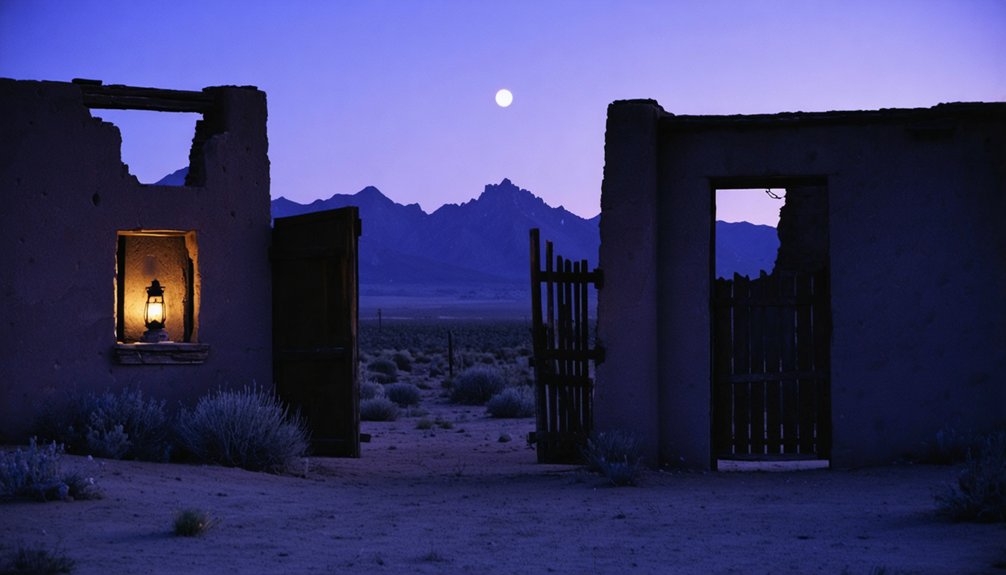
Throughout the American West, abandoned military installations stand as silent witnesses to frontier history, their crumbling adobe walls and weathered foundations harboring more than just architectural remains.
Fort Bowie’s ruins tell stories through abandoned memories of Apache conflicts, while Charleston’s lawless past echoes with ghostly echoes of notorious outlaws like Frank Stilwell.
You’ll discover these sites offer more than historical significance—they’re portals to another time.
- Fort Bowie operated from 1862-1894, requiring a 1.5-mile hike to access its preserved adobe walls.
- Charleston thrived as Tombstone’s neighbor until silver processing declined, leaving only foundations.
- WWII and Cold War bases like Roosevelt Road remain hazardous, with unexploded ordnance and toxic chemicals lingering decades after abandonment.
These forgotten outposts reveal America’s military evolution from frontier defense to global warfare.
Night Tours and Paranormal Investigations at Historical Forts
When darkness falls over America’s historic frontier forts, a different kind of exploration begins, transforming these daytime historical attractions into centers for paranormal investigation.
You’ll find night tours offered at several military outposts, including Fort Riley’s October ghost tours and Fort Leavenworth’s 1.5-hour Haunted Walking Tour.
Fort Casper schedules bi-annual paranormal investigations where you’re equipped with spirit boxes and detection devices that illuminate when supernatural presence is suspected.
The evidence collected is compelling—from the boy in period clothing vanishing at Fort Casper to Captain’s Quarters at Fort Leavenworth experiencing self-opening doors despite lacking electricity.
Cold spot detection in Fort Columbia’s underground tunnels reveals temperature drops exceeding 10 degrees.
Bring your skepticism or belief—these tours welcome both, providing paranormal equipment while you investigate spine-chilling screams and mysterious footsteps documented by previous visitors.
How Architecture and Landscape Amplify the Haunted Experience
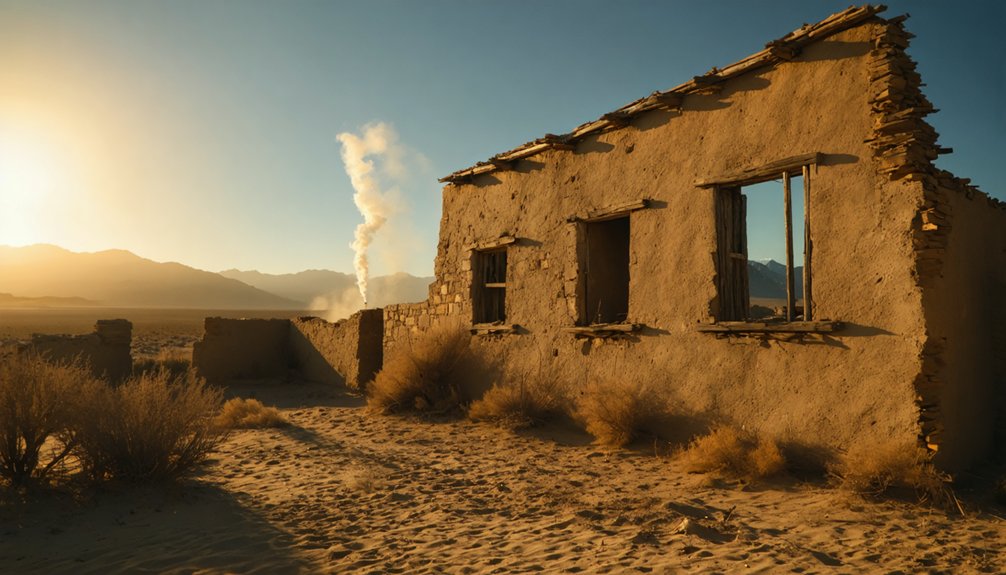
The architectural elements and natural settings of America’s frontier forts play essential roles in creating the haunted experiences reported by visitors and investigators alike.
Exploring the forgotten towns of the great plains reveals the remnants of a bygone era, where stories of settlers and their struggles still linger in the air. These towns, often overshadowed by more prominent destinations, hold a unique charm and an eerie tranquility that invites curiosity. Visitors are drawn to the desolate streets, hoping to uncover the mysteries that time has left behind.
When you walk through Fort Mifflin’s torch-lit passageways, the interplay of light and shadow creates architectural illusions that transform ordinary corners into supernatural encounters.
- Riverfront acoustics at forts like Mifflin amplify disembodied sounds, making whispers seem to follow you across parade grounds.
- Unfinished structures at Fort East Martello create spatial disorientation through architectural voids that generate unexplained phenomena.
- Adobe construction at Fort Laramie lacks modern electrical systems, yet visitors report inexplicable bright lights contrasting with the aged buildings.
These design features, combined with fog-laden environments and labyrinthine pathways, transform ordinary historical sites into portals to the paranormal.
Frequently Asked Questions
Can Visitors Bring Paranormal Equipment During Regular Daytime Tours?
No, you can’t bring paranormal equipment during regular daytime tours. Most forts enforce strict equipment regulations requiring after-hours investigations instead. Proper paranormal etiquette requires using specialized gear during designated events only.
Have Any Haunting Reports Been Officially Documented by Military Personnel?
You’ve hit the nail on the head – military sightings have been extensively documented at historic forts, with personnel reporting apparitions, phantom sounds, and physical disturbances that prompted official ghost investigations at multiple installations.
What’s the Best Season or Weather for Experiencing Paranormal Activity?
You’ll experience more paranormal activity during fall evenings when temperatures drop and humidity rises. Cold, moonlit nights with minimal wind create ideal conditions for capturing evidence, especially during October and November.
Are Any Haunted Forts Considered Dangerous Due to Supernatural Threats?
Yes. You’ll face legitimate supernatural risks at Bhangarh Fort with its government-enforced dusk restrictions, while Fort Delaware’s documented ghostly encounters include physical contact that some consider potentially dangerous manifestations.
Has Technology Changed How Researchers Document Hauntings at Historic Forts?
You’ll find ghost hunting has transformed through digital documentation at historic forts, with EMF meters, thermal imaging, and AI analysis replacing subjective experiences with measurable data and extensive environmental monitoring systems.
References
- https://rivercityghosts.com/americas-most-haunted-places-in-the-west-and-south-west/
- https://www.military.com/feature/2025/10/25/haunted-military-sites-skeptics-guide-most-allegedly-haunted-military-sites.html
- https://www.geotab.com/ghost-towns/
- https://en.wikipedia.org/wiki/List_of_reportedly_haunted_locations_in_the_United_States
- https://www.youtube.com/watch?v=JXmm6-JZVIY
- https://nightlyspirits.com/top-places-to-experience-the-dark-wild-west/
- https://usghostadventures.com/haunted-stories/the-alamo/
- https://ghostcitytours.com/san-antonio/haunted-san-antonio/haunted-alamo-ghosts/
- https://rivercityghosts.com/the-spirits-of-the-alamo/
- https://www.legendsofamerica.com/tx-alamoghosts/