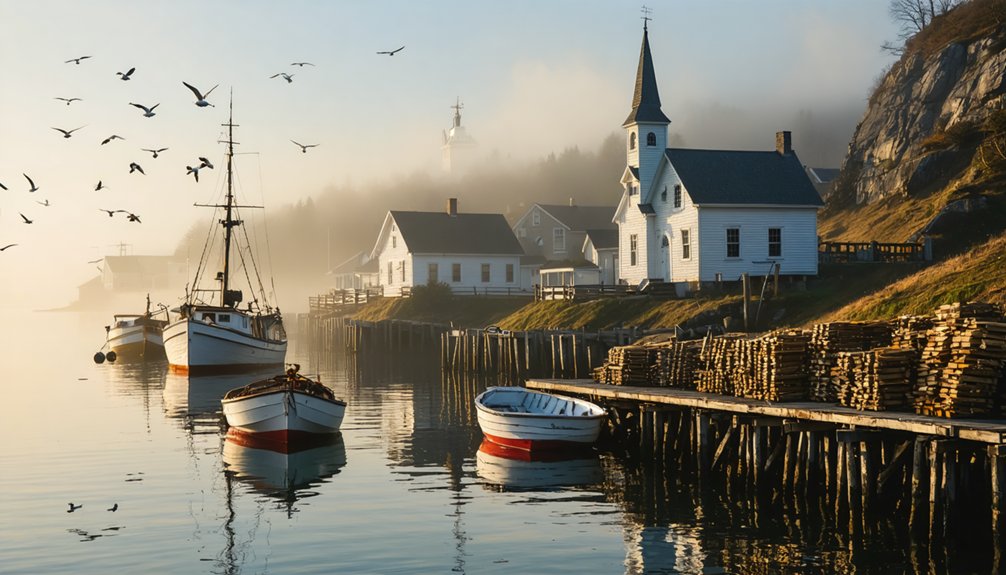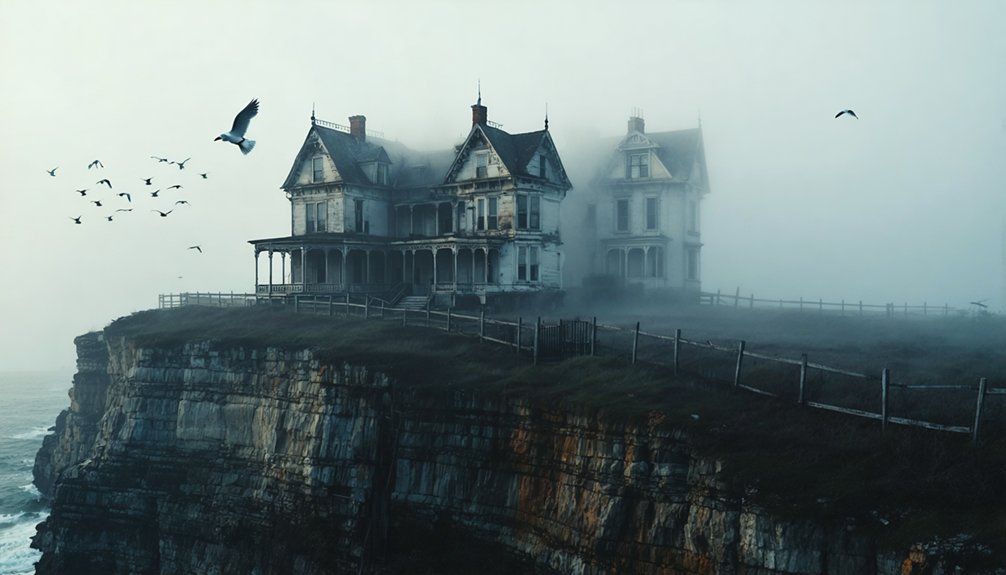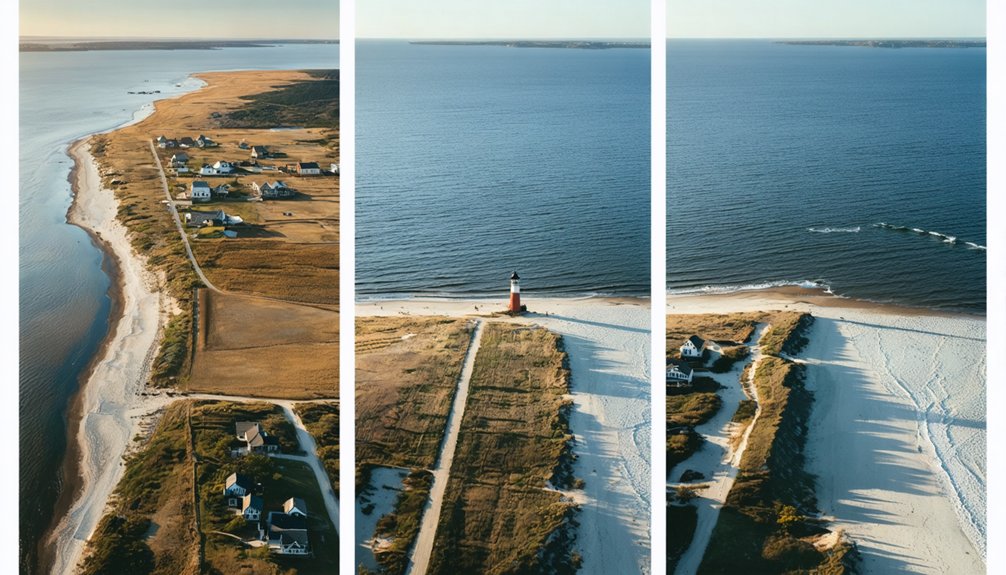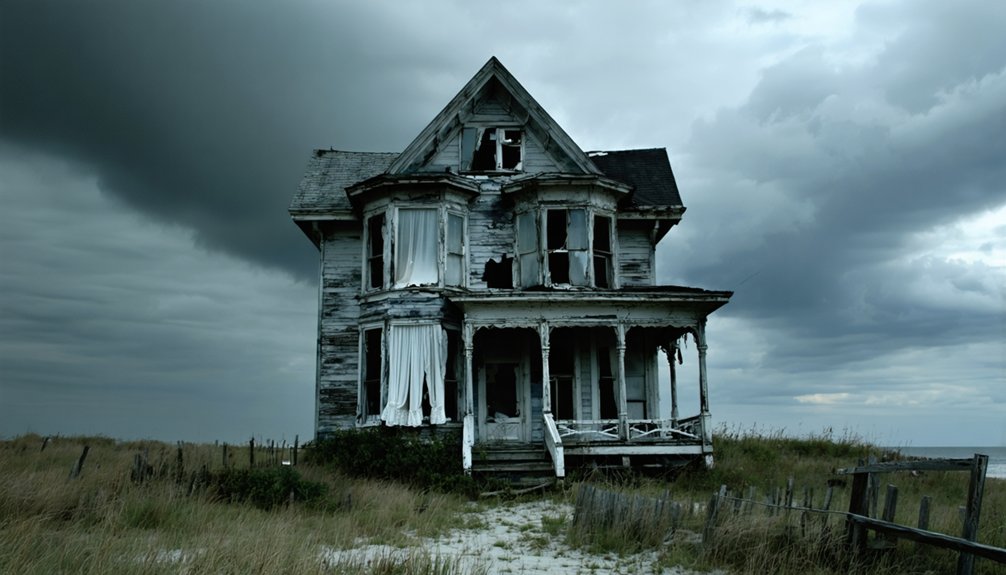
Along America’s eastern shores, you’ll find ghostly remnants of once-vibrant coastal communities. Sea Breeze’s abandoned resort frames Delaware Bay, while Cape Lookout’s spectral keeper’s quarters stand frozen in time. The “lone house” of Gilchrist defies Hurricane Ike’s destruction, and Cumberland Island’s Carnegie ruins whisper of Gilded Age excess. These hauntings exist in perpetual twilight, where forgotten histories and structural echoes await those who dare explore their crumbling thresholds.
Key Takeaways
- Sea Breeze, a once-thriving Delaware Bay resort town, was abandoned after Hurricane Gloria in 1985.
- The Carnegie Ruins on Cumberland Island feature a 59-room seaside castle where visitors report ghostly apparitions at dusk.
- Portsmouth Village in the Outer Banks became a ghost town in 1971, leaving behind a Methodist church and historical buildings.
- Cape Lookout’s ghost village contains abandoned lighthouse keepers’ quarters with Queen Anne architecture, accessible only by boat.
- Hurricane Ike’s 2008 storm surge destroyed Gilchrist, Texas, leaving only the iconic “lone house” standing amid complete devastation.
Sea Breeze: The Vanished Delaware Bay Resort Town

While the waters of Delaware Bay now lap at vacant shores, Sea Breeze once thrived as a premier resort destination established in the 1800s. You can almost hear the ghostly remnants of laughter from vacationers who arrived via the John A. Warner steamboat in 1887, heading straight to the luxurious 40-room Warner House hotel.
Time has claimed Sea Breeze, leaving only whispers of its grand past where steamboats once delivered guests to bayside luxury.
The community’s resilience was tested repeatedly by devastating fires that claimed the Warner House in 1890 and later the Seabreeze Hotel in the 1940s.
During Prohibition, you’d find the town transformed into a smuggler’s paradise, with speakeasies operating behind closed doors. The rumored speakeasy operations at the Seabreeze attracted visitors seeking illicit entertainment during the dry years.
Hurricane Gloria’s 1985 destruction of the Sea Breeze Tavern marked the final chapter in this seaside nostalgia.
Today, you’ll find only scattered foundations and weathered docks—silent witnesses to a vanished era. The Department of Environmental Protection eventually acquired most properties after residents could no longer protect them from the natural elements.
Specters of Cape Lookout: North Carolina’s Ghost Village
You’ll find the lighthouse keepers’ abandoned quarters standing eerily vacant amid Cape Lookout’s historic district, their lives interrupted mid-century when isolation and hardship drove families to mainland shores.
The salt-bleached wooden structures—once vibrant with Queen Anne and American Craftsman details—now serve as weathered monuments to a coastal community that thrived before World War II’s artillery batteries replaced fishing boats.
Maritime ghosts seem frozen in time throughout the 810-acre district, where twenty contributing buildings including the Life-Saving Station and “Coca-Cola House” remain accessible only by boat, their stories preserved in National Park Service plaques amid advancing sand and spectral “ghost forests.” Gordon Willis House is currently the only structure that remains habitable for staff and volunteers who maintain this historic area. Visitors should prepare for exploration with bug spray and comfortable walking shoes as they venture through this well-preserved historical landscape.
Lighthouse Keepers’ Abandoned Lives
Along the windswept shores of Cape Lookout, the abandoned lives of lighthouse keepers echo through time, their stories etched into the weathered structures they once called home.
You’ll sense their presence in the 1907 Keepers’ Quarters, where lighthouse relics tell tales of isolated existence and dutiful vigilance.
The 1859 lighthouse stands as their legacy, a prototype that influenced all Outer Banks light structures.
When you explore these spectral spaces, you’ll find yourself walking through rooms where keeper stories whispered between walls now crumble under coastal elements.
After 1915’s merger forming the Coast Guard, keeper traditions faded.
Their abandoned quarters—perfectly preserved in this ghost town—remain accessible only by ferry.
The distinctive black and white diamond pattern of the 163-foot lighthouse has guided mariners through treacherous waters since the late 1850s.
Each interpretive plaque you encounter reveals another fragment of their forgotten maritime lives, suspended in time since their final departure.
Much like the island of Portsmouth established in 1753, these locations became ghost villages after residents abandoned them due to various challenges.
Salt-Bleached Memory Remnants
Beyond the lighthouse keepers’ quarters, a broader ghost town unfolds across Cape Lookout’s windswept dunes.
Among the crumbling facades and rusted signage, tales of abandoned settlements in the wild west emerge, steeped in mystery and nostalgia. Each weathered structure holds stories of its former inhabitants, revealing glimpses of a rugged past etched into the landscape. As the wind whispers through the remnants, one can almost hear the echoes of laughter and hardship that once filled these now-silent streets.
You’ll discover Queen Anne and American Craftsman structures—silent witnesses to lost coastal legacies—scattered across 810 acres of this National Historic District.
The weathered architectural whispers of the Life-Saving Station (1888), Coca-Cola House, and Casablanca (c.1930) tell stories of a vanished community.
By 1921, only a handful of families remained, driven away by storms, economic hardship, and wartime disruption.
Walking through the village’s circulation network, you’ll encounter National Park Service plaques marking these abandoned homes.
Only the Gordon Willis House remains habitable today.
This seldom-seen attraction requires preparation—bug spray, walking shoes, and a willingness to explore a community that time forgot.
Maritime Ghosts Frozen
Preserved in a haunting tableau of maritime abandonment, the skeletal remains of Portsmouth Village stand frozen in time since its final residents departed in 1971.
You’ll discover a ghost town that once thrived as the Outer Banks’ largest settlement, where coastal whispers echo through empty beach bungalows and Queen Anne structures.
Portsmouth Island’s meteoric rise from its 1753 establishment to a bustling port of 1,000 souls has reversed into perfect stillness.
The Methodist church, general store, and weathered homes create a maritime necropolis now guarded by the National Park Service.
The 1888 Life-Saving Station and 1916 Coast Guard buildings stand as sentinels to a vanished way of life.
Nature’s shifting sands that once brought prosperity ultimately sealed the community’s fate when inlets closed and economic lifelines disappeared.
Swept Away: The Haunting Remains of Gilchrist, Texas
The haunting silhouette of Gilchrist, Texas stands as a ghostly memorial to nature’s merciless power, where Hurricane Ike‘s 20-foot storm surge swept away an entire community in September 2008.
You’ll find few traces of the once-thriving fishing village as you traverse this hurricane aftermath. Over 100 residents vanished, some never to be found, while structures disappeared into the Gulf’s hungry maw. The notorious “lone house” remains—a solitary sentinel amid devastation, uninhabited yet defiant. Many believe the structure survived due to major remodeling efforts completed after Hurricane Rita.
The Gulf devoured a community whole, leaving only whispers of what once was and a single stubborn structure.
Time moves differently here. The peninsula’s history repeats itself, echoing Indianola’s twin destructions in 1875 and 1886. The beautiful waterfront town transformed into complete ruins, leaving residents with constant reminders of what once was.
Despite fleeting attempts at community resilience, Gilchrist exists now as a phantom—its seafood traditions, local businesses, and cultural identity erased by water and wind, leaving only scattered remains for you to discover.
Carnegie Ghosts: The Ruins of Phillips Island
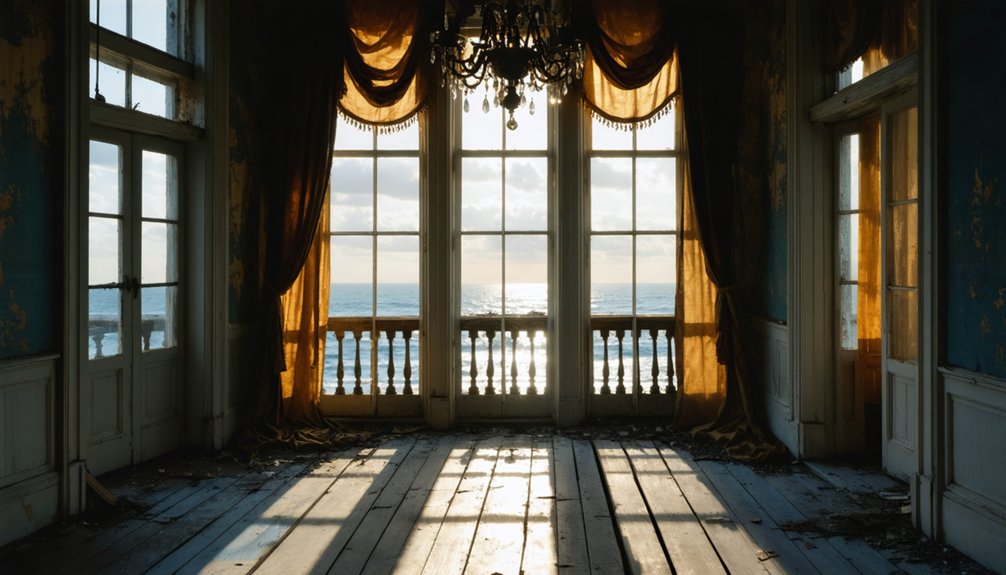
While hurricane-ravaged Gilchrist reveals nature’s destructive force, Cumberland Island’s Carnegie ruins whisper of human ambition frozen in time and stone.
You’ll find the skeletal remains of Thomas and Lucy Carnegie’s 59-room seaside castle, where wealth once erected a 35,000-square-foot monument to Gilded Age excess.
Approaching the tabby ruins, you’re walking the same grounds where 200 servants once maintained this seasonal retreat.
The Carnegie legacy stands in crumbling walls, silent since the 1929 market crash prompted the family’s departure.
By 1959, alleged arson transformed opulence into the architectural ghosts you see today.
Many visitors report ghostly apparitions at dusk when shadows play across the remnants of four-story turrets.
Once a beacon for sailors, Dungeness now beckons those seeking freedom among remnants of faded grandeur and untold stories.
Lucy Carnegie, who became the first female Yacht Club member, continued developing the estate after her husband’s unexpected death in 1886.
The mansion was originally constructed in 1802 by Phineas Miller before being rebuilt by the Carnegie family in 1884.
Untouched Wilderness: St. Phillips Island’s Eerie Solitude
You’ll find St. Phillips Island remains virtually untouched by modern development, creating an eerie contrast to the surrounding resort-filled coastline.
Its 4,680 acres of pristine wilderness—protected since 1986 as a National Natural Landmark—stand as a spectral reminder to what coastal South Carolina looked like before human intervention.
The island’s ancient sand dunes, virgin-growth maritime forests, and tidal creeks continue their silent, undisturbed cycles as they’ve for thousands of years, creating an unsettling reminder of nature’s persistence in the absence of humanity.
Nature Reclaims All
Hidden from human intervention for centuries, St. Phillips Island stands as nature’s defiant symbol to ecological legacy.
You’ll witness the haunting “boneyards” where maritime forests surrender to the sea—trees collapsing upon each other as shorelines erode beneath their roots.
Across this 4,680-acre sanctuary, nature’s resilience manifests in virgin-growth forests and marshes untouched by timber operations or development.
The ancient shell middens revealed by fallen cedars whisper of civilizations long vanished.
While a modest beach house and cleared path represent mankind’s minimal footprint, the island remains gloriously wild.
Endangered species reintroduced after eradicating feral hogs now thrive among 250 different creatures inhabiting this pristine landscape.
In this spectral preservation, you’re witnessing time’s true course—not human interference but nature’s own undisturbed rhythm.
Pristine Coastal Isolation
Where civilization’s footprint falters, St. Phillips Island stands as a haunting reminder of pristine wilderness untamed by human interference.
You’ll find yourself enveloped in coastal tranquility that few modern souls have experienced, accessible only by boat through tidal creeks and salt marshes.
The island’s spectral qualities emerge from:
- Five distinct ecosystems compressed within 3.4 miles, creating an unnatural density of biodiversity
- Ancient pottery fragments that mysteriously surface after storms, origins still unknown
- Virgin maritime forests draped in Spanish moss that haven’t felt the axe in centuries
- The Turner House – the island’s sole structure standing in defiance of nature’s reclamation
This barrier island’s eerie solitude remains protected by conservation easements, ensuring its spectral beauty endures while mainland development races forward.
Salton Sea: California’s Decaying Desert Shoreline
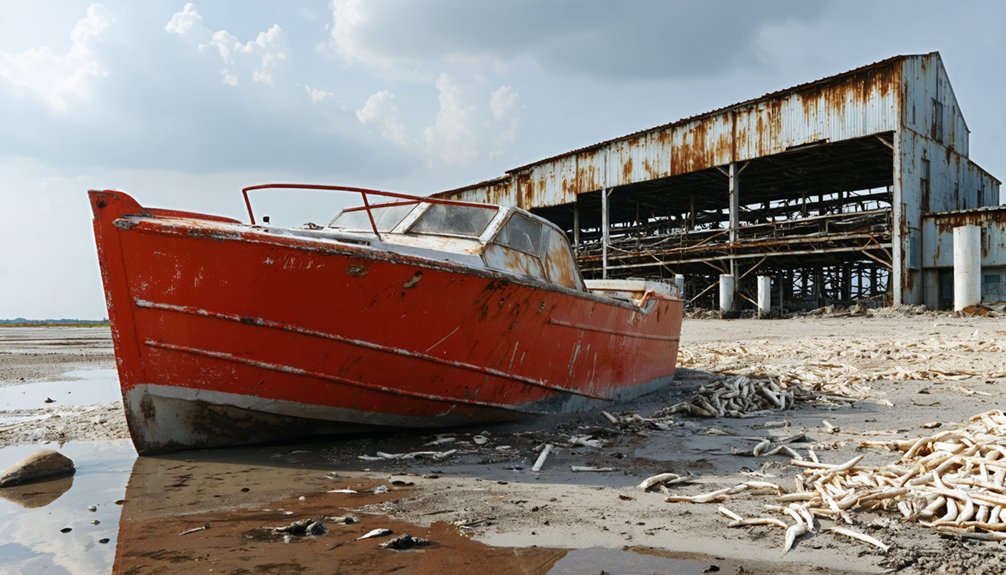
In the midst of California’s scorching desert landscape lies the Salton Sea, a haunting proof of human engineering gone awry.
Once a thriving tourist destination, these desert shorelines now host ghostly resorts and abandoned infrastructure—skeletal remains of Penn Phillips’ failed development dreams.
You’ll witness a timeline of decay: born from catastrophic flooding in 1905, transformed into a vacation paradise by mid-century, then abandoned after devastating storms in the 1970s.
The ecological decline accelerated as agricultural runoff poisoned waters that have no natural outlet.
Today, you can walk among crumbling foundations where pelicans gather on increasingly saline waters.
The shrinking shoreline exposes toxic lakebed, creating dust that carries the sea’s contaminated history into surrounding communities—a freedom from oversight that became environmental imprisonment.
Maritime Shadows: Forgotten Lighthouse Communities of the Atlantic
Sentinels of forgotten coastlines, Atlantic lighthouses and their surrounding communities face a silent battle against relentless natural forces.
You’ll find these maritime shadows particularly vulnerable along the Delaware Bay, where historic structures like East Point Lighthouse stand just 120 feet from encroaching tides that sometimes reach its door.
Four stark realities of lighthouse preservation:
- The original Cape Hatteras Lighthouse vanished to erosion despite standing a mile from shore.
- Delaware Bay communities remain “forgotten” despite equivalent erosion threats to Atlantic towns.
- Coastal heritage sites receive funding based on tourism revenue, not historical significance.
- Sea level rise accelerates the natural westward migration of barrier islands.
While 779 lighthouses still stand nationwide, many face abandonment as maintenance costs soar beyond $400,000 for even basic repairs.
Frequently Asked Questions
Are Paranormal Investigators Allowed to Conduct Overnight Research at These Locations?
You’re generally restricted without explicit permission. Paranormal investigators must secure proper authorizations, following strict investigator guidelines. Your spectral documentation requires adherence to chronological analysis protocols despite structural anomalies complicating access.
What Unexplained Phenomena Have Locals Reported Near These Abandoned Towns?
Have you felt that chill down your spine at night? You’d witness ghostly sightings like the Gray Man on Pawleys Island, eerie sounds of phantom parties, strange floating lights, and oppressive silence that defies natural explanation.
Do Any Properties Within These Ghost Towns Remain Privately Owned?
Yes, you’ll find ghost town properties under private ownership despite deterioration. Banks cling to foreclosed mansions while heirs maintain ancestral estates—forgotten treasures caught in legal limbo amid crumbling structural anomalies.
Which Location Has the Most Documented Supernatural Occurrences?
Like a lighthouse drawing lost souls, the Graveyard of the Atlantic leads supernatural hotspots with over 2,000 documented hauntings. You’ll find these spectral manifestations chronologically clustering around shipwrecks, creating structural anomalies that beckon freedom-seeking explorers.
Can Visitors Legally Remove Artifacts or “Souvenirs” From These Sites?
No, you can’t legally remove artifacts. Artifact preservation laws impose severe legal ramifications including fines and imprisonment. Your chronological analysis of spectral documentation must preserve structural anomalies where they hauntingly remain.
References
- https://wicproject.com/travel/10-abandoned-seaside-places-in-america-that-were-once-tourist-hotspots/
- https://wpst.com/abandoned-town-new-jersey/
- https://www.expeditions.com/expedition-stories/stories/10-hidden-islands-of-the-us-east-coast
- https://flungmagazine.com/2016/06/15/the-fascinating-ruins-of-5-long-lost-beach-resorts/
- https://www.youtube.com/watch?v=iqQ_61jTGKA
- https://thehistorymom.com/2022/06/15/historical-sites-near-a-beach/
- https://www.explore.com/1889250/explore-pristine-coastal-wilderness-unique-north-carolina-ghost-town-portsmouth-island/
- https://backroadplanet.com/8-famous-east-coast-boardwalks-and-beach-towns-that-never-get-old/
- https://thedigestonline.com/new-jersey/the-forgotten-beach-town-of-nj-sea-breeze/
- https://www.onlyinyourstate.com/experiences/new-jersey/abandoned-beach-town-nj