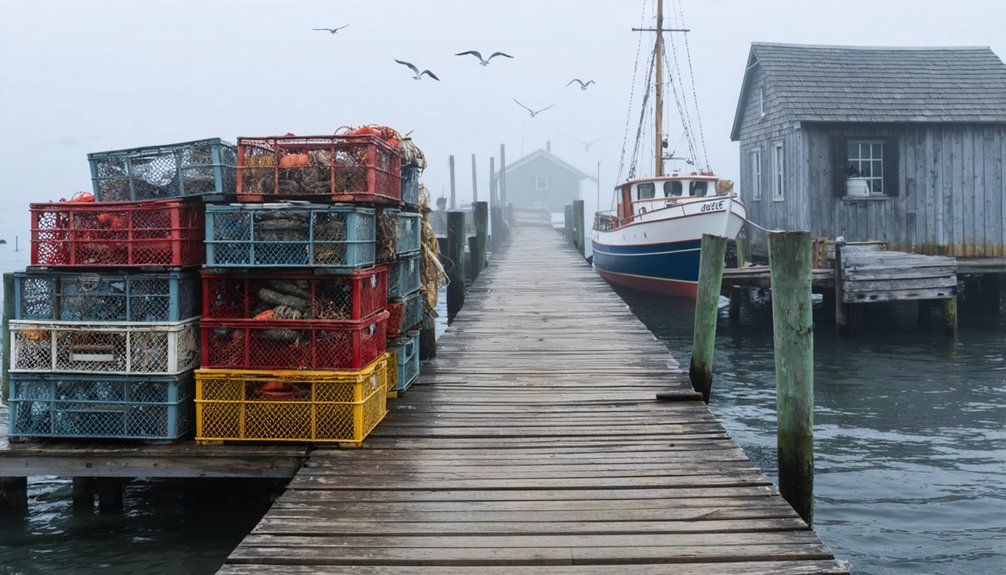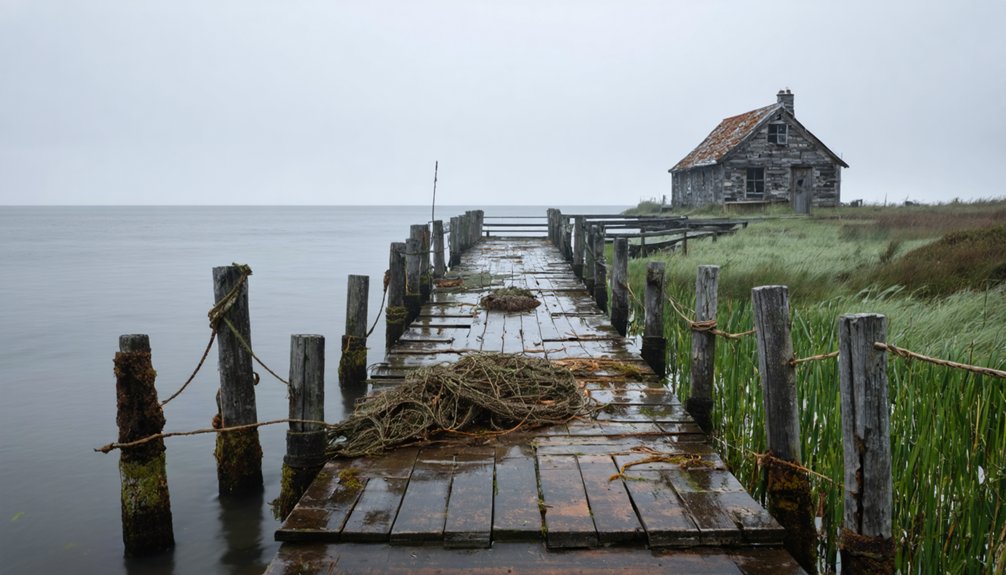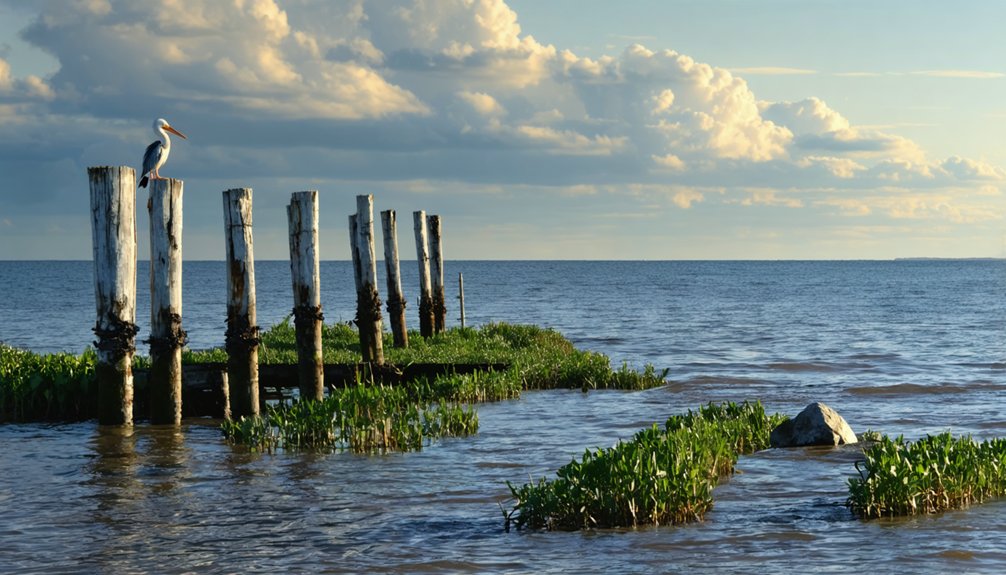
You’ll discover America’s forgotten fishing villages along both coasts, from Jones Island’s Polish settlement in Milwaukee to Terminal Island’s Japanese enclave in California. These vanished communities were erased through government condemnation, forced removal, and economic pressures despite their unique cultural practices and maritime innovations. While physical structures have largely disappeared, their legacies endure through historical photographs, archaeological findings, and memorial monuments that document their multicultural contributions. The hidden stories beneath tourist destinations reveal a deeper coastal heritage.
Key Takeaways
- Jones Island in Milwaukee once housed a thriving Polish fishing village before being condemned and erased in 1914.
- Terminal Island’s Japanese fishing community “Fish Harbor” was forcibly removed in 1942, with only a memorial remaining today.
- Cuban fishing ranchos in Southwest Florida created Spanish-Indigenous cultural fusion settlements evidenced by archaeological findings.
- Historical fishing communities in Stumpy Point and Rodanthe, North Carolina have largely disappeared despite their cultural significance.
- Ocracoke Island preserves the last remaining fish house through the Working Watermen’s Association’s preservation efforts.
Multicultural Origins: The Legacy of Jones Island and China Camp

While countless American coastal communities flaunt their maritime heritage for tourists, Jones Island presents a more complex story of cultural resilience and eventual displacement.
You’ll find no trace of the vibrant Kashubian culture that once thrived there—only Kaszube’s Park remains as evidence.
Beginning in the 1870s, these Polish Baltic immigrants created a tight-knit fishing village where knowledge passed through generations. Families shared work, assigned fishing rights collectively, and maintained traditional practices like net-cleaning and fish-drying.
The community’s distinctive identity manifested through their native Slavic language and communal decision-making. These settlers, who were primarily Slavic fishermen, established a community complete with its own Main Street and beach around 1898. Children used the shoreline as their playground, catching crayfish and steering through winter ice. Their annual catch included nearly 2 million pounds of various fish species that supported the unique village economy.
Speaking their ancestral tongue and governing through consensus, they thrived while their children frolicked along Milwaukee’s icy waters.
Despite legal challenges against industrial expansion, the city condemned the village in 1914, gradually erasing this unique multicultural fishing settlement from Milwaukee’s landscape.
Vanished Maritime Enclaves: Terminal Island’s Japanese Fishing Heritage
Just forty miles south of Los Angeles lies Terminal Island, home to what was once the thriving Japanese fishing enclave of Fish Harbor—a community whose maritime innovations transformed the American tuna industry before being systematically erased.
By 1942, the Furusato (“hometown”) had grown to 3,000 Nikkei residents whose cultural resilience flourished despite discrimination.
You’d find:
- Revolutionary bamboo pole fishing techniques that shifted American commercial focus from sardines to tuna
- A self-contained village built on pilings with its own dialect, shops, and traditions
- 250 Japanese-operated fishing vessels supporting the local economy
- A community forcibly removed within 48 hours following Executive Order 9066, their homes bulldozed
The community’s cultural heart included a judo dojo housed in a wooden building with white mats where traditional martial arts were practiced.
Today, a memorial monument stands as one of the few acknowledgments of the once-vibrant Japanese village that shaped the area’s history.
When you visit today, little remains of this maritime heritage, though its fishing innovations permanently altered California’s coastal economy.
Seasonal Settlements: The Harsh Reality of Helltown’s Winter Refuge
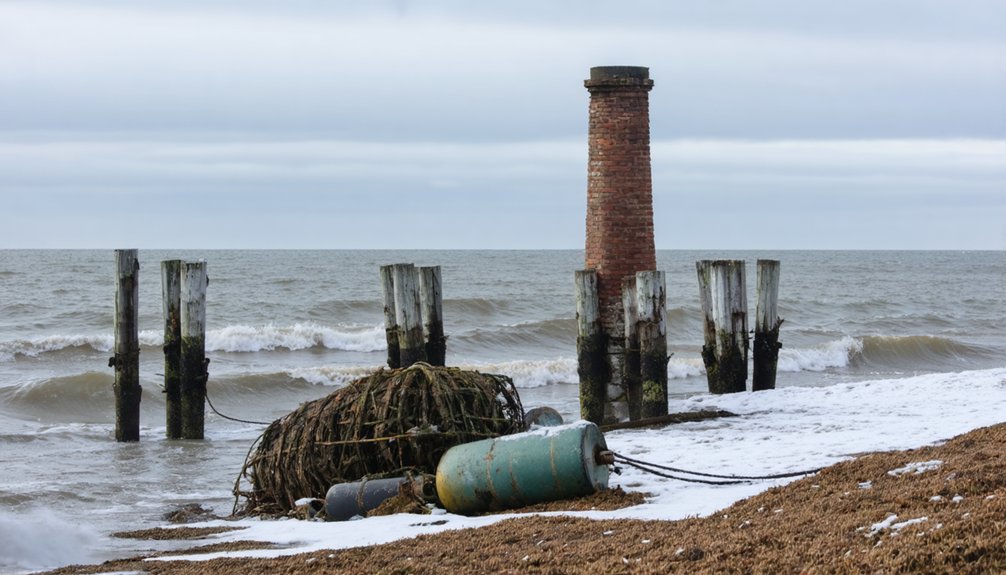
Along the isolated, wind-battered shores of Cape Cod exists another forgotten maritime community—Helltown, a seasonal refuge that served as winter sanctuary for Portuguese dorymen from the late 1800s through early 1900s.
You can almost feel the Helltown hardships these fishermen endured, constructing rudimentary shanties and bridges over tidal channels merely to survive.
With $15 weekly wages from winter fishing, they still paid fees for ice and barrels to preserve their catch. The settlement emerged from necessity—when harsh weather made rounding the point treacherous, this strategic outpost between Wood End and Race Point offered shelter.
Meager earnings quickly diminished by preservation costs—these fishermen built refuges where the sea’s fury made passage impossible.
The fishermen constantly navigated dangerous crosscurrents at Race Point, requiring exceptional seafaring skills to avoid disaster.
Much like the abandoned Boston Township that became known as Helltown in Ohio, this coastal settlement fell victim to changing times and economic shifts.
exploring the history of new market reveals a tapestry of stories, from its founding days to its decline as a bustling hub. Each historic site tells a tale of resilience, showcasing the community’s efforts to adapt and thrive despite the challenges. As we delve deeper into its past, we uncover the events that shaped the lives of its residents and the legacy they left behind.
The windswept village disappeared as modern transportation eliminated the need for seasonal refuges, but its legacy reveals how coastal communities adapted to environmental extremes, carving temporary existences from an unforgiving maritime landscape.
Cuban Fishing Ranchos: Southwest Florida’s Colonial Maritime Economy
Hidden among the mangrove-lined shores of Southwest Florida, a distinct colonial maritime network thrived from the late 18th to early 19th centuries when Spanish Cuban fishermen established seasonal fishing outposts known as ranchos.
These settlements embody a forgotten chapter of Cuban heritage along America’s coastline.
- Fishermen first arrived in the 1680s with permission from the Calusa people, creating a unique Spanish-Indigenous cultural fusion.
- Their sophisticated fishing techniques supported markets in Havana, supplying both dried fish and turtle eggs.
- Communities at Useppa Island, Punta Rassa, and river mouths formed their own creole identity, distinct from Seminoles.
- The industry collapsed around 1840 due to Seminole Wars, hurricanes, and changing political landscapes.
These coastal communities consisted of approximately 300 residents by 1831, including about 65 Spanish men married to Native American women who helped with fish processing.
Archaeological investigations at sites like Maximo Hernandez’s rancho have uncovered Spanish tobacco pipes and other artifacts that provide tangible evidence of these multicultural maritime settlements.
You can still find archaeological traces of these maritime villages where freedom and cultural exchange once flourished.
Forgotten Faces of the Catch: North Carolina’s Documented Fishing Communities

You’ll discover Charles Farrell’s overlooked photographic archive documenting North Carolina’s fishing communities during the 1980s-1990s, which captured the diversity of participants spanning Black oystermen, Vietnamese shrimpers, and generational fish house workers.
These visual records stand as vital testimony to a maritime workforce that’s declined by 57% since 2000, with fewer than 2,200 commercial fishers remaining today.
North Carolina’s once-thriving coastal communities face extinction as working waterfronts disappear, replaced by recreational fishing infrastructure and second homes that erase centuries of distinctive maritime heritage. The transition from traditional fisheries to blue crab dominance represents a significant shift in North Carolina’s commercial fishing landscape. This transformation reflects the state’s dramatic population growth from 4 million in 1950 to 10.7 million currently, placing unprecedented pressure on coastal ecosystems and traditional fishing livelihoods.
Farrell’s Lost Visual Archive
Though largely forgotten until recent historical preservation efforts, Charles A. Farrell’s photographs provide unprecedented visual documentation of North Carolina’s coastal fishing communities from 1936-1941. His lens captured what others overlooked—women, people of color, children, and elders—revealing the complex social fabric that sustained these economies.
You’ll find in Farrell’s archive:
- Intimate glimpses inside canneries, mess halls, and bunkhouses that reveal workers’ daily realities
- Documentation of massive commercial operations that dominated southern coastal economies
- Evidence of seasonal migrations and the itinerant nature of fishing life
- Religious and social institutions that anchored these mobile communities
Now preserved at North Carolina State Archives, this collection represents our most complete visual record of these vanishing places, from prominent ports like Beaufort to nearly forgotten hamlets like Terrapin Point and Marines.
Diverse Industry Participants
North Carolina’s commercial fishing industry has seen a dramatic 57% decline in participants since 2000, with fewer than 2,200 remaining by 2023. Behind these numbers are diverse communities whose livelihoods intertwined with coastal waters for generations.
You’d find not just boat captains but a network of fish dealers, whose numbers fell 23%, from 850 to 655 licenses.
The industry’s aquaculture diversity emerges in approximately 250 pond and tank operators documented in the early 2000s. Indigenous contributions, like the Meherrin tribe’s fishing weirs, represent centuries-old techniques that supported cultural traditions and economies before European arrival.
Today’s participants navigate competing interests between commercial and recreational sectors, with the latter generating nearly $1.7 billion compared to commercial’s $69 million in 2021.
These remaining commercial fishers represent a resilient yet diminishing coastal heritage.
Vanishing Maritime Heritage
Hidden beneath the modern veneer of coastal development, America’s forgotten fishing villages tell a story of resilience and isolation that spans centuries. In North Carolina, you’ll find the fading footprints of once-thriving maritime communities where vanishing traditions face modern challenges.
- Communities like Stumpy Point and Rodanthe have largely disappeared despite their former significance as commercial fishing centers.
- African-American crews, essential to menhaden fisheries from the 1920s to 1970s, represent an often overlooked chapter in maritime history.
- The Ocracoke Working Watermen’s Association exemplifies community resilience through their successful fight to preserve the island’s last fish house.
- Geographic isolation shaped unique cultural identities now at risk of being lost.
These villages aren’t just historical footnotes—they’re living testimonies to how coastal people adapted to changing tides while maintaining distinctive ways of life.
Displacement and Preservation: The Fate of America’s Historic Fishing Villages
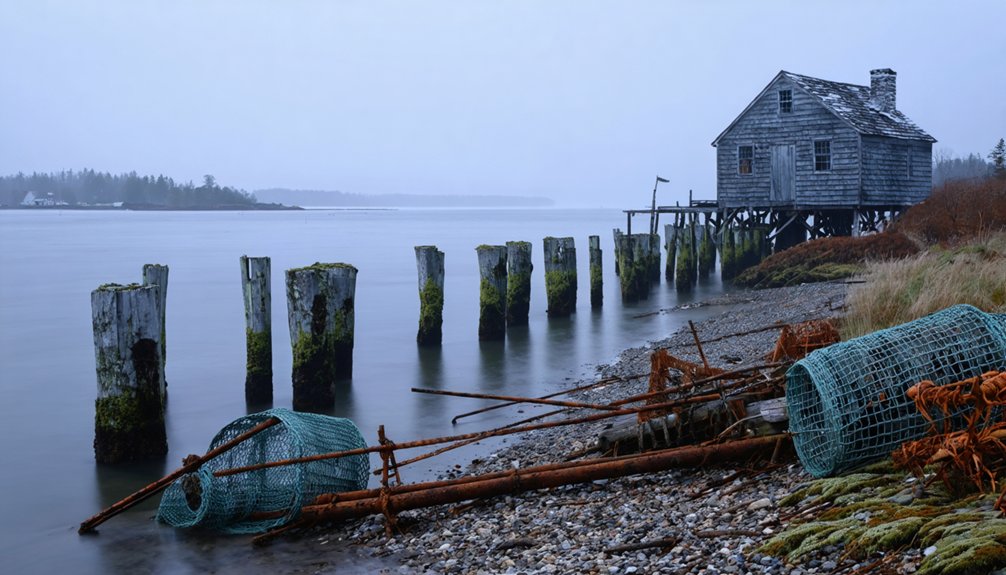
The inexorable tide of change sweeping across America’s coastal regions has transformed once-thriving fishing villages into endangered cultural landscapes.
You’ll find displacement impacts evident in communities like Oakwood Beach, where storm surges forced relocation, and Maine’s gentrified harbors where rising property values pushed out generational fishing families.
Community resilience varies dramatically. Some villages, like Niobrara, Nebraska, pioneered managed retreat programs, while others collapsed completely—Eastport’s population plummeting from 5,311 to just 1,331 over a century.
When you explore these places today, you’ll encounter demographic shifts: aging populations, fewer working boats, and tourism replacing maritime industries.
What remains? Ethnographic research preserves memories of these vanishing communities, though preservation efforts often conflict with gentrification as newcomers reshape coastal identities according to their idealized visions rather than lived realities.
Frequently Asked Questions
What Fishing Techniques Distinguished Different Ethnic Fishing Communities?
You’ll find Indigenous communities excelled at stone weirs and gill net fishing while colonial Europeans developed specialized long poles. Pacific Northwest tribes mastered cedar canoe-based net fishing, distinct from trap fishing methods of immigrant coastal settlers.
How Did Children Participate in Historic Fishing Village Economies?
You’d find children’s economic contributions centered on seafood processing—cutting fish, packing sardines, and sorting clams—often at the expense of their education, with child labor providing essential family income despite hazardous conditions.
Can Visitors Explore Any Preserved Fishing Village Structures Today?
You can wander through several nautical treasures today: Gig Harbor’s active netsheds, Leland’s repurposed wooden shanties, and Lapakahi’s ancient ruins all offer immersive, preserved structures for your exploration and discovery.
What Technologies Revolutionized These Fishing Villages Before Their Decline?
You’d witness steam engines, trawling innovations, refrigeration systems, and sonar technology transforming these communities, yet these fishing innovations ultimately compromised sustainable practices that had preserved marine ecosystems for generations.
Were Any Fishing Village Residents Able to Regain Their Land?
Crumbling hopes against industrial might, you won’t find successful land reclamation efforts despite community activism. Neither Milwaukee’s Jones Island nor LA’s Terminal Island residents regained their homes after eviction and internment. Freedom remained elusive.
References
- https://www.milwaukeemag.com/milwaukees-lost-fishing-village/
- https://www.messynessychic.com/2021/11/23/the-japanese-fishing-village-that-vanished-from-los-angeles/
- https://www.youtube.com/watch?v=-Xu6l8YPQiM
- https://www.floridamuseum.ufl.edu/rrc/blog/tour-cayo-costa-history/
- https://coastalreview.org/2022/01/lost-photographs-remembering-ncs-fishing-communities/
- https://www.startribune.com/tradition-lives-on-in-fishing-village/130372683
- https://www.sfgate.com/local/article/china-camp-hike-fishing-village-san-francisco-16236157.php
- https://seaside.stanford.edu/point-alones-chinese-fishing-village-0
- http://www.neighborhoodsinmilwaukee.org/Jones Island.pdf
- https://urbanmilwaukee.com/2016/04/13/yesterdays-milwaukee-jones-island-fishing-village-1898/