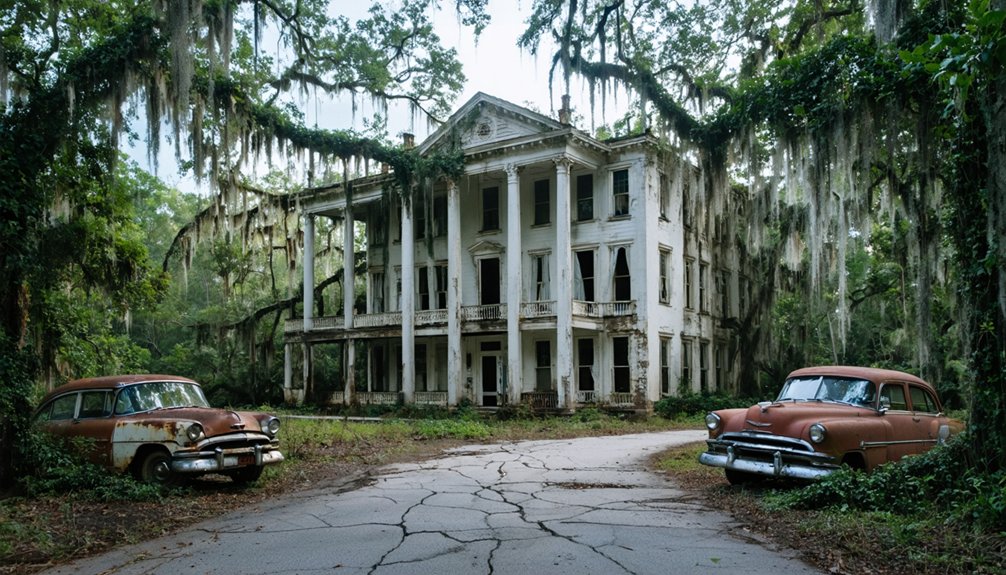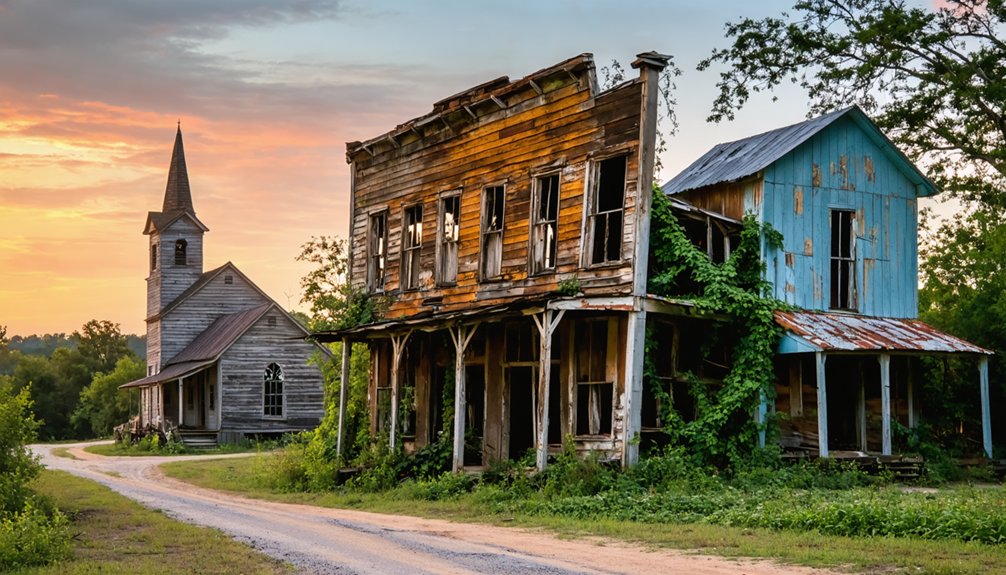
You’ll find numerous hidden ghost towns throughout Southern America, from Alabama’s Blakeley (once rivaling Mobile before yellow fever struck) to Texas’ Terlingua (abandoned after mercury mining collapsed in 1942). These forgotten settlements include St. Stephens, Claiborne, Rhyolite, Elkmont, St. Elmo, and Buffalo City. Each abandoned community tells a unique story of boom-and-bust economies, natural disasters, or government displacement that shaped the region’s complex history.
Key Takeaways
- Blakeley, Alabama was a thriving port that surpassed Mobile before yellow fever epidemics led to complete abandonment.
- Terlingua, Texas flourished during the mercury mining boom but was abandoned after the Chisos Mining Company’s 1942 bankruptcy.
- St. Stephens served as Alabama’s first territorial capital but now exists only as archaeological ruins.
- Elkmont, Tennessee transformed from a logging settlement to a resort area before being abandoned.
- Auraria, Georgia emerged during the 1832 gold rush, extracting approximately $20 million before declining when Dahlonega became the county seat.
Alabama’s Forgotten Settlements: Blakeley, St. Stephens and Claiborne
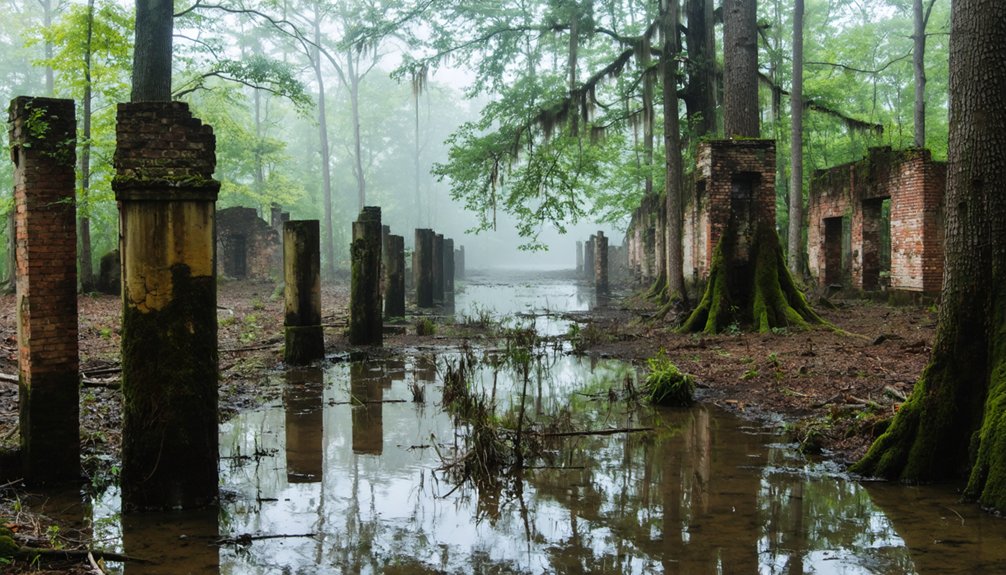
When Alabama was still finding its footing in the early 19th century, numerous settlements competed for prominence along its waterways.
Blakeley history reveals a once-thriving port that surpassed Mobile in population before yellow fever epidemics decimated the town in the 1820s. By the Civil War, it had dwindled to just 100 residents before complete abandonment. The town was originally chartered in 1814 and served as the first county seat of Baldwin County.
Once a rival to Mobile itself, Blakeley’s promise vanished as yellow fever swept through, leaving only ghosts by war’s end.
St. Stephens legacy endures as Alabama’s first territorial capital, though today only ruins remain of this former commercial center.
Archaeological digs continue to uncover territorial-era artifacts at the site, now preserved as a historical park.
Claiborne remnants tell a similar story of rise and fall—a bustling river port that flourished in the 1820s before environmental challenges and shifting economic priorities reduced it to scattered foundations and a cemetery that’s now listed on the National Register of Historic Places.
Today, visitors to Historic Blakeley State Park can view ghost structures in Washington Square that represent the size and shape of original 1820s buildings.
The Rise and Fall of Terlingua: Texas’ Quicksilver Mining Community
If you’d visited Terlingua during its early 20th century mercury boom years, you’d have found a thriving company town where the Chisos Mining Company employed hundreds of workers and generated daily profits reaching $2,000 during World War I.
The settlement expanded rapidly from a few hundred residents in 1902 to approximately 2,000 by the 1920s, with segregated living arrangements reflecting the ethnic divisions between Mexican laborers and Anglo residents. Many of these Mexican immigrants were fleeing the violence of the Mexican Revolution and found work in the dangerous underground mines.
Howard Perry, who founded the Chisos Mining Company, oversaw the extraction of an estimated $12 million worth of mercury by 1934, making Terlingua one of the most productive mining areas in Texas.
Terlingua’s population vanished almost completely after the Chisos Mining Company declared bankruptcy in 1942, leaving behind limestone structures and abandoned mine works as silent reminders to the town’s brief but productive existence.
Mercury Rush Boom Years
Though scarcely remembered today, the mercury rush that transformed Terlingua, Texas from an obscure border village into a thriving mining center represents one of America’s most distinctive resource booms.
The Chisos Mining Company, founded in 1903, spearheaded this transformation following Howard Perry’s strategic land purchase. Cinnabar extraction evolved from primitive hand-sorting operations to industrialized processes utilizing 20-ton Scott Furnaces by 1908.
Mercury production reached unprecedented heights between 1914-1936, coinciding with World War I‘s disruption of European supplies and increased military demand for the element.
You’d hardly recognize the bustling boomtown that once housed 2,000 residents with its own infrastructure.
Mexican laborers, fleeing revolution in their homeland, formed the backbone of this industry—working 12-hour shifts in treacherous conditions while company profits soared to $2,000 daily. The historic Terlingua Cemetery stands as a solemn reminder of the harsh realities faced by these workers, particularly during the devastating influenza pandemic of 1918-1919.
The mining community enjoyed modern amenities including a company commissary, hotel, school, and even medical services that were rare luxuries in rural Texas during that era.
Company Town Economy
Terlingua’s economic structure transcended mere mining operations, developing into a classic company town where every aspect of residents’ lives fell under the Chisos Mining Company‘s influence. This control manifested through ownership of essential services—the company store, post office, and school—creating inescapable labor dependence among workers.
The company town dynamics reinforced racial segregation, with Mexican laborers housed east of the store in limestone dwellings they built themselves, while Anglo residents enjoyed superior accommodations westward near Perry’s mansion. Howard E. Perry’s imposing mansion, constructed before 1910, stood as a physical symbol of the stark class divisions that characterized Terlingua’s social landscape.
Though social life centered around communal spaces like the dance pavilion, these interactions occurred within rigid economic hierarchies.
As production peaked in the 1920s with Terlingua producing 40% of America’s quicksilver, the town flourished. Yet this prosperity remained precarious—when ore depleted and bankruptcy struck in 1942, residents discovered the true cost of their economic captivity. The Chisos Mining Company had operated continuously for forty years starting in 1903, becoming one of the most enduring mercury operations in Texas before its ultimate collapse.
Sudden Population Exodus
When the Chisos Mining Company filed for bankruptcy on October 1, 1942, it triggered one of the most dramatic population collapses in Texas mining history. This once-thriving community of up to 2,000 residents quickly dispersed as economic opportunities vanished.
Population trends show how the town emptied almost overnight when mining operations ceased in 1946, unable to overcome artesian groundwater flooding and depressed post-war markets.
You’ll find ghostly remnants of this sudden exodus throughout the area, as families abandoned homes and businesses when the mercury boom ended.
Despite brief revivals in the 1950s and early 1970s with federal price guarantees and new furnace technology, these efforts proved unsustainable.
Nevada’s Rhyolite: Preserved Remnants Near Death Valley
Nestled near the entrance to Death Valley, Nevada’s Rhyolite stands as one of America’s most intact ghost towns, preserving the remnants of a meteoric rise and fall during the early 20th century gold rush.
Frozen in time, Rhyolite whispers tales of Nevada’s golden dreams and their swift dissolution.
The town exploded into existence after Frank “Shorty” Harris and Ernest Cross discovered gold in 1904, transforming from two tents to a bustling community of 5,000 within months.
For ghost town exploration enthusiasts, Rhyolite history offers impressive architectural survivors, including the John S. Cook Bank building and a $130,000 train depot.
At its peak (1907-1908), the town boasted 50 saloons, electricity, and three railroads, producing over $1 million in gold.
However, the prosperity vanished quickly when high-grade ore diminished and the 1906 San Francisco earthquake disrupted crucial rail connections, leaving behind the haunting skeleton you’ll find today.
The town’s population declined dramatically after the financial panic of 1907, causing most mining operations to fold and reducing resident numbers to fewer than 1,000 by the end of 1909.
Today, visitors can see the famous Bottle House constructed from approximately 50,000 beer bottles, making it one of the most photographed structures in the ghost town.
Elkmont: From Lumber Operation to Upscale Resort in Tennessee
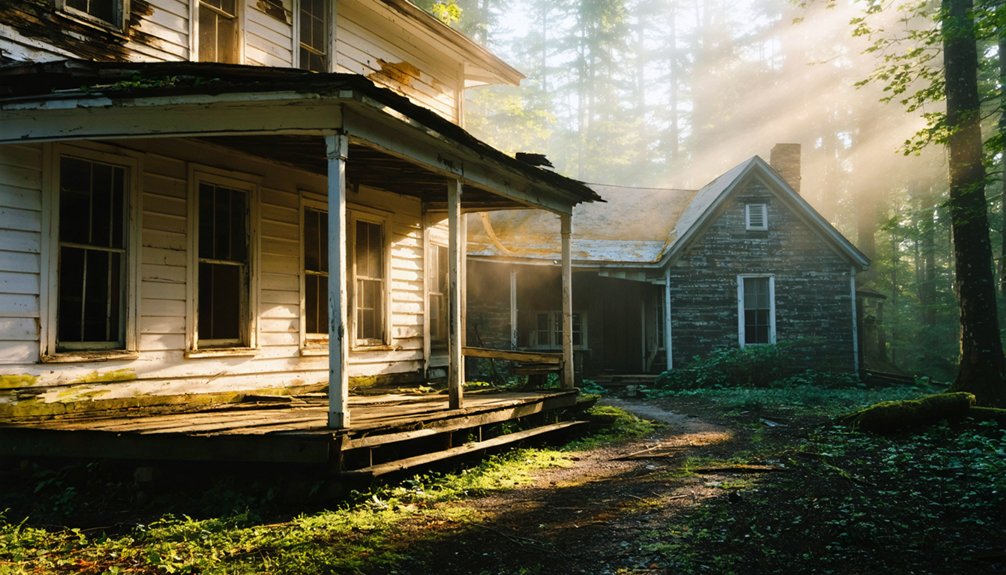
Deep in the Great Smoky Mountains of Tennessee, Elkmont transformed from a modest logging settlement into one of the South’s most exclusive resort communities during the early 20th century.
Originally known as “Little River,” the area’s history shifted dramatically when the Little River Lumber Company sold land to wealthy Knoxville residents who established the Appalachian and Wonderland Clubs.
Elkmont history and architecture reflect this change from industry to leisure:
- “Set-off houses” designed to be movable during logging operations became permanent fixtures
- The Wonderland Hotel featured 50 rooms and expansive valley-view balconies
- “Daisy Town” emerged as the primary vacation cottage section
By 1920, the former logging town hosted elite social gatherings in its clubhouse.
After incorporation into the National Park in 1934, residents traded ownership for lifetime leases.
St. Elmo: Colorado’s Mining Boom and Bust Cycle
High in the rugged Chalk Creek Canyon of central Colorado, St. Elmo stands as a monument to America’s boom-and-bust mining era. Following Abner Wright and John Royal’s silver discovery in 1875, the settlement transformed from Forest City into incorporated St. Elmo by 1880, eventually housing 2,000 residents.
The arrival of Denver, South Park and Pacific Railroad in 1881 established St. Elmo as a regional hub, with over 150 patented mining claims supporting a thriving commercial district. The Mary Murphy Mine, employing 250 workers and producing 220,000 ounces of gold, anchored the local economy.
St. Elmo’s legacy was shaped by devastating fires (1890, 1898, 1899), followed by the Alpine Tunnel closure (1910) and railroad abandonment (1922).
Despite brief revival during World War II, mining technology couldn’t sustain profitability, leaving St. Elmo preserved as Colorado’s best-maintained ghost town.
Auraria: Georgia’s “City of Gold” and Its Disappointed Prospectors
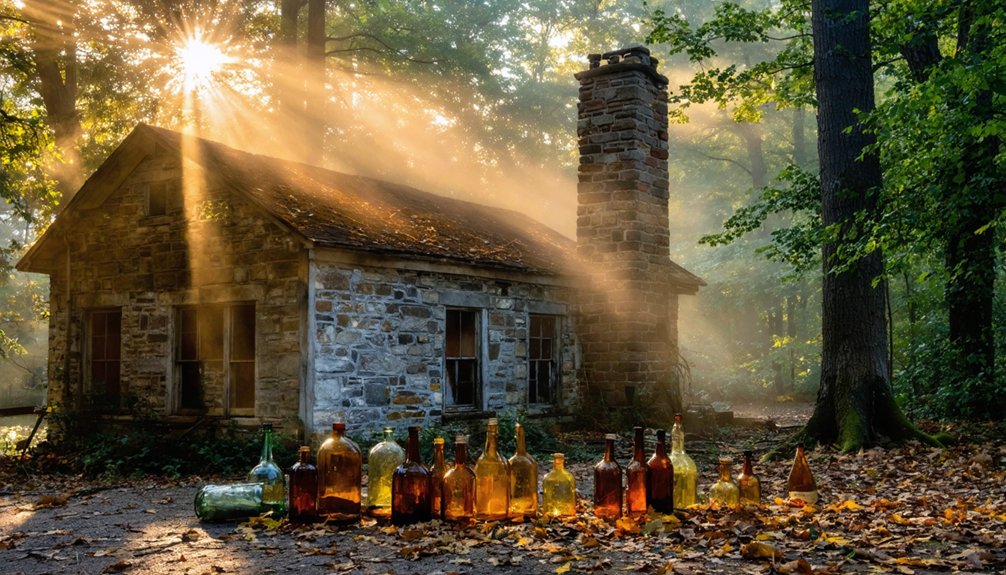
Located between the Chestatee and Etowah Rivers, Auraria emerged in 1832 when William Dean constructed the first cabin in what would become Georgia’s premier gold rush settlement.
The town quickly transformed into a bustling community with approximately $20 million in gold extracted during its peak years. After Dahlonega became the county seat in 1833, Auraria’s decline accelerated, ultimately becoming America’s first ghost town after the gold mining boom collapsed.
Notable aspects of Auraria’s town legacy include:
- Named after the Latin word for “gold,” reflecting its purpose
- Rivaled only by Dahlonega before California’s 1849 gold rush
- The Russell brothers later founded Colorado’s Auraria (now Denver)
- “Grandma Paschal” served as the town’s humanitarian heart
- Many buildings were reportedly burned when residents departed
Buffalo City: North Carolina’s Timber Town Turned Moonshine Capital
While most ghost towns in America’s history faded due to depleted mineral resources, Buffalo City charted a different course through the swampy wilderness of North Carolina’s Dare County.
The changes in the automotive landscape mirrored the broader economic shifts in the nation, leading to declining industries in Detroit. As companies struggled to adapt, many factories faced closure, leaving behind a stark reminder of what once was. This transformation not only affected the local economy but also reshaped the identity of a city that had long been synonymous with American manufacturing.
Founded in 1888 by a New York timber company, this once-thriving settlement became Dare County’s largest community, with hundreds of workers harvesting cypress and juniper from over 100,000 acres.
Buffalo City’s timber legacy shaped a hardscrabble company town where residents endured harsh conditions and used “pluck” currency at the company store.
As logging declined in the early 1900s, prohibition created new opportunity. Buffalo City’s moonshine culture flourished in its isolated location, transforming it into the “moonshine capital of the world.”
When prohibition ended in 1933, the town’s economic lifeline was severed. By 1954, the settlement was completely abandoned, reclaimed by the swamp.
Government-Displaced Communities of the South
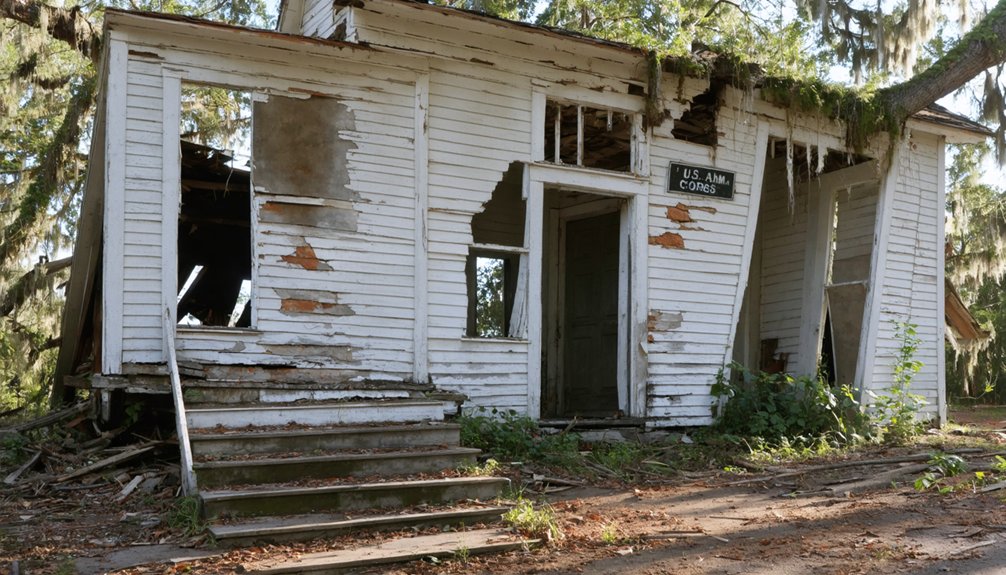
Throughout the American South, you’ll find ghost towns that emerged not from economic decline but from deliberate government displacement policies that uprooted established communities.
Federal land acquisitions for national parks, like Shenandoah in Virginia, forced over 500 families from their mountain homesteads in the 1930s without adequate compensation or resettlement assistance.
These displacements, along with relocations for environmental projects, disproportionately affected marginalized communities, creating a pattern of disrupted cultural continuity and lost heritage that continues to shape the region’s landscape.
Forced Relocations and Consequences
When the United States government enacted the Indian Removal Act of 1830, it set in motion one of America’s most devastating campaigns of forced displacement.
These forced removals, often executed through military force and coercion, ripped over 60,000 Native Americans from their ancestral homelands and marched them westward to designated territories.
The cultural impacts and socioeconomic consequences were profound:
- The infamous Trail of Tears claimed approximately 4,000 Cherokee lives during the brutal 1,000-mile journey
- Federal soldiers and state militias enforced removals despite Supreme Court rulings protecting tribal lands
- Communities lost established farms, businesses, and cultural continuity
- Tribes often faced immediate conflicts with existing Indigenous groups upon relocation
- Government repeatedly broke promises regarding provisions, protection, and compensation
These ghost towns of the South stand as silent witnesses to this ethnic cleansing campaign.
Environmental Project Displacements
Government displacement programs didn’t end with Native American removals; they’ve continued well into modern times through environmental projects and disaster management. Since the 1980s, FEMA has implemented approximately 43,000 buyouts, particularly in post-Katrina Louisiana and post-Sandy New York, forcing communities to relocate in the name of climate adaptation.
The United States witnessed 675,000 internal displacements from disasters in 2022 alone, with over 9 million in the past decade. Low-income communities of color bear disproportionate vulnerability, facing greater barriers to rebuilding after hurricanes, floods, and wildfires.
This pattern reveals troubling environmental justice concerns as displacement leaves people vulnerable to homelessness and financial hardship.
When temporarily displaced residents can’t return, neighboring counties with better economic prospects often become permanent resettlement locations, transforming Southern communities into modern ghost towns.
Federal Land Acquisitions
Federal acquisition of southern lands, spanning from the annexation of Texas to the implementation of conservation programs, fundamentally reshaped community landscapes throughout the region.
You’ll find that aggressive federal land policies frequently resulted in community displacement, particularly affecting marginalized populations.
- The Gadsden Purchase (1853) prioritized railroad construction over established settlements.
- Post-Civil War federal programs integrated southern lands into national management, often displacing existing communities.
- African American and Native American settlements faced disproportionate removal under expanding federal control.
- Conservation initiatives creating national forests displaced rural populations with generations-deep roots.
- Failed railroad projects after land grants created unstable tenure, leaving communities vulnerable to displacement.
When you explore these ghost towns today, you’re witnessing the physical remnants of communities sacrificed to federal expansion priorities.
Natural Disasters and Abandoned Settlements: Harrisburg’s Story
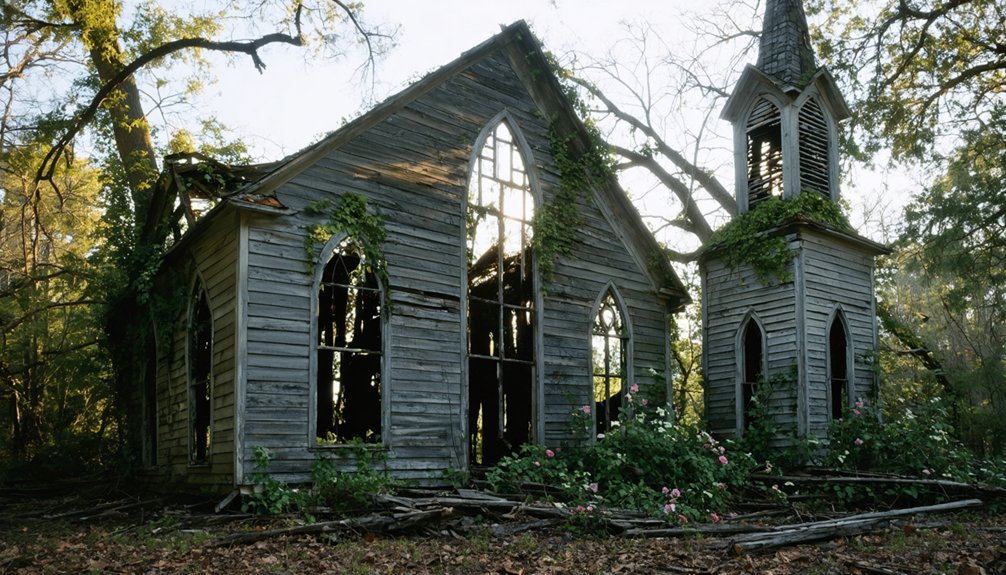
Among the most compelling tales of settlement abandonment in Southern America, Harrisburg’s story stands as a tribute to nature’s unforgiving power over human ambition. Founded in 1859 along Quail Creek, this Mormon settlement initially demonstrated remarkable natural resilience with stone construction and irrigation innovations.
By 1864, 128 residents had established a thriving community. However, disaster struck repeatedly—the 1862 flood destroyed Harrisville, forcing relocation upriver.
Grasshopper plagues in 1869 triggered exodus, while Navajo raids, drought, and rocky soil compounded challenges. Despite its historical significance, Harrisburg couldn’t withstand these pressures.
Exploring Accessible Ghost Towns: Tourism Opportunities in the Southern States
While Harrisburg’s tragedy represents the demise of settlements against nature’s fury, today’s travelers can explore numerous ghost towns that have survived the ravages of time.
The South offers particularly accessible locations where tourism development meets preservation challenges.
- Buffalo City, North Carolina stands as the “Moonshine Capital of the World,” offering a unique prohibition-era narrative.
- Terlingua, Texas provides guided tours through over 60 structures, including the notable Hotel Meade.
- Auraria, Georgia reflects the region’s gold rush history with accessible historical sites.
- Latuda, Utah represents more recent abandonment, just an hour’s drive from Helper.
- Iosepa Cemetery Memorial offers cultural connection through annual commemorative events.
These destinations balance visitor access with historical integrity, allowing you to experience authentic remnants of Southern frontier life while contributing to their preservation.
Frequently Asked Questions
How Do Environmental Factors Impact Ghost Town Preservation?
You’ll find climate effects dramatically accelerate decay while preservation techniques must counter soil erosion, toxic contamination, vegetation encroachment, and geological instability that threaten ghost towns’ structural integrity.
What Legal Protections Exist for Historic Ghost Towns?
While you explore ghost towns, you’re bound by federal laws like ARPA and NHPA, plus state-specific historic site regulations. You’ll find preservation funding options through tax credits if you respect these irreplaceable cultural treasures.
Are Any Southern Ghost Towns Believed to Be Haunted?
Yes, you’ll find haunted legends at Cahawba, Alabama’s former capital, with documented ghostly sightings. Old Cahawba Archaeological Park, Myrtles Plantation, and several South Alabama ghost towns attract paranormal enthusiasts seeking supernatural experiences.
Can Visitors Legally Collect Artifacts From Ghost Towns?
Like John Doe who faced felony charges in Arizona, you can’t legally collect artifacts from ghost towns. Artifact preservation laws on federal, state, and tribal lands carry serious legal implications for unauthorized removal.
Which Ghost Towns Have Potential for Modern Revitalization?
Terlingua, Ruby, and Charleston-Millville offer strong urban renewal potential through their preserved infrastructure, cultural heritage narratives, and proximity to existing tourism destinations—making them ideal candidates for modern revitalization projects.
References
- https://deepsouthurbex.com/2020/01/02/6-south-alabama-ghost-towns/
- https://quirkytravelguy.com/ghost-towns-of-the-deep-south/
- https://styleblueprint.com/everyday/ghost-towns-in-the-south/
- https://theforgottensouth.com/ghost-towns/
- https://www.geotab.com/ghost-towns/
- https://www.tnmagazine.org/19-ghost-towns-in-tennessee-that-are-not-underwater/
- https://en.wikipedia.org/wiki/Lists_of_ghost_towns_in_the_United_States
- https://www.atlasobscura.com/lists/americas-best-preserved-ghost-towns
- https://www.youtube.com/watch?v=tErPiMbfhsw
- https://midwestwanderer.com/article/historic-blakeley-state-park-ghost-town-and-battlefield/