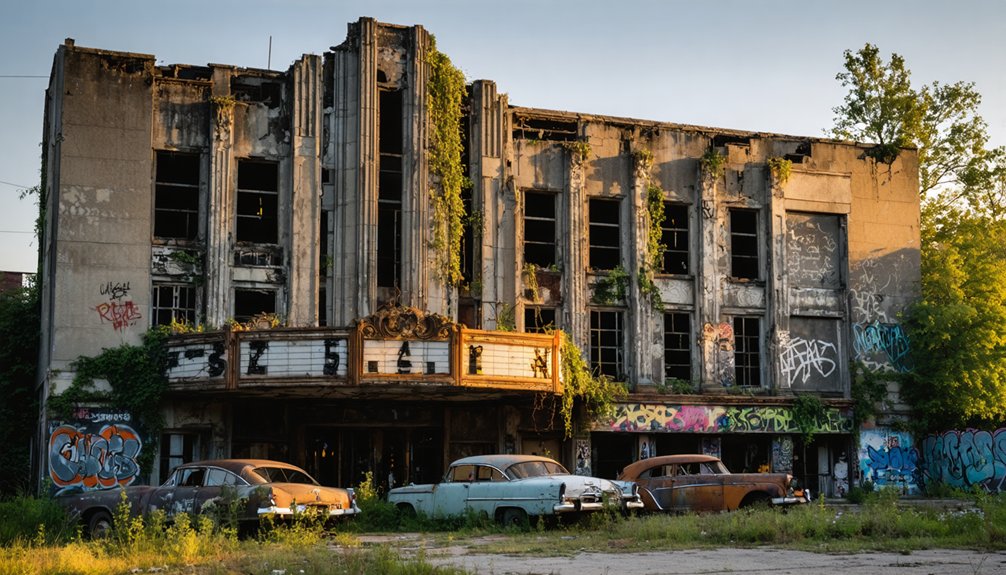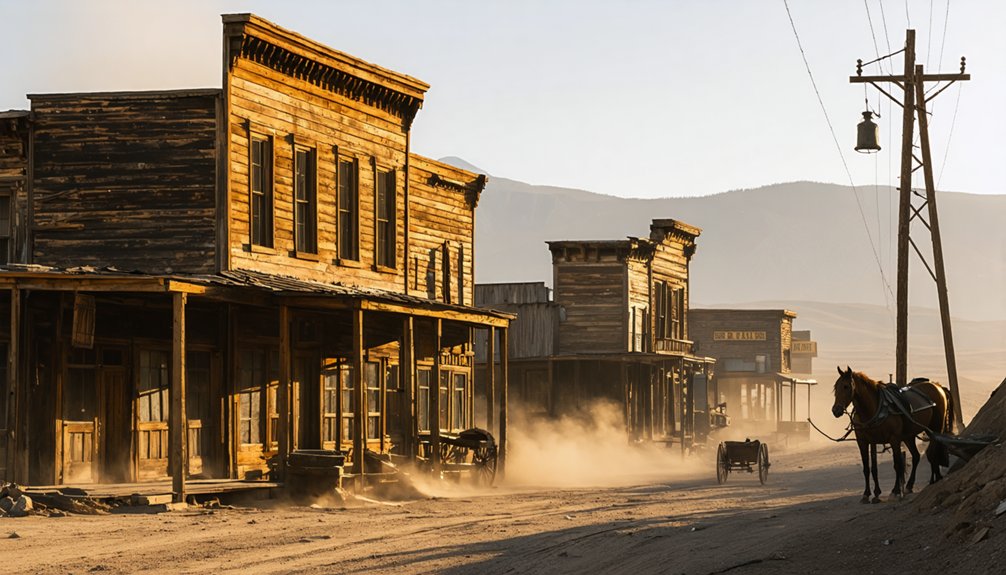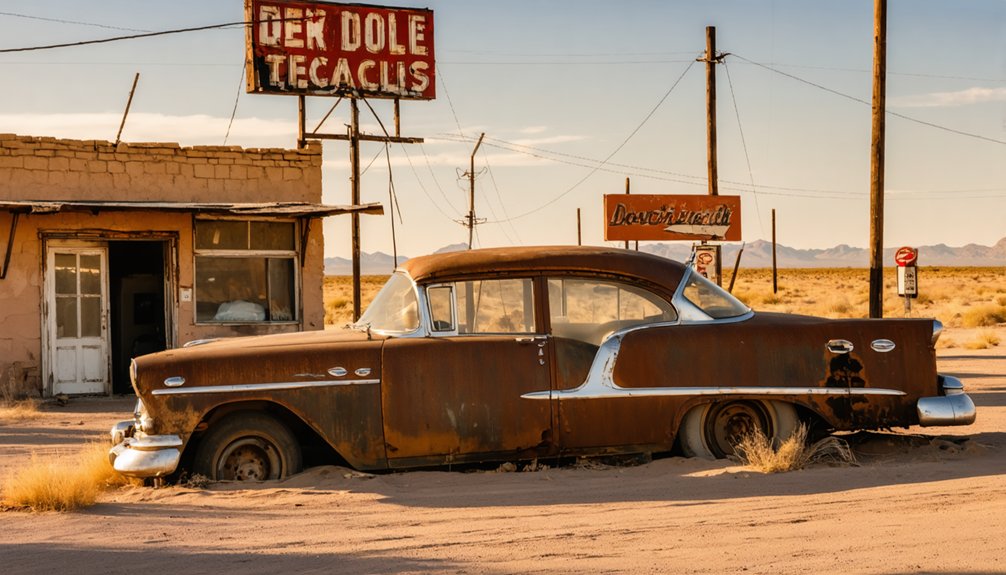
America’s ghost towns emerged from various catastrophes: natural disasters like the Great Flood of 1993 in Valmeyer, resource depletion in mining communities like Bodie, and environmental disasters such as Centralia’s underground fire burning since 1962. You’ll find mining boomtowns that collapsed after ore quality diminished, leaving environmental damage and structural instability. These abandoned places now serve as preserved historical sites, tourist destinations, and subjects of supernatural folklore. Their decaying architecture tells stories of prosperity, collapse, and America’s complex past.
Key Takeaways
- Mining boom towns like Bodie, California, once home to 10,000 people, rapidly declined due to resource depletion and economic recession.
- Centralia, Pennsylvania became uninhabitable after an underground coal mine fire started in 1962 and continues burning today.
- Times Beach, Missouri was completely evacuated in 1983 due to widespread dioxin contamination from contaminated waste oil.
- Environmental disasters transformed Valmeyer, Illinois (flooding) and coastal towns like Holland Island (erosion) into modern American ghost towns.
- Picher, Oklahoma collapsed from undermined foundations and toxic contamination, becoming an EPA Superfund site requiring total evacuation.
The Origins of America’s Ghost Towns: Natural Disasters and Resource Depletion

While natural disasters have shaped human settlements throughout history, they’ve played a particularly devastating role in creating America’s ghost towns.
You’ll find places like Valmeyer, Illinois, abandoned after the Great Flood of 1993, and Plymouth, Montserrat, evacuated following devastating pyroclastic flows in 1997.
Natural calamities weren’t the only culprits. Resource depletion transformed once-thriving communities into abandoned relics.
While fortunes vanished with exhausted mines, entire towns disappeared, leaving only echoes of prosperity behind.
Towns like Bodie, California, home to 10,000 gold-seekers, emptied when precious metals dwindled. Similar fates befell Garnet, Montana, where gold exhaustion followed by a destructive fire in 1912 sealed its destiny. Historic Shasta and California towns that once flourished during the Gold Rush were later decimated by wildfires due to increasingly dangerous environmental conditions. Times Beach, Missouri faced complete evacuation when dioxin contamination was discovered throughout the town in 1982.
Poor resource management often exacerbated these situations. Communities built at river confluences, like Cahawba, Alabama, couldn’t withstand repeated flooding, while mining towns lacked economic diversity to survive resource exhaustion.
Centralia: The Town That Still Burns Beneath
Resource depletion and natural disasters may have claimed many American towns, but none tell a more haunting tale than Centralia, Pennsylvania, where an apocalyptic scenario unfolds in real-time beneath residents’ feet.
Since May 1962, when a landfill fire ignited the coal seams below, the Centralia fire has consumed an underground labyrinth spanning 3,700 acres across 8 miles of mining tunnels.
You’ll find a community decimated by toxic emissions of carbon monoxide and sulfurous fumes seeping through cracks in the earth. The fire’s environmental legacy includes dangerous sinkholes—one nearly swallowed a child in 1981—and widespread urban decay. With temperatures exceeding 1,000 degrees Fahrenheit at the fire site, the area has become completely inhospitable to human life.
Despite multiple containment attempts, authorities abandoned fire suppression efforts, instead allocating $42 million for relocation. From initial amusement at the situation, residents faced the grim reality of their town being slowly condemned by an unstoppable force. The historical significance of this mining disaster serves as a stark reminder of industrial hubris, while revealing unexpected community resilience among those who refused to leave.
Mining Boom to Bust: The Rise and Fall of Western Ghost Towns
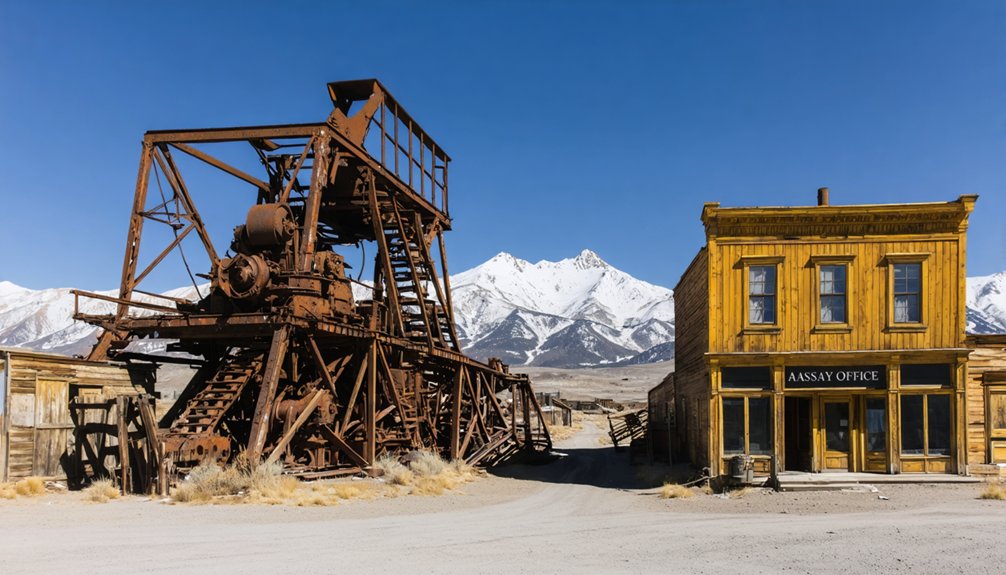
You’ll find America’s most dramatic boom-to-bust narratives in the Western mining towns that exploded with populations exceeding 100,000 during the late 19th century gold and silver rushes.
These communities often operated as lawless frontiers where saloons, brothels, and gambling halls flourished alongside mines until economic recessions, resource depletion, and falling commodity prices triggered their rapid abandonment. Towns like Bodie, California, which was established in 1859, experienced significant decline by the 1910s with only 110 structures remaining today. Belmont, Nevada followed a similar trajectory, booming after a silver strike in 1865 before its population dwindled from 2,000 residents to near abandonment.
The environmental legacy of these ghost towns remains visible today in acid mine drainage, contaminated soil, and Superfund sites like Picher, Oklahoma, where toxic mining waste rendered entire communities uninhabitable.
Gold Rush Glory
During the mid-19th century, America’s western frontier transformed dramatically as mining camps blossomed into bustling towns following significant mineral discoveries throughout the region. The gold rush created boomtowns like Bodie, California, established in 1859, which exploded to over 10,000 residents with 65 saloons and numerous brothels after substantial gold findings in the 1870s.
You’d have witnessed similar patterns across the West—Bannack, Montana flourished after 1862’s gold strike, quickly becoming Montana Territory’s capital.
Meanwhile, Goldfield, Nevada demonstrated the most dramatic boom cycle, rapidly becoming the state’s largest city. Towns like Spokane thrived with such prosperity they even funded a school in 1927. These settlements expanded further when 1880s rail development made mineral transportation economically viable, cementing America’s mining legacy.
Belmont, Nevada exemplifies this pattern, growing from nothing to a thriving community with five restaurants and two newspapers following its 1865 silver discovery.
However, this prosperity proved fleeting, as diminishing ore quality eventually triggered the downfall of these once-thriving communities.
Lawless Mining Communities
While the Gold Rush birthed countless boomtowns across America’s western frontier, the rapid emergence of these settlements created a perfect storm for lawlessness.
You’d find mining camps springing up overnight in rugged, isolated terrain where formal governance simply didn’t exist.
In this vacuum, saloon culture flourished—Bodie alone boasted 65 establishments where violence erupted regularly.
Murders, gunfights, and theft became commonplace without sheriffs or courts to maintain order.
When faced with such chaos, residents took matters into their own hands.
Vigilante justice emerged as communities formed vigilance committees to restore stability.
These groups conducted swift trials and executions, targeting violent offenders in towns like Deadwood and Tombstone.
While effective at curbing immediate disorder, these committees sometimes devolved into corruption themselves—reflecting the complex struggle for order in America’s wildest settlements.
Mining camps were characterized by a predominance of young men with few respectable women, creating a social environment prone to vice and disorder.
Towns like Jerome, Arizona earned infamous reputations as wickedest towns due to their particularly chaotic and immoral atmosphere.
Environmental Aftermath
As the mining booms across America faded into distant memory, they left behind more than just abandoned buildings and faded dreams—they created a toxic environmental legacy that continues to plague these regions today.
If you visit these ghost towns now, you’ll find a landscape scarred by decades of unrestricted extraction. Massive tailings piles leach heavy metals like lead, arsenic, and uranium into groundwater and soil.
The mining impacts extend far beyond aesthetics—entire communities face structural instability from undermined foundations, as seen in Picher, Oklahoma, where buildings risk collapse.
Native American populations near these sites suffer disproportionately from kidney disease and hypertension linked to contamination.
Even brief visits expose you to hazardous dust that can infiltrate your vehicle and clothing, while abandoned mine shafts emit dangerous gases like methane and carbon monoxide.
Environmental Catastrophes and Forced Evacuations

Environmental catastrophes have forced numerous American communities to face the ultimate decision: abandonment of their homes and livelihoods.
You’ll find abandoned infrastructure throughout these modern ghost towns, their ecological impact serving as stark warnings of environmental vulnerability.
- Centralia, Pennsylvania became uninhabitable when an underground mine fire began in 1962, releasing deadly carbon monoxide through the ground and creating dangerous sinkholes.
- Times Beach, Missouri’s 2,000 residents evacuated in 1983 after dioxin contamination reached 300 times safety limits.
- Coastal communities like Burrwood, Louisiana and Holland Island, Maryland disappeared entirely beneath rising waters and erosion.
- Historic towns of Shasta and Helena, California first declined economically, then faced destruction by intensified wildfires, leaving only brick facades as haunting reminders.
Preserving the Past: Ghost Towns as Historic Landmarks
When you explore America’s ghost towns that have gained National Heritage designations, you’ll encounter the delicate balance between authentic decay management and historical preservation.
Sites like Bodie, California maintain “arrested decay” to showcase the raw authenticity of abandonment, while Batsto Village, New Jersey and Fort Jefferson, Florida have received formal historic recognition that guarantees their protection.
These preservation efforts constantly navigate the tension between promoting tourism that financially sustains these sites and implementing conservation measures that prevent further deterioration of their irreplaceable historical structures.
National Heritage Site Designations
Throughout America’s abandoned landscape, numerous ghost towns have gained recognition as cultural treasures through official heritage designations that protect their historical significance.
These preservation efforts guarantee you’ll find authentic glimpses into America’s past despite preservation challenges posed by weather, vandalism, and development pressures.
The National Register of Historic Places has become an essential heritage designation system, safeguarding places like South Pass City in Wyoming and Virginia City in Montana.
- Bodie, California stands as the official state gold rush ghost town, with 200 frontier buildings frozen in “arrested decay.”
- Calico earned distinction as California’s official silver rush ghost town.
- State and national parks manage sites like Batsto Village, offering ranger-led interpretive tours.
- Designation criteria include historical significance, physical integrity, and representation of broader themes like westward expansion.
Authentic Decay Management
Beyond formal designations, the concept of “authentic decay” has emerged as a cornerstone philosophy guiding preservation efforts in America’s ghost towns. This approach deliberately maintains the aesthetic of weathered buildings and natural aging, focusing on preventing collapse rather than full restoration.
You’ll find preservation techniques that prioritize minimal intervention—stabilizing structures with internal frames and replacing roofs while leaving the patina of time intact.
When you explore these sites, you’re experiencing decay aesthetics intentionally preserved to convey the authentic passage of time.
Preservation teams carefully balance safety concerns with maintaining the site’s ruined character, creating spaces where you can physically connect with history’s decline and resilience.
This philosophy honors the original construction methods while allowing you the freedom to experience a tangible, unvarnished link to America’s abandoned past.
Tourism Versus Conservation
The delicate balance between tourism and conservation creates profound tensions in America’s ghost towns, where economic imperatives frequently collide with preservation ethics.
You’ll find preservation challenges intensify when visitor traffic accelerates structural deterioration, yet these same tourists provide essential revenue streams for conservation efforts. The $7 million National Park Service investment exemplifies the substantial funding required for proper preservation.
- Legal protections often clash with property rights, creating jurisdictional complications
- Adaptive reuse strategies repurpose historic structures while maintaining authenticity
- Controlled access systems help mitigate damage from excessive visitation
- Tax incentives can distort local economies despite intentions to promote economic sustainability
This fundamental tension—between marketing ghost towns as destinations while protecting their fragile structures—represents a microcosm of broader heritage conservation issues facing communities seeking both cultural preservation and economic viability.
Life After Abandonment: The Ecology of Deserted Communities
When human settlements fall into abandonment, nature begins a remarkable reclamation process that transforms once-bustling communities into living laboratories of ecological succession.
You’ll witness native flora pushing through cracked sidewalks and wildlife adapting to these new frontier habitats, with birds nesting in deteriorating rooftops and mammals sheltering within collapsed structures.
Not all ecological restoration proceeds smoothly, however. Many ghost towns harbor toxic legacies—heavy metals in mining communities like Picher, Oklahoma, or the underground fires of Centralia, Pennsylvania, that prevent safe habitation.
Weather continuously reshapes these landscapes, creating unique microclimates within ruins that support distinctive ecological niches. In desert ghost towns, extreme temperature fluctuations accelerate structural decay while limiting which species can thrive.
These abandoned spaces ultimately become testing grounds for understanding how environments recover after human departure.
Tourism and the Afterlife of Ghost Towns
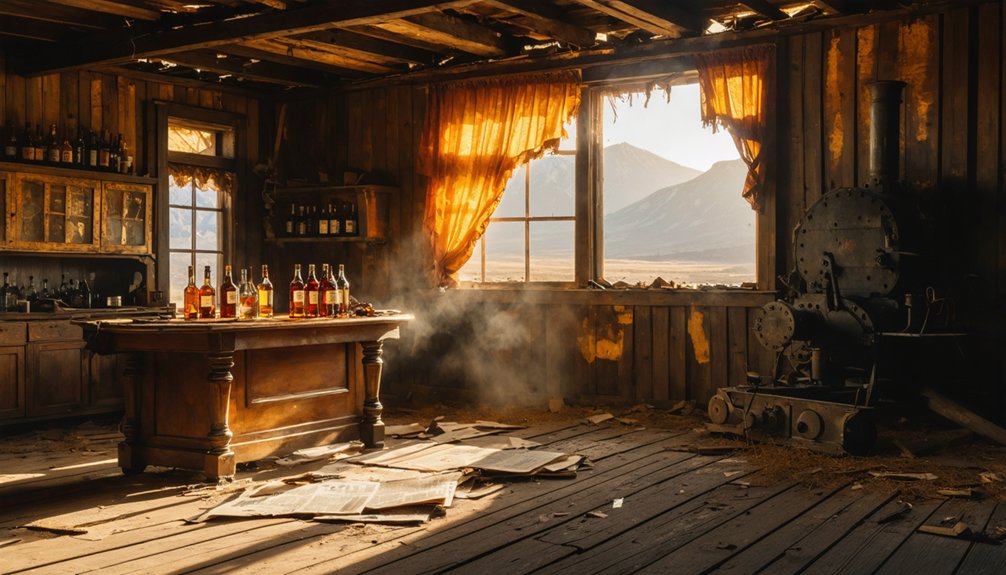
Tourism has breathed new economic life into many abandoned American communities, transforming desolate ghost towns into destinations where history meets adventure.
When you explore these haunting landscapes, you’ll discover America’s boom-and-bust narrative etched into decaying storefronts and weathered mining shafts.
Ghost town tourism creates fascinating contradictions across the country:
The haunting beauty of abandoned places reveals America’s complicated relationship with progress and preservation.
- Historic preservation efforts, like National Register listings, have revitalized places like St. Elmo, Colorado, while urban centers like Portland face alarming 37% tourism declines.
- Former boomtowns attract photographers and cultural explorers seeking authentic encounters with America’s past.
- Route 66 ghost towns exemplify how transportation shifts devastate communities once thriving with visitors.
- Heritage attractions create economic opportunities in regions where 3,800+ ghost towns stand as monuments to failed dreams and economic collapse.
Haunted Histories: Folklore and Legends of Abandoned Places
You’ll encounter tales of ghostly miners who never left their claims at Bodie and St. Elmo, where visitors report spectral lantern lights and the echoing sounds of pickaxes long after operations ceased.
The infamous “Bodie Curse” warns that those who remove artifacts from the site will suffer misfortune until the stolen relics are returned.
Throughout these abandoned settlements, from Crystal City’s vanished miners to Frisco’s cemetery specters, local folklore preserves not just historical accounts but the supernatural whispers of those who supposedly remain trapped between worlds.
Supernatural Resident Stories
Why do abandoned places so often become vessels for supernatural tales? Ghost towns like St. Elmo, Colorado, and Jerome, Arizona, harbor spectral legends of miners continuing their eternal work long after death.
Among these eerie locations, mysterious submerged towns in Mississippi captivate the imagination with their stories of lost lives and forgotten dreams. Often hidden beneath the surface of the water, these towns evoke curiosity and a sense of the uncanny, as whispers of their past linger in the depths. Visitors and locals alike share ghostly encounters and chilling tales that breathe life into the ruins of these once-thriving communities.
These ghostly encounters reflect the tragic circumstances of their demise and the unfinished business that binds spirits to place.
- The Phantom Miner – Colorado’s Crystal Mill features a lantern-carrying figure who continues his work a century after death.
- Lake Lanier’s Drowned Town – Submerged Oscarville’s spirits manifest through unusual drownings and accidents.
- Feltville’s Missing Sisters – Three vanished girls from 1912 whose apparitions haunt New Jersey cottages.
- Indigenous Curses – Places like Panamint City carry supernatural warnings tied to their violent displacement histories.
The supernatural narratives of these towns reveal our complex relationship with abandonment, memory, and unresolved trauma.
Curse of Stolen Relics
When abandoned towns decay into silence, the objects left behind often become potent vessels for supernatural beliefs. You’ll find this particularly evident in mining ghost towns like Bodie, California, where stolen souvenirs reportedly trigger misfortune through cursed relics.
Mining equipment, personal belongings, and architectural fragments rank among the most notorious carriers of supernatural energy. Items connected to violent histories—like weapons from Frisco, Utah’s lawless era—are believed to harbor especially malevolent forces.
Cemetery artifacts are considered the most dangerous to disturb.
Documentation of these curses includes mysterious accidents, illnesses, and persistent bad luck affecting those who remove artifacts from places like Centralia or St. Elmo. Many sites now display explicit warnings against souvenir hunting—not merely for preservation purposes but to protect visitors from the vengeful spirits of disturbed residents.
Vanished Miners’ Whispers
Throughout the abandoned mining towns of America, the spectral presence of miners who vanished in tragic circumstances continues to permeate these desolate landscapes.
You’ll encounter ghostly echoes of pickaxes striking stone and disembodied voices calling out from collapsed shafts in places like Bodie, California and St. Elmo, Colorado—towns frozen in “arrested decay” where time itself seems suspended.
- Bobbing lanterns move independently along ridges near the Crystal Mill in Colorado
- Unexplained footsteps and heavy breathing emanate from sealed mine entrances at dusk
- Personal items shift position overnight in abandoned cabins near Lake Pactola
- Miner spirits wearing period attire appear briefly before dissipating into the mountain mist
These haunting phenomena reflect unresolved tragedies and unfulfilled destinies in America’s resource-extraction history.
The Architecture of Decay: Structural Remnants Across America
Across America’s forgotten landscapes, the architectural remnants of abandoned towns tell silent stories of prosperity, sudden exodus, and gradual decay.
You’ll find derelict concrete buildings standing alongside crumbling brick and timber frameworks—urban decay frozen in time. The architectural symbolism is powerful: foundations, chimneys, and partial walls of once-thriving establishments now succumb to nature’s reclamation.
Weather accelerates this transformation, with hurricanes battering coastal ghost towns while ivy slowly consumes others. In places like Centralia, underground fires have created surreal scenes of cracked roads venting steam.
Commercial storefronts, residential units, and industrial complexes remain in various preservation states—some maintained as historic parks, others slowly disintegrating despite BLM protection efforts. These structural remnants represent America’s transient relationship with permanence, each crumbling wall a reflection of abandoned dreams.
Ghost Towns in Modern Media and Popular Culture

- Drone videography bridges historical disaster memories with speculative futures, creating a “negative sublime” that combines beauty and dread.
- Iconic government buildings and financial districts serve as symbolic ruins in films like “Zombieland.”
- Post-apocalyptic urban landscapes articulate contemporary anxieties about environmental crises, pandemics, and political failure.
- Ghost town imagery functions as active narrative elements rather than mere backdrops, reflecting the fragility of social order and institutions.
Frequently Asked Questions
How Do Ghost Towns Impact Surrounding Property Values?
What happens when decay spreads? Ghost town economics devastates your property values, with homes within 500 feet losing up to 9.4% value, creating a domino effect of neighborhood-wide property value depreciation.
Can People Legally Claim Abandoned Buildings in Ghost Towns?
You can legally claim ghost town buildings through adverse possession, but you’ll need to occupy the property openly for years while respecting existing property rights. Research thoroughly to avoid legal consequences.
What Hazardous Materials Remain in Abandoned Mining Towns?
Walking through history’s toxic footprints, you’ll face lead, zinc, cadmium, thallium, arsenic, copper, and asbestos as the primary toxic remnants. These environmental hazards contaminate soil, water, and structures throughout abandoned mining towns.
How Do Seasonal Weather Patterns Affect Ghost Town Deterioration?
You’ll observe weather erosion accelerating during freeze-thaw cycles, while seasonal decay progresses through moisture infiltration. Winter’s structural stress, spring’s water damage, and summer’s UV deterioration create compounding deterioration patterns annually.
Are There Communities That Successfully Reversed Ghost Town Status?
Yes, you’ll find several cases where revitalization efforts succeeded. Animas Forks and Cerro Gordo demonstrate how community engagement, historic preservation, and strategic tourism development transformed dying settlements into cultural destinations worth preserving.
References
- https://pg.world/articles/abandoned_places_part_1
- https://nightofthejack.com/2025/01/23/top-creepy-ghost-towns-in-america/
- https://www.geotab.com/ghost-towns/
- https://albiongould.com/ghost-towns-to-visit-in-the-states/
- https://www.christywanders.com/2024/08/top-ghost-towns-for-history-buffs.html
- https://www.youtube.com/watch?v=ns4M-ar6uJQ
- https://en.wikipedia.org/wiki/Lists_of_ghost_towns_in_the_United_States
- https://www.atlasobscura.com/lists/americas-best-preserved-ghost-towns
- https://www.united.com/en/us/hemispheres/places-to-go/5-western-ghost-towns.html
- https://www.abandonedspaces.com/towns/natural-disaster-ghost-towns.html