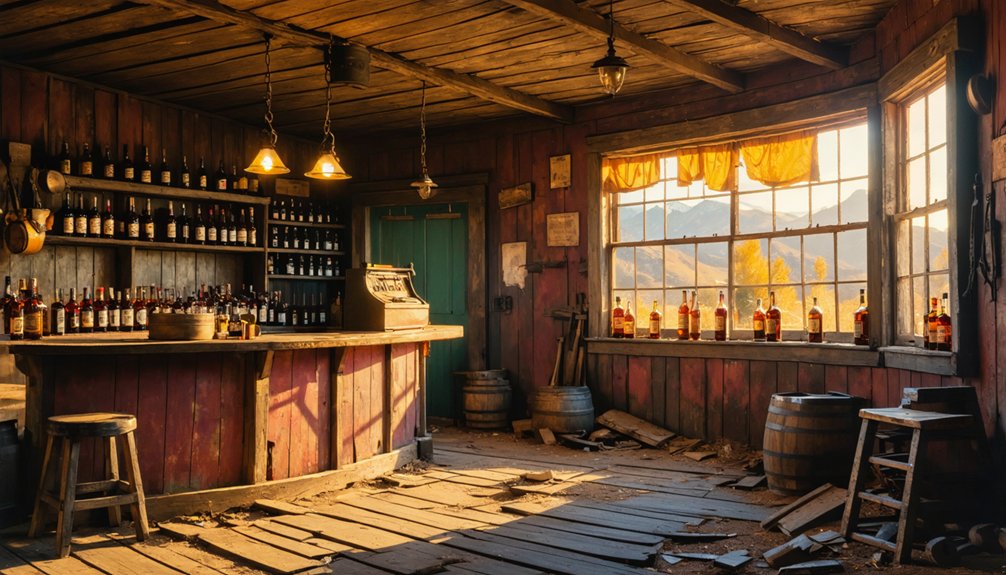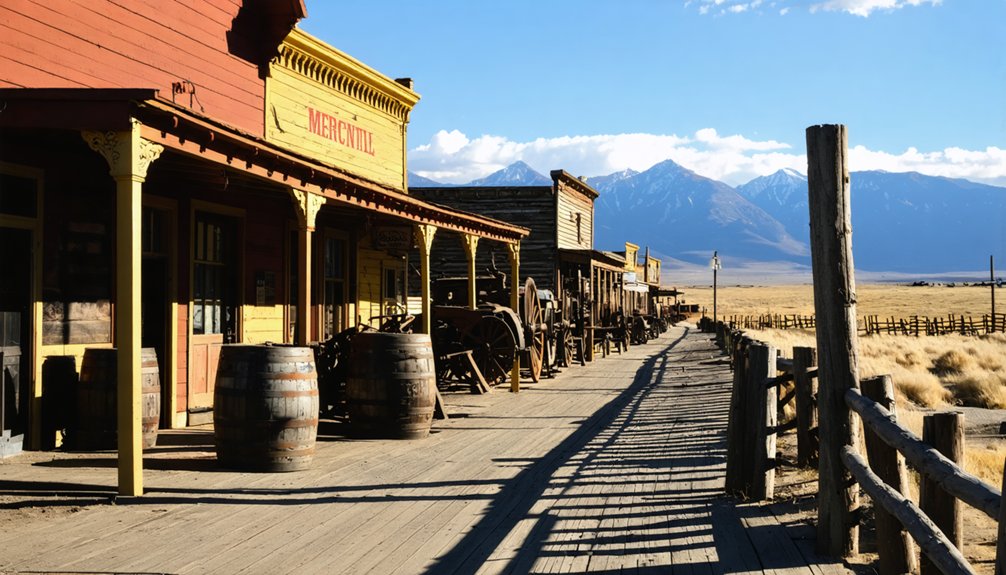
Holland’s (originally Dornbach) is a remote Sierra Nevada ghost town at 8,379 feet elevation, founded by German immigrants in 1852 during the Gold Rush. You’ll need a high-clearance vehicle to navigate the rough dirt roads leading to this California Historical Landmark No. 397. The preserved general store, barbershop, and drugstore offer authentic glimpses of 1860s mining life, while the surrounding landscape bears scars of the economic boom and bust that shaped its fate.
Key Takeaways
- Hollands is a preserved ghost town at 8,379 feet in California’s Sierra Nevada mountains, accessible via Highway 395 and rough dirt roads.
- Originally named Dornbach by German founders in 1852, it was mistakenly renamed Hollands when “Deutsch” was misinterpreted as “Dutch.”
- The town is California Historical Landmark No. 397, known for its Gold Rush heritage and former reputation as a lawless mining community.
- Five core businesses formed Holland’s economic backbone in the 1860s before mining declined in the 1880s due to depleted gold deposits.
- Today, visitors can explore preserved buildings including a general store, barbershop, and museum displaying authentic Gold Rush era artifacts.
Finding Holland’s Hidden Legacy in the Sierra Nevada
Nestled high in the rugged Sierra Nevada mountains at 8,379 feet, Holland’s ghost town reveals its secrets only to those determined enough to venture beyond Yosemite’s northeastern boundary.
You’ll need to navigate Highway 395 and follow rough dirt roads where the last three miles demand reduced speeds and high clearance vehicles. Winter transforms this journey into a true adventure, accessible only by skis, snowshoes, or snowmobiles.
Unlike the crowds at better-known destinations, Holland’s Heritage remains preserved in pristine isolation, drawing those seeking freedom from tourist traps.
Far from the beaten path, Holland’s secrets await only those who prize authenticity over convenience.
The town’s remote location—which once fueled its lawless reputation during the mining boom—now serves as its protection. Here, among Sierra Nevada’s windswept peaks, you’ll walk among authentic remnants of America’s gold rush era, undisturbed and hauntingly real.
Like the historic Bodie Ghost Town that offers approximately 75 buildings to explore, Holland’s provides a window into California’s rich mining past.
For those researching similar historic mining settlements, note that Holland’s should not be confused with other ghost towns listed on disambiguation pages like Bodie.
The German Origins of a Forgotten Gold Rush Settlement
You’ll be surprised to learn that Hollands, despite its Dutch-sounding name, was actually founded by the Dornbach brothers, German immigrants who established the mining camp in 1852.
These ambitious siblings from Bavaria quickly capitalized on the Gold Rush fever, transforming their modest claim into a bustling supply post for prospectors searching for fortune in the Sierra Nevada creeks.
Their entrepreneurial spirit typified the German immigrant experience in California’s gold country, where immigrants often leveraged commercial acumen rather than mere mining skill to build lasting enterprises amid the chaotic rush for riches. Like many immigrants, the Dornbachs maintained connections with their homeland through handwritten letters that detailed their successes and challenges in America.
German Brothers’ Initial Settlement
In 1851, while thousands of fortune-seekers streamed into California’s gold country, two German immigrants named Joseph and Charles Dornbach arrived in what would soon become Dutch Flat.
Settling in the Sierra Nevada foothills of Placer County, they established the foundations of a community that would rapidly expand during the Gold Rush boom.
You’ll find the Dornbach legacy interwoven with Dutch Flat’s earliest infrastructure. Their mining entrepreneurship attracted other prospectors and businesspeople to this strategic location along the Dutch Flat–Donner Summit Road.
The brothers’ timing proved fortuitous—they’d positioned themselves at a critical junction for commerce and mining activity. This development paralleled the experience of early Dutch settlers who were drawn to fertile lands in Wisconsin after its admission to the Union.
As they worked the gold-bearing streams, the Dornbachs helped transform an unnamed location into a bustling hub that would eventually earn recognition as California Historical Landmark No. 397.
From Dornbach to Dutch
Although widely referred to as “Dutch Flat” today, the settlement’s name reflects a curious historical misunderstanding rather than its actual German heritage. The original founders from Dornbach, Bavaria never intended their community to bear a Dutch connection.
When English-speaking miners heard the Germans refer to themselves as “Deutsch,” they misinterpreted this as “Dutch,” leading to the gradual evolution from Dornbach to Hollands.
This linguistic confusion obscured the settlement’s German roots as the California Gold Rush progressed. Maps from 1852 still labeled it “Dornbach,” but by 1855, “Hollands” appeared in county records.
The settlement’s true Bavarian origins faded from collective memory, replaced by an incorrectly attributed Dutch identity—a common fate for many German-founded communities in Gold Country where language barriers transformed cultural identities through simple misunderstandings.
Immigrant Entrepreneurial Spirit
The misunderstood German identity of Hollands reflects a broader pattern of immigrant entrepreneurship that characterized California’s Gold Rush settlements.
You’ll find that unlike the formal ethnic colonies that emerged later, these early German settlers demonstrated remarkable entrepreneurial resilience by establishing individual ventures rather than cohesive communities.
When you examine Hollands’ history against settlements like Anaheim, you’ll recognize the same immigrant innovation that allowed Germans to adapt from mining to permanent businesses. This adaptability was a common thread among many immigrant colonies, which faced water problems and needed to develop collective solutions to survive in California’s often challenging environment.
Their adaptability mirrors the Los Angeles Vineyard Society’s shift from wine to citrus production when faced with agricultural devastation.
Though lacking the organized Vereinswesen of San Francisco’s German community, Hollands’ settlers participated in the same dual identity formation—maintaining cultural traditions while enthusiastically engaging with California’s economic opportunities, creating prosperity through flexibility rather than isolation.
Daily Life in a Bustling 1860s Mining Hub
When you strolled through Hollands’ bustling main street in the 1860s, you’d encounter miners gathering at the community hall each Sunday to exchange news and settle disputes through an informal democratic process.
You’d notice the absence of traditional currency, with the town’s merchants instead operating on a complex barter system where gold dust, imported goods, and labor formed the backbone of the local economy.
The monthly market day transformed the town square into a vibrant exchange hub where miners, merchants, and nearby farmers conducted business while community bonds were strengthened through shared meals and music. Unlike similar towns with unclear naming conventions, Hollands avoided the disambiguation confusion that plagued other settlements with similar names. Like many settlements that experienced gold depletion, Hollands eventually declined as miners moved on to seek more profitable strikes elsewhere.
Community Gatherings
Miners, merchants, and families alike found respite from the grueling work of frontier life through community gatherings that defined Hollands’ social fabric in the 1860s.
While historical records of this specific settlement remain elusive, community events in California mining towns typically followed patterns seen throughout the Gold Rush era.
These gatherings would likely have included:
- Independence Day celebrations with patriotic speeches, picnics, and makeshift parades down the main thoroughfare
- Harvest festivals where local produce was showcased alongside mining accomplishments
- Christmas socials where even competing claim holders set aside differences
- Impromptu musical performances where miners showcased talents from their homelands
Local traditions evolved uniquely in each settlement, influenced by the ethnic backgrounds of inhabitants and the specific challenges they faced in their particular mountain or desert locale. Mining towns like Hollands were notorious for their lawlessness similar to Bodie during its heyday. Like many settlements that experienced boom and bust cycles, Hollands’ community events reflected the transient nature of mining towns, with celebrations growing more elaborate during prosperous times and becoming more modest as fortunes declined.
Merchant Exchange Economy
Within Hollands’ dusty main street, five core businesses formed the economic backbone of this California mining settlement during its 1860s heyday.
You’d find Foster’s General Store anchoring commerce, where merchant pricing reflected the forty-mile freight journey from Sacramento. Most goods commanded triple their city prices.
When cash ran short, you’d engage in complex barter systems with shopkeepers. Your gold dust became the preferred currency, carefully weighed on brass scales before disappearing into merchants’ safes.
When payday arrived for company men, Foster extended credit in leather-bound ledgers. The region experienced economic volatility similar to other settlements that yielded $87 million in gold during the California Gold Rush period.
The Chinese-owned Celestial Market specialized in imported goods, while Thompson’s Assay Office purchased raw gold at rates that favored their pockets.
Miners’ wages circulated rapidly through these establishments, creating a self-contained economic ecosystem that thrived until the mines faltered.
Economic Rise and Fall Along the Bear River
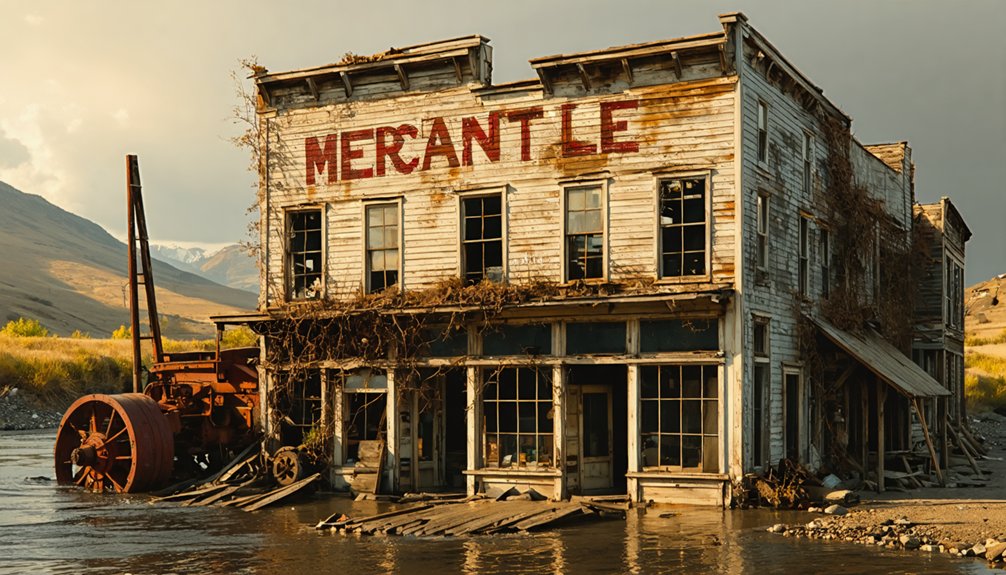
The discovery of gold in the Bear River watershed in 1850 ignited a dramatic economic transformation that would reshape California’s landscape for generations to come.
You’d have witnessed dramatic economic fluctuations as boomtowns like Hollands flourished then withered when placer deposits depleted.
Mining infrastructure quickly evolved from simple panning to elaborate hydraulic operations, with water diversion systems stretching for miles.
The economic cycle followed four distinct phases:
- Initial boom with Mexican miners yielding up to $250,000 in weeks
- Change to capital-intensive hydraulic mining dominated by corporations
- Legal battles between mining interests and farmers over environmental damage
- Gradual shift to aggregate mining as gold reserves diminished
When you explore these ghost towns today, you’re walking through the physical remnants of California’s boom-and-bust legacy.
The Slow Fade: Why Holland’s Was Abandoned
As gold yields dwindled throughout the 1880s, Holland’s slow descent into abandonment began—a fate sealed by converging economic and environmental pressures.
The mining decline followed a familiar pattern seen across California’s gold country—once-profitable operations became financially unsustainable as accessible minerals disappeared and extraction costs rose.
You’d have struggled against Holland’s geographic isolation even in prosperous times. Remote mountain terrain made supply routes tenuous, driving up costs for necessities while complicating daily survival.
When railroads bypassed the settlement, critical trade connections evaporated. Young workers departed first, leaving an aging population unable to maintain essential community structures.
Chinese residents, who maintained separate quarters and burial grounds, gradually dispersed as opportunities vanished.
Without economic anchors, Holland’s faded—joining countless settlements reclaimed by California’s rugged wilderness.
Exploring the Remnants: What Survives Today
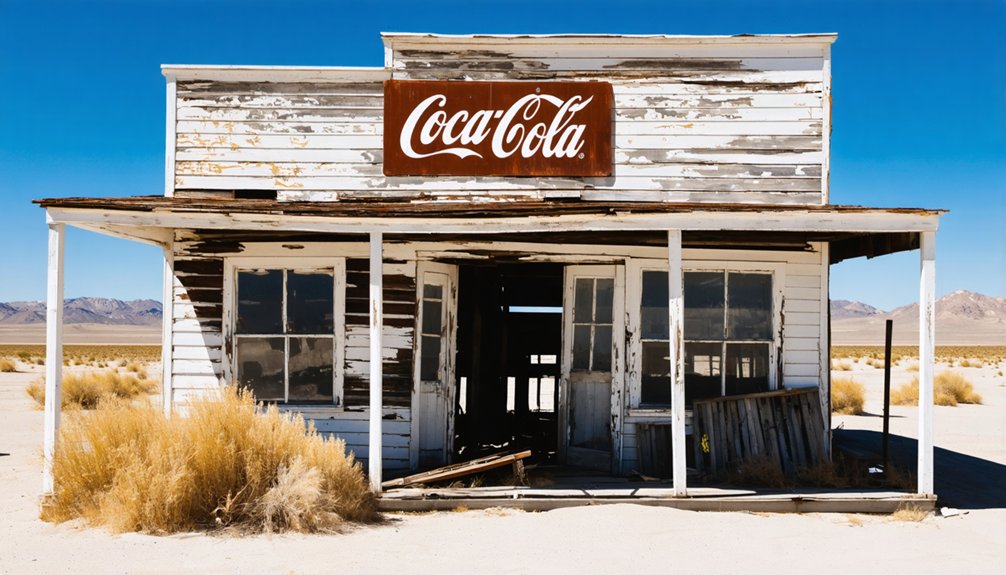
Despite nearly a century and a half of abandonment, Holland’s ghostly presence persists through an impressive collection of preserved buildings that offer visitors a tangible connection to California’s gold rush era.
You’ll discover a remarkably intact townscape where the general store still displays original merchandise, and Victorian architectural details adorn surviving structures.
Within Malakoff Diggins State Historic Park, you’ll find:
- The fully restored barbershop and drugstore with authentic period furnishings
- A museum housing Wells Fargo artifacts and mining-era photographs
- Original wooden homes with decorative trim and porches
- Historical artifacts including pioneer tools and household items
The juxtaposition of these carefully maintained buildings against the dramatic, scarred landscape created by hydraulic mining operations creates an unforgettable glimpse into California’s industrial past.
Frequently Asked Questions
Are There Any Dangerous Wildlife Encounters Reported at Hollands?
Tranquility meets potential danger in Hollands; you’ll find no documented wildlife sightings requiring safety precautions. The ghost town’s isolation hasn’t yielded official reports of dangerous animal encounters worth noting.
Did Any Famous Gold Rush Figures Visit or Live in Hollands?
You won’t find major gold rush celebrities in Hollands’ history. No famous residents like Marshall or Sutter lived there—Abraham Holland himself remains the settlement’s most historically significant figure.
What Artifacts Have Been Recovered From the Hollands Site?
You’ll find mining equipment, household items, personal effects, and structural remnants at Hollands. These artifacts provide significant historical context for understanding daily life in this remote California mining settlement.
Were There Any Significant Natural Disasters That Affected Hollands?
Like embers of forgotten history, wildfire remains your most threatening foe. You won’t find earthquake impact or flood damage in Hollands’ story—just the recurring flames that repeatedly threatened this remote mining settlement.
Does Anyone Still Own Property in the Hollands Area Today?
You’d find scattered property ownership in the area today, though there aren’t current residents maintaining homes. Records through county assessors would reveal who maintains legal title to these forgotten parcels.
References
- https://www.youtube.com/watch?v=OD9M6MP6RRU
- https://rachelsruminations.com/favorite-ghost-towns-in-california/
- https://www.eenews.net/articles/5-climate-ghost-towns/
- https://www.thecollector.com/ghost-towns-california-explore/
- https://en.wikipedia.org/wiki/Dutch_Flat
- https://thevelvetrocket.com/2011/12/18/california-ghost-towns-howland-flat/
- https://en.wikipedia.org/wiki/List_of_ghost_towns_in_California
- https://sierranevadageotourism.org/entries/howland-flat/d643e116-38cc-4c17-b1b4-8e2b53f2f1b7
- https://pitsenberger.com/blog/category/Ghost+Towns
- https://www.parks.ca.gov/?page_id=26330