Horseshoe Bend was a Gold Rush settlement established in 1848 in California’s Sierra Nevada foothills. You’d have found 400 residents during its peak, with miners enduring 14-hour workdays in cramped conditions. The community thrived on placer and hydraulic mining until gold depletion caused its decline in the late 19th century. In 1967, the completion of Exchequer Dam submerged this multicultural boomtown beneath Lake McClure, transforming it into an underwater memorial to California’s mining heritage.
Key Takeaways
- Horseshoe Bend was a California gold mining settlement established in 1848 that peaked at 400 residents.
- Named for a U-shaped river bend, the town featured diverse ethnic communities including Chinese, Mexican and European miners.
- The settlement declined as gold deposits depleted in the late 19th century, causing miners to leave.
- The original 1926 Exchequer Dam partially submerged the town, with the 1964 dam expansion completing its inundation.
- Horseshoe Bend now exists underwater as Lake McClure, with history preserved through archives and historical societies.
The Gold Rush Origins of Horseshoe Bend
When gold was discovered in California in 1848, it triggered a massive westward migration that would reshape the American landscape and give birth to numerous mining settlements, including Horseshoe Bend.
You’ll find this camp nestled in the Sierra Nevada foothills, about three miles southwest of Coulterville in Mariposa County. Gold fever swept through the region as thousands of prospectors descended upon the gold-rich terrain, establishing a thriving community that would eventually house 400 residents at its peak.
Horseshoe Bend quickly evolved from a simple placer mining operation to incorporate hydraulic and quartz mining technologies between 1848-1859.
The settlement’s mining legacy began with individual prospectors but soon transformed into more industrialized operations featuring eight-stamp mills and advanced crushing equipment for processing deeper quartz deposits. The name reflects its geographical formation with the nearby river creating a distinctive U-shaped bend similar to a horseshoe. Similar to Idaho’s Horseshoe Bend during the Boise Basin Gold Rush of 1862, the California settlement served as an important hub for miners seeking fortune.
Life in a Sierra Nevada Mining Camp
You’d wake before dawn in your cramped 12×14 cabin shared with three other miners, beginning a grueling 14-hour day of shoveling ore and processing paydirt with minimal breaks.
At Horseshoe Bend, Chinese, Mexican, and European immigrants worked alongside Americans, creating a diverse yet stratified society where cultural tensions often simmered beneath necessary cooperation. The Chinese laborers often faced violent discrimination, similar to those who had fled Truckee after targeted attacks.
Your survival depended on adapting to Sierra Nevada’s harsh seasons, enduring winter isolation when supplies dwindled, and developing resilience against the constant threats of disease, mining accidents, and contaminated water sources. Inside your humble dwelling, you’d find basic furnishings crafted from local tree limbs, a dirt floor, and essential cooking equipment hanging from the walls.
Daily Mining Routines
In a Sierra Nevada mining camp like Horseshoe Bend, five distinct phases marked the daily routine of miners struggling to extract fortune from the earth.
Your day would begin before sunrise with a simple breakfast of beans, bacon, and coffee before gathering picks and powder for safety checks. You’d walk miles to the mine entrance, descending hundreds of feet by ladder or hoist.
Underground, you’d drill rock faces by hand, pack holes with blasting powder, and detonate charges during your 10-12 hour shift. After clearing debris with shovels, you’d install timber supports to prevent cave-ins—a critical mining safety precaution.
Once ore reached the surface, you’d sort valuable material from waste before processing gold with mercury. Your meager $1.00 hourly wage barely covered lodging in crowded bunkhouses and supplies from company stores. Many miners sought solace after shifts in local bars that served as social clubs where they shared news and supported each other through hardships. The invention of dynamite in 1867 dramatically transformed mining operations, allowing workers to reach deeper veins and extract ore more efficiently than with traditional gunpowder.
Multicultural Camp Society
A tapestry of cultures defined life in Horseshoe Bend, where the Sierra Nevada mining camps attracted a remarkable diversity of fortune-seekers from across the globe. Americans worked alongside Mexicans, Chinese, French, Irish, Germans, and Jews—each group contributing distinctive elements to camp society.
You’d find ethnic enclaves like Sonoranian Camp and Chinese Camp, where immigrants maintained cultural traditions while adapting to frontier life. These communities formed essential support networks amid challenging conditions.
Daily interactions between different nationalities sparked significant cultural exchange through shared meals, mining techniques, and trading practices. The exhibit at the California Midwinter International Exposition of 1894 captured this diversity while simultaneously promoting white male dominance. The Foreign Miners Act of 1850 severely impacted these communities by imposing a $20 monthly tax on non-American miners, creating additional hardships for immigrant prospectors.
While racial tensions and discrimination persisted, especially toward Chinese and Mexican miners, cooperation also flourished. Mutual aid societies emerged along national lines, while social gatherings featuring gambling, music, and theater occasionally united the diverse population, transcending language barriers and cultural differences.
Survival Amidst Harsh Conditions
While gold lured thousands to Horseshoe Bend, the Sierra Nevada foothills presented formidable challenges that tested miners’ resilience daily.
You’d face extreme seasonal shifts—blistering summers and frigid winters—requiring adaptable shelter and clothing as primary survival strategies. Water dictated your existence: the Merced River supplied mining operations but threatened flooding, while seasonal scarcity halted placer mining during dry periods.
You’d earn $5-$10 daily working grueling hours with primitive tools like “long toms” and rocker boxes. Mining operations evolved from individual prospecting to cooperative efforts as deeper deposits required teamwork and capital investment.
Environmental adaptations became essential as you navigated steep terrain that complicated supply routes and increased isolation. Without formal governance, you’d rely on community solidarity and informal social systems for dispute resolution—sometimes as dramatic as duels between saloon patrons that often ended without bloodshed due to poor marksmanship.
Your knowledge of local water management and terrain ultimately determined whether you prospered or perished in this harsh landscape.
Mining Operations and Economic Impact
Mining operations at Horseshoe Bend flourished after the Golden Horseshoe Mining Company‘s incorporation in 1910, establishing what would become a significant economic engine for Plumas County. Shares sold for just 10 cents each, creating investment opportunities for those seeking fortune in California’s mineral-rich landscapes.
The area employed both hydraulic and hard rock mining techniques, with water-powered systems blasting gold from placer deposits while tunnels penetrated deep into quartz veins.
These operations’ economic contributions extended beyond mere extraction, generating local employment and supporting numerous ancillary businesses.
Transportation networks connected Horseshoe Bend’s mineral wealth to Sacramento and Stockton markets, while mining revenues funded critical infrastructure projects.
Nearby agricultural ventures thrived by supplying the growing mining communities, creating a symbiotic relationship that sustained the region during its boom years.
The Decline of Horseshoe Bend
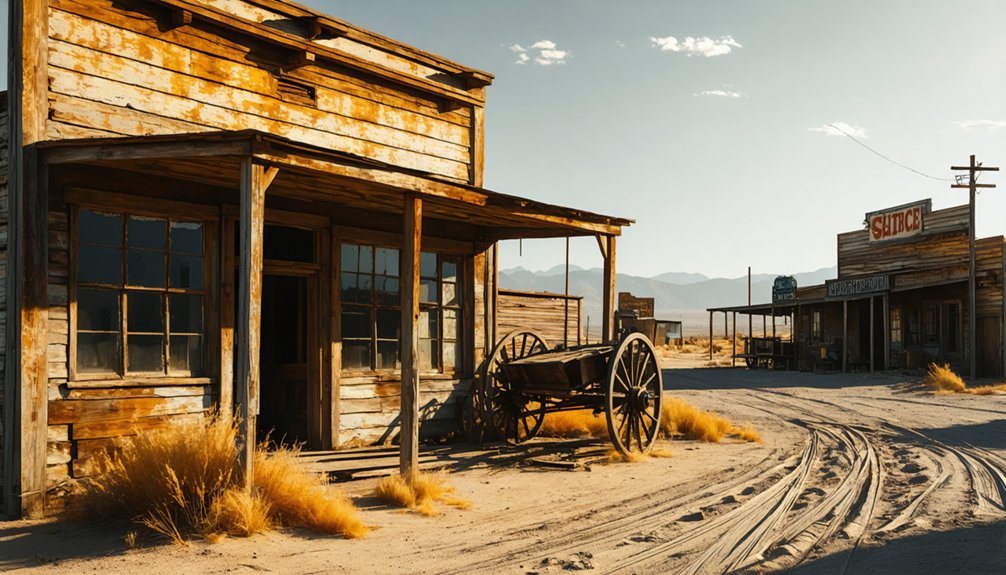
You’ll find that Horseshoe Bend’s prosperity began to wane as gold deposits became increasingly scarce, triggering a steady exodus of miners and their families by the late 19th century.
The town’s fate was permanently sealed with the 1926 completion of the Exchequer Dam, which created Lake McClure reservoir directly over the settlement’s location.
What little remained of the once-thriving mining community disappeared beneath the rising waters, transforming the physical site from a ghost town into an underwater memorial to California’s Gold Rush era.
Gold Depletion Effects
As gold deposits throughout Horseshoe Bend gradually diminished in the years following the California Gold Rush, the once-thriving settlement began experiencing irreversible economic decline.
The shift from placer to hydraulic gold mining signaled the exhaustion of easily accessible surface gold, requiring more capital-intensive extraction methods that threatened economic sustainability.
You’d have witnessed the settlement’s population dwindling as miners abandoned their claims for more promising opportunities elsewhere.
By World War I, severe manpower shortages dealt another blow to the struggling operations. With increasing costs and diminishing returns, the 400-residence community couldn’t maintain its economic viability.
The exodus accelerated as workers relocated to more productive mining districts, leaving Horseshoe Bend to join countless other abandoned settlements scattered throughout the Sierra Nevada foothills—casualties of depleted natural resources.
Exchequer Dam Construction
While gold depletion had already set Horseshoe Bend’s decline in motion, the 1964 Exchequer Dam project sealed the settlement’s fate.
The dam engineering began that July, just downstream from the original 1926 structure that had first altered the Merced River’s flow through the former mining community.
Tudor Engineering designed a 490-foot concrete-faced rockfill structure that would quadruple water storage to over one million acre-feet.
You’d hardly recognize the innovative water management approach—using compacted layers ranging from 1.6 to 66 feet thick in vertical zones.
From Boomtown to Lake Bottom: The Exchequer Dam Project
The history of Horseshoe Bend‘s transformation from thriving settlement to submerged ghost town began in 1921, when plans for the original Exchequer Dam first took shape.
This dam engineering marvel, completed in 1926, stood 310–326 feet high with a 281,000-acre-foot capacity, creating a 14-mile reservoir that began altering the landscape’s historical significance.
By the 1950s, growing agricultural demands necessitated expansion, leading to:
- Construction of the New Exchequer Dam in 1964, directly downstream from the original
- Integration of the old dam as the upstream toe for the new structure
- Completion in 1967, expanding capacity to over 1 million acre-feet
- Formation of Lake McClure, which completely submerged Horseshoe Bend
You’re witnessing the outcome of progress that sacrificed a community for regional agricultural stability and flood control.
Historical Documentation and Preservation Efforts
Historical documentation of Horseshoe Bend remains largely confined to archival materials since the town’s physical remains disappeared beneath Lake McClure’s waters decades ago.
You’ll find the town’s historical significance primarily preserved through mining camp archives, census records, and John Muir’s naturalist writings about the area.
Preservation challenges are substantial due to the complete inundation of the site after the Exchequer Dam’s completion in 1926.
With no physical structures to conserve, preservation efforts have shifted toward maintaining historical memory through the naming of recreational facilities and creating interpretive materials around Lake McClure.
Local historical societies maintain photographs and accounts of this once-thriving community of 400 residences, while researchers rely on archival documents rather than archaeological excavation to piece together the story of this submerged Gold Rush settlement.
Visiting Horseshoe Bend Today: Lake McClure Recreation
Visitors seeking to experience what remains of Horseshoe Bend today will find a transformed landscape where Lake McClure’s waters now cover the once-thriving mining settlement.
The area now serves as a popular recreation destination with 97 campsites, including 35 with water and electric hookups.
The modern Horseshoe Bend Recreation Area offers:
- G-loop campsites with elevated lake views and full hookups
- Visitor amenities including free hot showers, flush toilets, and a seasonal camp store
- Recreation activities such as fishing, boating, and access to the Splash-n-Dash Aqua Park
- Nearby attractions including Exchequer Mountain Bike Park with scenic trails
Though the swimming lagoon at Horseshoe Bend is closed, you’ll find ample opportunities for outdoor adventure just minutes from Coulterville via Highway 132.
Frequently Asked Questions
Were Any Human Remains Found During the Flooding of Horseshoe Bend?
Yes, a human skull was discovered on a rock ledge during flooding at Horseshoe Bend Campground. The remains required anthropological analysis after floodwaters revealed this previously submerged evidence.
What Indigenous Peoples Originally Inhabited the Horseshoe Bend Area?
You’d think we’d know exactly who first walked Horseshoe Bend’s paths, but historical records remain limited. The area’s Native Tribes likely included Miwok or Paiute peoples, whose Cultural Heritage predated settlement.
Did Any Famous Outlaws or Celebrities Visit Horseshoe Bend?
You won’t find evidence of famous outlaws or celebrity sightings at Horseshoe Bend. Historical records document only John Muir’s visit, as documentation focused on mining operations rather than tracking notable visitors.
Does the Water Level Ever Drop Enough to Reveal Town Ruins?
You won’t glimpse the past here. Water level fluctuations at Horseshoe Bend rarely drop enough to reveal town ruins, with most remnants buried under sediment or completely dismantled during the 1930s.
Were There Any Major Disasters or Epidemics in Horseshoe Bend?
No, there weren’t any major natural disasters or disease outbreaks in Horseshoe Bend. You’ll find its decline was gradual, tied to mining exhaustion, and ultimately ended by planned reservoir submersion in 1926.
References
- https://kids.kiddle.co/Horseshoe_Bend
- https://www.wikiwand.com/en/articles/Horseshoe_Bend
- https://en.wikipedia.org/wiki/List_of_ghost_towns_in_California
- https://freepages.rootsweb.com/~gtusa/history/usa/ca/mrp-co/h.htm
- https://freepages.history.rootsweb.com/~gtusa/usa/ca/mrp-co/w.htm
- https://www.ebay.com/itm/174235775183
- https://westernmininghistory.com/mine-detail/10040704/
- https://www.usawelcome.net/news/explore-ghost-towns-west-usa.htm
- https://www.hsbvalleychamber.org/history-of-horseshoe-bend
- https://en.wikipedia.org/wiki/Horseshoe_Bend