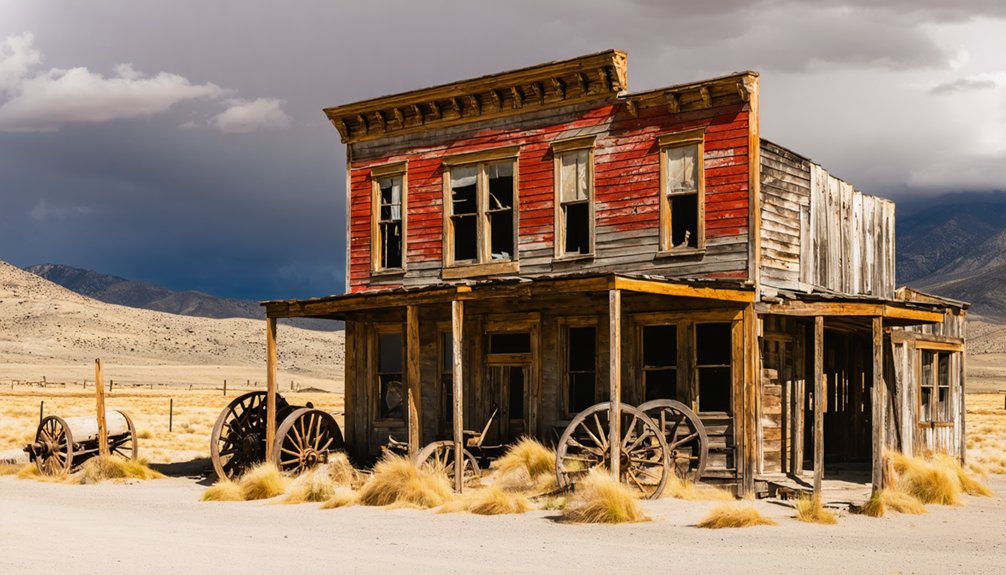
Ghost towns get their names from the people and events that founded them. You’ll find settlements named after military commanders like Fort McDermitt, prospectors like Harrisburg (for Shorty Harris), or geological features like Rhyolite’s volcanic rock. Communities honored founders, commemorated mineral discoveries—gold strikes, silver veins, copper deposits—and documented geographic features through official sources like USGS records. When resources depleted or railroads bypassed these towns, their names remained as historical markers. Transportation shifts and economic busts preserved these naming stories, which reveal the complete circumstances behind each settlement’s origin.
Key Takeaways
- Ghost towns are often named after military figures, founders, or prominent political leaders who established or commanded early frontier settlements.
- Mineral discoveries like gold, silver, and copper directly inspired names commemorating prospectors, mining strikes, or the specific resources found there.
- Geographic features such as ridges, valleys, canyons, and rock formations influenced settlement names based on distinctive landscape characteristics.
- Local folklore, cultural stories, and community legends contributed colorful names reflecting unique regional heritage and memorable events.
- Economic booms and transportation changes determined town fates, preserving names of once-thriving settlements that became ghost towns after resource depletion.
Named After Military Leaders and Their Camps
Military commanders left their mark on the American frontier not through monuments, but through the towns that bore their names. Ghost town naming conventions frequently honored military leaders who established frontier posts during periods of territorial expansion and conflict.
Fort Schellbourne in Nevada commemorated Major A.J. Schell, while Fort McDermitt, established in 1865, recognized its district commander. The Army established Fort Schellbourne in 1860 to protect the Pony Express station from Paiute raids that had killed the stationmaster and attendants. Military nomenclature became permanently embedded in settlement identities, serving as historical markers of leadership during the Civil War era and Indian conflicts.
These naming practices reflected the rank and prominence of officers stationed in remote regions, creating lasting legacies even after communities declined. Fort Leavenworth, established in 1827, became one of the earliest examples of this tradition, anchoring military presence in Kansas territory. You’ll find this pattern throughout western territories, where military infrastructure attracted civilian settlement before eventual abandonment transformed these honored posts into ghost towns.
Prospectors and Mining Discoveries That Shaped Town Names
You’ll find that many ghost towns bear the names of the prospectors who first struck ore or the minerals that drew thousands to remote locations. Towns like Harrisburg in Death Valley took Shorty Harris’s name after his 1905 gold discovery, while Skidoo emerged when two prospectors found gold en route to that same strike in 1906.
Geographic features and mineral wealth shaped names equally—Leadfield referenced its copper and lead deposits, and Belmont arose from an 1865 silver strike that attracted 2,000 residents to Nevada’s interior. Berlin’s establishment in the late 19th century reflected its founder’s origins, and the town’s mine produced approximately $849,000 before abandonment in 1911. Ballarat, founded in 1897, was home to the Radcliffe mine which produced 15,000 tons of gold ore and supported a population of 400 by 1898.
Mineral-Based Town Naming
When prospectors struck gold, silver, or other valuable minerals in the American West, they often named their nascent settlements directly after the ore that promised fortune. You’ll find Goldfield, Nevada earned its designation after 1902 discoveries of abundant gold ore—replacing its Shoshone name Grandpa. By 1904, the settlement’s mines were producing approximately $10,000 in gold ore daily, justifying its mineral-based name.
Ancient mineral deposits determined similar fates: Calico’s 1881 silver strike yielded $20 million over twelve years from 500 mines, while Telluride memorialized tellurium-bearing ores containing zinc, lead, copper, and precious metals.
Even industrial minerals left their mark—Calcite quarries supplied lime for Black Hills mining operations, and Cambria’s anthracite coal powered locomotives for four decades. Rhyolite took its name from the silica-rich volcanic rock prevalent in the area where prospectors discovered quartz full of free gold in 1904.
Geological survey methods revealed Copper’s ore valued at $120 per ton in 1860s California, prompting immediate renaming.
These designations served practical purposes: advertising mineral wealth to investors and settlers seeking independence through resource extraction.
Famous Prospector Namesakes
Beyond generic references to minerals themselves, individual prospectors and their discoveries frequently determined how mining settlements identified themselves on territorial maps.
You’ll find Caribou, Colorado commemorates the prospector who traced placer gold upstream in 1861 to uncover the district’s first silver vein. Steins, New Mexico honors U.S. Army Major Enoch Steen, while Kennicott, Alaska bears a prospector’s name from its 1903 copper boom.
Berlin, Nevada reflects German prospectors’ origins during the 1880s gold rush. Ashcroft, Colorado earned its designation after an 1882 silver ore discovery transformed Castle Forks City into a 3,500-resident boomtown. Bannack, Montana briefly served as the territorial capital with a population of 10,000 during its mining heyday.
Today these abandoned settlements attract visitors seeking both documented mining history and the ghost stories and urban legends that inevitably accompany frontier fortune-seeking, where ambition collided with geological reality.
Natural Resources That Defined Community Identity
You’ll find that ghost towns often bore names directly reflecting the mineral wealth that sparked their creation, from Rhyolite’s silica-rich volcanic rock to What Cheer’s coal deposits that drew Scottish miners in the 1800s.
The Bullfrog district’s quartz formations containing free gold generated enough excitement to sustain claims across a 30-mile area, while Namibia’s Sperrgebiet zone spawned multiple diamond rush settlements like Kolmanskop during the 1908 rush.
These resource-based names served as advertisements of economic opportunity, transforming geological features into community identities that persisted even after the mines went silent. In Arkansas, steamboat communities emerged along the river, where boatmen “sucking on the bottle” during extended stops inspired the enduring name Toad Suck, reflecting both the waterway commerce and the colorful behavior of workers in transit towns. The abandoned settlement of Crab Town near Iowa’s Maquoketa River reflects family heritage rather than any connection to local wildlife, named after the Crab Family who inhabited the area during the mid-1800s before the town disbanded around 1900.
Mineral Discoveries Shape Names
Mining discoveries stamped their geological signatures directly onto town names across the American West, creating an enduring record of the minerals that drew thousands to remote locations. You’ll find Rhyolite, Nevada, named after the silica-rich volcanic rock where prospectors discovered gold-bearing quartz in 1904.
Historical settlers staked over 2,000 claims within the 30-mile Bullfrog district, transforming geological terminology into community identity. Unlike urban legends surrounding many abandoned settlements, these names documented precise mineralogical conditions that justified establishing entire towns.
Kennicott, Alaska emerged from copper deposits that supplied America’s electrification boom from 1903 until depletion in 1938. The Montana Mine in Ruby, Arizona produced zinc, lead, and silver, with the town itself named after Lillie B. Ruby Andrews when established in 1912, blending personal tribute with mineral enterprise.
Coal and Gold Economies
Coal deposits transformed barren landscapes into bustling industrial colonies where company control shaped every aspect of daily existence. You’ll find evidence in Thurber, Texas, where 8,000-10,000 residents depended entirely on coal operations until labor disputes and the 1926-1927 strike hastened its decline.
Mining equipment defined these settlements’ purpose—Carbon housed 1,000 railroad workers supporting steam locomotives, while Clarkville’s 400 inhabitants operated company stores and hospitals.
The corporations dictated community character: Rudefeha banned saloons, forcing drinkers to nearby Dillon. When mines exhausted resources, populations vanished—Mentmore collapsed after 1952, Clarkville became ghostly by 1910.
These weren’t just towns; they were corporate assets. Your freedom ended where company property began, creating settlements that lived and died by extraction economics.
Family Legacies and Founder Tributes
When settlers established new communities across America, they often immortalized the founders and early residents who shaped their development. Cultural influences determined whether you’d find straightforward possessive forms like Aaronsburg (Aaron Levy) and Canonsburg (John Cannon) in Pennsylvania, or variations honoring military figures such as Gainesboro, Tennessee‘s tribute to General Gaines.
Naming conventions reflected the settler’s prominence. Developers like Monroe Abernathy secured Texas town names, while land agents such as Theophilus Cazenove earned multiple Cazenovia designations.
You’ll notice political figures commanded respect—Joseph Abbott’s name graces Texas communities, while institutional connections mattered too. Cincinnati’s indirect homage to Roman statesman Cincinnatus through the Society of the Cincinnati demonstrates how founder tributes extended beyond immediate pioneers to encompass historical ideals of leadership and civic virtue.
Colorful Stories and Local Legends Behind Names
Small-town America’s most memorable place names often emerged from spontaneous moments that captured community imagination rather than formal decree.
You’ll find Santa Claus, Indiana originated when church doors mysteriously blew open during an 1852 Christmas Eve meeting, prompting children to shout the saint’s name.
Two Egg, Florida immortalized Depression-era boys who traded eggs for sugar, while Bug Tussle, Texas preserved either an insect swarm catastrophe or residents watching tumblebugs battle.
These folklore and ghost stories evolved beyond simple naming events—Helltown, Ohio’s legendary hauntings and myths included tales of the Peninsula Python, supposedly mutated by chemical spills.
Two Egg added its own cryptid mythology with the Stump Jumper sightings.
Such colorful origins transformed mundane settlements into communities with narrative identities worth preserving.
Transportation Changes That Created Ghost Towns
The railroad’s arrival determined which settlements would prosper and which would vanish from the American landscape. Railroad land grants enabled corporations to establish new towns through subsidiaries, monopolizing freight and sales while bypassing established communities.
You’ll find White Cloud declined after 1878 when Nebraska City’s line diverted traffic to rival Lawrence. Farmers abandoned older settlements for rail-served towns offering cheaper goods without transport costs.
Highway bypasses repeated this pattern generations later. Route 66 communities became ghosts after Interstate 40’s late-1950s construction diverted travelers.
Texas towns withered when Highway 40 circumvented their main streets in 1975, shuttering stores and gas stations. Political routing decisions doomed communities overnight.
Thurmond peaked handling more freight than Cincinnati before diesel engines and declining coal demand erased its prosperity post-1920s.
Geographic Features and Geological Terms
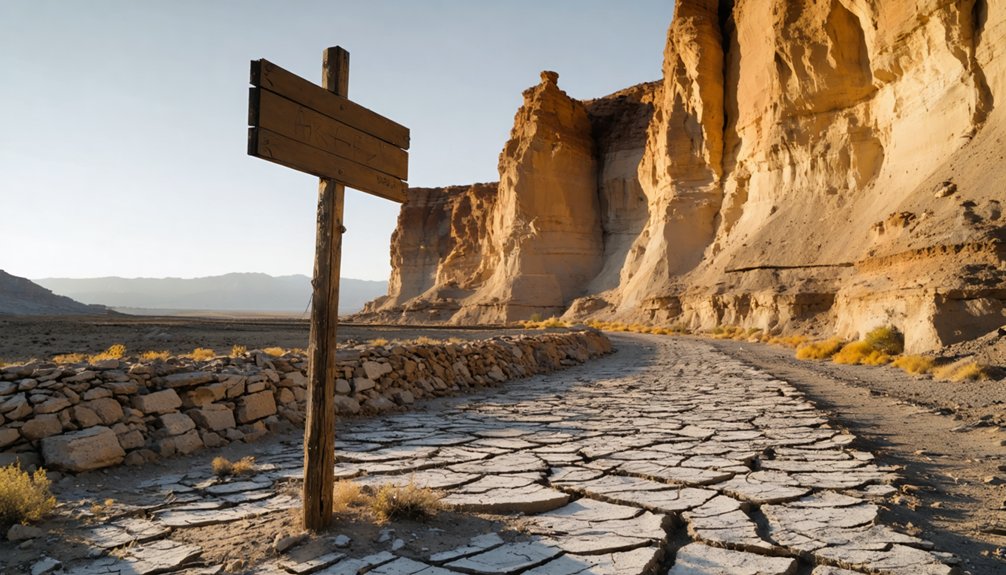
Ghost town names follow a binomial structure that combines specific identifiers with generic geographic terms, creating labels like Coffin Canyon or Soulstone Quarry. You’ll find these abandoned settlements cataloged in the USGS Geographic Names Information System (GNIS), which documents over two million features using standardized geological terminology.
Ghost town nomenclature merges descriptive specifics with standardized geographic classifiers, systematically documenting abandoned settlements through federal cartographic databases.
Geographic formations directly shape settlement names—ridges become Phantomridge, valleys transform into Shrouded Valley, and mesas emerge as Twilight Mesa. The U.S. Board on Geographic Names ensures consistency by classifying features as buttes, hollows, springs, or lava flows.
Rock compositions influence quarry town names like Hollow Stone, while terrain descriptors such as “narrow” or “concealed” modify generics like canyon or creek.
This classification system originated from post-Civil War mapping surges, capturing the spoken language of western territories and preserving their geographic legacy.
Economic Booms and Busts That Left Names Behind
When resource discoveries sparked settlement, economic forces carved both prosperity and abandonment into America’s landscape with equal force. You’ll find names like Pithole preserving memories of Pennsylvania’s 1865 oil rush, where population exploded from 2,000 to 20,000 within months before collapsing to 200 by 1868.
Tombstone’s silver wealth attracted 7,000 residents until flooded mines triggered urban decay. Jerome’s copper prosperity ended when WWII demand vanished, nearly erasing the town entirely.
Transportation shifts left cultural influences embedded in names—Cisco and Glen Rio mark Route 66‘s golden age before highway rerouting killed their economies. These boom-bust cycles created instant cities with Bodie reaching 10,000 residents during gold rushes.
towns surviving resource depletion developed diversified economies, while isolated single-industry settlements became the ghost towns whose names you recognize today.
Frequently Asked Questions
How Were Ghost Towns Named After Indigenous Peoples or Native Languages?
You’ll find ghost towns named through indigenous language origins—like Algonquian “broken ground” or Ojibwe “maize”—while others honor chiefs like Cochise and Washakie, preserving native cultural significance across landscapes where tribal communities once thrived freely.
Did Religious or Spiritual Beliefs Influence Any Ghost Town Names?
Religious beliefs profoundly shaped ghost town naming traditions through cultural influences from Mormon scripture. You’ll find Book of Mormon references like Nephi, Lehi, and Moroni, plus biblical names like Hebron, documenting settlers’ spiritual devotion throughout Utah’s landscape.
Were Ghost Towns Ever Renamed by Later Inhabitants or Governments?
Picture abandoned streets reclaimed by nature—yes, you’ll find ghost towns renamed through relocation. Harrisville became Harrisburg after flooding, while Kensico vanished entirely beneath its reservoir. Governments documented these transformations, creating new historic landmarks from urban legends.
How Did Natural Disasters Affect the Naming of Abandoned Settlements?
Natural disasters rarely changed naming conventions; settlements kept their original names even after abandonment. You’ll find historical influences preserved the pre-disaster identities—Pripyat, Herculaneum, and Dunwich retained names reflecting their founding, not their catastrophic ends.
What Role Did Outlaws or Criminal Activity Play in Naming Towns?
Outlaw legends directly shaped town identities rather than names themselves. You’ll find criminal histories defined places like Skidoo through Simpson’s hanging and Deadwood through Wild Bill Hickok, creating notorious reputations that attracted fortune-seekers seeking unregulated opportunities.
References
- https://www.sdpb.org/rural-life-and-history/2023-08-21/some-black-hills-ghost-towns-and-their-origins
- https://www.nps.gov/deva/learn/historyculture/rhyolite-ghost-town.htm
- https://www.mentalfloss.com/article/27987/15-places-strange-names-and-how-they-got-them
- https://en.wikipedia.org/wiki/Ghost_town
- https://iowastartingline.com/2022/10/31/6-weird-town-names-in-iowa-and-their-origins/
- https://soldiersangels.org/haunted-military-bases/
- https://www.historynet.com/ghost-towns-schellbourne-nevada/
- https://www.legendsofamerica.com/roosevelt-texas/
- https://en.wikipedia.org/wiki/List_of_ghost_towns_in_South_Dakota
- https://kmhk.com/stmarie-ghost-town-montana/