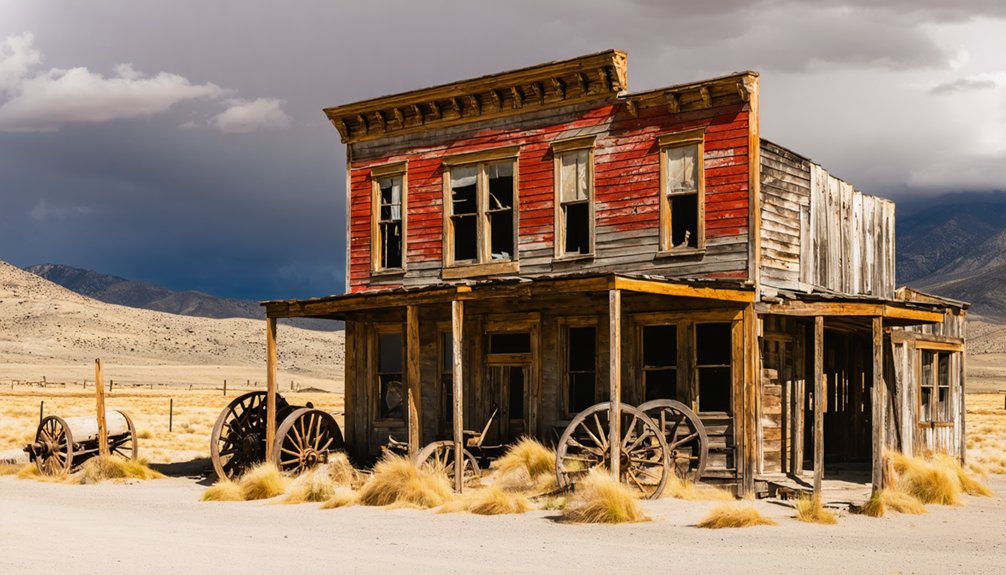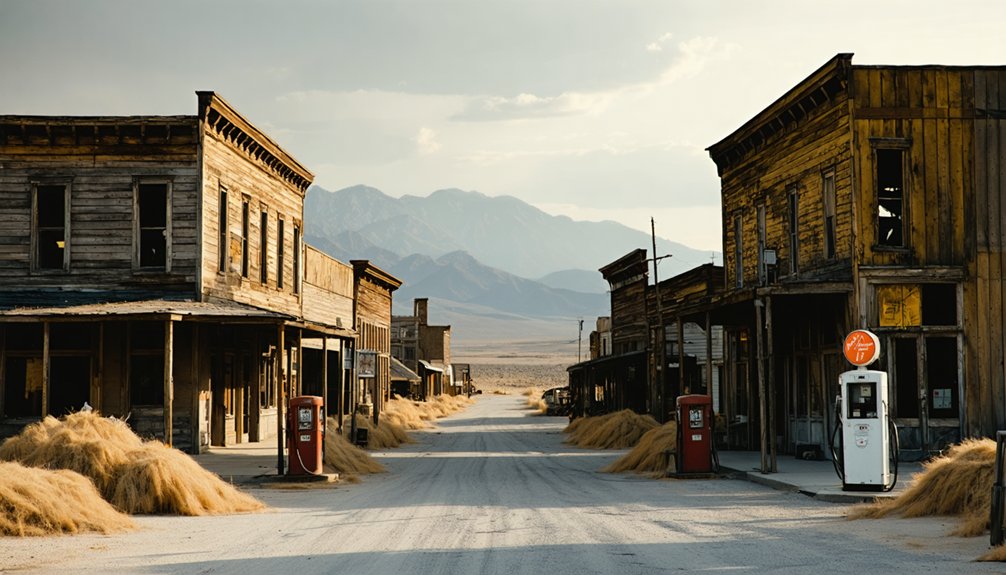
Towns become ghost settlements when you’re witnessing the collapse of their economic foundations—typically through resource depletion in mining or oil industries—or when disasters like earthquakes, floods, and industrial contamination render areas uninhabitable. You’ll find infrastructure changes, particularly railroad bypasses and highway rerouting, accelerate abandonment by cutting off essential transportation links. Human conflicts and environmental neglect further compound these pressures, creating varying degrees of depopulation from partial decay to complete desertion. The patterns reveal complex sociological transformations worth examining further.
Key Takeaways
- Towns become ghost towns when key industries like mining, oil, or coal collapse after resource depletion, triggering economic decline and population exodus.
- Natural disasters such as earthquakes, floods, volcanic eruptions, and human-induced catastrophes like underground fires destroy infrastructure and make areas uninhabitable.
- Transportation changes, including railroad bypasses and highway rerouting, shift economic centers away from towns, leading to depopulation and abandonment.
- Industrial contamination from asbestos, lead, or toxic waste creates hazardous environments that force evacuations or make communities uninhabitable.
- Warfare and military conflicts displace populations, destroy structures, and transform inhabited areas into abandoned zones through sustained bombardment and violence.
What Defines a Ghost Town
Though definitions vary among historians and geographers, a ghost town fundamentally represents a settlement whose original purpose has ceased to exist, leaving behind physical evidence of its former importance.
A ghost town is a settlement abandoned yet preserved, its empty structures bearing witness to vanished purpose and faded significance.
You’ll find these abandoned communities marked by empty structures, from main streets to cemeteries, with populations dramatically reduced from their peak. The classification remains contested—some insist on complete desertion, while others accept minimal populations that can’t sustain the town’s original function.
Physical accessibility matters; you should be able to explore tangible remains, whether intact buildings or mere foundations. These sites often inspire urban legends and folklore stories, transforming economic failures into cultural artifacts.
Places like Bodie, California, and Centralia, Pennsylvania, demonstrate how disaster or collapsed industries create what Lambert Florin called a “shadowy semblance” of former dynamism. Causes for abandonment typically include economic failure or catastrophic events such as floods, war, or nuclear disasters that force populations to relocate permanently. The closure of key facilities, such as coal mines that provided the primary employment, can trigger rapid abandonment as residents seek opportunities elsewhere.
Economic Collapse and Resource Depletion
When you examine the historical pattern of American ghost towns, you’ll find that resource depletion and sudden economic collapse create predictable abandonment cycles.
Mining operations that once sustained entire communities—from Colorado’s Lake County silver towns to Texas’s post-Spindletop oil settlements—left behind vacant buildings and displaced populations once ore bodies exhausted or wells ran dry.
You’re witnessing this same boom-bust mechanism repeat today as extractive industries withdraw, severing the linked labor and housing markets that made isolated communities viable.
The 2008 housing crisis created modern ghost towns across South Florida, Arizona, California, where developers overbuilt during the boom and left entire neighborhoods abandoned with vacant high-end condos and unfinished model homes.
Economic collapse triggers a downward spiral where empty homes lead to declining retail activity, reduced tax revenues, and less investment in infrastructure, making recovery increasingly difficult for affected communities.
Mining Operations Shut Down
The collapse of mining operations transforms once-thriving communities into economic wastelands through a predictable sequence of devastation. When mines close, you’ll witness entire regional economies unravel as job losses cascade beyond extraction sites into local businesses dependent on mining wages.
Mining subsidies that once sustained operations disappear alongside deposits, while environmental regulations accelerate shutdowns in marginally profitable locations. The data reveals stark consequences: mining-dependent counties experienced 25% slower income growth from 1980-2000 compared to national averages, with poverty rates climbing highest among all industrial groups.
You’ll find ghost towns weren’t accidents but inevitable outcomes when resource depletion meets economic vulnerability. Central Appalachian coal regions exemplify this pattern, where output plunged 80% over fifteen years, eliminating two-thirds of employment and triggering population exodus that left behind economic ruins. These sudden closures create community-wide emergencies as entire towns lose their primary economic foundation, leaving families without livelihoods and municipalities unable to sustain basic services. Company officials who once functioned as de facto mayors with eviction power disappeared along with the mines, leaving no local government infrastructure to manage the social and economic fallout.
Railroad Bypass Effects
Railroad placement decisions in the 19th century functioned as economic death sentences for communities left off the network, initiating collapse patterns that federal infrastructure projects would replicate for generations. You’ll find 511 ghost towns across Texas alone, abandoned when railroads chose competitors within miles.
When Gomez lost the South Plains and Santa Fe Railway to Brownfield—just four miles east—merchants and settlers relocated immediately, triggering urban decay. The “agglomeration shadow” effect devastated towns within 10 kilometers of rail lines, draining populations toward depot sites.
Kansas farmers absorbed $20.5 million in losses after rail abandonment forced expensive truck transport. Population decline accelerated as anchor cities like Lubbock captured eight railroad connections by 1930, systematically extracting resources from bypassed neighbors unable to compete without transportation access. Over 120 rural hospitals closed nationwide since 2010, with 26 closures in Texas further accelerating abandonment as essential services vanished from transportation-starved communities. Later highway construction repeated this pattern, as I-40’s rerouting displaced Route 66 communities like Amboy, California, which declined after losing its position on the main transportation corridor.
Natural Disasters That Force Abandonment
Natural forces have repeatedly demonstrated their capacity to transform thriving communities into abandoned ruins, rendering human settlements uninhabitable within hours or decades. You’ll find earthquakes triggering the most dramatic evacuations—Apice’s 1962 tremor displaced 6,500 residents, while Poggioreale’s 1968 disaster killed 200 and proved economically unviable to rebuild.
Underground fires present insidious threats; Centralia’s mine blaze drove population decline from over 1,000 to just 10 by 2010, creating toxic sinkholes that made government seizure inevitable. The 1962 coal fire started from trash burning in a landfill before spreading to underground mine tunnels. Italian towns like Ischiazza faced similar displacement when 1966 flooding destroyed infrastructure and forced permanent evacuation.
Centralia’s unstoppable underground inferno transformed a thousand-strong community into a toxic wasteland, proving fire’s patient devastation requires no visible flames.
Volcanic eruptions deliver catastrophic finality—Montserrat’s 1997 burial of Plymouth ended tourism supporting 25,000 visitors annually. Landslides and floods compound these disasters, as Thistle’s 1983 submersion and Craco’s unstable slopes demonstrate.
Such events accelerate urban decay, forcing communities to acknowledge nature’s ultimate authority over settlement patterns.
Human Actions and Government Interventions
You’ll find that human conflict and industrial negligence create ghost towns as decisively as any natural catastrophe.
Military requisitions during wartime—such as Tyneham’s seizure for WWII exercises—permanently displace populations through contamination with unexploded ordnance.
While environmental disasters stem from corporate and governmental failures.
These interventions transform inhabited spaces into exclusion zones where return becomes legally prohibited or physically impossible, revealing how institutional decisions reshape settlement patterns across generations.
War and Displacement
When state militaries and armed groups transform inhabited spaces into battlefields, entire communities vanish from the landscape within months. You’ll witness how Gaza’s 15-month bombardment displaced 90% of its population, leaving 60,000 structures destroyed and communities reduced to cement-gray ruins.
Sudan’s conflict created 11.3 million internal displacements—the world’s largest—while Ukraine’s frontline cities became ghost towns of rubble and blackened trees.
These demographic changes reshape entire regions: 30.4 million Sudanese now require urgent assistance, and 541,000 Nigerians fled violence in 2018 alone.
Cultural shifts follow when Jenin’s refugee camp sees every building damaged and Libya’s displacement doubles year-over-year.
You’re observing systematic erasure of populated spaces, where returning civilians find no infrastructure, no services, and no possibility of recovery.
Environmental Contamination and Relocation
Industrial operations transform inhabited spaces into uninhabitable zones through contamination that persists for generations, forcing governments to choose between expensive remediation and permanent relocation.
You’ll find Wittenoom’s 3 million tons of asbestos tailings embedded in infrastructure, making evacuation more practical than cleanup, while Picher’s lead-zinc waste created 200-foot chat mounds that poison air and collapse ground beneath homes.
Homestake’s repeated deadline failures—1980s, 2006, 2013—demonstrate how contaminated sites burden communities for decades despite treating 10 billion gallons of groundwater.
Environmental remediation costs often exceed political will, leaving 15,000 residents near threatened water sources.
When Samarco’s dam released arsenic and lead at 10–20 times legal limits, authorities destroyed Bento Rodrigues rather than restore it.
These abandonments reveal how industrial legacy trumps human habitation.
The Role of Transportation and Infrastructure Changes
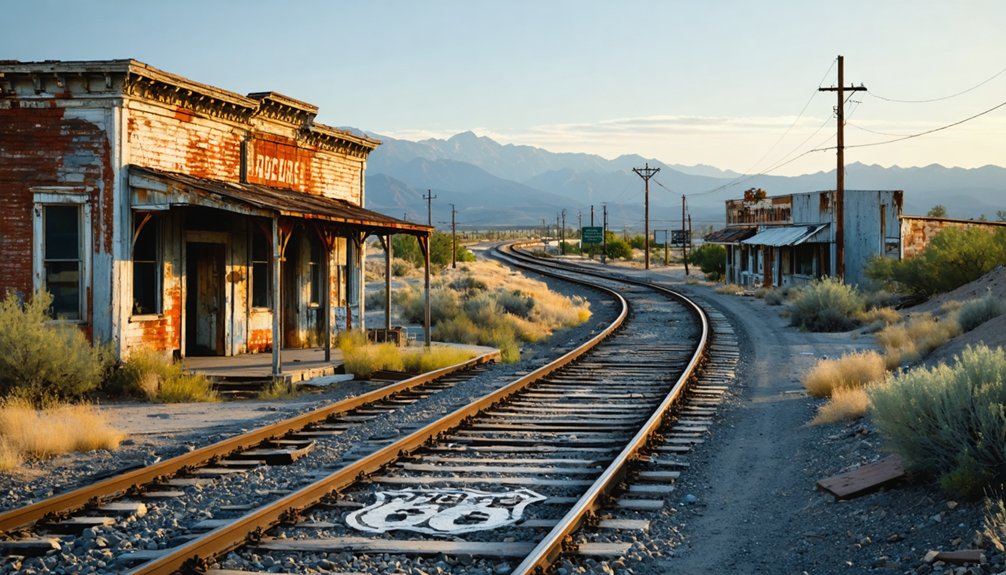
Throughout the twentieth century, transportation networks fundamentally reshaped America’s settlement patterns, determining which communities would thrive and which would disappear. When railroads abandoned over 100,000 miles of track, thousands of towns lost their economic lifelines.
Transportation networks didn’t just connect America—they decided which towns would survive and which would vanish into history.
The interstate system accelerated this population shift, bypassing over 3,000 communities that depended on traveler traffic.
Infrastructure changes that triggered abandonment:
- Railroad dieselization eliminated water stops, stranding towns like Amboy, California
- Interstate highways replaced Route 66, causing urban decay in communities without exits
- Improved mobility let residents drive farther for services, shuttering local businesses
- Depopulation stressed aging infrastructure—water systems, power grids—creating cascading failures
You’ll find that prosperity wasn’t about geography but connectivity. When infrastructure bypassed your town, economic survival became impossible.
Varying Degrees of Abandonment
Infrastructure changes determined whether towns survived or disappeared, but abandonment itself manifests along a spectrum rather than as a binary outcome.
You’ll find partial abandonment in cities like Buffalo, where vacancy rates hit 15.7% and population dropped from 292,648 to 261,310 between 2000-2010. Urban decay clusters spatially—zombie properties concentrate in racially segregated neighborhoods with Global I values exceeding 0.4.
Rural areas experience near-complete depopulation, with 759 counties losing residents during economic booms and 1,300 declining post-2008.
Demographic shifts accelerate gradually: Buffalo’s abandonment rose slowly from 2003-2006 before spiking after 2010.
Village-level variability appears stark—Ruijin City’s abandonment ranged from 0.01% to 50.62% per village.
These patterns reveal how decline operates through localized clustering rather than uniform deterioration.
Notable Ghost Towns Across America
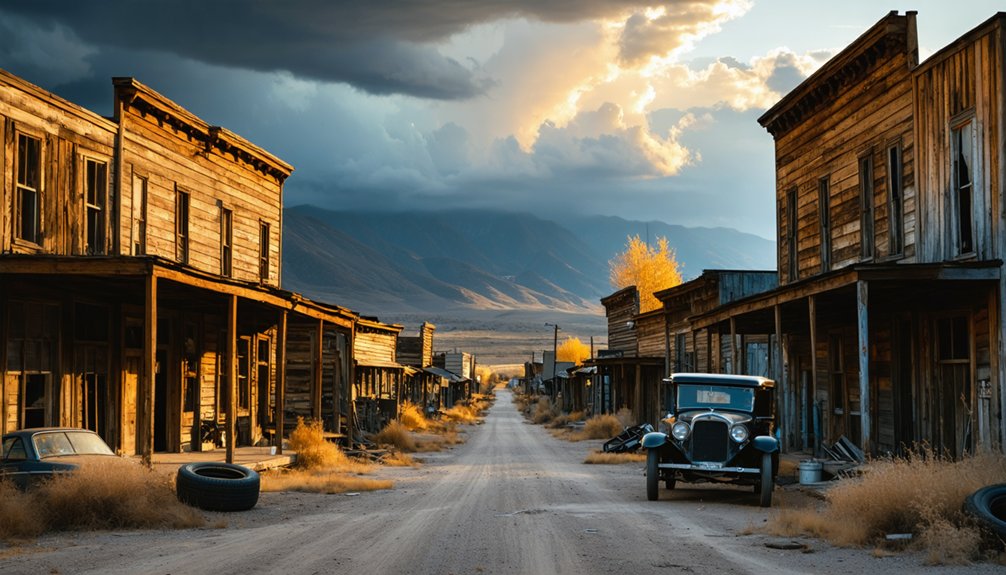
- Bodie, California – 200 frontier buildings preserve gold rush artifacts from its 10,000-resident peak through daily ranger tours.
- Bannack, Montana – 60 structures document 1860s lawlessness along Virginia City’s stagecoach route, with haunting legends of bandit victims.
- Cahawba, Alabama – Archaeological ruins reveal capital-city infrastructure destroyed by repeated flooding post-Civil War.
- Batsto Village, New Jersey – 1766 iron-manufacturing complex showcases industrial shift, associated with Jersey Devil folklore.
You’ll find these sites offer unmediated access to economic collapse patterns, from mineral depletion to infrastructure failure, documenting how communities dissolve when resource extraction ends.
Frequently Asked Questions
Can Ghost Towns Be Legally Purchased or Owned by Individuals?
You can legally purchase ghost towns through standard ownership transfer processes if sellers exist. However, property salvage rights depend on zoning laws and historic designations. Abandoned doesn’t mean ownerless—you’ll need legitimate purchase or face legal consequences restricting your autonomy.
Understanding ghost towns and their history can reveal fascinating stories of past communities and economies that once thrived. Exploring these abandoned places often uncovers artifacts and architecture that reflect the lifestyles of their former inhabitants. As you dive deeper into these sites, you’ll gain insight into the cultural significance and reasons behind their decline.
The history of abandoned places in America is rich with tales of ingenuity and abandonment, showcasing how rapidly communities can change over time. Each location has its own unique narrative, intertwined with the broader patterns of migration and economic shifts that have shaped the American landscape. By examining these forgotten sites, we not only honor their past but also learn valuable lessons about resilience and progress.
Are Ghost Towns Safe to Visit or Explore Without Permission?
You’d face catastrophic legal consequences exploring ghost towns without permission. Visitor safety demands respecting private property boundaries, regardless of haunted legends attracting you. Trespassing risks arrest, structural collapse, and toxic exposure—freedom requires acknowledging others’ rights while pursuing adventure responsibly.
How Long Does It Take for a Town to Become Abandoned?
Historical depopulation timelines vary drastically—you’ll find economic decline can empty towns within decades (like Kennicott’s 35 years) or span generations. Mining depletion, disasters, and infrastructure shifts each accelerate abandonment differently, offering no universal timeline for freedom-seeking communities.
Do Any Ghost Towns Ever Become Repopulated or Revived?
You’ll find ghost towns do revive through historical preservation efforts like Bodie’s tourism model and economic revival strategies. Communities reclaim abandoned spaces as eco-villages, reconstruct war-damaged sites, or attract new residents seeking authentic, self-determined living beyond conventional urban constraints.
This resurgence of interest often leads to unique experiences, such as exploring abandoned towns in California, where remnants of the past tell captivating stories. As these areas gain attention, local economies benefit from tourism, with visitors eager to engage with the history and mystery of these forgotten places. Additionally, preservation efforts can inspire new generations to appreciate and maintain the cultural heritage of their regions.
What Happens to Property Rights When a Town Is Abandoned?
When you abandon property, ownership typically reverts to the state through escheat laws. However, historical preservation efforts and land reconstruction projects can transfer rights to developers or conservationists, enabling your community’s potential revival and restoration.
References
- https://westernmininghistory.com/664/what-is-a-ghost-town-wmh-town-classifications-explained/
- https://quillbot.com/blog/frequently-asked-questions/what-is-a-ghost-town/
- https://www.britannica.com/topic/ghost-town
- https://en.wikipedia.org/wiki/Ghost_town
- https://statelibraryofarizona.wordpress.com/2023/09/18/arizona-ghost-towns/
- https://texashighways.com/culture/history/what-the-heck-is-a-ghost-town/
- https://exhibits.lib.utah.edu/s/ghost-towns/page/Introduction
- https://www.nps.gov/thingstodo/ghost-towns.htm
- https://www.youtube.com/watch?v=ZiJctD8Cs70
- https://www.thefiscaltimes.com/Articles/2011/08/04/9-Worst-Recession-Ghost-Towns-in-America