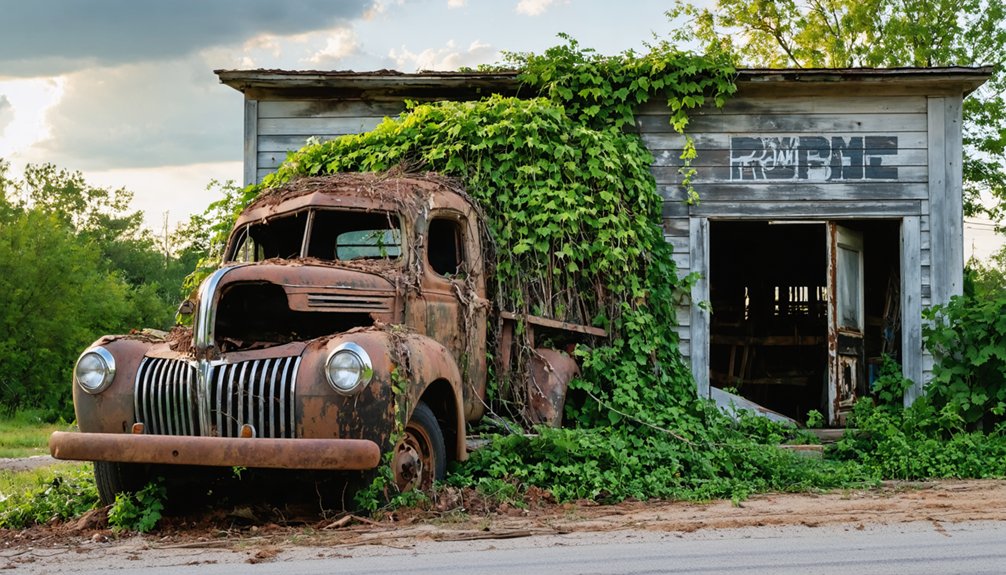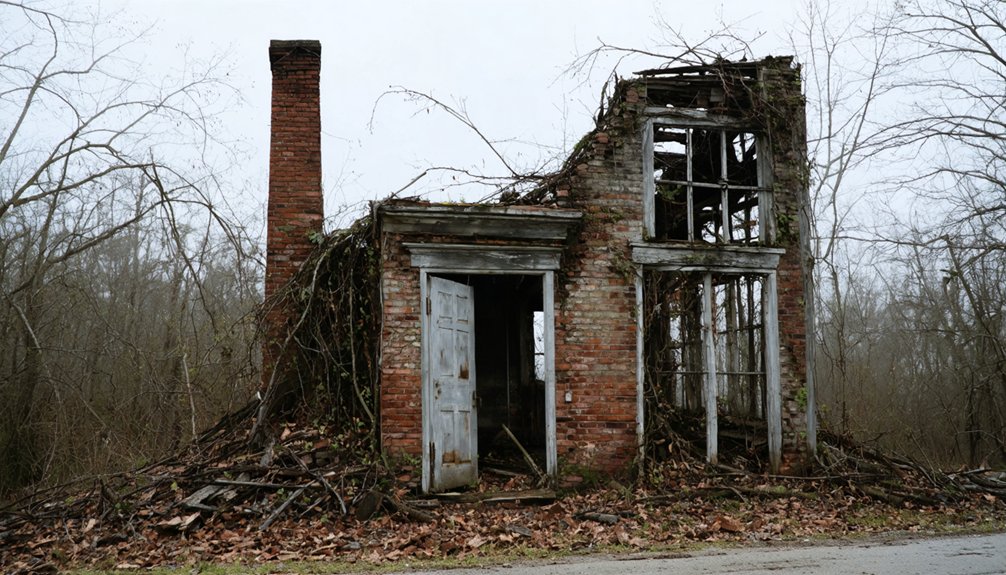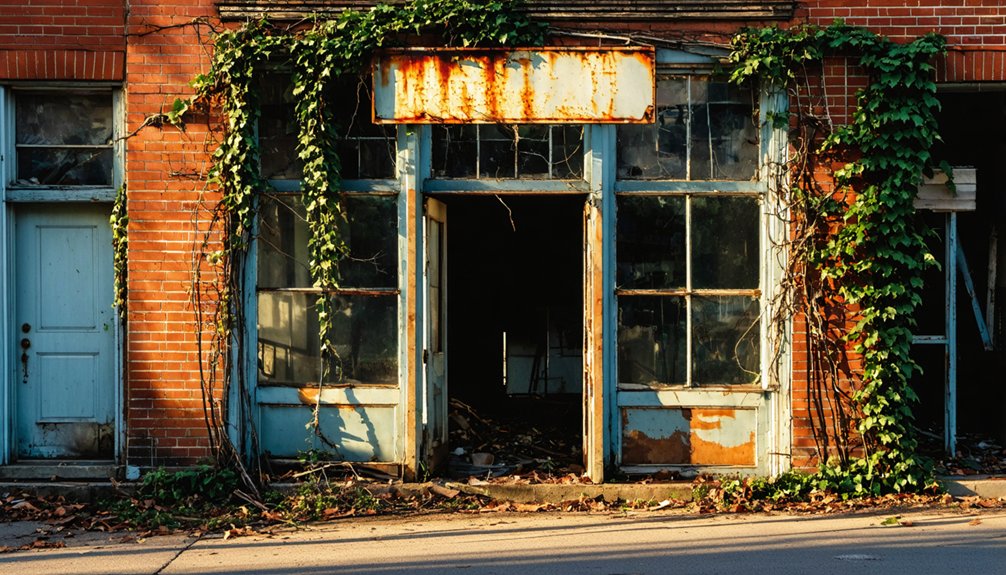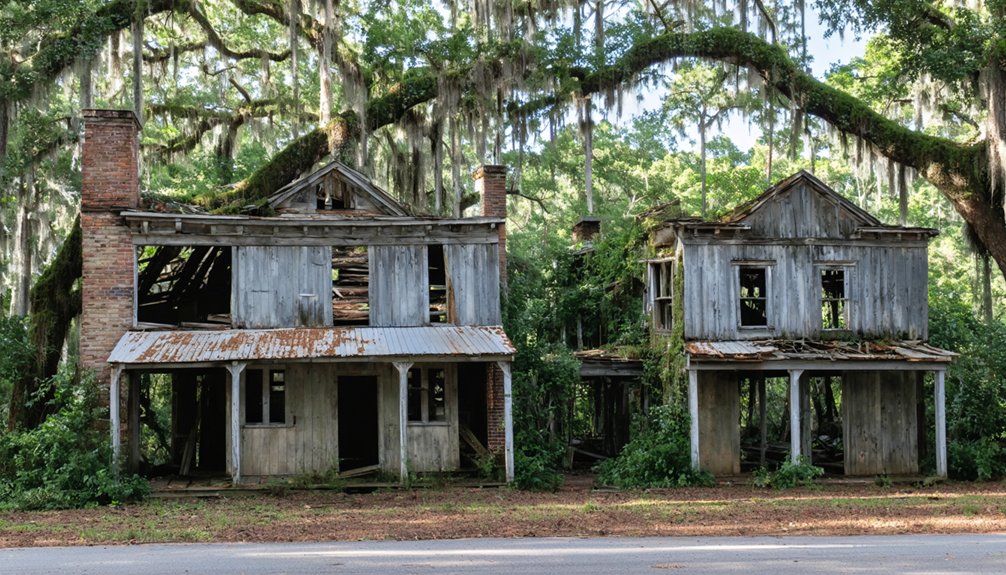
Alabama officially lists 55 ghost towns, but you’ll find the actual number likely exceeds 350 abandoned settlements when county archives, unpublished surveys, and field documentation are considered. Many unincorporated villages, mining camps, and river ports vanished without formal records, especially those lacking post offices or municipal status. Counties like Blount (17 sites) and Bibb (12 sites) reveal how official tallies undercount reality. From Cahawba’s flooded capital to bypassed railroad towns, Alabama’s landscape holds far more lost communities than public registries acknowledge—and understanding their distribution reveals compelling patterns about settlement, decline, and preservation across the state’s diverse regions.
Key Takeaways
- Official estimates suggest fewer than two dozen ghost towns in Alabama, but the actual number likely exceeds several hundred sites.
- County-level surveys document hundreds of locations, with counties like Blount recording 17 ghost towns and Bibb recording 12.
- Approximately 350 ghost town locations remain uncataloged due to incomplete records and absence of post offices or formal municipalities.
- Documentation challenges stem from unrecorded settlements, fragmented archives, and sites that disappeared without census data or official recognition.
- Notable ghost towns include Cahaba (first state capital), Claiborne (5,000 residents), Bellefonte, and St. Stephens, now preserved as historic sites.
The Official Count: 55 Documented Ghost Towns
Alabama’s ghost town inventory remains imprecise despite ongoing documentation efforts by historians and preservation societies. You’ll find numerous references to abandoned settlements throughout the state, yet no authoritative registry confirms exactly 55 ghost towns.
Researchers have identified dozens of sites—from Old Cahawba to Bellefonte—but thorough cataloging remains incomplete. This documentation gap affects both historical preservation initiatives and the development of tourist attractions centered on these forgotten communities.
You’re steering through a landscape where informal surveys compete with partial archival records. While enthusiasts have documented over 3,800 ghost towns nationally, Alabama’s specific count fluctuates depending on definitional criteria. These abandoned settlements span from gold mining boomtowns like Arbacoochee in Cleburne County to former county seats such as Bootsville in DeKalb County.
The absence of official verification means you’ll encounter varying figures across sources, reflecting the challenge of systematically documenting settlements that vanished from maps and collective memory decades ago.
Why the Actual Number Is Likely Much Higher
You’ll find the official count of 55 ghost towns represents only a fraction of Alabama’s abandoned settlements, as researcher files document approximately 350 locations that remain uncatalogued in standard inventories.
Hundreds of dispersed sites—including unincorporated villages, turpentine camps, and rural crossroads communities—never entered formal records because they lacked post offices or municipal structures. Over three-quarters of rural Alabama counties experienced population decline between 2010 and 2020, contributing to the ongoing formation of abandoned settlements.
The systematic gaps in documentation stem from Alabama’s settlement patterns, where transient populations and agricultural communities dissolved without generating the archival footprint necessary for inclusion in all-encompassing databases. Even documented towns like Bellefonte, which was incorporated in 1821, declined when railroad routing choices directed infrastructure miles away from the original settlement.
Dispersed Sites Lack Documentation
While official tallies suggest Alabama contains fewer than two dozen ghost towns, the true figure likely exceeds several hundred due to systematic gaps in historical documentation.
Archival Difficulties plague researchers attempting accurate counts—early settlements like Old Cahawba and Arcola’s French immigrant communities lack comprehensive population censuses, while disease-ravaged sites such as Bellefonte disappeared without thorough records.
Hidden Settlements across Central Alabama remain cataloged informally rather than officially designated, with 30+ abandoned places excluded from state registries.
River ports including Jackson and Coffeeville left only fragmented trade logs after the steamboat era collapsed. Small-scale communities like Repton, Castleberry, and Silas vanished from economic records entirely. Civil War-era sites contain unmarked graves where documentation ceased during the 1860s, leaving entire communities unaccounted for in historical registries. Modern industrial towns face similar documentation gaps, particularly in areas like Marshall County where demographic shifts from migration have transformed communities without adequate tracking mechanisms to record population movements and settlement changes.
Without unified documentation standards distinguishing dispersed sites from recognized ghost towns like Blakeley, Alabama’s abandoned landscape remains systematically undercounted and historically obscured.
Researcher Files Show Hundreds
Though national inventories list roughly 55 ghost towns in Alabama, county-level surveys reveal the true figure likely reaches into the hundreds. You’ll find documented evidence scattered across researcher files and archaeological records that challenge official totals.
The Alabama State Site File maintains exhaustive documentation accessible through the Office of Archaeological Research at Moundville, capturing sites absent from public registries.
Historical narratives emerge from these archival sources:
- Autauga County records 11 ghost towns including Andrew and Booth
- Bibb County identifies 12 sites like Active and Ashby
- Blount County documents 17 locations such as Bird and Birdie
Demographic changes drove these communities’ abandonment, yet their physical remnants—cemeteries, wells, and post office sites—persist. Walker County contains settlements like Manasco, which existed from 1879 until around 1900 before disappearing completely.
Section 106 cultural resource reviews continue revealing forgotten settlements, suggesting Alabama’s ghost town count substantially exceeds published estimates. These abandoned sites represent hidden parts of Alabama’s historical narrative, providing insights into regional development and the lives of past residents through physical exploration.
Small Settlements Go Unrecorded
Because cartographic databases prioritize populated settlements, Alabama’s smallest communities vanish from official records before historians document their existence. Hidden histories emerge only through local accounts: Odena Plantation’s original depot town survives as misidentified structures on industrial property, while Piper’s mining tunnels collapse into unrecorded soil.
You’ll find GNIS omits micro-communities like those east of Conecuh River, though Rand McNally acknowledges Gum Pond’s uncertain location across three counties. Preservation challenges intensify when settlements absorb into private plantations—Arcola disappeared into agricultural expansion by the 1850s, leaving no population data.
Colonial-era sites like Baldwin County’s 1812 wooden fort vanished entirely after hurricane destruction, documented solely in fragmentary territorial records. Infrastructural development further erased entire communities, as Riverton was submerged after dam construction in the 1930s when the Pickwick Landing Dam flooded the Tennessee River trade town. Bainbridge experienced similar fate when Wilson Lake submerged the former Tennessee River settlement abandoned by the 1840s. These archival gaps suggest Alabama harbors hundreds more ghost towns than state databases recognize.
How Alabama Compares to Other States
Alabama’s 55 documented ghost towns place the state in a middle position nationally, tied with Minnesota for 27th among all states in total abandoned communities.
This ranking challenges common geography myths that portray the South as uniformly populated or economically stable throughout history.
You’ll find stark regional contrasts when examining ghost town distribution:
- Western mining states like Texas (511), California (346), and Nevada (106) dwarf Alabama’s count due to extractive industry collapses.
- Great Plains states including Kansas (308) and South Dakota (238) experienced massive Dust Bowl-era abandonment.
- Southern peers like Georgia (16) and South Carolina (11) report markedly fewer documented sites.
Alabama’s higher count reflects unique preservation challenges, including dam construction impacts and limited heritage tourism infrastructure compared to western states that have commercialized their abandoned settlements.
Famous Ghost Towns in Southern Alabama
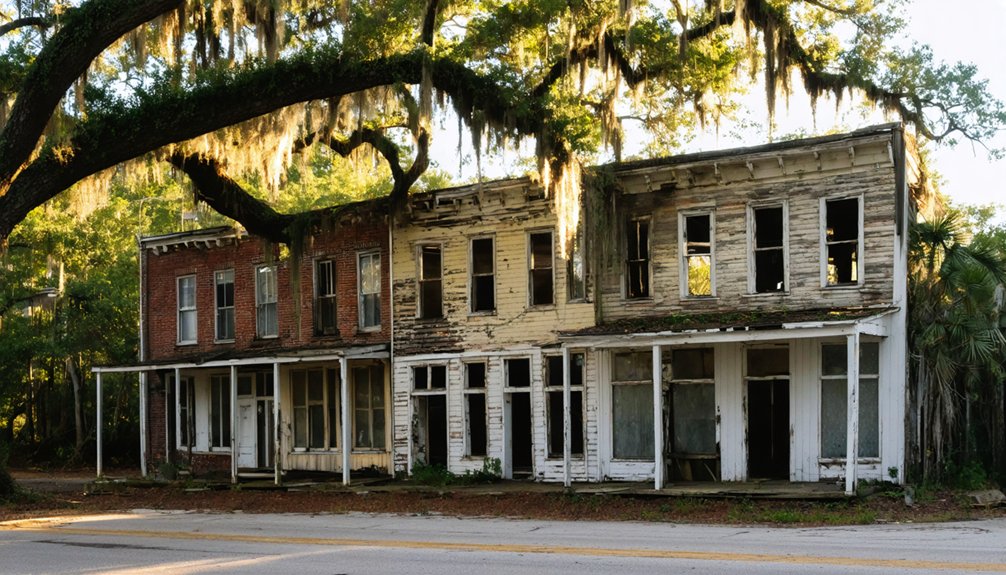
Southern Alabama’s ghost towns document the state’s territorial and antebellum economic ambitions through sites like Cahaba, which served as Alabama’s first capital from 1819 before succumbing to repeated flooding.
You’ll find Claiborne’s trajectory particularly dramatic—growing from its 1816 founding to 5,000 residents before disease epidemics reduced the population to 350 by 1872.
Unlike these nineteenth-century casualties, Alberta represents a modern abandonment case, though its decline followed familiar patterns of economic displacement that characterized earlier river settlements throughout the region.
Cahaba: Alabama’s First Capital
When commissioners convened at St. Stephens on February 13, 1818, they selected a strategic confluence site that would become Alabama’s first permanent capital. You’ll find Cahaba’s architecture reflected its ambitions: a two-story brick statehouse funded by $123,856 in lot auctions, positioned within a grid system where tree-named streets ran north-south.
The town’s trajectory reveals governmental instability‘s impact:
- Population exceeded 1,000 by 1821, surpassing Montgomery’s contemporaneous size.
- Capital relocation to Tuscaloosa in 1826 triggered immediate abandonment.
- County seat transfer to Selma in 1866 accelerated final decline.
Today, Cahaba’s archaeology at Old Cahawba Archaeological Park uncovers layers spanning Mississippian mounds to Reconstruction-era freedmen’s settlements, preserving Alabama’s most documented ghost town for independent exploration.
Claiborne’s Rise and Fall
However, yellow fever epidemics, Civil War occupation, and railroad bypasses devastated Claiborne’s economy.
Today’s ghost town offers no urban revitalization—only the James Dellet House and three cemeteries survive.
Cultural preservation efforts include historical markers and occasional home tours, documenting how Alabama’s once-second-largest city surrendered to economic obsolescence.
Its 350 remaining residents departed by 1872.
Alberta’s Recent Abandonment
Unlike Claiborne’s antebellum prominence, Alberta’s story reflects twentieth-century rural decline across Wilcox County’s Black Belt.
You’ll find this settlement’s abandonment wasn’t dramatic but gradual, tied directly to economic forces that bypassed the region entirely.
Railroad development favored other corridors, leaving Alberta isolated from commercial arteries. Without mining history or industrial infrastructure to anchor its economy, the community couldn’t survive when river trade collapsed and highways redirected traffic elsewhere.
Population dwindled below 100 by mid-century as farmland viability decreased.
Today, you’ll discover:
- Cemetery stones from the 1860s marking family plots
- Overgrown foundations scattered through wooded areas
- Former Prairie Bluff road now absorbed into modern subdivisions
Environmental degradation and outmigration transformed this once-thriving agricultural hub into scattered remnants, demonstrating how twentieth-century economic shifts erased rural communities without preservation efforts.
Notable Abandoned Sites in North and Central Regions
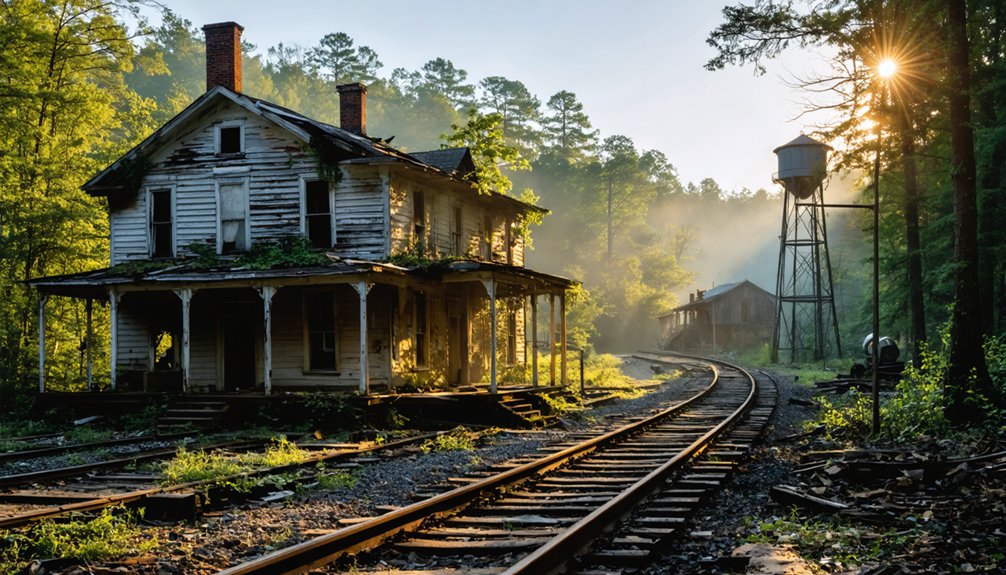
North and central Alabama’s abandoned settlements reveal distinct patterns of nineteenth-century decline tied to transportation infrastructure and political shifts. You’ll find Bellefonte, incorporated in 1821 in Jackson County, exemplifying railroad-bypass devastation—Civil War destruction assured it couldn’t recover from lost commercial viability.
Bellefonte’s 1821 incorporation couldn’t save it from railroad-bypass devastation and Civil War destruction—infrastructure determined survival, not founding dates.
Old Cahawka, the former state capital, peaked at 3,000 residents with 450 structures before abandonment; today’s Barker Slave Quarters and Corcheron Mansion ruins carry profound cultural significance as testimony to antebellum society.
Elyton preceded Birmingham’s rise as Jefferson County’s original judicial center. St. Stephens thrived briefly during 1819-1820 before progressing into a historical park preserving Native American remains.
These sites demonstrate how ecological impacts—flooding at Cahawba, resource depletion elsewhere—combined with political and economic forces to reshape Alabama’s settlement geography, leaving archaeological records that challenge romantic ghost-town narratives.
What Caused These Towns to Disappear
Alabama’s ghost towns emerged from intersecting catastrophes that compounded over decades, creating cascades of decline no single community could withstand.
You’ll find abandonment patterns rooted in ecological collapse—floods submerged Cahawba repeatedly while malaria and yellow fever waves drove survivors away.
Economic transformations proved equally destructive:
- Infrastructure abandonment: Railroad bypasses stranded Repton and Frisco City, severing commercial lifelines.
- Resource depletion: Millry’s turpentine operations exhausted forests; Piper’s mines collapsed inward.
- Political decisions: Capital relocation from Cahawba to Tuscaloosa in 1825 stripped governmental anchors.
Disease outbreaks like cholera obliterated Bellefonte entirely.
River trade cessation doomed ports including Coffeeville and Jackson.
By 1900, Cahawba’s remaining assets sold for $500—buildings dismantled, cultural heritage stripped for salvage.
These communities couldn’t adapt when multiple catastrophic forces converged simultaneously.
Complete List of Alabama Ghost Towns by County
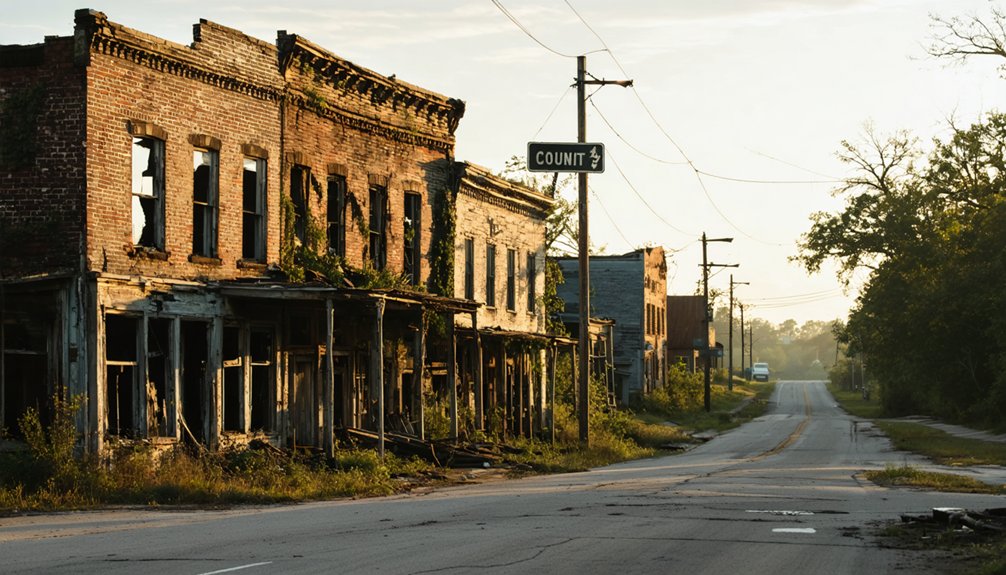
These catastrophic forces left physical evidence scattered across Alabama’s 67 counties, with documented ghost towns clustering in regions where economic dependencies proved most fragile.
You’ll find Hale County’s Arcola on the Black Warrior River, where French immigrants established commerce in 1820 before railroad competition eroded its viability.
Henry County preserves Aberdeen near Ward’s Crossroads and Abba on County Road 65, both victims of post-1870 depopulation.
Marengo County’s Aigleville demonstrates river-dependent settlement patterns.
Chambers County’s Cedric sits abandoned near Bacon Level Church under private ownership.
Monroe County offers Claiborne, perched dramatically above the Alabama River at a former ferry crossing.
Urban exploration here requires respecting property rights, though historic preservation efforts document these sites before they vanish completely from Alabama’s landscape.
Planning a Ghost Town Road Trip in Alabama
When designing your expedition through Alabama’s abandoned settlements, you’ll discover multiple documented routes that balance historical significance with logistical efficiency. The South Alabama Ghost Town Loop provides an all-encompassing 400-mile circuit through six vanished communities, requiring eight hours of drive time.
For maximum site coverage, the extended itinerary spans 709 miles across thirteen hours, targeting the state’s most desolate locations.
Your route options include:
- Fastest northern path: 280 miles covering the Spectre film set with abandoned architecture and relocated Claiborne structures at Perdue Hill
- Prairie Bluff exploration: Access 1860s cemetery sites along former St. Stephens-Cahaba corridor, now gated subdivisions
- Haunted legends integration: Jacksonville’s Dump Road and Old Chief Ladiga Trail sections featuring documented paranormal activity
Strategic planning accommodates historical documentation requirements while maintaining autonomous exploration capabilities.
Preservation Efforts and What Remains Today
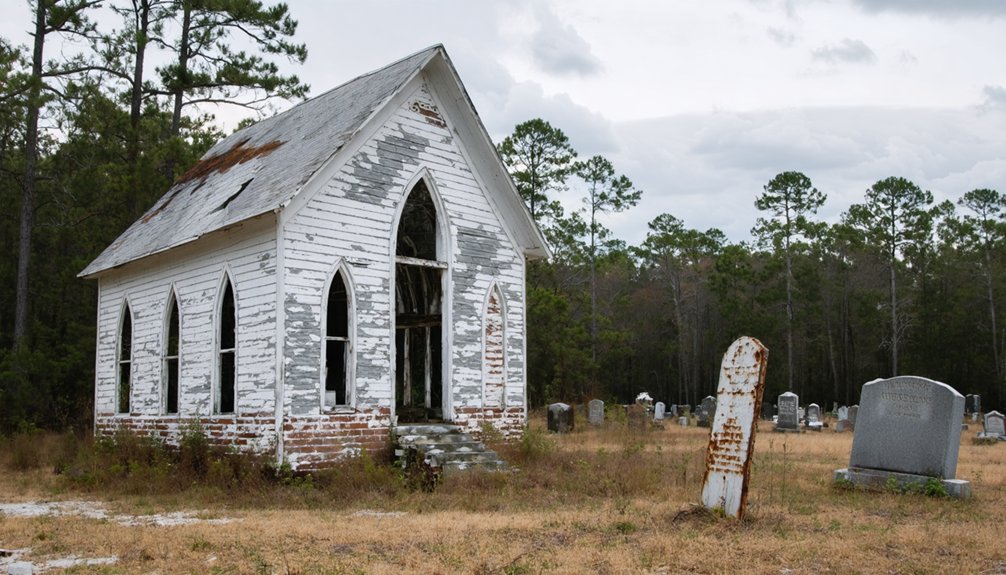
Since its designation to the National Register of Historic Places in 1973, Old Cahawba has anchored Alabama’s ghost town preservation movement through structured governmental oversight and aggressive private acquisition campaigns. You’ll find the Alabama Historical Commission managing the archaeological park while the Cahawba Foundation’s two-million-dollar campaign secured over 27 acres—nearly 65% of the original thousand-acre townsite now protected from urban decay.
What remains tells a fragmentary story: Crocheron Columns, Castle Morgan ruins, the Perine artesian well, and St. Luke’s Episcopal Church, relocated from Martin Station.
The historical significance extends beyond Cahawba—Forever Wild Land Trust preserved Tannehill State Historic Park and incorporated Hale Springs’ 18 acres into Bluff Park Preserve.
Yet preservation crawls forward as government funding dwindles, forcing reliance on private initiatives against persistent river erosion and environmental threats.
Frequently Asked Questions
Are Alabama’s Ghost Towns Safe to Visit Without Permission?
You shouldn’t visit Alabama’s ghost towns without permission, as most require landowner consent and pose physical hazards. Public sites like Old Cahawba balance historical preservation with tourism development, offering safe, legal access while protecting archaeological integrity and your personal freedom.
Can You Legally Metal Detect or Collect Artifacts From Ghost Towns?
You can’t legally metal detect or collect artifacts from Alabama’s ghost towns without explicit permission. Legal considerations include strict artifact restrictions under state and federal laws, with violations resulting in felony charges and substantial fines.
Which Alabama Ghost Town Is Considered the Most Haunted?
Old Cahawba stands as Alabama’s most haunted ghost town, where you’ll find documented spectral sightings and haunted legends rooted in archival records. Disembodied voices and children’s laughter echo through its cemeteries, marking genuine paranormal encounters.
Do People Still Live in Any of Alabama’s Ghost Towns?
No, you won’t find residents in Alabama’s ghost towns—they’re definitionally abandoned. However, historical preservation efforts maintain sites like Old Cahawba for exploration, where local legends persist despite zero current population, offering freedom to discover authentic regional history independently.
What’s the Best Time of Year to Explore Alabama Ghost Towns?
Spring and fall offer you ideal exploration conditions with mild seasonal weather averaging 50-75°F, minimal tourist crowds at remote sites, and dry road access to Alabama’s documented ghost towns, ensuring safer navigation and unrestricted discovery of archaeological remnants.
References
- https://www.ezhomesearch.com/blog/11-ghost-towns-in-alabama-that-bridge-the-distance-between-yesterday-and-today/
- https://freepages.history.rootsweb.com/~gtusa/usa/al.htm
- https://deepsouthurbex.com/2020/01/02/6-south-alabama-ghost-towns/
- https://www.loveexploring.com/gallerylist/188219/the-us-state-with-the-most-ghost-towns-revealed
- https://www.youtube.com/watch?v=1Qy5Sq51SbA
- https://247wallst.com/special-report/2018/11/02/30-american-ghost-towns-3/
- https://www.geotab.com/ghost-towns/
- https://en.wikipedia.org/wiki/List_of_ghost_towns_in_Alabama
- https://kids.kiddle.co/List_of_ghost_towns_in_Alabama
- https://digitalalabama.com/alabama-ghost-towns/alabama-ghost-towns/9449