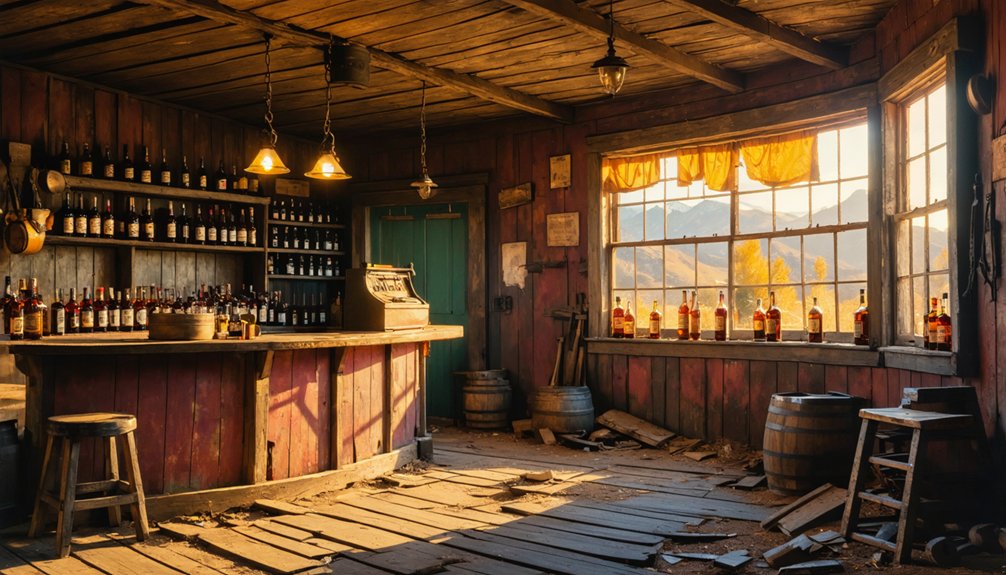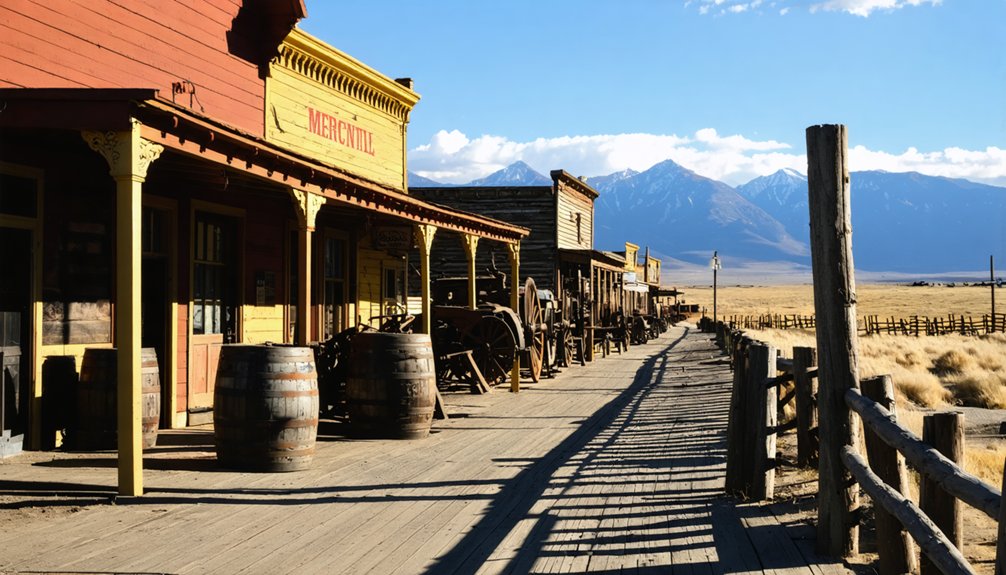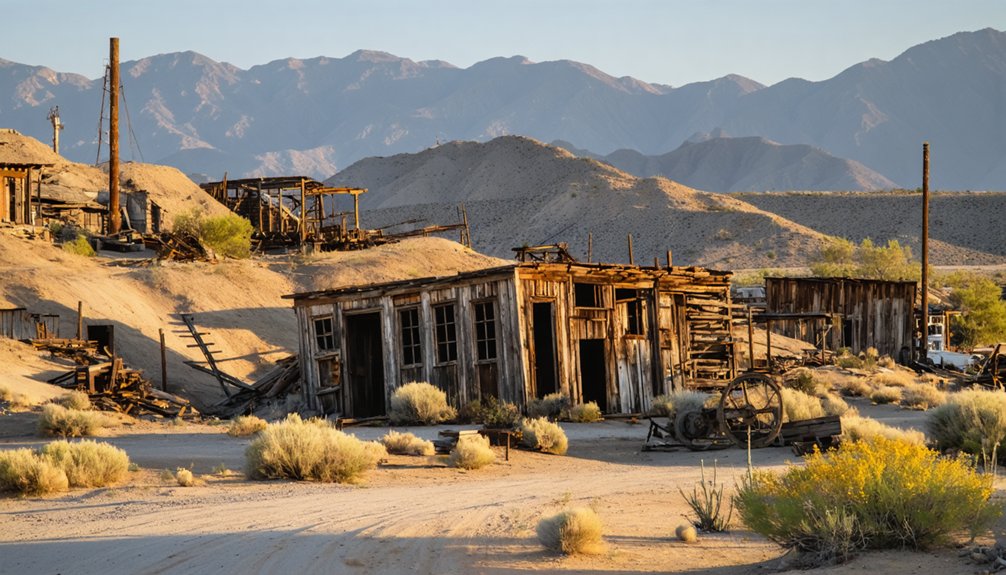
California holds 346 documented ghost towns scattered across its deserts, mountains, and valleys—the third-highest concentration in the nation behind Texas. You’ll find the densest clustering in Kern County, which contains 113 abandoned sites, mostly remnants of 19th-century mining booms. These settlements span from completely barren locations to preserved historic parks like Bodie, each marking where gold rushes, silver crashes, catastrophic floods, and resource depletion abruptly ended communities. The state’s archives reveal how quickly prosperity turned to abandonment across these haunting landscapes.
Key Takeaways
- California has 346 documented ghost towns scattered across deserts, mountains, and valleys throughout the state.
- Over 240 verified ghost town sites have been cataloged through systematic mapping efforts.
- Kern County contains the highest concentration with 113 ghost town sites.
- California ranks third nationally for ghost towns, behind Texas which has 550 documented sites.
- Ghost towns range from completely barren sites with no structures to locations with still-standing neglected buildings.
The Total Count of Abandoned Settlements Across California
California’s landscape harbors 346 documented ghost towns, scattered across its deserts, mountain ranges, and valleys—a proof to the state’s volatile boom-and-bust cycles that defined the American West. You’ll find these abandoned settlements concentrated in mining-rich counties, where gold rushes and mineral strikes triggered rapid demographic shifts that left entire communities stranded when resources depleted.
Kern County alone accounts for 113 of these sites, the highest concentration statewide. Historical preservation efforts have cataloged over 240 verified locations through mapping initiatives, though archival records suggest this count remains incomplete. These settlements range from barren sites with no remaining structures to neglected towns that still retain buildings despite lacking populations. Natural disasters like floods contributed to abandonment, with the Great Flood of 1862 washing away settlements including Agua Mansa, Eldoradoville, and Empire City.
Nationally, California ranks third behind Texas’s 550 ghost towns, reflecting the state’s integral role in westward expansion. These skeletal communities stand as monuments to frontier independence, where fortunes rose and vanished overnight.
Why Mining Communities Were Left Behind
You’ll find California’s mining ghost towns emerged from three interconnected forces documented in nineteenth-century production records and geological surveys.
When ore bodies depleted after intense extraction—Calico’s 500 mines yielded $20 million before silver’s 1890s collapse—prospectors relocated to newly discovered deposits rather than work marginal claims.
These boom-to-bust cycles, compressed into spans ranging from months in early placer camps to two decades at sites like Ballarat, left behind skeletal communities that mark each exhausted strike across the state’s mining districts. The State Historical Landmark 782 designation for Calico in 2005 formalized recognition of these abandoned settlements as valuable archaeological sites preserving California’s extraction economy heritage. Mining abandonment also resulted from environmental changes and outlawed practices that made continued operation impossible or economically unfeasible.
Depleted Gold and Silver
The collapse of precious metal deposits transformed California’s most prosperous mining camps into abandoned relics within decades. You’ll find Calico’s 500 mines produced over $20 million in silver before economic downturns in the mid-1890s triggered a mass exodus.
Bodie’s nearly 10,000 residents vanished when gold-silver veins exhausted abruptly, leaving preserved structures frozen in time.
Cerro Gordo, California’s richest 1870s silver producer, couldn’t sustain operations once ore depleted. The town’s peak population reached about 1,500 residents, but by 1920 it had declined to only ten miners. Even Empire Mine—the state’s deepest and most productive gold operation—closed in 1956 after generating 5.8 million ounces across a century.
Bennettville’s story proves most cautionary: residents abandoned their fully constructed town by the 1880s when promised veins never materialized. The town’s restored bunkhouse and assay office now stand as reminders of effort and hope that never reached fruition.
Mining decline didn’t discriminate between hopeful prospectors and established operations.
Relocating to Richer Deposits
By September 1863, five distinct mining districts—Mogul, Monitor, Silver Mountain, Raymond, and Alpine—had materialized across Alpine County, creating a volatile landscape where entire populations relocated within months based on strike quality.
You’ll find miners didn’t hesitate to abandon established camps when richer deposits emerged elsewhere. When Bodie’s veins proved superior in 1876, Silver Mountain City’s residents packed up and left, taking the county seat with them to Markleeville.
Mining infrastructure followed wealth, not sentiment. Transportation networks like toll roads connecting Monitor to Antelope Valley redirected commerce toward productive claims. Buildings themselves traveled—the Alpine County Jail physically moved to Markleeville. Randsburg’s 1895 gold discovery sparked similar patterns of rapid settlement, with over 4,000 residents flooding the area once claims proved profitable.
At 7,000 feet elevation, Mogul‘s geographic isolation proved fatal once ore depleted. Hydraulic mining operations transformed gold extraction in the 1870s, with water jets stripping entire mountainsides until the practice was outlawed in 1884. Without operational mines justifying investment, these settlements evaporated as quickly as they’d formed.
Boom-to-Bust Economic Cycles
California’s mining settlements collapsed under predictable economic forces that transformed bustling commercial centers into abandoned shells within a generation. You’ll find these boom-to-bust cycles followed distinct patterns across the Sierra’s mining districts.
Three Economic Forces That Emptied Towns:
- Silver market collapse in the 1890s devastated Calico despite producing 70% of California’s state silver in 1884.
- Resource exhaustion occurred rapidly—Radcliffe mine extracted 15,000 tons between 1898-1903 before depletion.
- Population exodus followed price volatility, with St. Elmo’s 2,000 residents abandoning town when ore quality declined.
Urban decay proceeded swiftly once miners departed. Merchants and service providers couldn’t sustain communities without mining activity. The lawless nature of some mining regions accelerated abandonment, as 80+ murders occurred in desert towns like Darwin between 1874-1877, driving away those seeking legitimate enterprise. Calico’s mines produced $86 million in silver over three decades before market forces ended operations.
Today’s preservation efforts document this archival evidence: infrastructure built for thousands serving nobody, marking freedom-seeking prospectors’ abandoned dreams across 400+ identified ghost town sites.
Kern County: Home to California’s Largest Ghost Town Concentration
Stretching across California’s southern interior, Kern County harbors an unmatched concentration of 113 ghost towns—more than any other county in the United States. You’ll find 71 abandoned settlements within just 25 miles of Bakersfield, creating a landscape where ghost town legends outnumber living communities.
Mining booms and oil discoveries initially sparked these settlements, while the 1880s rail expansion brought temporary prosperity before inevitable economic collapse.
Sites like Garlock, Randsburg, and Atolia stand as famous landmarks documenting California’s extractive industries. Desert Spring’s coordinates mark a settlement that existed from pre-1834 through the 1850s, now completely barren.
Federal and state laws protect these archaeological sites—you can’t legally remove even a nail. Volunteers monitor locations with trail cameras, preserving what remains of Kern’s unparalleled ghost town heritage for future exploration.
Most Famous Ghost Towns Worth Visiting Today
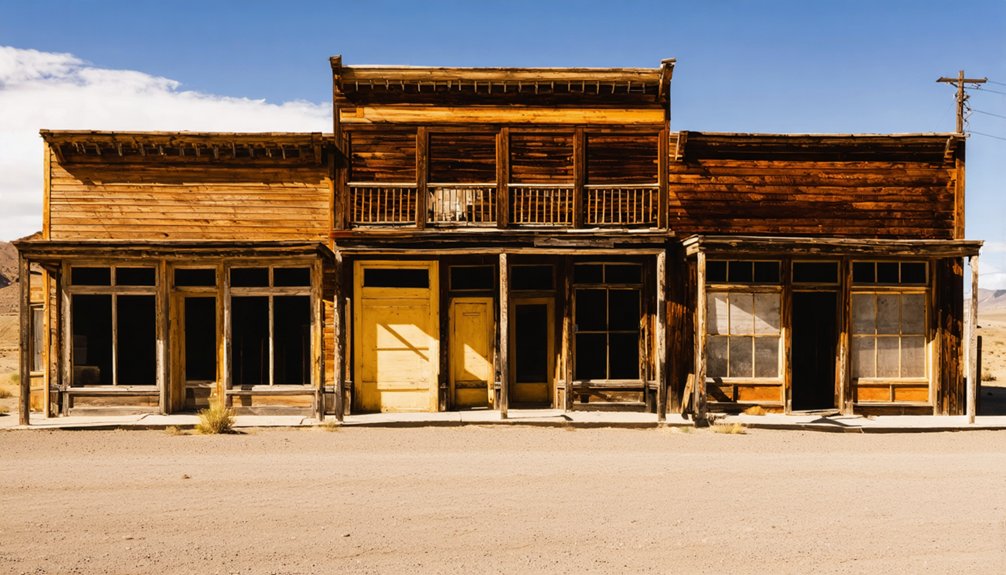
While Kern County holds the numerical advantage, California’s most visited ghost towns span from the Sierra Nevada to the Mojave Desert. Each is preserved through distinct preservation philosophies that reveal regional attitudes toward historical decay.
Top Ghost Towns by Preservation Approach:
- Bodie State Historic Park – Arrested decay maintains authentic weathered structures near Yosemite’s eastern edge. It offers unvarnished historical preservation without theme park modifications.
- Calico Ghost Town – Walter Knott’s restoration created accessible tourist attractions with an $8 admission fee, mine tours, and overnight cabins. It earned State Historical Landmark status in 2005.
- Cerro Gordo – The “Silver Queen” perches high in the Inyo Mountains. Preserved mining buildings like the American Hotel remain accessible for exploration without commercial development.
Randsburg and Goffs represent semi-active alternatives. They maintain Route 66 heritage while hosting weekend businesses and cultural preservation initiatives.
From Internment Camps to Socialist Communes: Unconventional Ghost Towns
Beyond the Gold Rush narrative, California’s ghost towns include spaces of forced displacement and ideological experimentation.
You’ll find Manzanar and Tule Lake—internment camps that imprisoned over 120,000 Japanese Americans between 1942 and 1945—now standing as National Historic Sites marking one of the state’s darkest chapters.
The Mojave Desert’s Llano del Rio Socialist Commune represents another unconventional abandonment, where early 20th-century utopian ideals collapsed under water scarcity rather than mining busts.
Japanese American Internment Sites
Executive Order 9066 transformed California’s landscape into a network of incarceration sites that would hold over 110,000 Japanese Americans between 1942 and 1945. You’ll find these Japanese internment locations evolved into ghost towns after their closure, offering pivotal lessons about constitutional violations and wartime hysteria.
California operated multiple assembly centers before permanent relocation:
- Racetracks and fairgrounds at Santa Anita, Fresno, Tulare, Stockton, and Merced forced families into horse stables.
- Manzanar in Owens Valley peaked at 10,000 residents, including 101 orphans at Children’s Village.
- Tule Lake became a segregation center for those deemed “disloyal.”
Today, ghost town preservation efforts at Manzanar National Historic Site document this dark chapter. These abandoned camps stand as monuments to civil liberties stripped away under government authority.
Llano Del Rio Commune
How does a socialist lawyer’s failed political campaign lead to one of California’s most ambitious utopian experiments? After Job Harriman lost his 1911 Los Angeles mayoral bid, he founded Llano del Rio in 1914 on 10,000 Mojave Desert acres.
You’ll find this wasn’t just another commune—nearly 1,000 residents built a self-sustaining empire complete with quarries, sawmills, and even an airplane. Their communal living model produced 90% of necessities while workers earned $4 daily toward collective ownership.
Yet freedom’s promise collapsed by 1918. Water disputes with ranchers, internal conflicts over socialist priorities, and isolation strangled the economy. Two hundred colonists migrated to Louisiana’s New Llano, which survived until 1937.
Today’s granite ruins stand as California Historical Landmark No. 933, record to these bold utopian experiments.
What You Can Experience at California’s Ghost Town Attractions
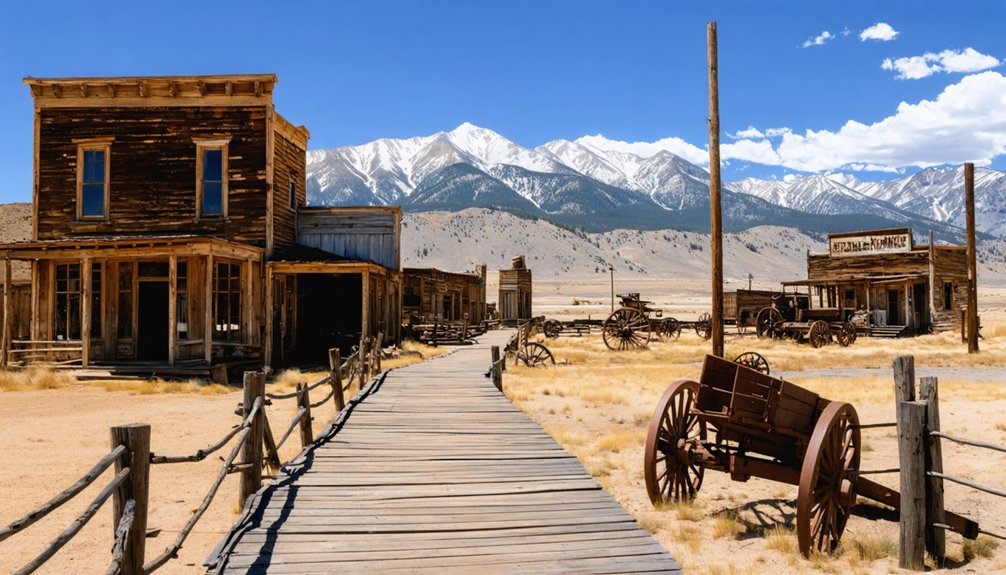
California’s ghost town attractions offer vastly different experiences depending on whether you’re seeking entertainment or authenticity.
Among these, the history of Inskip, California reveals a fascinating tale of mining, community, and eventual decline. Visitors can explore remnants of the town and take in the stunning landscapes that surround it. Each visit offers a glimpse into a past that shaped the region’s culture and economy, inviting exploration and reflection.
At Calico, you’ll find commercialized adventures including mine tours, train rides, and gold panning activities alongside free museum access.
Bodie preserves its chilling atmosphere without modern amenities, maintaining the haunting essence of lost settlements.
Randsburg operates as a living community where you can visit saloons and museums during weekends.
For deeper exploration, consider these distinct experiences:
- Empire Mine State Historic Park showcases 367 miles of underground tunnels and 5.6 million ounces of gold production history.
- Ghost tours at Calico offer paranormal encounters through abandoned structures, welcoming skeptics and believers.
- Seasonal events like Halloween Ghost Haunt and Old West Day recreate historical mining culture.
Each location preserves California’s mining heritage through different interpretive approaches.
Regional Breakdown: Where to Find Ghost Towns by County
Ghost towns cluster across California’s landscape following the geological distribution of precious metals and early transportation corridors.
Kern County dominates with sites like Johannesburg’s mining structures, Saltdale’s 1914 salt operations, and Randsburg’s preserved heritage. You’ll find Silver City near Lake Isabella from the 1850s rush.
San Bernardino County showcases desert landscapes through Calico’s restored 1881 silver camp (Historical Landmark #782) and Amboy’s Route 66 roots. Ballarat peaked at 500 residents during 1898 gold strikes.
Inyo County preserves Bodie’s iconic gold rush architecture and Skidoo’s stamp mill remains. Darwin’s population dwindled from 54 to 43 by 2010.
Shasta County anchors northern exploration via Shasta State Historic Park and North Bloomfield’s hydraulic mining legacy.
Other regions include Hornitos’s historic architecture in Mariposa County and Alcatraz’s unique federal penitentiary evolution.
How Natural Disasters and Resource Depletion Created Ghost Towns
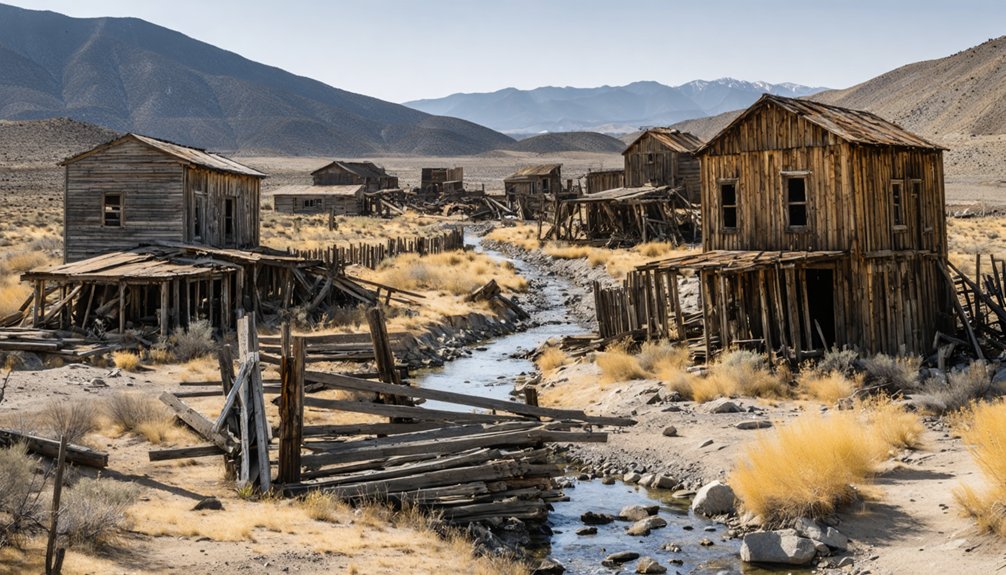
Natural disasters and depleted mineral reserves have transformed thriving California settlements into abandoned ruins throughout the state’s history.
California’s boom-and-bust cycle has left a haunting trail of ghost towns, abandoned when resources vanished or disaster struck.
You’ll find three primary forces that created these ghost towns:
- Mining Collapse: North Bloomfield’s population plummeted from 2,000 to under 10 after hydraulic mining bans in 1884, while Calico emptied when silver values crashed in the mid-1890s.
- Catastrophic Floods: The 1861 flooding converted Sacramento Valley into a 300-mile inland sea, forcing mass evacuations and permanent abandonment of communities.
- Wildfire Destruction: Paradise’s Camp Fire killed 86 residents, and the CZU Lightning Complex destroyed 1,500 structures, leaving neighborhoods uninhabitable.
These abandoned settlements now offer tourism opportunities and historical preservation insights, letting you explore California’s volatile past while understanding why communities failed when nature or economics turned against them.
Frequently Asked Questions
Are California’s Ghost Towns Safe to Explore on Your Own?
Safety varies dramatically—you’ll find protected sites with maintained trails, but you’ll risk structural collapse at abandoned locations, encounter wildlife in remote areas, and face trespassing charges on private property. Historical preservation doesn’t guarantee accessibility or security.
Can You Legally Take Artifacts or Souvenirs From Ghost Towns?
No, you can’t legally take artifacts or souvenirs from California’s ghost towns. Federal laws like ARPA and state codes prohibit artifact removal and souvenir collection from historic sites, whether on public lands or private property, with substantial penalties enforced.
Which Ghost Towns Allow Overnight Camping or Accommodation?
You’ll find overnight stays at Calico Ghost Town Regional Park with full tourist amenities and historical preservation—265 RV sites plus cabins. Ballarat offers dispersed camping freedom on government land, while Bodie strictly prohibits camping to protect its authentic past.
What’s the Best Time of Year to Visit California Ghost Towns?
You’ll find fall offers ideal seasonal weather for exploring California’s ghost towns—mild desert temperatures and accessible mountain passes create perfect conditions. Best visiting hours run early morning through late afternoon before temperatures drop drastically.
Do You Need Special Permits to Photograph or Film Ghost Towns?
You’ll need permits for commercial filming on most public lands, with BLM sites charging $100+ and state parks like Bodie requiring $135 fees. Personal photography remains free, respecting your freedom while honoring legal considerations and cultural preservation needs.
References
- https://www.youtube.com/shorts/m62P8SI3jCo
- https://en.wikipedia.org/wiki/List_of_ghost_towns_in_California
- https://www.visitcalifornia.com/road-trips/ghost-towns/
- https://www.camp-california.com/california-ghost-towns/
- https://dornsife.usc.edu/magazine/echoes-in-the-dust/
- https://tisqui.github.io
- https://www.geotab.com/ghost-towns/
- https://blog.batchgeo.com/ghost-towns/
- https://www.voanews.com/a/hidden-secrets-of-america-s-ghost-towns/4636610.html
- https://www.tripadvisor.com/Attractions-g28926-Activities-c47-t14-California.html