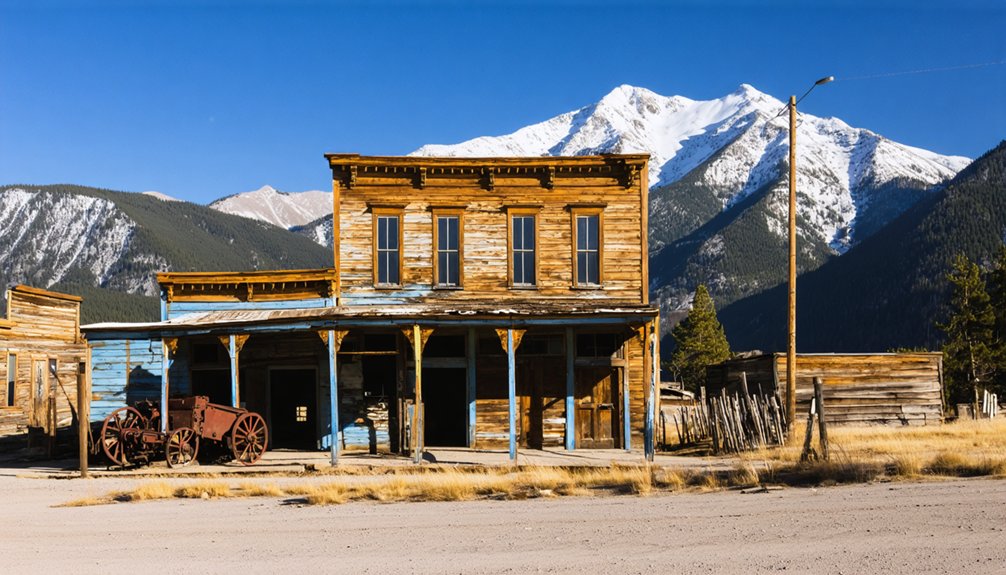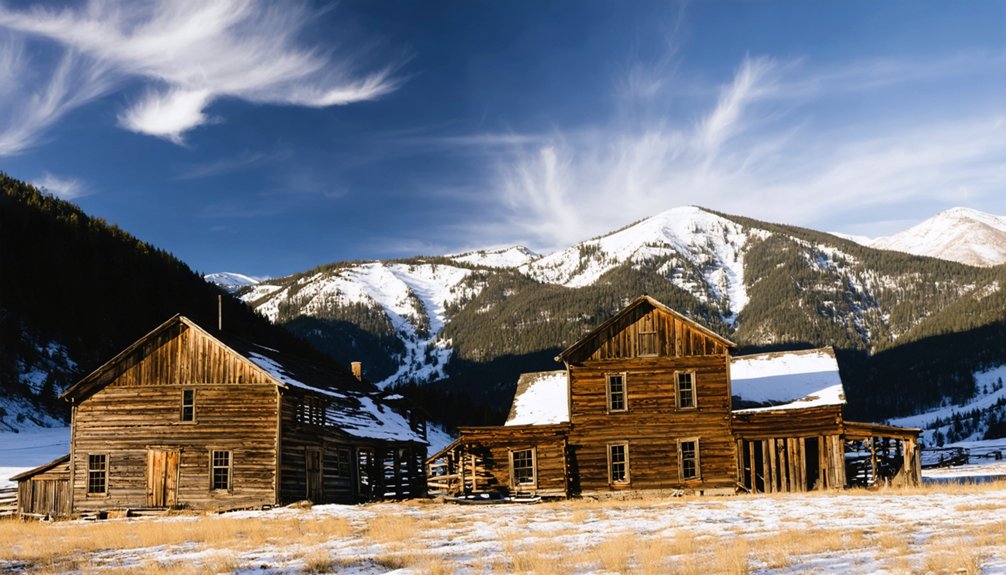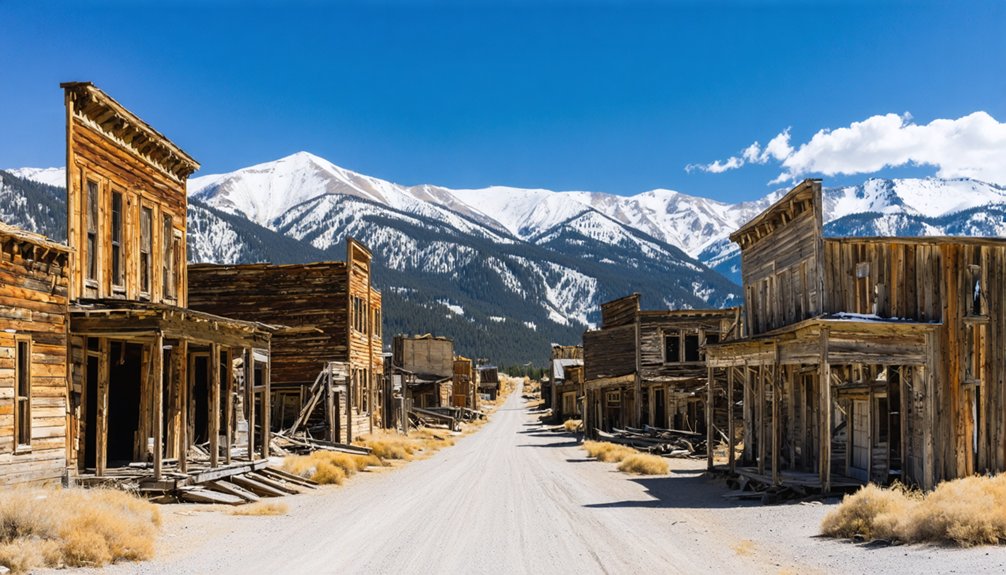
You’ll find between 600 and 1,500 ghost towns scattered across Colorado’s mountains and plains, though the exact count depends on how you define “abandoned.” The state officially recognizes just over 600 former mining camps, railroad stops, and frontier settlements. Counting gets tricky because some sites have completely vanished while others retain minimal populations. Definitions vary among historians—some require total desertion, others accept standing structures or foundations. The following sections break down why these numbers fluctuate and where you’ll discover the most significant concentrations.
Key Takeaways
- Colorado contains over 1,500 ghost towns across mountain ranges and plains, with officials documenting 600+ established sites.
- Exact counts vary because historians use different definitions of abandonment, from complete desertion to minimal remaining population.
- Most ghost towns originated from mining booms, with the 1893 silver devaluation causing widespread mine closures and community collapse.
- Many sites have vanished or been damaged, and incomplete official records hinder accurate totals of remaining ghost towns.
- Notable accessible examples include St. Elmo with 43 storefronts, Independence near Aspen, and high-altitude Animas Forks requiring 4×4 access.
Counting Colorado’s Abandoned Mining Camps and Settlements
Colorado’s mountain ranges and high plains conceal more than 1,500 ghost towns—abandoned settlements that once thrived during the state’s mining boom and subsequent economic cycles. You’ll find the majority concentrated throughout the Rockies, scattered across multiple counties where miners once struck gold, silver, and other valuable minerals.
Determining an exact count proves difficult since definitions of “ghost town” status vary among historians and preservationists. Mining-related abandonment accounts for the largest portion, though failed resort developments, obsolete stagecoach stops, and closed railroad lines contributed considerably. Silver devaluation in 1893 triggered widespread mine closures that left entire communities deserted across the state.
Historical preservation challenges intensify as weather, vandalism, and modern tourism impacts threaten these fragile sites. Some towns are listed on the National Register of Historic Places, recognizing their cultural and historical significance. The harsh mountain environment that once drove residents away now accelerates structural deterioration, making documentation and protection efforts increasingly urgent.
Why Accurate Numbers Are Hard to Pin Down
When historians attempt to catalog Colorado’s ghost towns, they immediately confront the fundamental problem of definition. You’ll find some researchers requiring complete desertion, while others accept settlements with minimal populations. Definition inconsistencies plague every count—does a town need standing buildings, or do foundations suffice?
Ghost town definitions vary wildly among historians—from complete abandonment to minimal populations, from standing structures to mere foundations.
T. Lindsey Baker considers any settlement whose original purpose vanished, yet this encompasses far more sites than traditional metrics.
Historical preservation efforts reveal these gaps starkly. Colorado’s 600-plus documented ghost towns don’t account for mining camps that disappeared entirely. You’re left tracking shadowy semblances without physical proof. Many old towns have disappeared or been damaged over the past 20 years due to vandalism, theft, or development.
The Red Mountain area exemplifies boundary confusion, where overlapping towns and relocated settlements defy precise enumeration. Even occupied sites like Bonanza blur abandonment criteria. Sites like Independence, accessible through guided tours available from the Aspen Historical Society, demonstrate how some ghost towns maintain structured visitation despite abandonment.
State markers and National Register listings remain incomplete, leaving you without authoritative totals for Colorado’s vanished communities.
What Caused These Towns to Empty Out
Economic collapse drove most Colorado settlements into oblivion, though the specific mechanisms varied dramatically across the state’s diverse landscapes. You’ll find mining depletion dominated: silver’s 1893 devaluation shuttered operations statewide, while gold exhaustion emptied Animas Forks and coal decline abandoned entire communities. Goldfield’s fate hinged entirely on Portland Mine’s productivity.
Environmental catastrophes forced different evacuations. The EPA expelled Gilman’s residents in 1984 after detecting toxic groundwater contamination. Radiation contamination from uranium extraction made Uravan uninhabitable, while Kokomo became a tailings repository.
Deliberate flooding claimed others—Howbert, Ioli, McPhee, Stout, and Swallows now rest beneath reservoirs. Railroad rerouting stranded former stops near Durango and Silverton.
Failed agriculture, harsh weather deterioration, and declining tourism finished off remaining settlements that couldn’t adapt to changing economic realities. Extreme alpine conditions including temperatures below -30°F accelerated abandonment in high-elevation mining camps. Colorado today features multiple ghost towns with diverse shapes and sizes scattered across its terrain.
The Most Famous and Accessible Ghost Towns to Visit
Five Colorado ghost towns stand out for their preservation quality and year-round accessibility, each offering distinct architectural remnants from the state’s mining era.
St. Elmo features 43 wooden storefronts along a dusty main street, reachable by regular car west of Buena Vista.
Independence’s original cabins line Highway 82 near Aspen, earning National Register designation for its historical architecture.
Animas Forks sits at 11,200 feet in the San Juans, requiring 4×4 vehicles to reach its remarkably preserved mining structures. The town was established in 1875 and once claimed to be the largest city at its altitude.
Vicksburg offers audio-guided exploration through Clear Creek Canyon’s poplar-lined streets.
Gold Hill maintains accessible tourism development while housing current residents, with its general store and museum operating along Boulder County’s Sunshine Canyon Drive. The Gold Hill Inn provides historic accommodations for visitors exploring the area.
Each site permits unrestricted walking among original buildings.
Regional Concentrations and Local Hotspots
Colorado’s ghost towns cluster heavily in the Rocky Mountain region, where elevation and mineral deposits created distinct geographic concentrations during the mining era. You’ll find the densest groupings along the Alpine Loop 4×4 byway near Silverton, with Animas Forks sitting at 11,200 feet.
Clear Creek Canyon north of Buena Vista contains Vicksburg and Winfield.
The Independence Pass corridor outside Aspen features extensive original homesteads.
West of Buena Vista, St. Elmo and Tin Cup represent prime examples for historical preservation efforts.
The eastern plains tell a different story—geographic isolation created scattered settlements like Dearfield, Colorado’s only all-Black community.
These plains towns supported over 700 African Americans before the Dust Bowl forced abandonment.
Today, tourism development focuses primarily on accessible mountain clusters rather than remote prairie sites. These sites have become destinations for heritage tourism, offering visitors tangible connections to Colorado’s mining and settlement history. Historical maps showing early towns, military roads, railroads, and forts from 1876 to 1900 help researchers track the development and subsequent abandonment of these settlements across the state.
Frequently Asked Questions
Are Ghost Town Visits in Colorado Free or Do They Charge Admission?
You’ll find most Colorado ghost towns are free as air—no admission fees required. Historical preservation efforts keep sites accessible, though some offer tourist amenities like St. Elmo’s General Store where you’ll spend money only if you choose.
Can You Legally Take Artifacts or Souvenirs From Colorado Ghost Towns?
You can’t legally remove artifacts from Colorado’s ghost towns due to historical preservation laws protecting archaeological resources. Legal considerations include federal penalties for protected sites, though private landowners set their own rules for unprotected locations.
What Safety Precautions Should Visitors Take When Exploring Ghost Towns?
You’ll need sturdy boots and awareness of environmental hazards like rotting floors, unstable mines, and wildlife. Respect historical preservation by documenting without touching. Colorado’s high-altitude ghost towns demand weather preparation—afternoon thunderstorms strike suddenly, threatening your exploration freedom.
Are Colorado Ghost Towns Safe to Explore With Children and Families?
Some Colorado ghost towns are family-safe, but 43 preserved buildings at St. Elmo show historical preservation varies widely. You’ll need vigilance for wildlife encounters, unstable structures, and high-altitude risks. Car-accessible sites like St. Elmo offer safer exploration than remote locations.
Do People Still Live in Any of Colorado’s Ghost Towns?
You’ll find seasonal residents in some ghost towns like St. Elmo and Gothic, where historical preservation and tourism impact maintain limited activity. However, most sites remain completely abandoned, giving you authentic access to Colorado’s unregulated mining heritage.
References
- https://en.wikipedia.org/wiki/List_of_ghost_towns_in_Colorado
- https://www.youtube.com/watch?v=Ne9DH89C-nA
- https://www.durango.com/colorado-ghost-towns/
- https://www.uncovercolorado.com/ghost-towns/
- https://www.cpr.org/show-segment/there-are-700-ghost-towns-in-colorado-and-ron-ruhoff-has-visited-many-of-them/
- https://coloradoinfo.com/blog_post/explore-ghost-towns-in-colorado/
- https://www.geotab.com/ghost-towns/
- https://leadville.com/the-ghost-towns-of-leadville-and-beyond/
- https://thedyrt.com/magazine/local/colorado-ghost-towns/
- https://www.islands.com/2061852/colorado-abandoned-ghost-towns-once-thriving/