You’ll find conflicting counts of Connecticut’s ghost towns ranging from four to eight, depending on which sources you consult. Wikipedia officially documents five abandoned settlements—Bara-Hack, Dudleytown, Gay City, Johnsonville Village, and Pleasure Beach—though variations arise from differing definitions of what constitutes complete abandonment versus population decline. These discrepancies stem from inconsistent research methodologies, varying inclusion criteria, and debates over archaeological visibility versus documented economic cessation. Understanding the specific characteristics of each site reveals why experts disagree on the precise total.
Key Takeaways
- Reports on Connecticut’s ghost towns range from 4 to 8, with variation due to differing research methods and definitions.
- Wikipedia officially lists five ghost towns: Bara-Hack, Dudleytown, Gay City, Johnsonville Village, and Pleasure Beach.
- Ghost towns are identified by complete abandonment, visible infrastructure remnants, and significant population decline from economic or ecological factors.
- Popular sites include Gay City State Park, Bara-Hack, and Dudleytown, each with unique histories and varying public accessibility.
- Inconsistent counts stem from debates over abandonment thresholds, preservation status, and archaeological evidence used in different source compilations.
Conflicting Counts Across Different Sources
When attempting to determine Connecticut’s ghost town count, researchers encounter numerical inconsistencies ranging from four to eight abandoned settlements depending on the source consulted.
Historical accuracy suffers when examining Geotab’s 2018 data and Loveexploring’s 2023 list, both reporting four ghost towns, while Wikipedia documents five and a YouTube video claims eight.
Conflicting sources report Connecticut’s ghost town count ranging from four to eight abandoned settlements, undermining historical documentation reliability.
Source verification reveals methodology differences: aggregated databases versus manually compiled inventories.
Wikipedia explicitly acknowledges its incompleteness, listing Bara-Hack, Dudleytown, Gay City, Johnsonville Village, and Pleasure Beach.
The YouTube presentation adds Little Danbury and three unnamed locations.
You’ll find Geotab and Loveexploring relied on ghosttowns.com and roadsidethoughts.com, establishing their four-town consensus.
However, these discrepancies demonstrate how varying research approaches produce conflicting tallies, leaving Connecticut’s actual ghost town count unresolved without standardized definitions and all-encompassing field documentation.
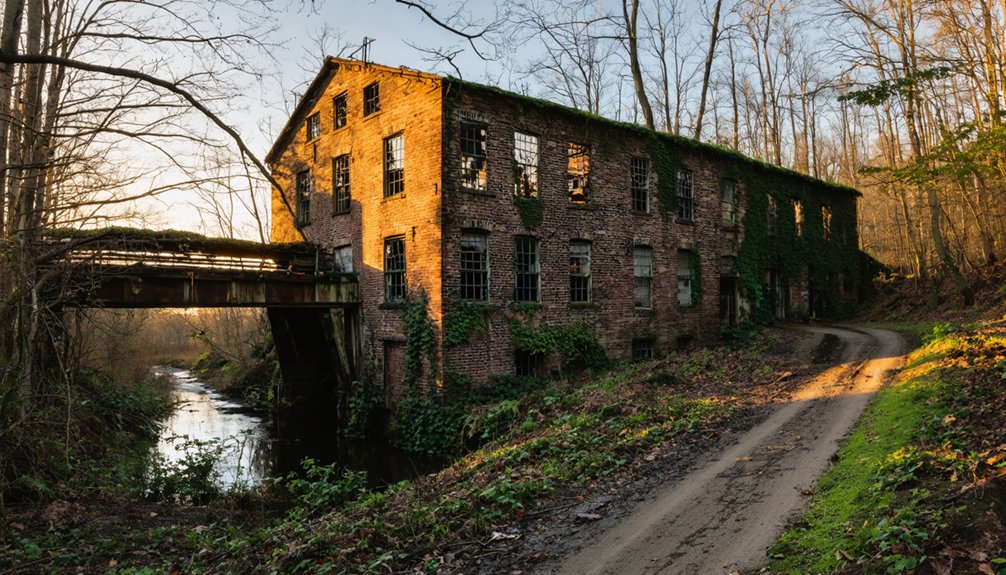
Among the documented sites, Johnsonville Village stands as a notable mid-1800s mill town featuring visible remains like the Emory Johnson Homestead.
Connecticut’s four ghost towns represent one of the lowest counts nationwide, contrasting sharply with states like Rhode Island’s single abandoned settlement.
The Five Ghost Towns Listed on Wikipedia
Wikipedia’s documentation provides the most detailed catalog of Connecticut’s ghost towns, identifying five specific locations: Bara-Hack, Dudleytown, Gay City, Johnsonville Village, and Pleasure Beach. Each site represents distinct phases of abandonment—from 18th-century Welsh settlements to 20th-century amusement parks.
These locations vary notably in accessibility and historical preservation status:
- Gay City State Park offers you public trails with interpretive signage and 38 documented images.
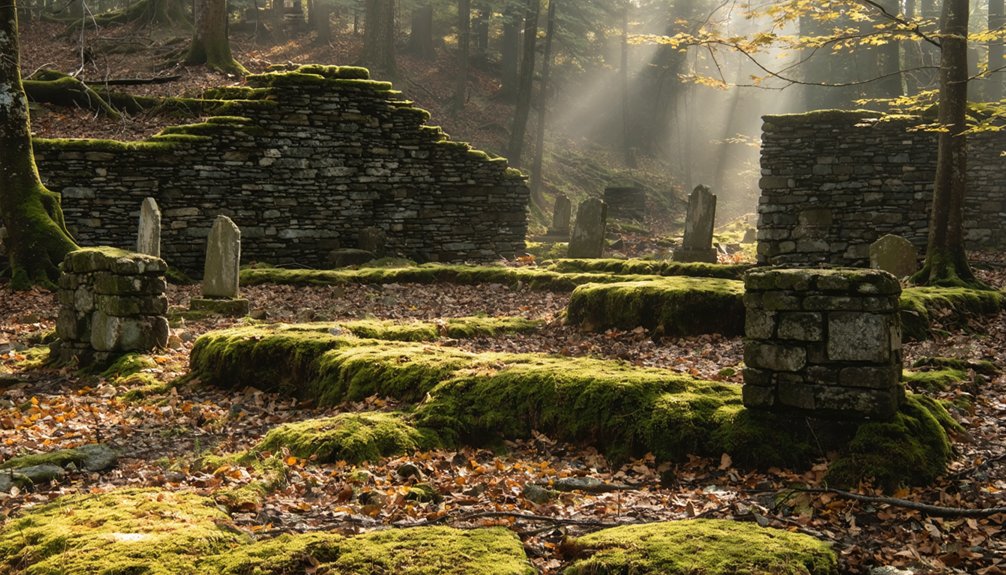
- Bara-Hack’s stone foundations remain accessible through maintained woodland paths.
- Johnsonville Village exists as private property with restricted Victorian-era architecture.
- Pleasure Beach requires boat access due to bridge deterioration.
While marketed as tourist attractions through folklore and haunting legends, historians have systematically debunked supernatural claims. You’ll find authentic value in their archaeological remains and documented settlement patterns rather than fabricated curse narratives. Several of these settlements emerged in remote or mountainous regions that ultimately proved economically unsustainable. This categorical index serves as a foundation for locating ghost towns relevant to historical or archaeological exploration within the state.
What Qualifies as a Ghost Town in Connecticut
Several core criteria distinguish authentic ghost towns from merely declining communities in Connecticut’s historical record. You’ll find that complete economic activity cessation marks the primary threshold, paired with visible infrastructure like stone foundations, cellar holes, and road remnants.
True ghost towns demand total economic collapse and physical evidence—not mere decline but documented abandonment with visible remains.
Historical preservation efforts document these tangible remains as evidence of former settlement viability. The distinction separates true abandonment from sites that vanished entirely without trace.
Connecticut’s examples require substantial population exodus, not gradual demographic shifts. You’re examining settlements where industry shutdown, transportation failures, or ecological factors prompted mass relocation.
The seasonal aesthetic of overgrown foundations in Dark Entry Forest exemplifies this classification. Debates persist over precise criteria, but abandoned settlements must demonstrate former economic vitality followed by documented collapse. These sites possess residual nostalgia and mystery that continue to attract researchers and history enthusiasts to Connecticut’s forgotten settlements.
Some abandoned Connecticut settlements have been repurposed for heritage tourism, transforming historical sites into educational destinations that preserve architectural features while generating renewed interest. Private property status often restricts access, complicating verification efforts for researchers seeking freedom to investigate Connecticut’s historical abandonment patterns.
Most Famous Abandoned Settlements Worth Visiting
Connecticut’s documented ghost towns concentrate in five principal sites that balance historical significance with varying degrees of public accessibility.
Primary Locations for Exploration:
- Gay City State Park (Tolland County) – Open public access with marked trails through 18th-century settlement ruins, offering ideal historical preservation and tourist safety conditions.
- Bara-Hack (Windham County) – Welsh settlement foundations on private property requiring permission, known for stone remnants and paranormal folklore.
- Dudleytown (Litchfield County) – Litchfield County’s most documented site, requiring off-trail navigation through unstable terrain in state forest land. Founded in 1747, this abandoned farming community became associated with legends of curses following its decline.
- Johnsonville Village (Middlesex County) – Complete Victorian mill community with intact structures, privately owned with restricted access. This Victorian ghost town was once a thriving mill community before its abandonment.
You’ll find Hopeville’s partially submerged ruins near recreational areas in New London County, though access varies seasonally based on water levels and property restrictions.
Why the Numbers Range From Four to Eight
When cataloging Connecticut’s ghost towns, researchers arrive at totals between four and eight depending on their definitional frameworks and data sources.
You’ll find criteria discrepancies emerge primarily from what qualifies as “abandoned.” Geotab’s study employs ghosttowns.com and roadsidethoughts.com databases, yielding four locations with county-level precision.
Wikipedia documents five settlements, acknowledging its list remains incomplete.
YouTube sources claim eight total, though detailed evidence supports only five examples.
The variance stems from whether researchers include sites with partial historical remnants, locations converted to state parks like Gay City, or settlements with minimal physical evidence. Media coverage from sources like Smithsonian Magazine and Atlas Obscura has raised public awareness of specific sites such as Bara-Hack and Dudleytown, influencing which locations gain recognition in ghost town inventories.
Different methodological approaches—ranging from book compilations to website aggregations—produce inconsistent totals.
You’re essentially navigating scholarly debates about abandonment thresholds, preservation status, and archaeological visibility when determining Connecticut’s ghost town count.
Frequently Asked Questions
Are Connecticut’s Ghost Towns Safe and Legal to Visit?
Safety and legality vary markedly across Connecticut’s ghost towns. You’ll find state parks like Gay City offer legal urban exploration with historical preservation protections, while private sites like Dudleytown remain strictly off-limits, requiring you to respect trespassing laws and structural hazards.
What Caused These Connecticut Settlements to Become Abandoned?
Like fallen empires crumbling into dust, Connecticut’s ghost towns succumbed to historical causes you’ll recognize: economic decline from exhausted soil, obsolete iron furnaces, failed mills, and industrial shifts. You’re witnessing capitalism’s natural selection leaving architectural fossils behind.
Which Connecticut Ghost Town Is Considered the Most Haunted?
Dudleytown holds historical significance as Connecticut’s most haunted ghost town, though you’ll find it’s now closed to tourist attractions due to trespassing issues. Actor Dan Aykroyd famously called it “the most haunted place on earth” in 1993.
Can You Camp Overnight at Gay City State Park Ruins?
You can’t pitch your tent beside the abandoned cabins, despite how romantically rebellious that sounds. Night camping requires proper permits at designated campground areas—the park’s accessible, but camping restrictions keep you away from the ruins themselves.
Does Connecticut Plan to Restore Any of These Ghost Towns?
Connecticut’s preservation efforts focus on historical significance through stabilization rather than full restoration. You’ll find Gay City maintains ruins as-is, while Holy Land USA receives community-led repairs. Most sites remain intentionally unrestored, preserving their authentic abandoned character for exploration.
References
- https://en.wikipedia.org/wiki/List_of_ghost_towns_in_Connecticut
- https://www.loveexploring.com/gallerylist/188219/the-us-state-with-the-most-ghost-towns-revealed
- https://www.youtube.com/watch?v=r1wkrSBkJYA
- https://www.atlasobscura.com/things-to-do/connecticut/ghost-towns
- https://www.youtube.com/watch?v=J9TIc7cqXNo
- https://www.geotab.com/press-release/american-ghost-towns/
- https://en.wikipedia.org/wiki/Category:Ghost_towns_in_Connecticut
- https://commons.wikimedia.org/wiki/Category:Ghost_towns_in_Connecticut
- https://en.wikipedia.org/wiki/Lists_of_ghost_towns_in_the_United_States
- https://en.wikipedia.org/wiki/Category:Former_populated_places_in_Connecticut